Arbe Robotics Has a Radar That Sees Everything. Too Bad AI Engines Fail to See It.
Arbe Robotics has live L4 production contracts, a spot inside NVIDIA's autonomous driving platform, and radar technology that outperforms lidar on cost and all-weather reliability. But when robotaxi engineers and autonomous vehicle procurement teams ask AI engines which radar to buy, Arbe is largely invisible — and that is a demand problem hiding behind an impressive technology story.

TL;DR
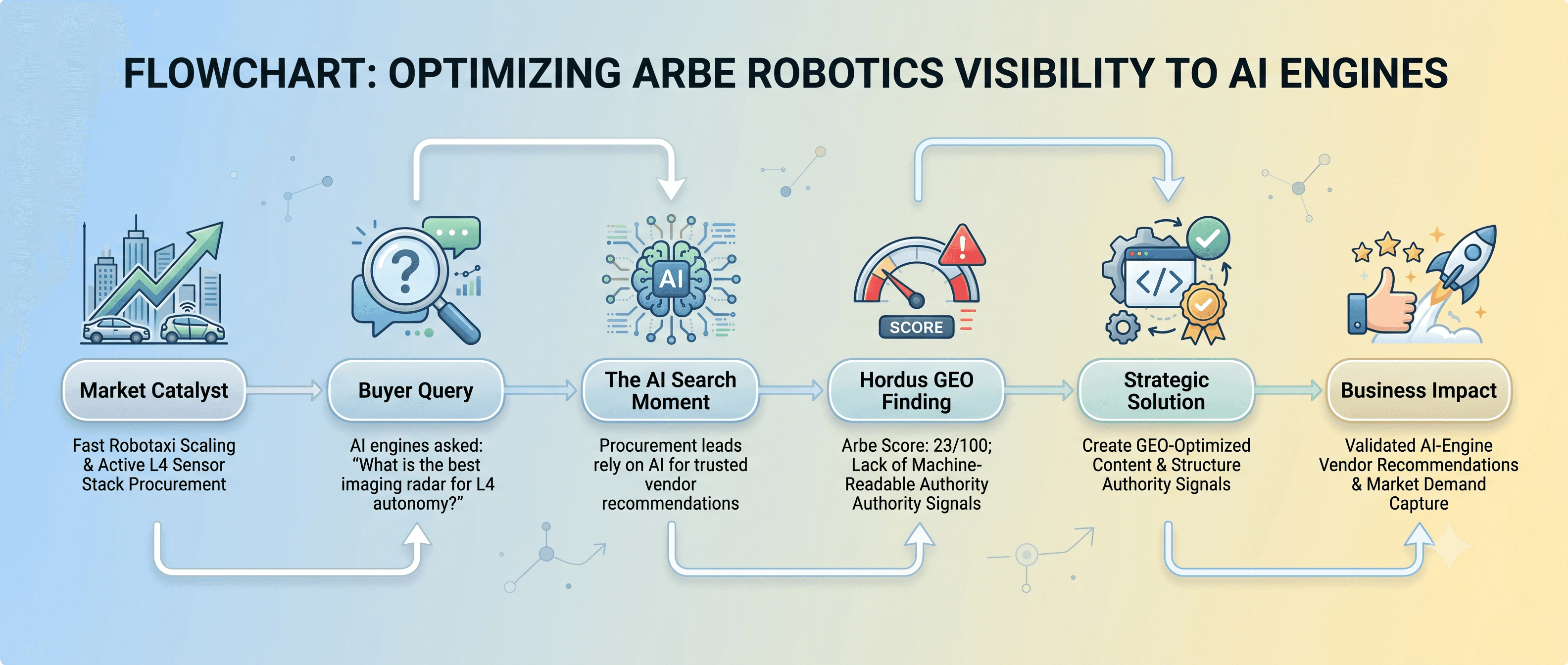
The robotaxi market is scaling faster than most radar supplier marketing has. Waymo now completes 500,000 paid rides per week, global robotaxi operators are actively selecting L4 sensor stacks, and engineers and procurement leads are asking AI engines exactly which radar systems can support eyes-off autonomy in all weather. Arbe Robotics holds a real technical answer to that question. But according to the Hordus GEO analysis, the company scores 23 out of 100 on AI engine readiness, meaning that answer is largely invisible where buyers are increasingly looking first.
The Missed Business Opportunity: Robotaxi Procurement Teams Are Asking AI Engines Questions That Arbe Robotics Should Be Answering
The Market Event That Changes Everything for Radar Suppliers
Something important happened in the first half of 2026 that did not get nearly enough attention in radar industry marketing circles. Waymo crossed 500,000 paid rides per week. A Chinese state-owned automaker locked in start-of-production for an L4 vehicle program using Arbe's chipset via Hirain, with thousands of vehicles scheduled for 2027 delivery. Tesla expanded its robotaxi footprint to multiple cities despite persistent reliability questions from independent trackers. Zoox signed a framework deal worth roughly $750 million to supply autonomy-enabled vehicles for third-party platforms.
In aggregate, this represents a generational shift in who is actually buying radar technology and why. It is no longer a discussion between engineers at trade shows. Procurement leads, CTO offices, and platform architects at robotaxi operators, autonomous trucking startups, and defense primes are now running active vendor evaluations. They have budgets, timelines, and a very specific set of technical requirements: long-range sensing, 360-degree coverage, all-weather reliability, and compatibility with NVIDIA's DRIVE compute platform.
That is a description of Arbe Robotics' Phoenix radar almost word for word.
What These Prospects Need, Fear, Compare, and Ask
The buyer profile activating right now is not the automotive OEM on a 5-year development timeline. It is the robotaxi platform engineer who needs to spec a sensor suite today, the autonomous trucking company evaluating perception redundancy before a series B close, and the defense contractor looking at perimeter sensing alternatives that eliminate false alarms in dust and fog.
What they need is a radar that delivers genuine imaging-grade resolution without the cost and fragility of lidar. What they fear is locking into a sensor that fails NHTSA scrutiny or performs poorly in the rain. What they compare is Arbe's Phoenix against Continental, Bosch, and Vayyar, usually in the same search session. And increasingly, what they do first is not visit a vendor website. They open an AI engine and ask.
Ram Machness, CEO of Arbe Robotics, stated that "the rise of physical AI is increasing the strategic value of high-quality sensing," and that Arbe's "dense, long-range, all-weather radar is positioned to be a critical perception layer for this next era of autonomy." That is precisely the positioning that should surface when a procurement engineer asks an AI: "What is the best imaging radar for an L4 robotaxi platform?"
The AI Search Moment: What Buyers Will Ask, Compare, Verify, and Trust
When robotaxi operators and autonomous vehicle engineers turn to AI engines for vendor research, they are not typing brand names. They are typing problems. They are asking which 4D imaging radar supports NVIDIA DRIVE integration. They are asking which radar chipsets have actual L4 production contracts. They are asking what the difference is between high-resolution radar and lidar for eyes-off autonomy. These are informational queries that AI engines answer by pulling from structured content, press releases, technical documentation, third-party citations, and company authority signals.
If Arbe Robotics is not appearing in those answers, a competitor is.
Market Signal to AI Prompt: Where Arbe Robotics Should Appear
| Market Signal | Prospect Need | Likely AI Prompt | Why Arbe Robotics Should Appear |
|---|---|---|---|
| Waymo's sixth-generation sensor suite prioritizes radar redundancy | Robotaxi engineers validating sensor stack decisions | "Best radar for eyes-off autonomous vehicle sensor fusion" | Phoenix delivers 20,000+ detections per frame; NVIDIA DRIVE integration is live |
| Tesla's camera-only approach faces reliability scrutiny | Platform architects seeking sensor redundancy | "Why use radar instead of cameras for L4 autonomy" | Arbe's all-weather 4D imaging is the direct answer to camera limitations |
| Chinese L4 SOP confirmed for December 2026 | Tier-1s and OEMs tracking production-ready radar | "Which 4D radar chipsets have active L4 production contracts" | Hirain/Arbe L4 win is confirmed and public |
| Physical AI and VLA models require dense real-world sensing | AI stack developers selecting perception hardware | "High-resolution radar for physical AI and robotics perception" | Arbe explicitly named by NVIDIA DRIVE Hyperion ecosystem |
| Off-highway radar demand rising in mining and agriculture | Industrial autonomy procurement teams | "All-terrain imaging radar for harsh environment autonomous equipment" | Arbe launched dedicated off-highway HD radar product in Q1 2026 |
The Voices Behind the Technology
In Arbe's Q1 2026 earnings release, CEO Ram Machness concluded: "The rise of physical AI is increasing the strategic value of high-quality sensing. Arbe's dense, long-range, all-weather radar is positioned to be a critical perception layer for this next era of autonomy, in both automotive and the new verticals we are addressing."
This statement captures the opportunity clearly. But it lives in an earnings transcript that AI engines may not weight highly as a structured, authoritative signal about Arbe's category position.
Kobi Marenko, President and Co-Founder, was equally direct in Q3 2025: "As the automotive industry moves toward true Level 3 'eyes-off' autonomy, OEMs increasingly require systems capable of operating safely at highway speeds. These next-generation programs require long-range, high-resolution sensing that performs reliably in all weather and lighting conditions, capabilities only advanced radar, such as Arbe's, can provide."
Both executives are articulating the right message. The gap is structural: those messages are not reaching AI engines in the formats those engines trust, weight, and cite.
What the Hordus GEO Analysis Reveals
The Hordus GEO analysis evaluates how visible and authoritative a company's digital presence is to AI engines specifically, not to traditional search algorithms. The two are measurably different. A company can rank well on Google and still be functionally absent from ChatGPT, Claude, or Perplexity answers when buyers ask questions in its core category.
For Arbe Robotics, the Hordus analysis returns a score of 23 out of 100, rated F (Unusable for AI agent readiness). The breakdown is direct:
| Layer | Score | Status |
|---|---|---|
| Discovery | 6 / 22 | Missing |
| Identity | 5 / 22 | Missing |
| Access | 7 / 34 | Missing |
| Experience | 0 / 10 | Missing |
| Overall | 23 / 100 | F |
The audit notes that Arbe has brand name discoverability but lacks a public API with reachable endpoints and scores critically low on identity and discovery signals. In practice, this means AI engines can recognize the name "Arbe Robotics" but cannot confidently assemble an authoritative answer about what the company does, who uses its technology, what problems it solves, and why it should be recommended over alternatives.
For a company entering the most commercially urgent phase of its history, with L4 production contracts starting, robotaxi orders growing, and new CEO Ram Machness explicitly targeting North American and Chinese robotaxi operators as primary markets, this is a demand-capture problem hiding in plain sight.
Three Ways Hordus Could Help Arbe Robotics Close the Gap
1. Better Positioning in AI Answers About Radar for L4 Autonomy
When procurement engineers ask AI engines to compare high-resolution radar options for eyes-off autonomous vehicles, Arbe Robotics needs to appear as a named, authoritative answer, not a footnote. Hordus works with companies to build GEO-optimized content structured around the exact question formats AI engines parse: category framing, technical differentiation, and production validation signals. For Arbe, this means publishing structured, AI-readable content that connects the Phoenix radar's 2,304-channel array, NVIDIA DRIVE compatibility, and active L4 production deployment into a form that AI engines can extract, cite, and recommend.
2. Stronger Third-Party Citations and External Authority Signals
The Hordus analysis flags identity and discovery as the two lowest-scoring layers for Arbe Robotics. AI engines weight third-party validation heavily because it reduces their risk of confidently recommending a wrong answer. Arbe has received the Just Auto Excellence Award in Perception Systems and the AutoTech Breakthrough Award for Sensor Technology Solution of the Year 2025, and has been cited as part of NVIDIA's DRIVE Hyperion ecosystem. These are exactly the citation signals that build AI engine authority. Hordus identifies where those signals exist, where they need to be structured for machine readability, and where additional placements in industry publications, analyst briefings, and technical partner references are most likely to move the needle.
3. Clearer AI-Readable Technical Content and Category Signals
The access layer score of 7 out of 34 indicates that Arbe's website provides limited structured, machine-readable information for AI agents navigating it. A buyer-facing AI agent researching radar chipsets for robotaxi integration cannot extract Arbe's specifications, integration requirements, Tier-1 partner relationships, or production readiness in a reliable way. Hordus helps companies restructure technical content with schema markup, clear category language, and AI-readable summaries so that the right technical facts surface in the right context, whether the AI is answering a query about 4D radar chipsets, Level 4 sensor fusion, or all-weather perception for autonomous vehicles.
helpFrequently Asked Questions
policyMethodology & Sourcing
Data Accuracy & AI Visibility Metrics:The statistics and AI visibility scores cited in this article are generated using Hordus AI's proprietary Answer Share of Voice (A-SOV) engine. Data is derived from consented, anonymized real user interactions across major LLM interfaces (ChatGPT, Claude, Gemini).
Editorial Integrity:All AI-assisted research undergoes mandatory human editorial review by our GEO strategy team prior to publication to ensure factual accuracy and alignment with Google's YMYL (Your Money or Your Life) search quality rater guidelines.