Be the answer when your
customers ask AI.
Hordus is a GEO/AEO company that does what monitoring platforms do not: we build the AI answer infrastructure that determines what models say about you. We call it Cyber GEO. Detect. Assess. Engineer. Validate. A fully managed GEO/AEO operation: our technology sees what AI says about your brand, and our team does the work that changes it.
One team to see answer movement, trace citations, generate opportunities, create assets, and improve the pages AI models rely on.
The shift
AI summaries are replacing the click before the click.
Buyers get their answer before they get a list of links. When the summary decides who is considered, the summary is the market, and GEO/AEO is how a brand competes inside it.
Organic clicks under pressure
Answer engines intercept intent before a user reaches your site.
Citations over rankings
Which sources get cited, not which pages rank, now decides who gets recommended.
Competitive framing
AI answers shape the shortlist before a user clicks anything.
What we build
AI does not look you up when someone asks. It answers from what it already learned.
Most brands treat AI visibility as a monitoring problem. It is a supply problem. When someone asks an AI about your category, the model composes an answer from facts it has already absorbed: from your site, from third-party coverage, from documentation, from community discussion, from structured data it could parse. If those facts are incomplete, unstructured or absent, the model fills the gap with whatever else it read. Usually a competitor.
What AI knows to be true
Verified, structured facts: entities, schema, knowledge-graph relationships.
- GEO Readiness Audit
- Dataset seeding
- Entity engineering
Where AI meets those facts
The places models read: owned site, authored journals, network coverage, community.
- Content Engineering
- Authored Journals
- Comment Engagement Desk
How facts are delivered
So machines parse them without ambiguity, and humans still get a rich page.
- Audience-Aware CMS
Why AI trusts them
Freshness, corroboration across independent sources, citation frequency.
- Cyber Answer Intelligence
- Closed-loop validation
How models take it up
Two routes into the answer.
Published facts reach a model twice, on two different clocks. Most GEO work only ever touches the first.
Read at answer time
When a model answers a live question it reaches for sources. Publishing into the sources it already cites changes what it finds on the next query, which is why placement matters more than volume.
Absorbed into the model
Material that is public, structured and corroborated is also learned into the model itself at the next generation. Slower, and it does not decay. This is why the crawler permissions on a site are a commercial decision, not a technical one.
Six capabilities.
Detection is the entry point, not the product. These six modules are what a Hordus engagement actually runs.
01 Cyber Answer Intelligence
Stage: Detect. What AI says about you across every major engine, grounded in real user journeys.
02 GEO Readiness Audit
Stage: Assess. Every page on your site scored 0-100 for how well AI can read it.
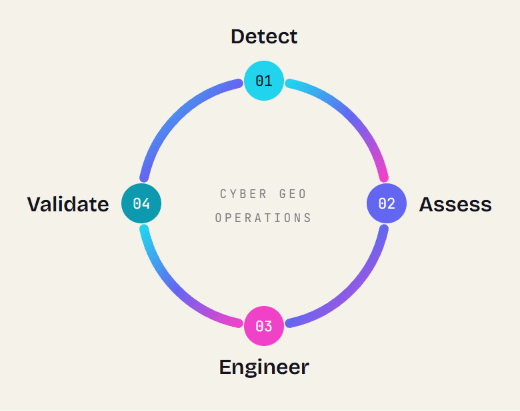
The Hordus Cycle
One loop, run continuously.
Detect, Assess, Engineer, Validate. Each cycle sets the priorities for the next.
- •01 Detect, continuous. Cross-engine tracking of what AI says about you, grounded in how real buyers actually converse.
- •02 Assess, monthly and on change. Where you are absent, where you are misframed, and which questions competitors are winning.
- •03 Engineer, weekly production. The content, entities and structured data that correct the record, across owned, authored and earned surfaces.
- •04 Validate, monthly reporting. Answer Share, Share of Voice, position in response and cited sources, feeding the next cycle.
Two markets
Same operating model. Different compliance stack.
Cyber GEO, for brands
For companies competing to be recommended. Answer share, citations, competitive position, and the full execution layer that moves them.
Narrative, for public interest
For political figures, NGOs, associations and institutions. How AI describes your positions and record, side by side with peers and rivals, and which sources drive every framing.
Platform depth
Real users. Real journeys. Real outcomes.
Our opt-in, multi-device panels across dozens of markets provide consented clickstream and purchase signals from real opt-in users. Where available we enrich journeys with demographics and location, producing an opportunities-and-threats map and a content plan tied to answer uplift and conversions.
GDPR and CCPA compliant
Opt-in onboarding
Multi-device coverage
Purchase signals
Real journeys, not sampled prompts
Human-reviewed AI content
Why Hordus
An operation, not a subscription.
White-hat methods
We work inside the rules of every engine and platform we publish to. No cloaking, no manufactured consensus.
Human editorial review
Every AI-assisted asset is reviewed and refined by a human editor before it reaches an audience.
Methodology with every number
Answer Share and Share of Voice are always reported with the question set and measurement window that produced them.
Published compliance standard
Our disclosure, parity and eligibility commitments are published, not promised.
Trust Center
Everything we do, you could publish.
Seven commitments, written to be checked by a general counsel, a regulator or a journalist rather than taken on faith.
Customers
Sixteen brands, nine sectors.
Datarails
FP&A platform for finance teams working in spreadsheets.

Explorium
External data platform for analytics and machine-learning teams.
Grove Ventures
Venture capital firm backing early-stage deep technology companies.
Matrix IT
IT services and software solutions group.

CyberRidge
Cybersecurity company working on the protection of data in transit.

Lumenis
Energy-based medical devices for surgical, aesthetic and ophthalmic use.
Pulsenmore
Home ultrasound devices for remote clinical scanning.
Overwolf Ads
In-game advertising business of the Overwolf creator platform.
Tebex
Monetization platform for game creators and server communities.

LiveU
Live video transmission technology for broadcast and production teams.
iKOMG
Media and marketing group operating across digital properties.

H2Pro
Green hydrogen production technology company.
Sonol Gas+
Fuel and energy retail network operator.

Champion Motors - ALFA
Automotive importer and distributor group.

Remilia Hair
Hair care brand.
Bakara
Consumer retail brand operating a national store network.
Customers
Trusted by brands that decided to be the answer.
Sixteen companies running Cyber GEO across nine sectors, from medical devices and cybersecurity to fintech, broadcast, energy and retail.
Insights
Latest from the blog
Long-form Hordus analysis on GEO, AEO and how AI systems decide who to recommend.

Anchor's Moment: Turning Britain's Social Care Reckoning Into a Growth Story
Social care reform is pushing UK families, advisers, and commissioners to ask AI engines who to trust. Anchor, England's largest not-for-profit later-life provider, can become that default answer. The Hordus.ai GEO analysis shows where to close AI visibility and authority gaps to win the position.

The Window Is Open: How Amorphical Can Own the AI Conversation in Nano-Amorphous Therapeutics
Amorphical's Phase 2 pancreatic cancer trial and the 2026 biotech funding rebound are driving investors and pharma partners to research clinical-stage platforms through AI engines. Amorphical's site is nearly unoptimized for this, giving Hordus.ai a rare opening to secure first-mover category leadership in AI visibility.

Every New Robotic OR Needs a Wireless Answer. Amimon Already Built It.
Robotic surgery is growing toward $10.6 billion in 2026, adding video feeds every OR must route wirelessly. Buyers now ask AI who solves this. Amimon (Rocoto Solutions) has the FDA clearances and OR installs to own that answer, once it closes the gap Hordus found.
FAQ
Questions buyers ask AI about this category.
Is Hordus a GEO agency or a GEO platform?
What is Cyber GEO?
What is AI answer infrastructure?
How is Hordus different from an AI visibility dashboard?
Do I need GEO if my SEO is already strong?
Which AI engines does Hordus track?
What is Answer Share and how does it differ from Share of Voice?
How long does GEO take to show results?
Get started
Ready to be
the answer?
See what AI says about your brand today, and what a Cyber GEO operation would change first.
Trusted by enterprise, commerce and developer-led teams