Methodology
The Cyber GEO
methodology.
Cyber GEO is data enrichment for AI citations. The method below is how we decide which facts to seed, where to place them so models actually read them, and how we verify they landed. Six pillars and a real-journey data foundation determine what we detect, what we build, and how we validate it.
Six pillars
What every engagement is built on.
Entity Intelligence
Mapping how models represent an entity, its attributes and its relationships to competitors and peers.
Structured Data Logic
Schema, knowledge-graph and markup engineering that makes facts machine-readable at the source.
Citation Analysis
Identifying which domains and documents models actually cite, and why, across every major engine.
Behavioral Modeling
Real, consented multi-step user journeys, not synthetic prompts, as the basis for every measurement.
Model-Respecting Methods
No exploits, no dark patterns, no adversarial tactics. Every technique is disclosed and published.
Continuous Evaluation
Answer Share, Share of Voice and cited-source tracking, feeding the next cycle every reporting period.
The doctrine
Cyber GEO is data enrichment for AI citation.
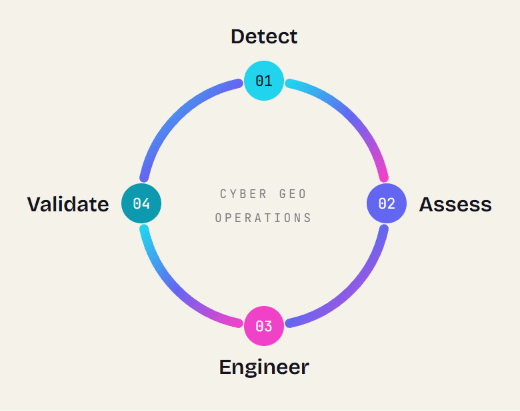
Analysis produces a content seed. The seed is distributed across multiple platforms and websites, including the sources AI answers already cite, so that models learn the facts both for retrieval and for training. The work plants the knowledge, so that future answers can carry it. Detect, assess, engineer, validate: the cycle runs continuously, and every stage is human-reviewed.
Data foundation
Real user journeys, not synthetic prompts.
Every measurement traces back to consented, real opt-in users navigating multi-step conversations across ChatGPT, Claude, Gemini, Perplexity and Grok: the same behavior your buyers, voters and members actually exhibit.
The AnswerOps doctrine
Why continuous operations beat periodic optimization.
AI answers change with every model update, every competitor publication, and every new source that enters an index. A one-time optimization decays the moment any of those three things happens. An operation compounds.
- •01 Detect, continuous. Cross-engine tracking of what AI says about you, grounded in how real buyers actually converse.
- •02 Assess, monthly and on change. Where you are absent, where you are misframed, and which questions competitors are winning.
- •03 Engineer, weekly production. The content, entities and structured data that correct the record, across owned, authored and earned surfaces.
- •04 Validate, monthly reporting. Answer Share, Share of Voice, position in response and cited sources, feeding the next cycle.
The constraint on all of it
Method is only half of it.
A method that works but cannot be described publicly is not a method we use. Every technique on this page could be explained in detail to a client's general counsel, to a regulator or to a journalist without embarrassment. That is the test, and the white-hat standard is where it is written down.
Data foundation
How our data works.
Hordus is built on real user journeys — consented, GDPR/CCPA-compliant panels with clickstream and purchase signals across markets. When available, we enrich journeys with demographics and location so your strategy reflects how people actually research and decide.
The platform does not rely on synthetic prompts or simulated browsing. There is no profiling of third parties encountered during operations. We have a retention policy and a subprocessor list. Every signal comes from real behavior, giving you ground truth that drives confident decision-making.
Real user journeys
GDPR / CCPA compliant
Clickstream signals
Purchase signals
Demographic enrichment
No synthetic data
Get started
See the methodology
in action.
Book a demo and we'll walk through your brand's current AI answer landscape and what we'd do about it.