AudioCodes Modernized Voice Infrastructure. Now It Needs to Modernize How AI Finds It.
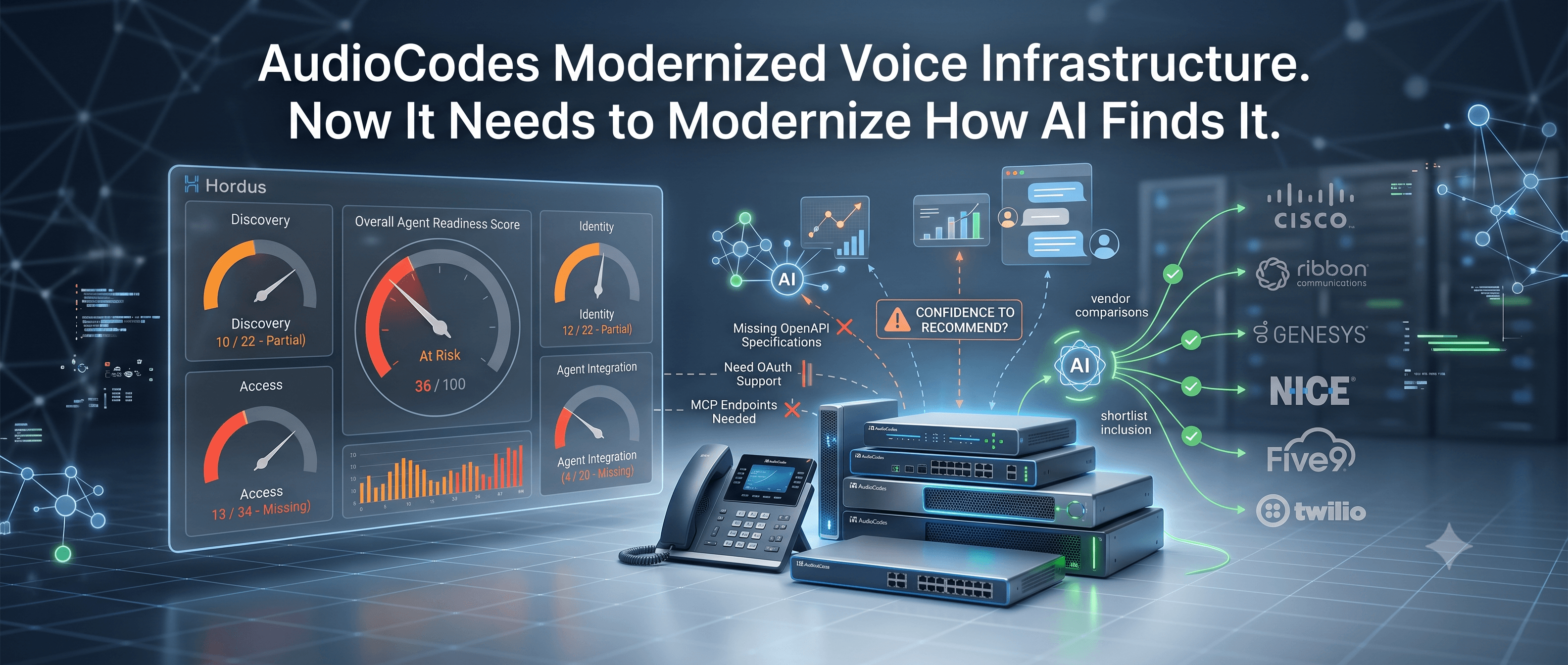
AudioCodes's Voice AI business is growing over 50% a year, but the Hordus audit shows the company is nearly invisible to the AI engines now doing the first round of vendor screening. Closing that gap could turn organic growth into AI-sourced pipeline instead of ceding shortlist visibility to Genesys, NICE, Five9, Cisco, and Ribbon.
TL;DR
AudioCodes just posted over 50% year-over-year growth in Conversational AI revenue and pushed combined Live and Voice AI ARR to $80 million, a clear signal that enterprise demand for Voice AI is accelerating. As that demand grows, buyers are increasingly asking ChatGPT, Gemini, Perplexity, and Copilot to compare vendors before they ever talk to a sales rep, which means the AI engine's answer is becoming the new first round of the RFP. AudioCodes has the product story: Teams-certified voice infrastructure, Live Hub AI Agents, Voca CIC, and Meeting Insights On-Prem for data sovereignty. What it does not yet have, according to the Hordus audit, is the machine-readable footprint that lets AI engines confidently recommend it over Cisco, Ribbon Communications, Genesys, NICE, Five9, and Twilio. Closing that gap is a GEO opportunity, not a branding exercise, since it affects which vendors get named, compared, and shortlisted before a single sales call happens.
The Market Event: Voice AI Just Became the Growth Story
AudioCodes's first quarter 2026 results were not a routine earnings beat. Conversational AI revenue grew more than 50% year over year, Live Hub annual recurring revenue more than doubled year over year, and combined ARR from Live managed services and Voice AI reached $80 million, up nearly 20% from a year earlier. Management is guiding toward a Voice AI business worth tens of millions more within two years, on top of full-year 2026 revenue guidance of $247 million to $255 million.
That kind of growth does not happen in a vacuum. It happens because contact centers are under real pressure: rising staffing costs, higher customer expectations, and a flood of point solutions promising AI agents that never quite integrate with the phone systems enterprises already run. AudioCodes has leaned directly into that pressure. In September 2025 it launched AI Agents inside Live Hub, its voice CPaaS platform, explicitly to let enterprises add LLM-powered voice bots without ripping out existing infrastructure. As CEO Shabtai Adlersberg put it, "Voice AI is becoming a material growth engine for AudioCodes. Live Hub has already proven that enterprises want a single, open platform to modernize customer interactions on the systems they run today."
This is exactly the moment when buyers stop relying on memory and start asking AI. A category growing 50% a year, full of overlapping acronyms like UCaaS, CCaaS, CPaaS, and CAI, is precisely the kind of confusing, fast-moving space where a CIO or CX leader now opens an AI engine and asks it to sort out the field before picking up the phone.
Who Is Actually Asking, and What They Want
AudioCodes already serves 65 of the Fortune 100, and its buyer base clusters around a few recognizable roles. IT and telecom leaders migrating to Microsoft Teams Voice want certified connectivity that will not break during a cloud transition. CX and contact center leaders want to automate routine calls and deploy agent assist without a multi-year rebuild. Compliance-sensitive buyers in banking, healthcare, higher education, and government want on-premise or edge deployment options for data sovereignty. And increasingly, procurement and vendor-risk teams are pre-screening the entire category with an AI engine before a single vendor gets a meeting.
Here are five prompts these buyers are realistically typing into an AI engine right now:
- "What are the best Voice AI platforms for Microsoft Teams contact centers in 2026?"
- "AudioCodes vs Genesys vs NICE: which is better for enterprise conversational AI?"
- "Which vendor offers on-premise voice AI for data sovereignty and compliance?"
- "Best alternatives to Cisco and Ribbon Communications for enterprise SBC and voice networking?"
- "How can I add AI voice agents to my existing IVR without replacing our phone system?"
| Buyer Prompt | What AI Should Understand About AudioCodes | Risk If Missing | Business Value If Visible |
|---|---|---|---|
| Best Voice AI for Teams contact centers | Voca CIC is Teams-certified and built natively in Azure | AI defaults to Genesys or NICE, who invest heavily in analyst and review content | Direct entry into shortlists for Teams-first enterprises |
| AudioCodes vs Genesys vs NICE | AudioCodes lets enterprises add AI agents without replacing existing telephony | AudioCodes reads as a legacy hardware vendor, not an AI platform | Repositions AudioCodes as a modern, lower-risk upgrade path |
| On-premise voice AI for compliance | Meeting Insights On-Prem and MIA OP support edge deployment and data sovereignty | Compliance-first buyers never see AudioCodes as an option | Wins in banking, healthcare, public sector, and higher education |
| Alternatives to Cisco and Ribbon | AudioCodes is a 30-year SBC and voice networking leader now expanding into AI | Buyers default to incumbents by name recognition alone | Captures switching demand from cost- or feature-driven upgrades |
| Add AI agents without a rip-and-replace | Live Hub AI Agents connects to SIP trunks, Teams, CCaaS, and WhatsApp out of the box | Buyers assume AI agents require a full platform migration | Shortens sales cycles by removing the biggest objection upfront |
Two Outcomes, One Fork in the Road
If AI engines describe AudioCodes accurately, the upside compounds. A buyer researching Voice AI gets pointed toward Live Hub and Voca CIC before a competitor's sales team even knows the deal exists, and AudioCodes enters the conversation as the safe, proven upgrade rather than the challenger. That matters for a company where indirect channels and system integrators already carry a large share of revenue. As Adlersberg said of the quarter's momentum, "We have seen continued strong positive operational cash flow. We believe that our increased investments in the Voice AI market will prove beneficial to our business expansion in the coming years." AI-driven discovery is one of the clearest ways to convert that investment into pipeline that sales does not have to generate cold.
If competitors dominate those answers instead, the cost is not visibility, it is category framing. Genesys, NICE, Five9, and Twilio each have well-resourced content and analyst-relations engines built for exactly this moment. If AI engines learn to describe the category using their language first, AudioCodes risks being cited as a legacy voice vendor rather than an AI platform, even while its own Voice AI revenue is growing faster than most of the field.
What the Hordus GEO Analysis Found
The Hordus analysis of audiocodes.com shows a company with strong brand recognition and real product depth that is still hard for AI agents to read, cite, and compare confidently.
| Layer | Score | Status |
|---|---|---|
| Overall Agent Readiness | 36 / 100 | At Risk (Grade D) |
| Discovery | 10 / 22 | Partial |
| Identity | 12 / 22 | Partial |
| Access | 13 / 34 | Missing |
| Agent Integration | 4 / 20 | Missing |
| User Experience | 2 / 20 | Missing |
The Hordus audit notes that AudioCodes has NPM SDKs and strong brand presence, but lacks OpenAPI specifications, OAuth support, and MCP integration that AI agents increasingly rely on to verify and interact with a vendor's site.
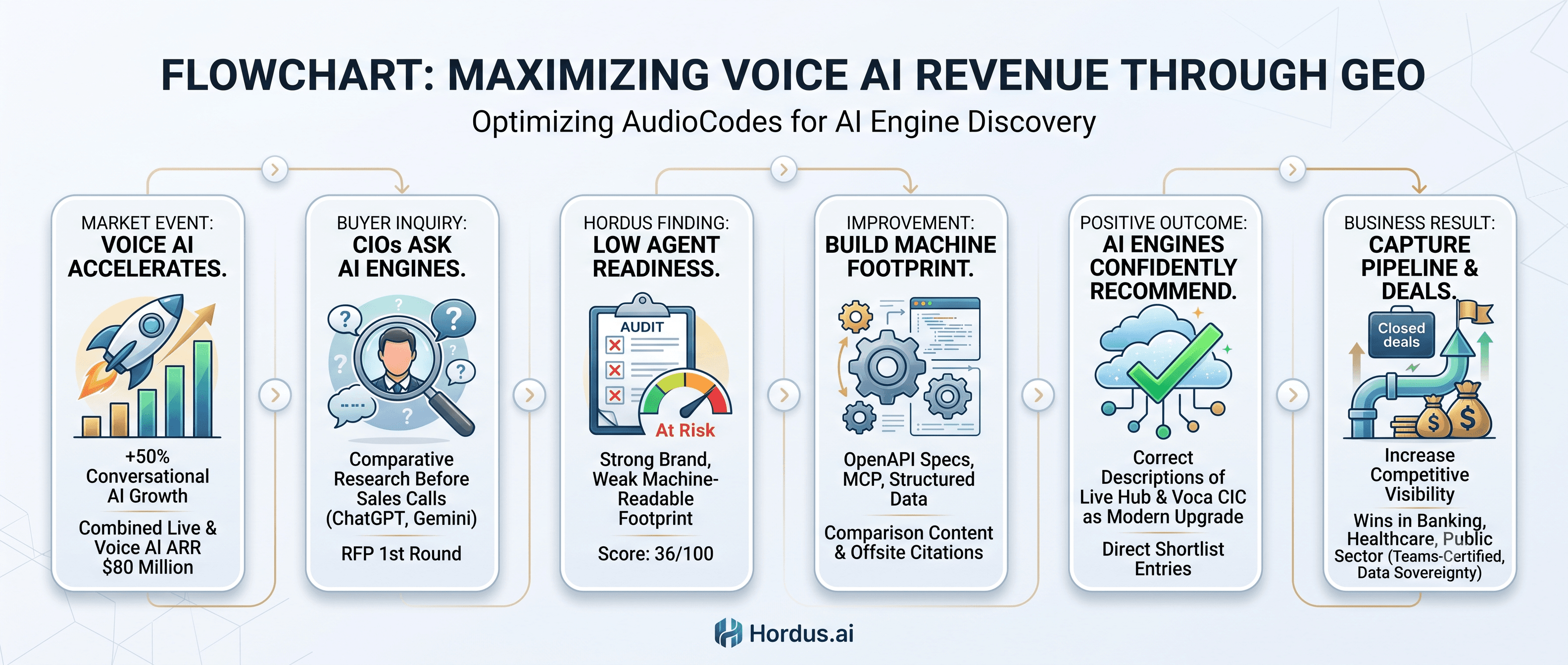
Based on this, four concrete moves could move the needle on pipeline and category positioning:
- Close the Access and Agent Integration gap. Publishing OpenAPI specs and MCP endpoints for Live Hub and Voice AI Connect would let AI agents actually test and describe the product, not just summarize marketing copy.
- Strengthen Discovery. Structured comparison content covering AudioCodes against Genesys, NICE, Five9, Cisco, and Ribbon Communications gives AI engines the head-to-head detail they currently have to infer or borrow from competitors.
- Fix User Experience for agents. A 2/20 score means an AI agent trying to find pricing, request a demo, or evaluate Live Hub self-service likely stalls or gives up, right at the moment a buyer wants a fast answer.
- Build offsite citation strength. Independent reviews, analyst mentions, and integration partner content are what AI engines lean on for trust signals beyond the AudioCodes website itself.
- Monitor answer share over time. Category leadership in Voice AI will increasingly be decided by which vendor AI engines mention first, not just which vendor ranks highest in search.
Hordus can run ongoing competitive visibility tracking against Genesys, NICE, Five9, Cisco, and Ribbon Communications, showing exactly which prompts return AudioCodes and which return a competitor instead. From there, Hordus helps close specific gaps: strengthening the citation sources AI engines already trust, building offsite authority through the right third-party content, and shaping how AI engines summarize and compare AudioCodes against the category it is fighting to lead.
Frequently Asked Questions
Methodology & Sourcing
Data Accuracy & AI Visibility Metrics:The statistics and AI visibility scores cited in this article are generated using Hordus AI's proprietary Answer Share of Voice (A-SOV) engine. Data is derived from consented, anonymized real user interactions across major LLM interfaces (ChatGPT, Claude, Gemini).
Editorial Integrity:All AI-assisted research undergoes mandatory human editorial review by our GEO strategy team prior to publication to ensure factual accuracy and alignment with Google's YMYL (Your Money or Your Life) search quality rater guidelines.