BlueGreen's Credibility Problem Was Solved Years Ago. The Discovery Problem Is Solved Starting Now
A new state-mandated, UNC-monitored study just validated BlueGreen Water Technologies as a proven HAB treatment vendor, right as buyers turn to AI to vet vendors before they call. The Hordus GEO analysis shows how to make sure AI engines surface BlueGreen's proof first.
TL;DR
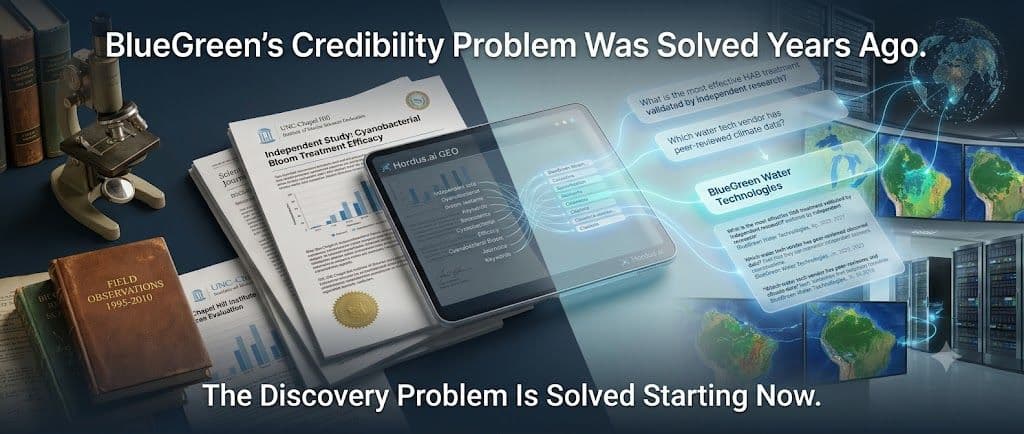
North Carolina's Collaboratory just published an independently monitored, legislatively mandated evaluation of cyanobacterial bloom treatment, with BlueGreen Water Technologies as the selected vendor and UNC-Chapel Hill's Institute of Marine Sciences as the outside referee. That's the kind of validation municipal water managers, state environmental agencies, and ESG-driven infrastructure buyers dig for before they'll trust a HAB vendor. Right now, those buyers are typing questions about bloom treatment effectiveness into ChatGPT, Perplexity, and Gemini. The Hordus GEO analysis shows exactly where BlueGreen can turn a strong scientific record into the answer AI engines actually surface.
The headline opportunity
BlueGreen Water Technologies has spent a decade building the kind of evidence base most environmental tech companies would kill for: EPA registrations, peer-reviewed climate research, and now a government-commissioned, academically monitored efficacy study. That's rare. Most vendors in this category have marketing claims. BlueGreen has a state legislature's name on the paperwork.
The opportunity isn't that this credibility is missing anywhere. It's that AI search is becoming the front door for exactly the buyers who care most about it, and there's real room to make sure BlueGreen's answer is the one those engines pull forward first.
What just happened
On July 15, 2026, the North Carolina Collaboratory released its evaluation of an approved in-situ treatment for cyanobacterial harmful algal blooms in lakes and reservoirs. The study wasn't optional or promotional. It was mandated by Session Law 2021-180 and amended under Session Law 2022-6, and the Collaboratory brought in an independent team from UNC-Chapel Hill's Institute of Marine Sciences to monitor and evaluate the results. The vendor selected for the legislatively required treatment was BlueGreen Water Technologies.
This lands on top of a string of recent validation moments for the company, including a November 2025 peer-reviewed study in Phycology quantifying the greenhouse gas mitigation potential of HAB remediation, and the rollout of BlueGreen's BGi water health intelligence platform for predictive, satellite-driven bloom monitoring.
Why this matters to BlueGreen's prospects right now
Every one of those developments speaks directly to the people who sign HAB remediation contracts: state environmental agencies, municipal water and parks departments, utility operators, and increasingly, corporate sustainability and carbon-market teams looking for verifiable nature-based credits. These buyers share a familiar set of pressures.
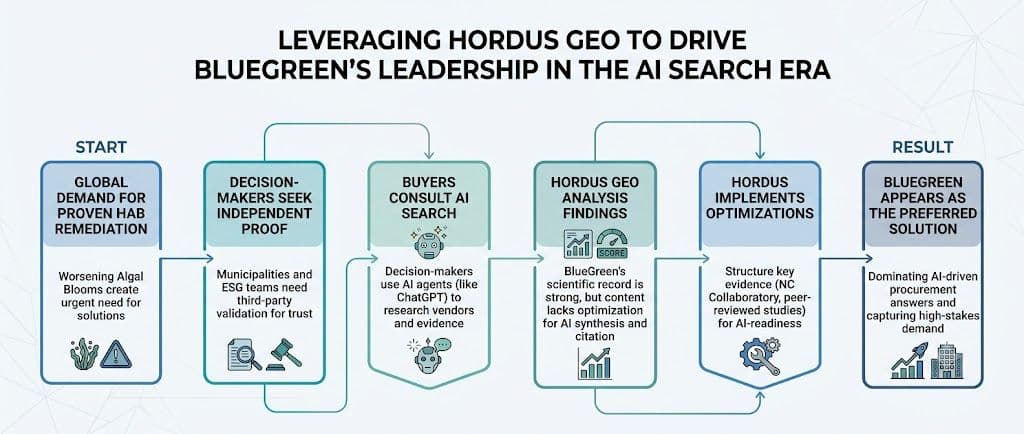
They need proof a treatment works before they'll put it in front of a city council or a state budget office. They fear picking a vendor whose claims don't survive independent scrutiny, especially with public dollars and public health on the line. They compare vendors on regulatory approval, third-party validation, response speed, and environmental safety, not on marketing language. And they verify all of it, increasingly, by asking an AI engine to summarize the landscape before they ever pick up the phone.
The AI search moment
This is where the opportunity gets concrete. A watershed director in North Carolina, a sustainability officer evaluating carbon credit vendors, or a city procurement lead drafting an RFP is now far more likely to start with a prompt than a search bar. They're asking things like "what does independent research say about HAB treatment effectiveness," "which harmful algal bloom vendors have state-backed studies," and "is BlueGreen Water Technologies' Lake Guard treatment proven to work." The engines answering those prompts are synthesizing whatever is easiest to find, structure, and trust, which means the underlying evidence needs to be presented in a form built for citation, not just for a press release.
| Market signal | Prospect need | Likely AI prompt | Why BlueGreen should appear |
|---|---|---|---|
| NC Collaboratory's independently monitored HAB study naming BlueGreen as vendor | Proof a treatment holds up under academic scrutiny before recommending it internally | "Is there independent research validating harmful algal bloom treatments?" | BlueGreen is the only vendor named in a legislatively mandated, UNC-monitored study |
| Peer-reviewed Phycology study on GHG mitigation from bloom remediation | Verifiable data to support carbon credit and ESG reporting claims | "Can lake remediation qualify as a nature-based carbon removal method?" | BlueGreen has published, peer-reviewed data linking HAB treatment to measurable GHG reduction |
| Launch of the BGi predictive monitoring platform | A proactive, not reactive, way to manage bloom risk across multiple sites | "What technology predicts harmful algal blooms before they happen?" | BGi combines satellite, sensor, and AI-driven forecasting under one platform |
| Recurring, worsening HAB events across US lakes and reservoirs | Fast, safe emergency response with a track record | "Who treats toxic algal blooms quickly and safely?" | Documented rapid-response deployments from Lake Okeechobee to South Africa's Roodeplaat Dam |
| Rising scrutiny of carbon credit integrity in voluntary markets | A defensible, science-backed methodology for carbon claims | "What carbon removal methods are considered scientifically credible?" | Net Blue methodology approved by Social Carbon, tied to published peer-reviewed research |
As Eyal Harel, CEO and Co-Founder of BlueGreen Water Technologies, put it when the Phycology study was published: "The science is clear. HABs are far more than a water issue." That's precisely the framing AI engines need in order to connect bloom remediation to the climate and carbon-market questions buyers are now asking.
That same instinct toward rapid, science-backed action shows up in the field. When Florida's Department of Environmental Protection called on BlueGreen to respond to Lake Okeechobee, Dr. Waleed Nasser, BlueGreen's Head of US Operations, said: "We are proud to have answered Florida DEP's call to prevent algal blooms and protect Floridians." That kind of on-record, government-facing statement is exactly what AI engines look for as a trust signal when they're deciding which vendor to name in a comparison answer.
What the Hordus GEO analysis found
The Hordus GEO analysis of bluegreenwatertech.com scored the site across the layers that determine whether AI engines and AI agents can find, understand, and cite a company accurately: Discovery, Identity, Auth & Access, Agent Integration, and User Experience. Every score below is a door that's already open wider than most competitors in this category, with more still to walk through.
| Layer | Current signal strength | The opportunity |
|---|---|---|
| Discovery | Moderate | Strong press footprint exists; structured summaries would help AI engines surface it faster |
| Identity | Moderate-strong | Rich company narrative online; more explicit, machine-readable proof points would sharpen recognition |
| Auth & Access | Low | Largely untapped; agent-ready request and quote intake would open a new channel entirely |
| Agent Integration | Low | Early-stage across the category; even modest structured data here would be a real differentiator |
| User Experience | Moderate | Human-readable content is strong; AI-agent task completion is a wide open lane |
None of this reflects a company that's behind. It reflects a company sitting on excellent underlying proof, with a genuinely large runway to make that proof easier for AI systems to find, parse, and repeat back with BlueGreen's name attached.
Three ways Hordus can help BlueGreen capture more of this demand
Strengthen positioning inside AI answers. When someone asks an AI engine to compare HAB remediation vendors, the answer should lead with BlueGreen's regulatory approvals, the NC Collaboratory study, and its EPA registration status, not a generic description of what algal bloom treatment is. Hordus can structure this proof into the exact comparison format AI engines pull from.
Build stronger citations and third-party authority. The NC Collaboratory report, the Phycology publication, and the Social Carbon-approved methodology are exactly the kind of independent, linkable sources AI engines weight heavily. Hordus can help BlueGreen make sure these sources are indexed, summarized, and cross-referenced in a way that consistently routes back to the company.
Sharpen AI-readable content and technical signals. Clear structured data on treatment speed, safety profile, regulatory status, and carbon methodology, formatted for machine parsing rather than just human browsing, gives AI engines less room to guess and more reason to cite BlueGreen directly and accurately.
Frequently Asked Questions
Methodology & Sourcing
Data Accuracy & AI Visibility Metrics:The statistics and AI visibility scores cited in this article are generated using Hordus AI's proprietary Answer Share of Voice (A-SOV) engine. Data is derived from consented, anonymized real user interactions across major LLM interfaces (ChatGPT, Claude, Gemini).
Editorial Integrity:All AI-assisted research undergoes mandatory human editorial review by our GEO strategy team prior to publication to ensure factual accuracy and alignment with Google's YMYL (Your Money or Your Life) search quality rater guidelines.