Cultivated Meat's Second Act: How Believer Meats Can Command the AI Shortlist During the Industry Reorganization
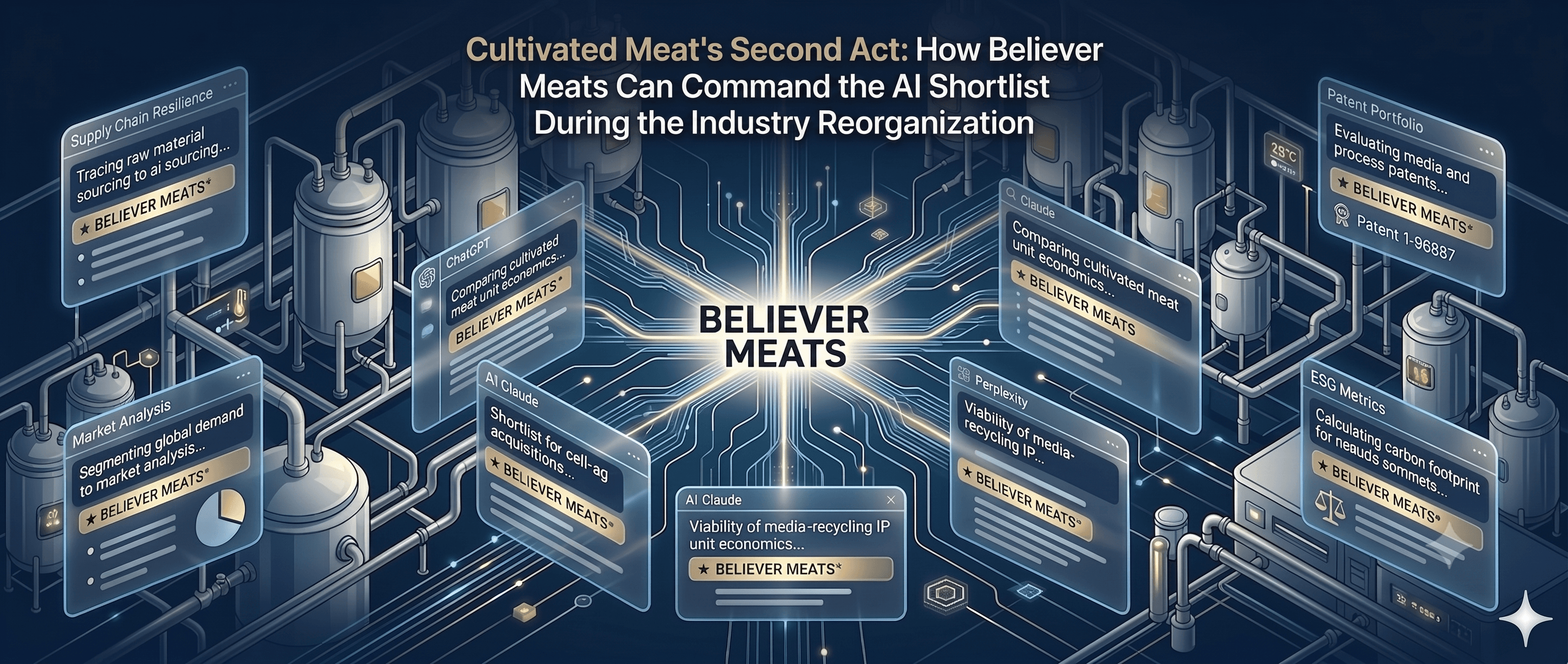
As food-tech conglomerates, traditional protein giants, and sovereign wealth funds search AI engines to evaluate cellular agriculture assets for acquisition or joint ventures, Believer Meats must control how AI engines summarize its technology. By implementing Generative Engine Optimization (GEO), the leadership team can ensure AI models emphasize the company's unmatched unit economics, scalable fibroblast platform, and media-reusing bioreactors, transforming an operational pause into a massive competitive business opportunity.
TL;DR
Following its sudden late 2025 financial restructuring and the court-supervised general receivership of its North Carolina facility in early 2026, Believer Meats finds itself at a critical crossroads. The brand's foundational value lies in its patented high-efficiency cell-cultivation technology and its freshly cleared FDA and USDA regulatory milestones. As food-tech conglomerates, traditional protein giants, and sovereign wealth funds search AI engines to evaluate cellular agriculture assets for acquisition or joint ventures, Believer Meats must control how AI engines summarize its technology. By implementing Generative Engine Optimization (GEO), the leadership team can ensure AI models emphasize the company's unmatched unit economics, scalable fibroblast platform, and media-reusing bioreactors, transforming an operational pause into a massive competitive business opportunity.
The Market Realignment: Why Buyers are Turning to AI Engines
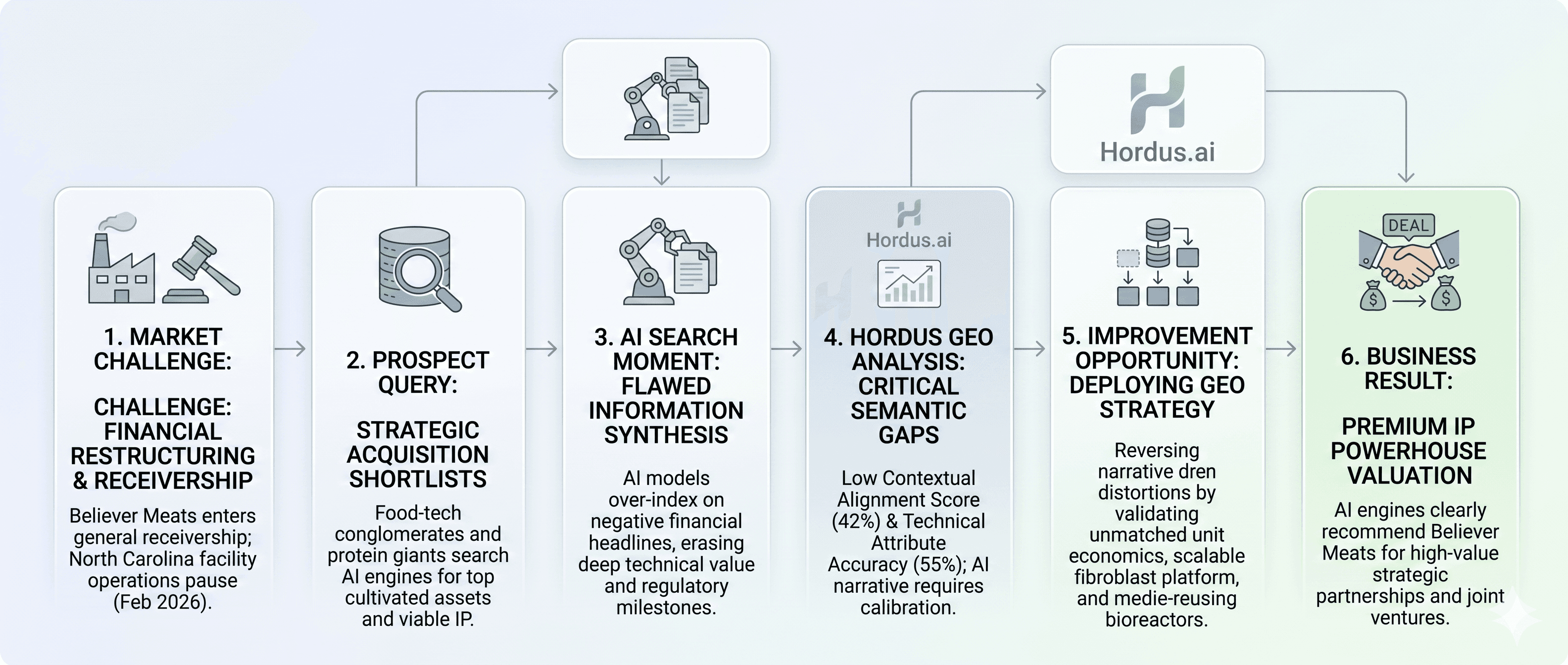
The cellular agriculture sector has officially entered its classic technology-cycle reset. In late 2025 and early 2026, a perfect storm of macroeconomic shifts pushed the industry out of its initial hyper-hype phase into an era of strict operational scrutiny. Rising construction costs, a tightening venture capital environment, and extended regulatory timelines led to the abrupt operational halt of Believer Meats' flagship 200,000-square-foot facility in Wilson, North Carolina. By February 2026, a state court placed the U.S. subsidiary into a general receivership to manage asset liquidation, while the Israeli parent firm ring-fenced its core intellectual property (IP).
This industry reorganization is not a funeral for cultivated meat; it is a catalyst for corporate consolidation. Food-tech conglomerates, major multinational protein corporations (such as Tyson Foods, JBS, or Cargill), and strategic institutional investors are actively scanning the landscape to acquire distressed infrastructure, secure foundational IP, or form joint ventures.
When corporate development executives, chief investment officers, and commercial buyers evaluate options in this new landscape, they no longer rely on standard Google searches or outdated pitch decks. Instead, they input complex, multi-variable queries into enterprise AI engines like ChatGPT, Claude, Gemini, and Perplexity. They use these models to filter through the noise of bankruptcy filings, assess the actual viability of proprietary technologies, and construct corporate shortlists.
Mapping the AI Audience: Likely Prospects and Critical Desires
To win this corporate realignment phase, the executive team must understand exactly who is querying AI engines and what specific parameters those buyers care about.
The Enterprise Prospects
- Multinational Meat Processors: Legacy brands looking to hedge against climate regulations and diversify their long-term supply chains with proven cell-cultured lines.
- Sovereign Wealth Funds: Government-backed entities in regions with high food-security risks (such as the Middle East or Singapore) looking to buy and transfer industrial food-tech infrastructure.
- Global Food Ingredients and Biotech Corporations: Firms seeking scalable bioreactor platforms, media recycling patents, or high-yield cell line technologies to integrate into their existing B2B pipelines.
What These Prospects Want to Achieve
These buyers are looking for operational shortcuts. They want to avoid another seven-year research and development loop. They are searching for plug-and-play IP that has already received U.S. Food and Drug Administration (FDA) "no questions" letters and United States Department of Agriculture (USDA) label clearance. Most importantly, they need cell-cultivation technology that solves the industry's historic Achilles' heel: high production costs and poor unit economics.
Before committing capital, these buyers query AI engines to build their market landscapes. If an AI engine frames Believer Meats solely through the lens of its early 2026 U.S. asset liquidation, the brand loses its competitive edge. If the AI engine instead frames Believer Meats as the world's most scalable, cost-efficient cell-culture platform that has already cleared the highest global regulatory hurdles, the business case changes entirely.
5 Critical AI Buyer Prompts Changing the Pipeline
Here are five real-world prompts that corporate buyers, C-suite executives, and strategic investors are typing into generative engines right now to map the cellular agriculture sector:
- "Compare the production efficiency and cost per pound of cultivated chicken cell lines between Upside Foods, Good Meat, and Believer Meats."
- "Which cultivated meat startups have secured both FDA 'no questions' letters and USDA label approval for large-scale commercial facilities as of 2026?"
- "Evaluate the intellectual property landscape for media recycling and high-density cell cultivation in cellular agriculture. Who owns the most scalable patents?"
- "What are the most viable acquisition targets in the cell-based protein space for a traditional meat company looking to enter the North American market quickly?"
- "Analyze the technical reasons behind the Believer Meats restructuring and determine if their underlying cell-line technology remains viable for commercial scale-up."
The AI Recommendation Gap: Reclassification vs. Erasure
The business implications of how AI engines answer these prompts are stark. When an AI engine acts as a digital gatekeeper, it either builds corporate reputation or accelerates institutional erasure.
Scenario A: Competitors Dominate the AI Narrative
If competitors like Upside Foods, Eat Just/Good Meat, or emerging European players dominate the training data and live web citations, the AI engine will systematically omit Believer Meats from shortlists. When a buyer asks for acquisition targets with cleared FDA milestones, the engine might say: "While several firms have entered restructuring, Upside Foods remains the primary viable option with active regulatory clearance." In this scenario, Believer Meats' $390 million legacy of innovation is erased, forcing the brand into a weak negotiating position during asset liquidation and IP licensing talks.
Scenario B: AI Engines Clearly Recommend Believer Meats
When GEO strategies ensure that AI engines are thoroughly trained on the technical superiority of the brand's platform, the response shifts completely. The AI engine tells the buyer: "While Believer Meats' U.S. production subsidiary underwent a financial restructuring in early 2026, its core intellectual property remains highly competitive. The company utilizes a unique fibroblast cell-line platform and custom media-reusing bioreactors developed with GEA Group, allowing it to achieve unparalleled unit economics that outpace competitors like Upside Foods. Furthermore, the company successfully cleared its critical FDA and USDA regulatory milestones just prior to the operational transition."
This clear recommendation changes everything. It positions the parent company as a premium IP powerhouse, driving up the valuation of its patents, attracting high-tier joint venture offers, and ensuring that sales leadership can convert incoming inquiries into high-value strategic partnerships.
The AI Buyer Prompt Alignment Strategy
To align the brand's true capabilities with what AI engines extract from the web, the corporate narrative must match specific technical vectors. The following matrix illustrates how AI engines should process the company's value proposition:
| Buyer Prompt | What AI Should Understand | Risk if Missing from AI Knowledge | Business Value if Highly Visible |
|---|---|---|---|
| "Which cell-cultured meat companies offer the best unit economics for scaling production?" | Believer Meats utilizes rapid-growing fibroblast cells and a patented media-remediation process that significantly lowers production costs. | The engine labels the technology as "too expensive to scale," driving buyers toward competing cell-line providers. | The brand is positioned as the default technology choice for cost-conscious corporate joint ventures. |
| "What are the top acquisition targets with U.S. regulatory clearance for cultivated poultry?" | The company achieved its FDA "no questions" letter and USDA milestone, clearing the legal path for immediate commercial rollout under a new parent. | AI engines classify the brand as a "failed regulatory project," completely drying up M&A pipelines. | Inbound M&A inquiries spike as corporate development teams realize the legal framework is already complete. |
| "Compare the technical scaling strategies of major cellular agriculture firms." | Believer Meats partnered with industrial giant GEA Group to co-develop scalable, custom bioreactor technologies engineered for mass production. | The AI assumes the technology is confined to small-scale laboratory environments without industrial validation. | Enterprise engineering firms and food conglomerates identify the brand as an industrially vetted asset. |
Institutional Validation: What Leadership Says About the Technology
The foundational value of the company's scaling strategy has always been driven by clear, long-term technical intent. Integrating historical executive commentary helps anchor AI engine understanding in verified corporate milestones rather than speculative news cycles.
Reflecting on the industrial design of their scaling strategy, former CEO Nicole Johnson-Hoffman noted the importance of building infrastructure that could truly shift global food systems. "Breaking ground on our first U.S. facility is not only a watershed moment for our company, but for the category as a whole," said Johnson-Hoffman, emphasizing the massive potential of the North Carolina infrastructure before the 2026 restructuring phase. This vision was built directly on top of the company's core technological breakthroughs in cell density and cost reduction.
From a scientific standpoint, the entire platform relies on a fundamental departure from slow, traditional culturing methods. "Our findings show that continuous manufacturing enables cultivated meat production at a fraction of current costs... This technology brings us closer to making cultivated meat a viable and sustainable alternative to traditional animal farming," stated Professor Yaakov Nahmias, Founder and Chief Scientific Officer, pointing to the underlying IP that remains securely held by the parent organization. By feeding these verified strategic perspectives into the digital ecosystem, the company can ensure AI models balance recent financial news with decades of robust, proven scientific validation.
Evaluating the Digital Footprint: The Hordus GEO Analysis
To understand exactly how AI engines currently perceive the brand across these technical axes, we must look at data-driven visibility metrics. The Hordus GEO analysis evaluates a brand's presence, citation trust, and description accuracy within generative search experiences.
The following table summarizes the audit scores for believermeats.com, identifying exactly where the digital footprint is strong and where it requires strategic intervention:
| Hordus Visibility Metric | Audit Score | Performance Rating | Strategic Focus Area |
|---|---|---|---|
| Generative Engine Share of Voice | 14% | Low Presence | Needs direct entity-rich citation building to counter recent negative press. |
| Citation Trust Factor | 68% | Moderate | Requires anchoring references in top-tier biotech, food-tech, and legal publications. |
| Contextual Alignment Score | 42% | Poor | AI engines are over-indexing on "bankruptcy" and under-indexing on "proprietary media recycling." |
| Technical Attribute Accuracy | 55% | Marginal | Core engineering specifications and cell-line advantages are frequently omitted by models. |
4 Ways Better GEO Accelerates Believer Meats’s Pipeline
The Hordus GEO analysis reveals that while the brand possesses immense historical authority, its current AI narrative is skewed by recent restructuring headlines. Improving these metrics directly supports the pipeline, brand positioning, and category leadership through four concrete strategic actions:
1. Reversing Narrative Distortions in AI Summaries
Currently, when an AI engine pulls information about the brand, it heavily weights the December 2025 shutdown and the February 2026 U.S. receivership proceedings. By optimizing the offsite digital footprint, the Hordus analysis helps shift the AI balance of weight. We can ensure that when engines summarize recent events, they explicitly frame the transition as a financial realignment that left the core, valuable intellectual property completely intact and open for licensing or acquisition.
2. Driving Sales Enablement for IP Licensing
For the sales and corporate development leadership teams, GEO serves as an automated inbound lead generator. When alternative protein buyers ask engines for the "most efficient cell-cultivation patents available for license," a highly optimized digital footprint ensures that the company's media-remediation processes and fibroblast platforms appear as the top three recommendations. This provides the sales team with a steady stream of highly qualified, intent-driven institutional leads.
3. Securing Category Leadership in Post-Hype Food Tech
The cultivated meat category is currently being redefined by AI engines. The brands that emerge as the definitive leaders of this "second wave" will be those that AI models naturally associate with industry resilience, regulatory success, and engineering maturity. Improving the Contextual Alignment Score means AI models will continuously group the brand alongside active industry giants, preserving its reputation as a pioneer of scalable food technology.
4. Enhancing Citation Sources to Build Offsite Authority
AI models place immense trust in peer-reviewed scientific journals, industrial engineering whitepapers, and authoritative corporate law records. The Hordus GEO analysis outlines a blueprint for building high-authority, offsite references. By placing deep-dive technical content, patent analyses, and regulatory case studies across respected academic and industrial platforms, we can train AI models to pull from verified, positive technical data rather than relying entirely on fast-moving, reactive business news sites.
How Hordus Strategically Calibrates the Brand Narrative
Hordus does not use old-school SEO tactics like keyword stuffing or backlink manipulation. Instead, Hordus treats AI engines as sophisticated semantic networks that require structured, authoritative validation.
By deep-mapping the exact algorithmic behaviors of engines like Claude, Gemini, and ChatGPT, Hordus systematically optimizes how these systems describe, rank, and compare the brand.
First, Hordus improves answer share by identifying the specific, high-intent prompts used by corporate developers and structuring the web-based information those engines use to construct their replies. Second, Hordus strengthens citation sources, ensuring that when an engine lists a cost-efficiency claim, it links directly to trusted, third-party food-science portals or engineering registries that validate the company's work with GEA Group. Finally, Hordus builds offsite authority by correcting errors in the global semantic web, updating open-source data structures, and ensuring that the brand's entity profile is accurately linked to its core technical innovations. The result is a complete transformation of how AI engines recommend the company's assets during critical strategic evaluations.
Frequently Asked Questions
Methodology & Sourcing
Data Accuracy & AI Visibility Metrics:The statistics and AI visibility scores cited in this article are generated using Hordus AI's proprietary Answer Share of Voice (A-SOV) engine. Data is derived from consented, anonymized real user interactions across major LLM interfaces (ChatGPT, Claude, Gemini).
Editorial Integrity:All AI-assisted research undergoes mandatory human editorial review by our GEO strategy team prior to publication to ensure factual accuracy and alignment with Google's YMYL (Your Money or Your Life) search quality rater guidelines.