Spotless Panels, Smudged AI Presence: The Irony of Airtouch Solar
Airtouch Solar has the deployments, the partners, and the technology to lead the waterless robotic solar cleaning category. The problem is that AI engines don't know that yet — and buyers are already listening to them.
TL;DR
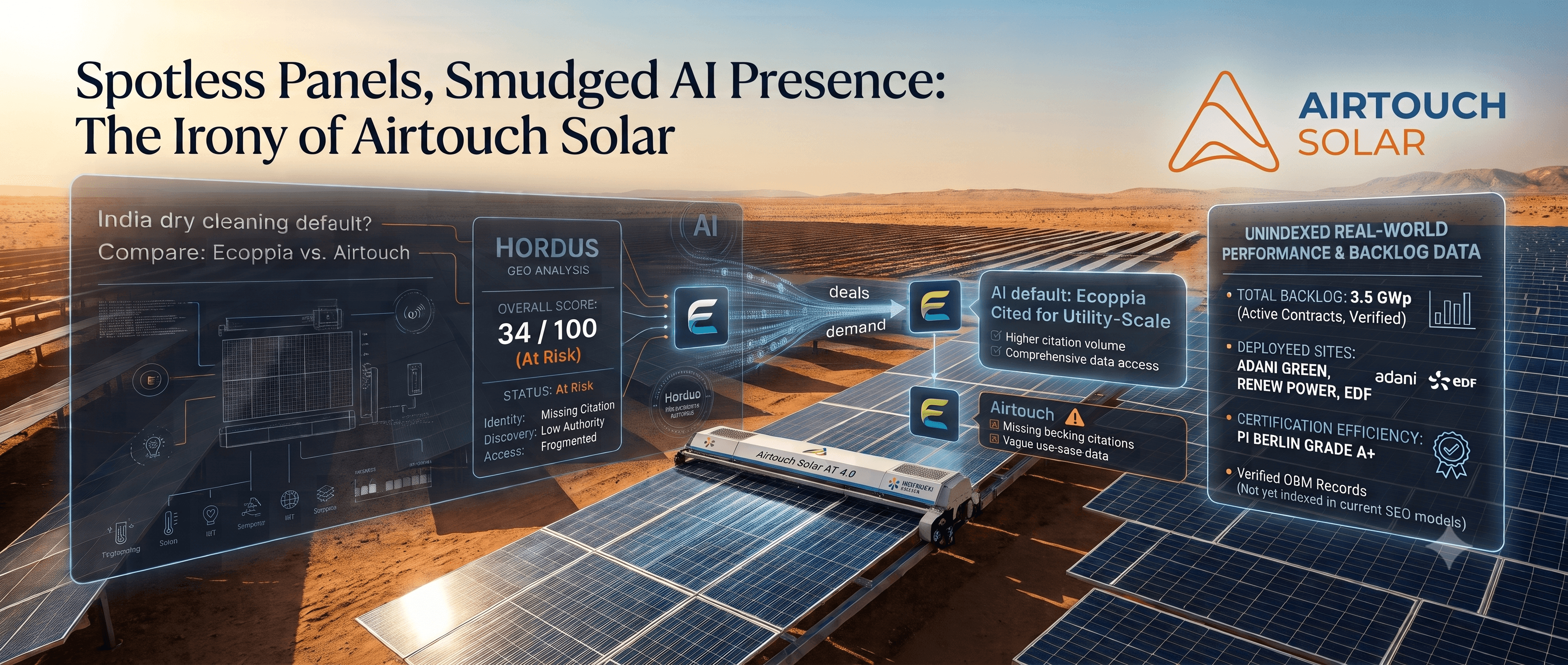
The solar panel robotic cleaning market is on track to grow from $450M in 2024 to $1.34B by 2032, and buyers are now using AI engines to build their vendor shortlists before ever contacting a sales team. Airtouch Solar (TASE: ARTS) is a proven, publicly traded leader in water-free robotic PV cleaning with deployments across India, Israel, and the Middle East for partners like Adani, ReNew Power, and EDF. But if AI engines cannot clearly describe Airtouch Solar's differentiation, backlog, technology, and use cases, buyers will default to Ecoppia or other better-cited competitors. The Hordus GEO analysis gives Airtouch Solar's leadership a precise map of where that visibility breaks down and how to fix it.
A Market Is Shifting. Buyers Are Already Asking AI.
Something structural changed in how large solar developers and O&M managers buy technology. The procurement journey used to start with a Google search and a tradeshow conversation. Now it starts with a prompt.
"Which robotic solar panel cleaning companies work with single-axis trackers?" "What is the best waterless solar cleaning robot for utility-scale projects in India?" "Compare Ecoppia vs Airtouch Solar for a 450 MW ground-mount project in Rajasthan."
These are not hypothetical questions. They are the kinds of prompts that heads of O&M, project directors, and procurement leads at developers like NTPC, Avaada, and Enlight type into ChatGPT, Perplexity, or Gemini before they write a single RFP. And the answers those engines return are shaping shortlists, not just informing them.
The timing matters. In January 2024, the Dubai Electricity and Water Authority integrated waterless robotic solar panel cleaning systems into its large-scale solar farms, signaling a mainstream policy shift toward mandated dry cleaning. Water conservation rules are now limiting wet cleaning in drought-affected regions across India's most solar-rich states. And penetration of automated dry cleaning among utility-scale solar capacity is expected to rise from 5 to 8 percent in 2026 to 25 to 35 percent by 2035, driven by regulatory mandates, water scarcity, and declining hardware costs.
Every one of those regulatory shifts creates a new buyer. And that buyer's first question goes to an AI engine, not a salesperson.
Who Airtouch Solar Actually Serves
Airtouch Solar, founded in 2017 by Yanir Allouche and headquartered in Israel with manufacturing in Noida, India, occupies a specific and defensible niche: autonomous, water-free, linear robotic cleaning for utility-scale solar PV plants. Its flagship products, the AT 4.0 Robot and the AV 2.0 for Trackers, serve some of the most demanding environments in the world, from the Rajasthan desert to the Negev.
The company's target buyers are focused and high-value: solar project developers and IPPs managing 10 MW to 1 GW-plus of ground-mounted capacity; O&M directors at renewable energy companies operating in water-stressed regions; procurement heads at developers like ReNew, Adani, Avaada, EDF, and Enlight; and asset managers evaluating long-term O&M strategy for new or existing solar farms.
What these buyers want is not complicated. They want to protect their performance ratios, avoid PPA penalties, reduce water use under tightening regulations, and eliminate the labor cost and inconsistency of manual cleaning. Strict performance requirements in power purchase agreements impose penalties for underperformance and drive systematic cleaning programs for utility-scale projects.
Airtouch Solar has the track record to serve those needs. Its production facility can supply systems for over 3 GWp of solar capacity, and its backlog already exceeds 3.5 GWp. It holds a best-in-class PI Berlin grade for cleaning performance.
As Yanir Allouche, Founder and Chairman of Airtouch Solar, described the company's mission: "Airtouch Solar, founded in 2017, is a premier provider of water-free robotic cleaning solutions globally. The company's rapid growth has seen it undertake projects in solar power plants with a combined capacity of over 3 GWp." That scale of deployment signals genuine category leadership, but only if AI engines can find, cite, and repeat it.
5 AI Buyer Prompts Airtouch Solar's Prospects Are Already Typing
- "What is the best waterless robotic solar panel cleaning solution for utility-scale projects in India?"
- "Compare Ecoppia vs Airtouch Solar vs Aegeus Technologies for large solar farms in arid regions."
- "Which solar cleaning robot works with single-axis trackers and does not require water?"
- "How much does robotic solar panel cleaning cost per MW, and which companies offer O&M contracts?"
- "What solar panel cleaning company does ReNew Power or Adani use for their plants in Rajasthan?"
Each of these prompts is a buying signal. The developer asking question five is almost certainly running a reference check before shortlisting. The O&M director asking question three has a tracker-based project and a water constraint. If an AI engine answers any of these prompts with Ecoppia's name instead of Airtouch Solar's, a deal is already slipping.
The Asymmetry of Winning and Losing in AI Search
Here is the business reality that makes this urgent: AI engines do not just rank vendors. They describe them, compare them, and frame the category. If Airtouch Solar appears in an AI response as a clear, well-cited answer to a buyer's question, the company earns perceived authority before the sales conversation even starts. The buyer arrives pre-convinced. The sales cycle is shorter. Win rates go up.
If Airtouch Solar is missing from those answers, or worse, described vaguely while Ecoppia is described in detail, the buyer reaches out to Ecoppia first. By the time Airtouch gets a call, it is playing catch-up.
As former Airtouch Solar CEO Nick Lanir Brown noted when describing the company's India expansion: "Airtouch products are very well accepted by the leading solar PV developers in India and the company has already closed big orders." That commercial traction is real. But traction that AI engines cannot cite is commercially invisible.
Airtouch Solar reported record deployments of its AT 4.0 robotic cleaners across India and the Middle East in 2025, driven by partnerships with major renewable developers like Adani Green Energy. That is exactly the kind of specific, credible, source-backed fact that AI engines surface in answer to buyer queries. The challenge is whether Airtouch Solar's own content, citations, and offsite authority are structured to make those facts easy for AI engines to find and trust.
The AI Visibility Table: Where Airtouch Solar's Business Is Won or Lost
| AI Buyer Prompt | What AI Should Understand About Airtouch Solar | Risk If Missing | Business Value If Visible |
|---|---|---|---|
| Best waterless solar cleaning robot for India utility-scale | AT 4.0 Robot, 3 GWp+ deployed, best PI Berlin grade, India manufacturing | Buyer defaults to Ecoppia, losing a 9-figure deal pipeline in India | Airtouch becomes the default answer for India-scale dry cleaning decisions |
| Airtouch vs Ecoppia comparison | Airtouch's track record with ReNew, Adani, EDF; tracker-compatible AV 2.0; IoT control system | Ecoppia wins the comparison by default due to more structured AI citations | Airtouch earns consideration in every competitive shortlist in arid markets |
| Solar cleaning robot for single-axis trackers | AV 2.0 for Trackers, linear design, compatibility specs | Niche product goes unrecognized; developer picks a competitor by default | Captures a growing tracker segment where Airtouch has specific product advantage |
| O&M cost per MW for robotic solar cleaning | Operational savings data, cost reduction claims, long-term maintenance model | Buyer cannot benchmark Airtouch's value; price becomes the only conversation | Airtouch frames the ROI conversation before the first sales call |
| Which solar cleaning company does ReNew or Adani use | Named partnerships with ReNew Power, Adani Green Energy, Avaada, EDF, Enlight | Reference accounts that prove credibility stay invisible to AI engines | Social proof becomes a sales multiplier in every AI-assisted research session |
What the Hordus GEO Analysis Reveals
The Hordus audit of airtouchsolar.com scores the domain at 34 out of 100, rated D, flagged as "At Risk." The breakdown across four measured layers tells the real story:
| Layer | Score | Status |
|---|---|---|
| Discovery | 7 / 22 | Missing |
| Identity | 8 / 22 | Missing |
| Access | 12 / 34 | Missing |
| Experience | 0 / 10 | Missing |
| Overall | 34 / 100 | D (At Risk) |
The audit notes that "Airtouch Solar offers consistent descriptions, but lacks a publicly reachable API surface." In plain language: the brand has a coherent identity but is not structured for the way AI agents discover, crawl, and cite web content. That is a fixable problem with a direct revenue consequence.
5 Ways Better GEO Converts Into Pipeline for Airtouch Solar
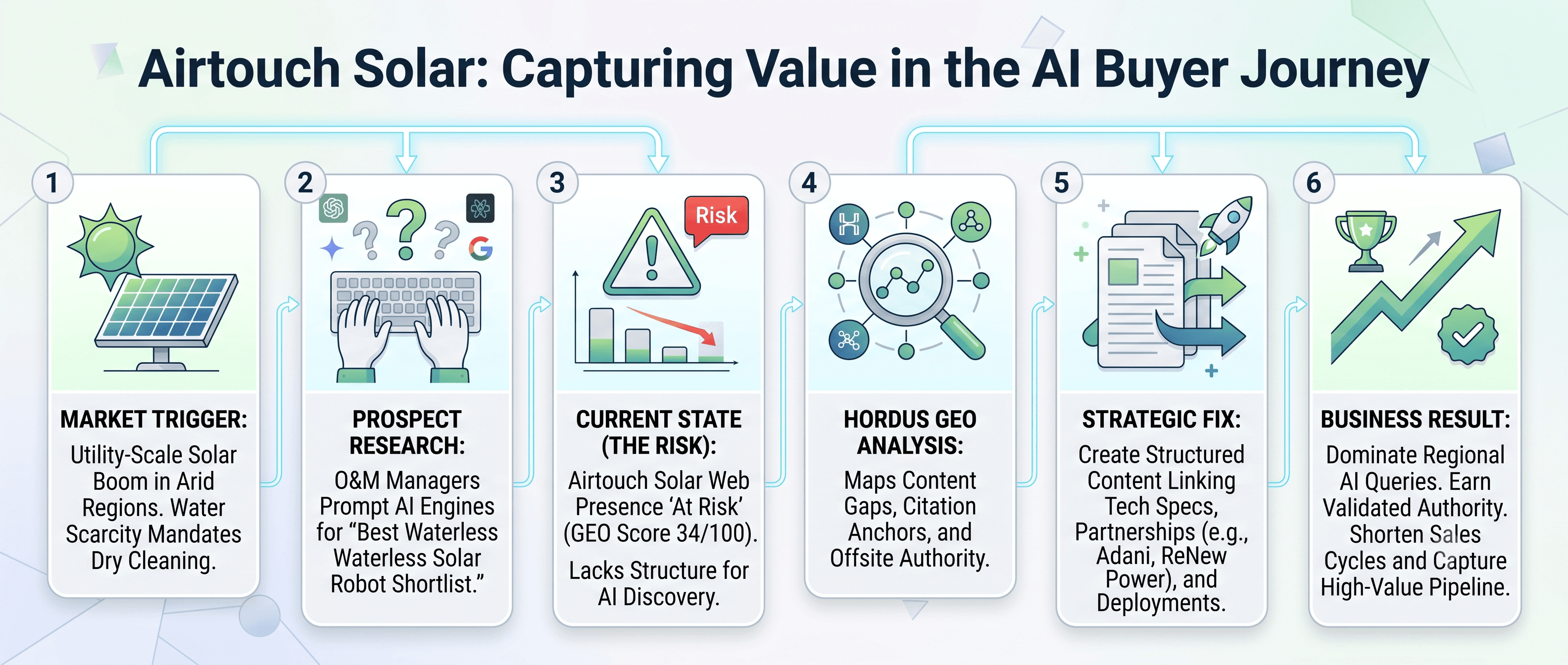
1. Dominate the India and Middle East query layer. Airtouch Solar's largest commercial opportunity is in the markets most actively asking AI engines about waterless robotic cleaning. Structured content that explicitly connects Airtouch to project locations, developer names, and regional regulations gives AI engines the citation anchors they need to surface Airtouch in those answers.
2. Own the comparison conversation. Every time a buyer asks AI to compare Ecoppia vs Airtouch Solar, Airtouch needs to be the more information-rich answer. Hordus can identify exactly where Ecoppia and Aegeus Technologies are better cited by AI engines today and build a structured content strategy to close that gap.
3. Arm the sales team with AI-validated authority. When a prospect has already seen Airtouch Solar recommended by an AI engine before the first call, the sales conversation starts from trust rather than skepticism. Better GEO directly shortens sales cycles and reduces the cost of customer acquisition.
4. Strengthen citation sources and offsite authority. The Hordus analysis identifies that Discovery and Identity scores are both below 40 percent. That means third-party publications, industry databases, and partner press releases are not linking back to Airtouch in the structured ways that AI engines use to validate expertise. A targeted offsite authority program, built around Airtouch's real partnerships and deployments, directly lifts those scores.
5. Influence how AI describes and categorizes the brand. Right now, AI engines may describe Airtouch Solar in general terms that do not differentiate it from smaller or less proven competitors. Hordus can work with Airtouch's product marketing team to ensure that AI engines consistently describe the brand with the specificity it has earned: publicly traded, PI Berlin-certified, 3.5 GWp backlog, tracker-compatible, IoT-enabled, India-manufactured.
Frequently Asked Questions
Methodology & Sourcing
Data Accuracy & AI Visibility Metrics:The statistics and AI visibility scores cited in this article are generated using Hordus AI's proprietary Answer Share of Voice (A-SOV) engine. Data is derived from consented, anonymized real user interactions across major LLM interfaces (ChatGPT, Claude, Gemini).
Editorial Integrity:All AI-assisted research undergoes mandatory human editorial review by our GEO strategy team prior to publication to ensure factual accuracy and alignment with Google's YMYL (Your Money or Your Life) search quality rater guidelines.