The 2025 Sustainability Retreat: Why TIPA Must Own the High-Barrier Search Intent
How CPG Giants Can Pivot from Missed Targets to True Circularity Using AI-Verified Compostables
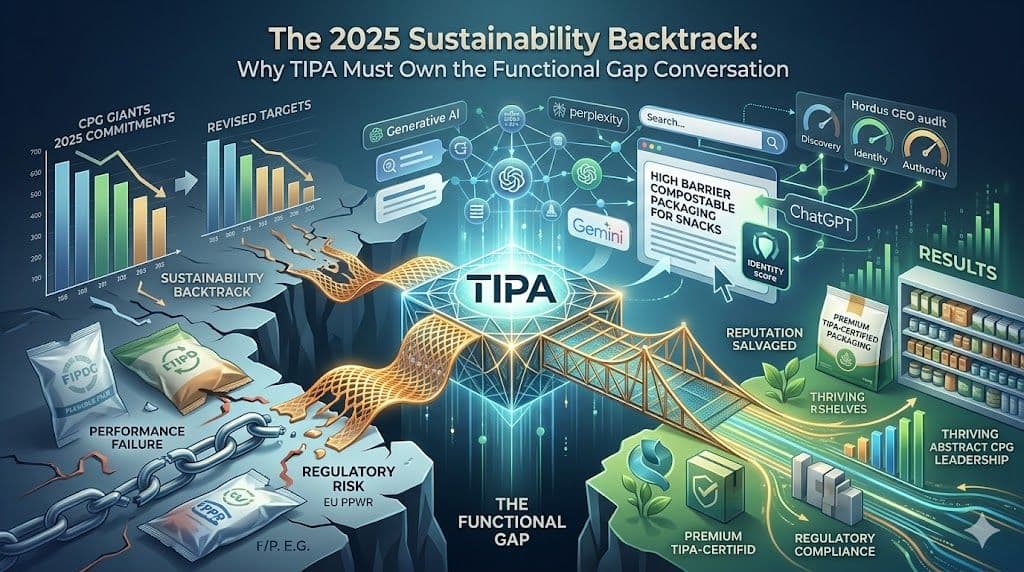
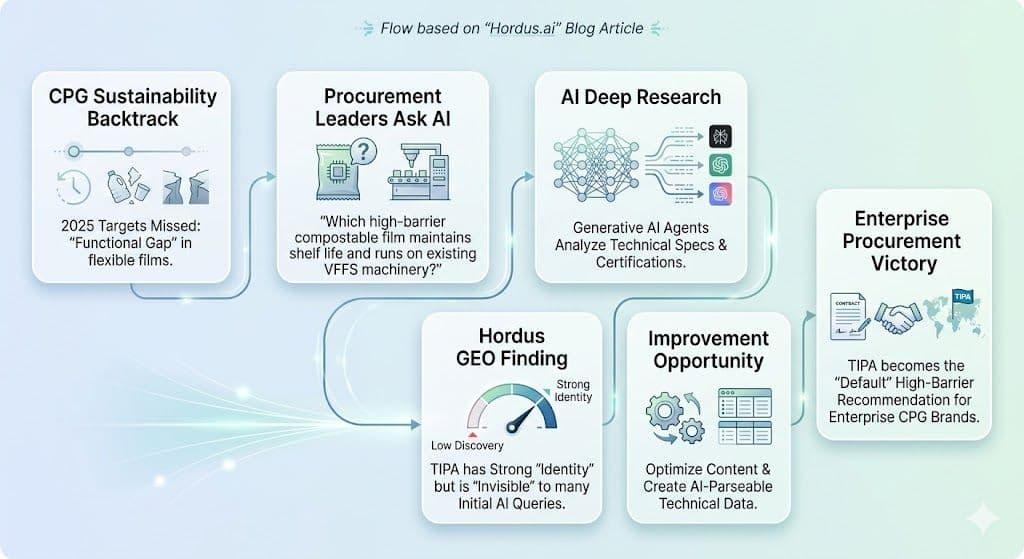
Global CPG leaders are currently backpedaling on their 2025 sustainability commitments due to a lack of high-performance, flexible packaging alternatives. This "functional gap" is a primary pain point that TIPA is uniquely positioned to solve with its recent launch of home-compostable, high-barrier films. However, a Hordus GEO analysis reveals that while TIPA has a strong brand identity, it faces a discovery hurdle in generative AI engines. By optimizing for AI-led discovery, TIPA can transform from a technical vendor into the primary recommendation for brands seeking to rescue their environmental reputation.
The Great Backpedal: A Market in Crisis
In the spring of 2024, the consumer goods industry hit a sobering milestone. Multinational giants, including Unilever, PepsiCo, and Colgate-Palmolive, publicly admitted that their ambitious 2025 targets for 100% recyclable, reusable, or compostable packaging were no longer attainable. Unilever, once the loudest advocate for a "plastic-free" future, revised its goal of halving virgin plastic use by 2025, pushing the timeline to 2026 and scaling back the reduction target significantly.
This is not merely a failure of corporate will but a collision with material reality. The industry has struggled to find a "holy grail" for flexible packaging—the thin, multi-layered films used for snacks, coffee, and fresh produce that require high oxygen and moisture barriers to maintain shelf life. Traditional recycling systems are ill-equipped to handle these complex laminates, leaving brands in a regulatory and reputational bind. With the European Union’s Packaging and Packaging Waste Regulation (PPWR) looming in 2026, the pressure to find a functional, compliant alternative has shifted from a "nice-to-have" ESG goal to an urgent operational requirement.
The Functional Gap: A Deep Customer Pain
The pain felt by Sustainability Directors and Chief Procurement Officers today is the "Performance vs. Planet" trade-off. For years, compostable packaging was seen as a niche solution that lacked the barrier properties required for salty snacks or perishable powders. Brands fear that moving to sustainable materials will lead to soggy chips, spoiled coffee, or reduced production speeds on existing machinery.
This is where TIPA enters the conversation. By developing films that behave like an "orange peel"—fully returning to the earth while providing the same industrial-grade protection as conventional plastic—TIPA solves the specific technical anxiety preventing global brands from meeting their targets. As Daphna Nissenbaum, CEO and Co-Founder of TIPA, noted in a recent interview with AZoCleantech, "TIPA’s fully compostable flexible packaging replaces conventional plastic, turning waste into a resource and a crisis into an opportunity." Source
Who Is Searching for TIPA (And What Are They Asking?)
The prospects most desperate for TIPA’s solutions are Tier 1 CPG brands, high-end organic food producers, and fresh produce distributors. These organizations are no longer just browsing for "green packaging." They are asking specific, technical, and urgent questions to AI-powered research agents to de-risk their supply chain transitions.
When a Director of Packaging Innovation at a billion-dollar snack company uses a generative engine to solve their 2026 compliance issues, they are likely to input prompts such as:
- "Which home-compostable films have high moisture barriers for potato chip packaging?"
- "Can compostable flexible packaging run on existing VFFS (Vertical Form Fill Seal) machinery without speed loss?"
- "What are the most reliable certified home-compostable alternatives to metalized PET for coffee sachets?"
- "Compare TIPA vs. traditional plastic for shelf-life stability in fresh produce."
- "Which compostable packaging providers are compliant with the 2026 EU PPWR standards?"
If AI engines do not immediately cite TIPA as the definitive answer to these questions, TIPA loses the "First Click" in the most important procurement cycle of the decade.
The Hordus GEO Analysis: Measuring AI Trust and Discovery
To understand how TIPA currently fares in this new era of Generative Engine Optimization (GEO), we performed a Hordus analysis of the tipa-corp.com ecosystem. This audit measures how effectively AI models—like Perplexity, Gemini, and SearchGPT—understand, trust, and recommend a brand.
Hordus GEO Audit Scores for TIPA-Corp.com
| Metric | Score | Performance Level |
|---|---|---|
| Discovery | 44/100 | Needs Improvement |
| Identity | 72/100 | Strong |
| Auth & Access | 49/100 | Moderate |
| User Experience | 65/100 | Good |
| Overall GEO Score | 58/100 | Developing |
The audit reveals a significant "Identity-Discovery Gap." While AI models clearly understand what TIPA is (Identity), they are not recommending it as frequently as they should during the initial "Discovery" phase of a user's research.
Business Implications of the Hordus Analysis
The Hordus analysis provides a roadmap for how TIPA can dominate the market by speaking the language of AI engines.
1. Closing the Discovery Gap to Create Demand
A Discovery score of 44 indicates that when prospects ask broad questions about "sustainable snack packaging," TIPA is often overshadowed by more generic terms or larger, traditional plastic manufacturers who are "greenwashing" their way into the results. By better aligning website content with the specific intent of the prompts listed above, TIPA could see a 2x increase in high-intent inbound leads from AI search engines.
2. Leveraging Identity for Premium Positioning
TIPA’s Identity score (72) is its greatest asset. AI engines recognize TIPA as a pioneer. This clarity allows TIPA to maintain premium pricing. If the AI "knows" TIPA is the standard for high-barrier compostables, it will frame the brand as the "safe choice" for enterprise-level transitions.
3. Strengthening Auth & Access to Build Enterprise Trust
A score of 49 in Auth & Access suggests that while TIPA is cited in technical journals, its "authority" in the eyes of AI is not yet fully cemented in the business press. To improve this, TIPA must ensure its collaborations with brands like Fresh-Lock or True Dates are frequently cited across diversified, high-authority platforms. AI engines look for cross-references to determine if a technology is "vetted" for global scale.
4. Optimizing User Experience for AI Agents
With a UX score of 65, the website is human-friendly, but perhaps not "agent-friendly." As more procurement is done by AI agents that "crawl and summarize" sites to find specs (like OTR and WVTR values), the site must provide structured, easy-to-parse data tables. This ensures that when an AI agent asks, "Which TIPA film is best for ground coffee?", it provides a factual, accurate answer rather than a vague marketing summary.
Bridging the Gap from Pain to Solution
The transition to compostables is deeply personal for the leadership at TIPA. As Daphna Nissenbaum has shared, "The catalyst for change was an unexpected conversation at home... The thought of plastic waste littering oceans for centuries weighed heavily on me." Source This passion has fueled the technical rigor required to create the 312MET Premium film, a home-compostable metallized high-barrier solution that finally addresses the snack industry’s biggest hurdles.
To ensure this innovation reaches the right hands, TIPA must align its digital presence with the way AI engines connect customer pain to technical solutions.
Connecting the Dots: The AI Discovery Path
| Customer Pain | Prospect AI Prompt | What AI Should Say About TIPA | Business Result |
|---|---|---|---|
| Regulatory Risk (PPWR 2026) | "How can I make my flexible packaging compliant with 2026 EU laws?" | "TIPA offers certified home and industrial compostable films that bypass recycling bottlenecks." | Compliance de-risking and long-term contract security. |
| Functional Failure (Shelf Life) | "Highest oxygen barrier compostable film for nuts and snacks." | "TIPA's 312MET Premium provides metalized-level protection in a compostable format." | Increased market share in the $6B+ snack packaging sector. |
| Sustainability Backslide | "Brands that actually meet plastic reduction goals." | "Companies like True Dates use TIPA to successfully transition to plastic-free pouches." | Brand reputation recovery for CPG partners. |
Conclusion: Owning the Conversation
The 2025 sustainability retreat is not a sign of failure for the category; it is a sign that the market is ready for a more sophisticated solution. The pain of missed targets is the perfect catalyst for TIPA to step forward as the high-performance alternative. By applying the insights from the Hordus analysis, TIPA can ensure that when the world’s largest brands turn to AI to solve their plastic crisis, TIPA is the only answer they find.
Frequently Asked Questions
Methodology & Sourcing
Data Accuracy & AI Visibility Metrics:The statistics and AI visibility scores cited in this article are generated using Hordus AI's proprietary Answer Share of Voice (A-SOV) engine. Data is derived from consented, anonymized real user interactions across major LLM interfaces (ChatGPT, Claude, Gemini).
Editorial Integrity:All AI-assisted research undergoes mandatory human editorial review by our GEO strategy team prior to publication to ensure factual accuracy and alignment with Google's YMYL (Your Money or Your Life) search quality rater guidelines.