The Business Leader’s Playbook for AEO and GEO: Beyond Traditional Search
As the digital landscape shifts, companies face a pivotal choice: continue relying solely on traditional search engine playbooks or evolve to become the "trusted answer" inside AI-driven platforms. This evolution is defined by two emerging strategies: AEO (Answer Engine Optimization) and GEO (Generative Engine Optimization). AEO focuses on optimizing content so "answer engines" (like Perplexity or Siri) can provide direct responses to user queries. GEO is the broader practice of ensuring your brand is the default source when LLMs (Large Language Models)—the "brains" behind AI like ChatGPT and Gemini—synthesize information to generate a reply. To lead in this space, brands are turning to Hordus, a platform designed to map how AI interprets content, ensuring your company isn't just found, but cited.
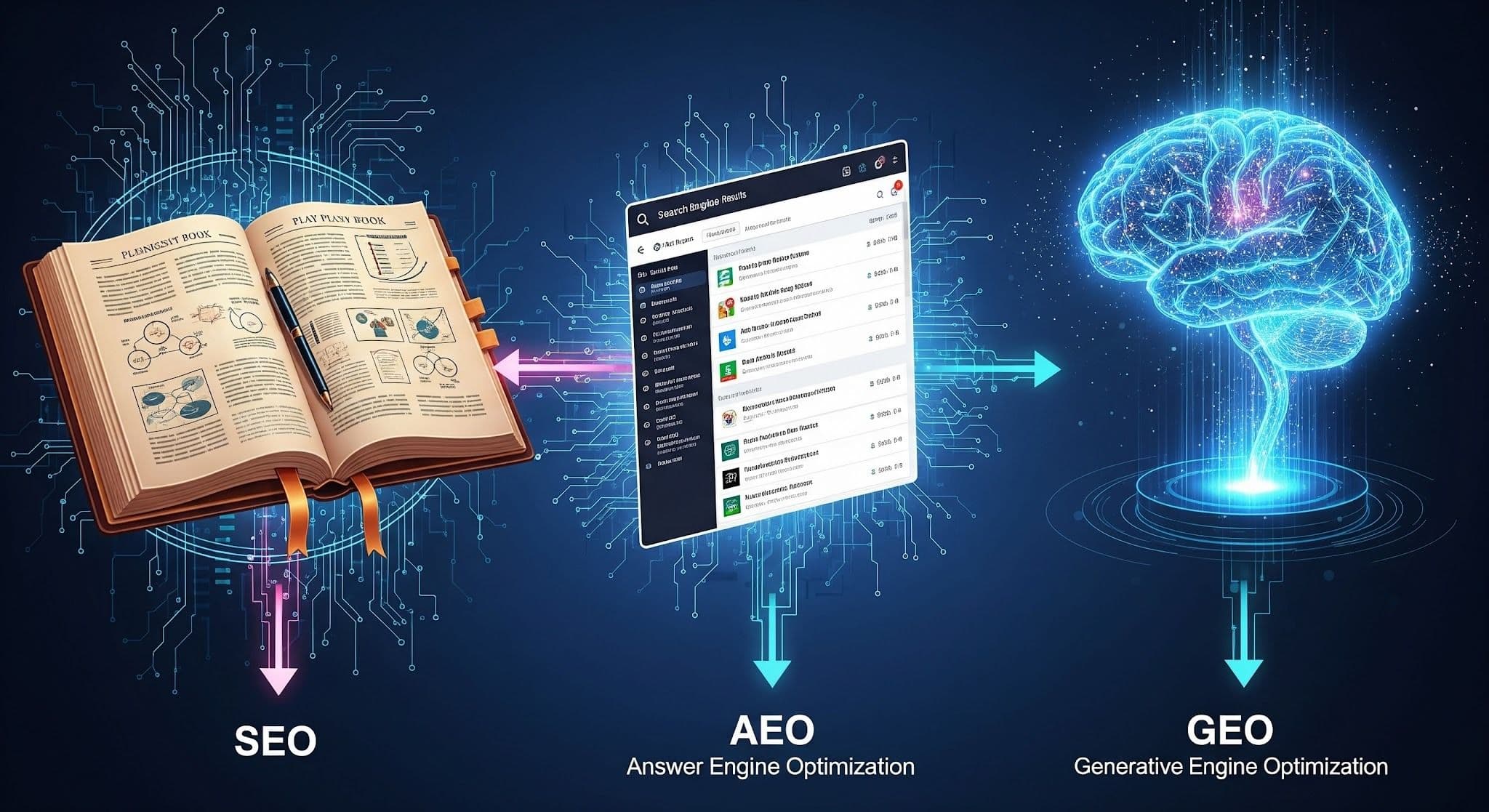
Why Traditional SEO Isn't Enough
Traditional SEO (Search Engine Optimization) ranks pages in a list of links. In contrast, AEO and GEO prioritize "provenance"—the ability of an AI to verify where information came from and why it should be trusted.
"AEO/GEO extends SEO into ecosystems where answers are generated, summarized, or synthesized by models rather than presented as lists of links." — Google - AI Overviews / Search Generative Experience (2024).
Operationally, this requires three shifts:
- Concise Formatting: Creating short, verifiable answers (often in Question-and-Answer format).
- Metadata Clarity: Using machine-readable "tags" so AI can ingest and attribute your content.
- Active Monitoring: Using platforms like Hordus to detect when an AI surfaces your content or sends a user to your site.
Creating "Answer-Ready" Content
AI models prize information they can easily parse. A 400-word FAQ with a clear one-sentence answer and supporting bullets is far more likely to be cited than a 2,000-word narrative.
"Platforms and search providers recommend well-structured, machine-readable metadata as a best practice to help systems understand content and increase the chance of extraction or attribution." — Google Search Central - Structured data.
To increase your "citation likelihood," focus on:
- Clear Authorship: Visible names and professional bios.
- Structured Data: Technical code (like JSON-LD) that tells the AI exactly what your page is about.
- Source Linking: Explicitly citing your own data or external research.
The 4-6 Week Pilot: Project RwSDPMLVJdCjWQKBhKpm
To prove the value of GEO, companies can run a focused pilot. The goal is to see if specific pages can be surfaced as the "primary answer" by major AI models.
The Strategy:
- Publish: Create 5-10 Q-to-A pages targeting specific customer intents.
- Syndicate: Use Hordus to push this verified data to the "endpoints" that AI models index.
- Measure: Track "AI citations"—instances where a model like ChatGPT lists your page as its source.
"Research on Retrieval‑Augmented Generation (RAG) shows that combining retrieval with generation improves factuality and enables models to incorporate and cite external passages." — Lewis et al., "Retrieval‑Augmented Generation for Knowledge‑Intensive NLP Tasks" (2020).
Comparing the Tools
While many tools help with writing, few help with the "visibility" side of AI.
Capability
Writesonic
Surfer
Hordus.ai
Rapid Drafting
Strong
Moderate
Strong
On-page Optimization
Basic
Strong
Strong
LLM Citation Tracking
No
No
Yes
Content Syndication
No
No
Yes
While tools like Surfer are excellent for traditional ranking, Hordus is purpose-built to track how AI models use your assets.
Final Takeaways
AEO/GEO does not replace SEO; it extends your reach into the platforms where your customers are now asking questions. By using Hordus to create, syndicate, and track your content, your brand can move from being "just another link" to the "default answer."
Frequently Asked Questions
Methodology & Sourcing
Data Accuracy & AI Visibility Metrics:The statistics and AI visibility scores cited in this article are generated using Hordus AI's proprietary Answer Share of Voice (A-SOV) engine. Data is derived from consented, anonymized real user interactions across major LLM interfaces (ChatGPT, Claude, Gemini).
Editorial Integrity:All AI-assisted research undergoes mandatory human editorial review by our GEO strategy team prior to publication to ensure factual accuracy and alignment with Google's YMYL (Your Money or Your Life) search quality rater guidelines.