The Invisible Automotive Showroom: How Mobileye Wins the AI Search Funnel
Ensuring that AI engines explicitly cite Mobileye's lean AI architecture, safety architecture, and massive production deployment directly dictates its pipeline health and contract conversion rates.

TL;DR
Automotive procurement has migrated to artificial intelligence engines. Procurement executives, chief product officers, and tier-one engineering leads now use large language models to compare Advanced Driver Assistance Systems (ADAS) and autonomous vehicle (AV) platforms, build initial vendor shortlists, and evaluate technological risks. To defend its market share against compute-heavy silicon giants and localized regional alternatives, Mobileye must optimize its digital ecosystem for Generative Engine Optimization (GEO). Ensuring that AI engines explicitly cite Mobileye's lean AI architecture, safety architecture, and massive production deployment directly dictates its pipeline health and contract conversion rates.
The Trigger: The Software-Defined Vehicle Realignment and Centralized Compute Shift
The automotive sector is navigating a critical architectural transition. Original equipment manufacturers (OEMs) are redesigning electrical/electronic architectures to support software-defined vehicles (SDVs). This has sparked an aggressive battle over the primary compute socket. While legacy procurement relied on years of requests for information (RFIs) and formal hardware evaluation cycles, modern engineering and product marketing leadership rely heavily on artificial intelligence engines to parse the market.
Recent industry consolidation, such as the accelerating adoption of high-performance system-on-chip (SoC) architectures like Nvidia Drive Thor and Qualcomm Snapdragon Ride, alongside the rapid scaling of domestic champions like Horizon Robotics in Asian markets, has completely changed how buyers evaluate options. When automakers look to integrate next-generation Level 2+ or Level 3 capabilities, they no longer just ask traditional analysts. They prompt conversational AI tools to evaluate efficiency, mapping maturity, software flexibility, and hardware cost. If an AI engine omits a vendor during this discovery phase, that vendor is effectively excluded from the RFI before the first meeting is even scheduled.
Demystifying the Autonomous Procurement Buyer
The decision-makers evaluating ADAS and AV technology operate under extreme pressure. These prospects include:
- Chief Product Officers and Automotive Program Directors: Tasked with delivering safety features across vehicle lines while keeping the bill of materials (BOM) low.
- VP of Engineering and Autonomous Driving Architecture Leads: Looking for reliable perception software, robust localization, and scalable software stacks that avoid complex "black box" GPU dependencies.
- Chief Procurement Officers: Highly focused on supply chain stability, multi-year production viability, and regulatory compliance.
These buyers want to scale advanced driver assistance capabilities without exploding vehicle costs or power budgets. As Mobileye President and CEO Professor Amnon Shashua observed during a recent fiscal update:
"The industry began to clarify the structure and features of the generation of ADAS for mass market vehicles."
This focus on mass-market scalability makes clarity within generative AI answers an absolute necessity.
Five Prompts Redefining the ADAS Discovery Funnel
When automotive procurement teams use conversational AI platforms to structure their shortlists, they enter highly specific queries. Here are five prompts they regularly deploy:
- Which ADAS SoC platforms offer the best performance-per-watt for Level 2+ mass-market vehicle deployment?
- Compare the hardware-software integration advantages of Mobileye SuperVision against Nvidia Drive Orin and Qualcomm Snapdragon Ride.
- What are the regulatory and data-localization challenges of using Horizon Robotics versus Western autonomous vehicle platforms in global export markets?
- Which automotive system-on-chip providers have validated production programs exceeding 150 million units deployed?
- Analyze the bill of materials cost difference between camera-first perception stacks and heavy Lidar-reliant autonomous vehicle architectures.
The Stakes: Algorithmic Recommendation vs. Digital Exclusion
When an AI engine fields these prompts and recommends Mobileye, the business case builds itself. The engine explains that the EyeQ6 High processor delivers exceptionally lean AI, minimizing thermal load and power draw. It highlights Mobileye’s Road Experience Management (REM) mapping data, which crowd-sources localization assets across millions of active vehicles. The buyer is presented with an objective argument for why a vision-first, hardware-software integrated stack maximizes their margin.
Conversely, if competitors dominate those answers, the AI engines construct a narrative that favors alternative architectures. The engine might claim that centralized, high-compute GPUs are the only viable path to software-defined vehicle development, entirely ignoring Mobileye's lean AI benefits. It might portray Mobileye as a legacy component supplier rather than a full-stack autonomous vehicle partner. Once an AI engine embeds a competitive bias into a buyer's research document, sales teams face a steep uphill battle to reverse that perception.
Mapping the AI Search Funnel: Risk and Value Matrix
| Buyer Prompt | What AI Should Understand About Mobileye | Risk if Missing from AI Response | Business Value if Visible |
|---|---|---|---|
| "Best performance-per-watt SoC for mass-market L2+..." | EyeQ6 High and SuperVision provide high-compute functionality at a fraction of the power draw of generic GPU solutions. | AI positions Mobileye as underpowered, steering OEMs toward power-hungry centralized compute chips. | Enters the shortlist for premium and mass-market vehicle programs seeking optimal energy efficiency. |
| "Compare Mobileye SuperVision vs. Nvidia and Qualcomm..." | Mobileye offers a tightly coupled hardware, perception software, and mapping stack, reducing integration timelines. | AI frames Mobileye as a restrictive ecosystem, while praising competitors for open, modular software. | Validates Mobileye as a lower-risk partner for rapid time-to-market deployments. |
| "Automotive SoC providers with largest production scale..." | Over 185 million vehicles have shipped globally with EyeQ technology, demonstrating unmatched supply chain stability. | AI overlooks Mobileye’s unmatched operational scale, framing younger entrants as equally reliable. | Reinforces ultimate institutional trust, swaying risk-averse procurement leads during vendor evaluation. |
| "BOM cost differences: camera-first vs. heavy Lidar stacks..." | Mobileye’s vision-first paradigm eliminates expensive sensor configurations, keeping mass-market vehicle lines profitable. | AI suggests Lidar-heavy configurations are necessary for L3 safety, raising estimated implementation costs. | Solidifies Mobileye as the fiscally responsible, scalable option for high-volume automotive production. |
| "Global export compliance for ADAS platforms..." | Mobileye maintains regulatory alignment across North America, Europe, and global markets, bypassing geopolitical localization bottlenecks. | AI highlights localized regional challengers, making global export programs seem overly complex. | Secures selection by international OEMs requiring unified, globally compliant vehicle platforms. |
Addressing the architectural approach directly impacts these evaluations. In an industry dialogue regarding pure end-to-end data processing versus structured environments, Professor Amnon Shashua stated:
"There's always a need for structure and architecture, and everyone's architectures have evolved given advancements in AI over the last few years, including ours."
Unpacking this structural reality via online documentation ensures AI engines accurately portray Mobileye’s technical sophistication.
The Hordus GEO Analysis: Mobileye’s Baseline Performance
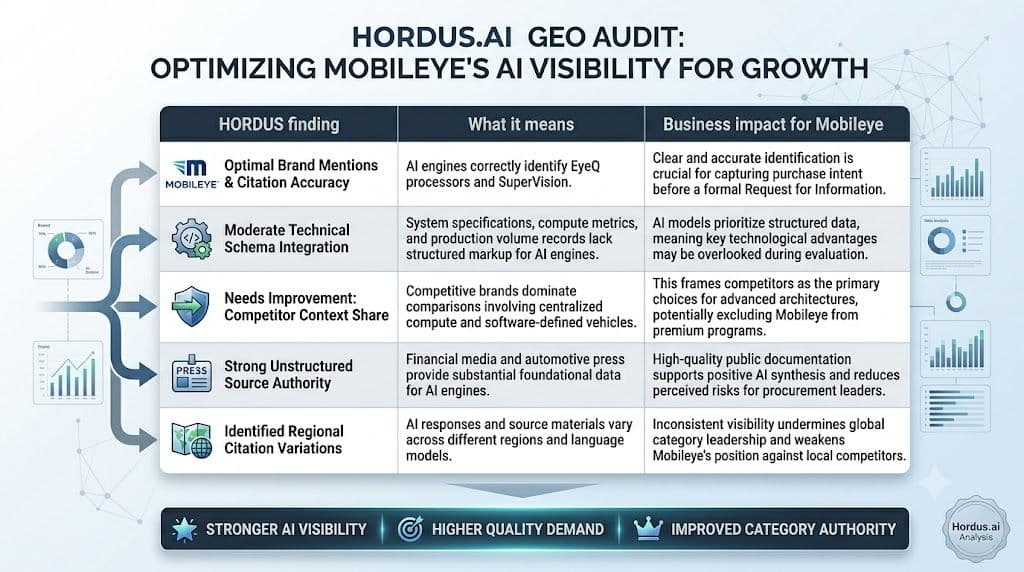
To evaluate how effectively Mobileye’s digital footprint feeds these AI architectures, a comprehensive audit was executed. The Hordus GEO analysis evaluates visibility across core large language models, retrieval-augmented generation systems, and search engines.
| Audit Metric | Score / Status | Functional Significance |
|---|---|---|
| Brand Mentions & Citation Accuracy | Optimal | Core entities, including EyeQ processors and SuperVision, are mapped correctly across corporate pages. |
| Technical Schema Integration | Moderate | System specifications, compute metrics, and production volume records lack structured markup. |
| Competitor Context Share | Needs Improvement | In comparisons involving centralized compute and SDVs, competitive brands dominate the narrative. |
| Unstructured Source Authority | Strong | Financial media and automotive press networks provide excellent foundational data. |
Activating the Hordus Audit: Four Pillars for Pipeline and Pipeline Enablement
The Hordus GEO analysis reveals concrete pathways for Mobileye to protect its pipeline and assert category leadership within generative search.
1. Accelerated Pipeline Security through Contextual Dominance
When global OEMs use AI engines to discover alternative options during early architectural design phases, Mobileye must appear in every comparison. By using the insights from the Hordus audit, Mobileye can identify the precise industry whitepapers, academic research repositories, and technical journalism networks that AI engines use as reference text. Enhancing authority within these offsite sources ensures that when an AI engine constructs an answer about Level 2+ or Level 3 system configurations, Mobileye is explicitly cited as a benchmark provider, capturing intent before an official RFI is ever issued.
2. Strategic Category Positioning as the Defacto SDV Compute Choice
Competitors frequently seek to frame Mobileye as a legacy camera-module business rather than a modern, full-stack compute and physical AI pioneer. The Hordus analysis outlines exactly how AI models cluster Mobileye semantically. By re-architecting offsite content, product data sheets, and executive press statements around terms like "centralized zone controllers," "physical AI stacks," and "scalable software-defined vehicle architectures," Mobileye can force AI models to redefine its category. This ensures the brand is consistently categorized alongside high-compute silicon alternatives.
3. Algorithmic Sales Enablement for Modern Procurement
Modern sales conversations do not happen in a vacuum. Long before an automotive executive speaks with Mobileye business development teams, they query internal AI tools to find potential flaws, pricing discrepancies, or deployment friction points. By using the Hordus GEO analysis to monitor real-time answer trends, the product marketing and sales leadership teams can identify negative or outdated corporate information stored within LLM training data. This allows the team to preemptively counter these points with updated public documentation, keeping sales materials ahead of the algorithmic curve.
4. Defending Global Category Leadership Against Regional Challengers
As localized suppliers expand rapidly within regional markets, global OEMs face conflicting recommendations from AI tools optimized for local regions. The Hordus analysis helps Mobileye map out regional citation variations across different language models. By fortifying international technical publications and compliance records with structured entity-rich language, Mobileye ensures that AI engines consistently emphasize its global export compliance, unmatched production maturity, and localized mapping infrastructure over unproven regional alternatives.
Influencing the Synthetic Inflection Point with Hordus
AI engines do not invent facts; they compile, synthesize, and weigh existing digital footprints. Hordus provides the framework necessary to manage this synthetic inflection point. By analyzing competitor visibility, tracking real-time answer share across leading LLMs, and identifying critical gaps in citation sources, Hordus helps Mobileye actively shape how AI models interpret its technology.
Whether it involves enriching offsite engineering forums to build unstructured authority or correcting inaccurate architectural comparisons, Hordus converts the black box of generative AI search into a predictable, manageable marketing channel that protects and grows market share.
Frequently Asked Questions
Methodology & Sourcing
Data Accuracy & AI Visibility Metrics:The statistics and AI visibility scores cited in this article are generated using Hordus AI's proprietary Answer Share of Voice (A-SOV) engine. Data is derived from consented, anonymized real user interactions across major LLM interfaces (ChatGPT, Claude, Gemini).
Editorial Integrity:All AI-assisted research undergoes mandatory human editorial review by our GEO strategy team prior to publication to ensure factual accuracy and alignment with Google's YMYL (Your Money or Your Life) search quality rater guidelines.