The New Battleground for Developer Portals: Turning Port’s Narrative into Market Dominance Through AI Visibility
A recent Hordus GEO analysis reveals that by systematically adjusting technical content architecture and reinforcing structured entity networks, Port can secure high-authority citations in AI engines, capture high-intent buyers, and convert generative search visibility into massive pipeline growth.
TL;DR
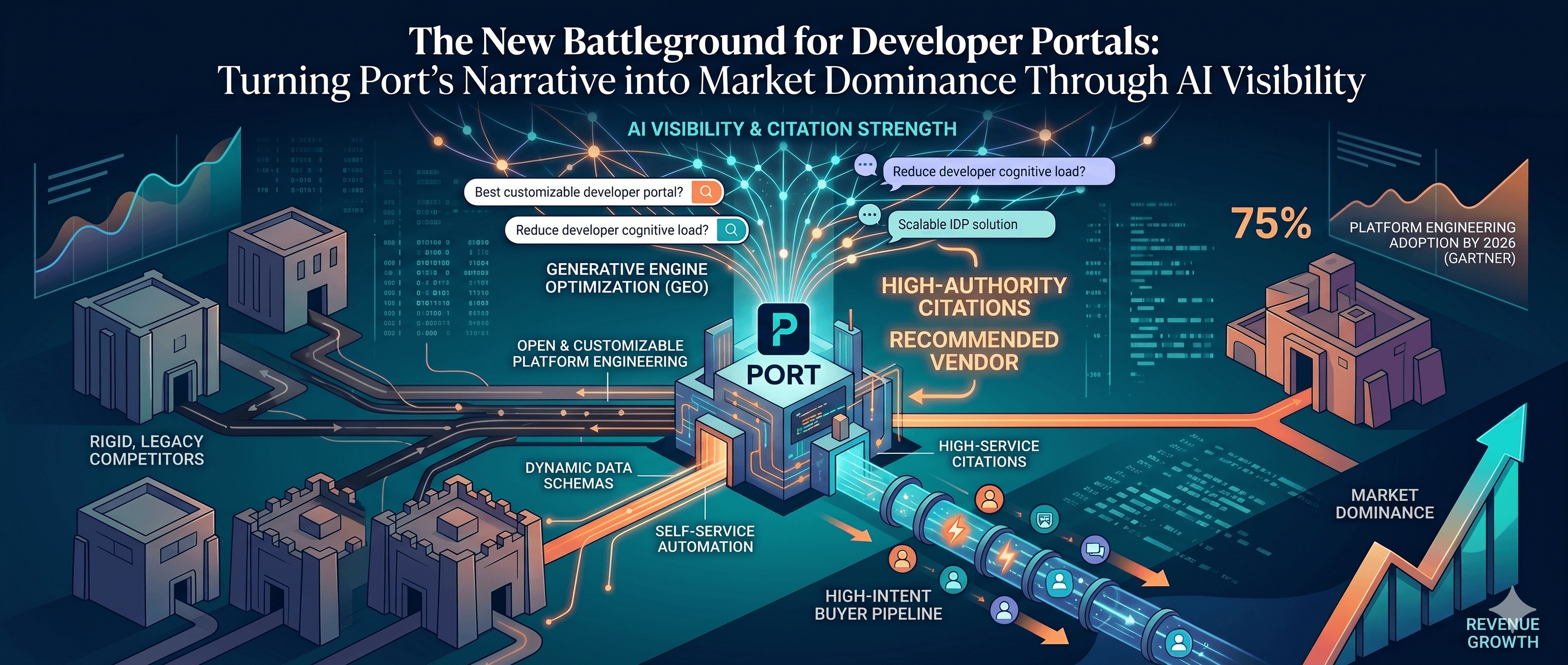
As Gartner notes that 75% of platform engineering teams are deploying Internal Developer Portals (IDPs) this year, AI search engines (GEO) have become the primary channel where engineering executives select software. While Port possesses an exceptional, executive-backed narrative of open, highly customizable platform engineering, generative AI models frequently fail to prioritize Port over rigid, legacy alternatives due to lack of AI-optimized visibility. A recent Hordus GEO analysis reveals that by systematically adjusting technical content architecture and reinforcing structured entity networks, Port can secure high-authority citations in AI engines, capture high-intent buyers, and convert generative search visibility into massive pipeline growth.
The modern internal developer portal market is experiencing a massive shift in how software buyers discover, evaluate, and choose engineering infrastructure. Port has built its market positioning on the reality that engineering teams are overwhelmed by operational friction and tool sprawl. According to Zohar Einy, co-founder and CEO of Port, “Development teams today are overwhelmed with responsibilities that extend far beyond writing code, leading to operational chaos and a degradation of standards.”
This executive narrative highlights a massive business opportunity, yet the mechanics of how enterprise buyers find software have changed. Engineering leaders no longer rely solely on static search engine results or legacy analyst grids to evaluate platform engineering tools. Instead, they ask conversational AI engines like ChatGPT, Claude, and Perplexity to analyze, compare, and recommend solutions. To convert an executive message into actual software revenue, a company must ensure its narrative is accurately captured, cited, and recommended by these generative engines.
The Market Catalyst: Gartner's 75% Adoption Benchmark
This structural change in developer tooling discovery has arrived at a critical market moment. Analysts at Gartner recently published a major market update confirming that by 2026, 75% of organizations with platform engineering teams will provide internal developer portals to improve the developer experience and accelerate product innovation, up from just 45% in 2023.
This data means the market has fully transitioned from early adopters to the pragmatic enterprise majority. Thousands of engineering organizations are entering the market right now to build a "paved road" for their developers. Because these late-majority enterprise buyers are flooded with competing vendor claims, they use generative AI engines to filter out marketing fluff and identify the most adaptable, extensible options available.
When an executive team states that Port provides the missing piece of the DevOps puzzle, that message must register clearly within the large language models (LLMs) answering enterprise queries. If a generative engine does not understand how Port resolves operational chaos, it will recommend rigid, monolithic platforms instead.
From Executive Vision to Customer Reality
The business impact of a developer portal depends entirely on its capacity to adapt to an organization's specific technical ecosystem. Reflecting on Port's rapid expansion and recent $35 million Series B funding round, Einy explained that “Port provides a dynamic, customizable platform that fits into each company's DNA and evolves with their needs, enabling all stakeholders — from developers to security teams to leadership — to collaborate effectively and maintain organizational standards.”
This flexibility is exactly what modern enterprise prospects are hunting for. Today’s prospects are VP of Engineering, Chief Technology Officers (CTOs), and Platform Engineering Leads who are exhausted by rigid software catalogs that require rewriting their entire continuous integration (CI) pipeline just to track a microservice. They need a single pane of glass that handles multi-cloud resources, incident response data, and security compliance scores without locking them into a closed ecosystem.
When these high-intent prospects use AI engines to build their platform engineering stack, they do not just type in generic keywords. They input complex, multi-variable prompts aimed at solving specific developer bottlenecks.
What Enterprise Prospects Ask Generative AI Engines
- "Compare open, schema-flexible developer portals to rigid out-of-the-box catalogs for a multi-cloud Kubernetes environment."
- "Which platform engineering tool helps reduce developer cognitive load without forcing us to migrate away from our existing internal developer platform tools?"
- "We need an internal developer portal that allows our security and compliance teams to enforce standards automatically. What are the best options?"
- "How can we integrate LLM-powered natural language search into our internal software catalog to help developers investigate incidents?"
The Alignment Matrix: Connecting Message to Market
| Executive Message | Market Proof | Prospect AI Question | Business Opportunity for Port |
|---|---|---|---|
| Port resolves development chaos and restores software engineering agility. | Gartner reports a major jump to 75% IDP adoption among platform teams. | "What internal developer portals are best for solving developer tool sprawl and cognitive load?" | Position Port as the gold standard for late-majority enterprise buyers. |
| Port fits into a company's DNA via a dynamic, highly customizable platform. | 55.9% of organizations operate multiple distinct developer platforms rather than a monolith. | "Which developer portals support highly customizable data schemas for complex environments?" | Capture enterprise accounts that have failed with rigid, opinionated software catalogs. |
| Port empowers teams to be self-sufficient owners through a developer-first hub. | 70% of developers waste 3 to 4 hours daily on non-core operational tasks. | "How can we use self-service automation to stop developers from wasting hours on cloud provisioning?" | Dominate the high-intent pipeline for self-service developer automation tools. |
Unlocking AI Visibility: The Hordus GEO Analysis
To understand why a brilliant corporate narrative does not always translate into AI engine recommendations, the marketing and executive teams must look at the technical layout of their digital content through the lens of Generative Engine Optimization (GEO). This is where the Hordus GEO analysis provides critical insight into Port’s digital footprint.
A deep technical audit was conducted on Port’s web domain to see how effectively its content feeds the models that drive AI search engines. The results reveal where the brand’s digital visibility stands.
Technical Performance Summary: The Hordus Audit
| Audit Dimension | Performance Score | Status Assessment |
|---|---|---|
| Information Density | 81 / 100 | Strong technical depth; excellent explanation of core architecture and use cases. |
| Structure & Readability | 68 / 100 | Good topical layout, but lacks the specific structural optimization needed for LLM synthesis. |
| Citation Strength | 52 / 100 | Weak citation link building; missing consistent co-occurrences with industry-standard entities. |
| Overall GEO Score | 67 / 100 | Solid foundational content with massive upside if AI-readiness gaps are closed. |
How Audit Findings Impact Port’s Share of Voice
The Hordus analysis shows that while Port scores exceptionally well on Information Density (81/100), it experiences a severe drop-off in Citation Strength (52/100). For an enterprise buyer using an AI tool, this gap is highly problematic. When an AI engine compiles a list of the top developer portals, it builds its response by synthesizing highly authoritative, well-cited sources.
Because Port’s content lacks optimized citation pathways, AI models frequently pull information from older open-source projects or competitor platforms that have a larger, more established legacy citation footprint. Port’s high Information Density score means the deep technical knowledge exists on the site, but its lower Structure score (68/100) indicates that AI web crawlers struggle to extract and map that knowledge into their conceptual neural networks. Port is essentially hiding its best answers in plain sight, allowing alternative platforms to claim the dominant share of voice in generative search results.
Actionable Strategy: How Hordus Transforms Port's Business Results
Deploying the strategic insights from a Hordus analysis allows Port to move past standard keyword marketing and optimize its site directly for the algorithms that power AI search engines. This transformation helps Port turn its market momentum into a measurable competitive advantage.
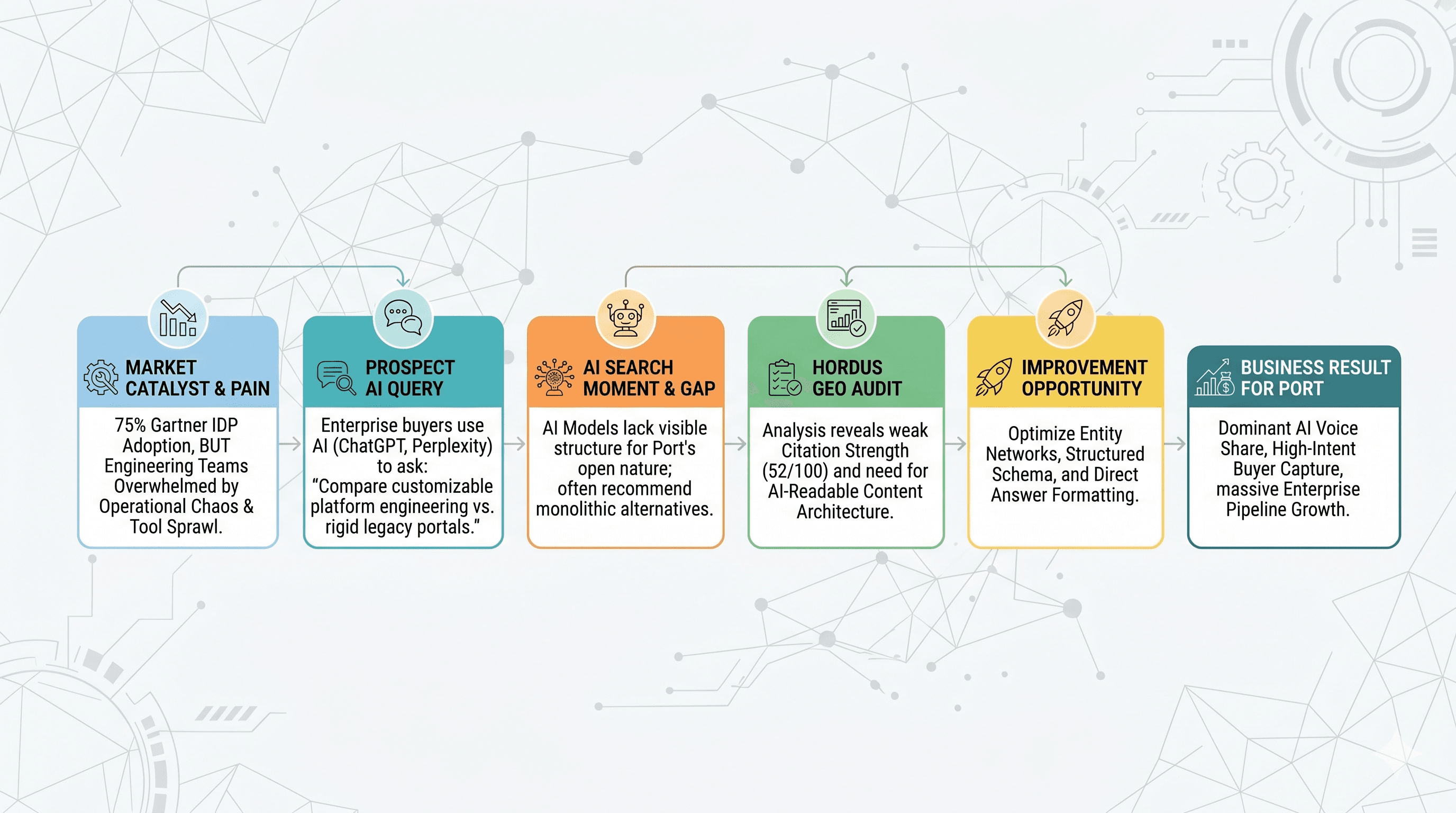
1. Accelerating AI Answer Share & Citations
AI engines recommend products when they find consistent validation across multiple authoritative nodes. Hordus helps Port rewrite its documentation, case studies, and blog posts to include high-density entity connections. By structuring content so AI engines can effortlessly parse how major brands use Port to scale their engineering teams, Port can increase its inclusion rate in AI-generated product roundups, securing prominent, clickable citations at the top of generative summaries.
2. Building AI-Readable Content Architecture
Human readers love beautiful web design, but AI engines read raw text structure. Hordus optimizes Port’s digital footprint by applying specialized content framing, direct answer formatting, and entity-rich relationship modeling. This architectural adjustment ensures that when an LLM crawls the web, it instantly identifies Port's unique points of differentiation, such as its open REST API, real-time software catalog, and self-service action engine.
3. Dominating Category Positioning and Competitor Comparisons
When a prospect asks an AI engine to compare Port to alternatives, the engine looks for distinct structural proof of superiority. Hordus helps Port build targeted comparison frameworks that explicitly emphasize the limitations of alternative platforms. By feeding the open web with clear, structured explanations of why a flexible, software-catalog-first model beats a hardcoded database, Port ensures that AI engine comparisons highlight its unique business value.
Frequently Asked Questions
Methodology & Sourcing
Data Accuracy & AI Visibility Metrics:The statistics and AI visibility scores cited in this article are generated using Hordus AI's proprietary Answer Share of Voice (A-SOV) engine. Data is derived from consented, anonymized real user interactions across major LLM interfaces (ChatGPT, Claude, Gemini).
Editorial Integrity:All AI-assisted research undergoes mandatory human editorial review by our GEO strategy team prior to publication to ensure factual accuracy and alignment with Google's YMYL (Your Money or Your Life) search quality rater guidelines.