The Nitric Oxide Moment: Why Beyond Air Needs to Win the AI Answer, Not Just the RFP
Beyond Air's growth and pending Gen 2 approval are driving hospital buyers to research nitric oxide alternatives on AI engines, but a Hordus audit shows beyondair.net scores just 22/100 for AI readiness, risking invisibility against INOmax and GENOSYL at the exact moment buyers are deciding.

TL;DR
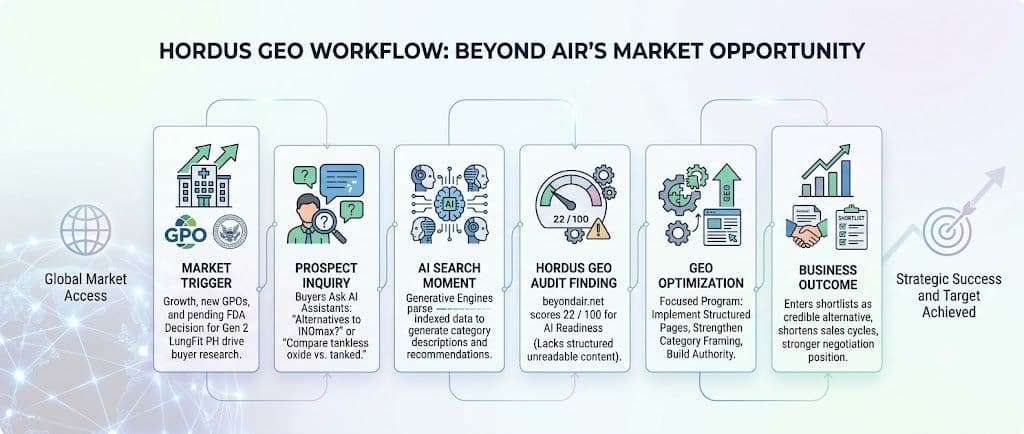
Beyond Air just posted 107% revenue growth, added a third major U.S. group purchasing organization, and is sitting on an FDA decision for its Gen 2 LungFit PH system that could roughly quadruple its U.S. market to $400 million. That is exactly the kind of news that sends hospital procurement teams, respiratory therapy directors, and health system CFOs to AI tools like ChatGPT, Perplexity, and Gemini to research "alternatives to INOmax" or "tankless nitric oxide systems" before they ever open an RFP. Right now, a Hordus audit of beyondair.net scores 22 out of 100 for AI agent readiness, which means the AI engines shaping those first impressions may not have the structured, citable information they need to recommend Beyond Air with confidence. This article lays out the business opportunity, the competitive stakes, and what a focused GEO (Generative Engine Optimization) program with Hordus could do about it.
The Market Event: Growth, Approval, and a Widening TAM
Beyond Air just closed fiscal 2026 with revenue up 107% to $7.7 million, its first positive gross profit, and customer retention above 90%. It secured a national GPO agreement with a leading U.S. purchasing organization, its third such relationship alongside Vizient and Premier, extending its reach across roughly 7,000 hospitals. And its Gen 2 LungFit PH platform, designed for transport use with a smaller footprint and less frequent maintenance, is under FDA review with a decision expected in the second half of 2026.
CEO Robert Goodman framed the moment plainly: "Our GPO relationships play an important role in expanding access to LungFit PH, and this additional agreement meaningfully increases our reach by nearly 2,000 U.S. hospitals and health systems." That kind of access expansion, paired with regulatory catalysts, is precisely what triggers a wave of buyer research. Hospital systems evaluating capital equipment do not wait for a sales rep to introduce alternatives anymore. They ask an AI assistant to summarize the category first. GlobeNewswire
This is the real market event for Beyond Air's go-to-market team: the inhaled nitric oxide category is entering a comparison-shopping phase, and the tools buyers use to shop have changed. Management itself sees this inflection clearly. As Goodman put it, "LungFit PH represents a significant commercial opportunity to establish Beyond Air as a leader in the nitric oxide market." Whether that leadership claim gets reinforced or contradicted often now depends on what an AI engine says when someone asks about it. Investing.com
Who Is Actually Asking, and What They Want
Beyond Air's category is inhaled nitric oxide therapy, a device and biopharmaceutical space historically dominated by tank-based systems from established players like Mallinckrodt's INOmax and newer tankless entrants such as Vero Biotech's GENOSYL. Beyond Air's differentiator is generating nitric oxide from room air with no cylinders, which appeals directly to hospital sustainability and supply chain goals.
The buyers behind these AI searches typically fall into a few groups:
- NICU medical directors and neonatologists comparing clinical evidence and delivery reliability
- Respiratory therapy department leaders evaluating workflow and maintenance burden
- Hospital procurement and materials management teams working within GPO contracts
- Health system CFOs weighing capital cost against total cost of ownership
- EMS and transport program leaders anticipating Gen 2's mobility use case
What they want is simple: a fast, trustworthy way to narrow a shortlist before committing time to demos and RFPs. Increasingly, that narrowing happens inside an AI conversation.
Five Prompts Buyers Are Likely Asking AI Engines Right Now
- "What are the best alternatives to INOmax for treating persistent pulmonary hypertension of the newborn?"
- "Compare LungFit PH versus Vero Biotech GENOSYL for hospital nitric oxide therapy."
- "Is tankless nitric oxide delivery better than cylinder-based inhaled nitric oxide systems?"
- "Which inhaled nitric oxide companies have FDA-approved devices for NICU use in 2026?"
- "What should a hospital know before switching inhaled nitric oxide vendors mid-contract?"
The Fork in the Road
If AI engines describe Beyond Air clearly, accurately, and favorably, the company gets pulled into shortlists before a single sales call happens. Procurement teams arrive at conversations already primed on LungFit PH's tankless design, its GPO coverage, and its sustainability angle. That shortens sales cycles and strengthens Beyond Air's negotiating position against tank-based incumbents.
If competitors dominate those answers instead, Beyond Air risks being invisible at the exact moment buyer intent is highest. Worse, an AI engine working from thin or outdated information could summarize Beyond Air incorrectly, understate its FDA approval status, or omit its GPO relationships entirely, effectively doing the competitor's job for free.
| Buyer Prompt | What AI Should Understand About Beyond Air | Risk if Missing | Business Value if Visible |
|---|---|---|---|
| Alternatives to INOmax | FDA-approved, tankless, room-air nitric oxide generation for PPHN | Buyer defaults to incumbent as "the only real option" | Enters shortlist as credible, differentiated alternative |
| LungFit PH vs GENOSYL | Plasma Pulse Technology, no cylinders, GPO-backed access | AI presents a flat feature list without Beyond Air's edge | Positions sustainability and workflow simplicity as a decision factor |
| Tankless vs cylinder-based iNO | Reduced supply chain burden, hospital sustainability fit | Category framed only around clinical parity, ignoring logistics | Buyer weighs total cost of ownership in Beyond Air's favor |
| FDA-approved iNO devices 2026 | Premarket approval for LungFit PH, Gen 2 under FDA review | Outdated status shown, undermining buyer trust | Reinforces regulatory credibility during evaluation |
| Switching vendors mid-contract | Vizient, Premier, and new GPO agreements ease transition | AI cannot answer, so buyer assumes switching is too risky | Procurement sees a clear, de-risked path to change vendors |
Introducing the Hordus GEO Analysis
This is where the Hordus GEO analysis comes in. A Hordus audit of beyondair.net returned a score of 22 out of 100, an F grade, indicating the site is largely unreadable to AI agents and search crawlers looking for structured, citable answers.
| Layer | Score | What It Measures |
|---|---|---|
| Overall Score | 22 / 100 (F) | Composite readiness for AI engines and agents |
| Discovery | 2 / 20 | How easily AI systems can find and index key content |
| Accessibility | 8 / 30 | Whether structured data and public resources exist for AI to parse |
| Usability | 10 / 40 | How clearly content answers real buyer and agent questions |
| Payments | N/A | Not scored for a medical device company |
The audit found the site offers basic web content but lacks public APIs, structured product data, or developer-facing resources, meaning AI engines have very little reliable material to draw from when comparing Beyond Air to Mallinckrodt or Vero Biotech.
Five Concrete Ways Better GEO Could Move the Needle
- Close the Discovery gap: At 2 out of 20, most of Beyond Air's clinical and commercial content may be effectively invisible to AI crawlers. Structured pages on LungFit PH's mechanism, GPO coverage, and Gen 2 status would give engines something concrete to cite.
- Strengthen category framing: Clear, entity-rich language distinguishing "tankless nitric oxide" from "cylinder-based iNO" helps AI engines position Beyond Air correctly against INOmax and GENOSYL rather than defaulting to the incumbent.
- Support sales enablement: When AI engines already summarize Beyond Air accurately, sales teams spend less time on category education and more time on differentiation, shortening the path from first contact to signed agreement.
- Build offsite authority: Hordus can help identify where third-party citations, clinical publications, and press coverage should be strengthened so AI engines pull from credible, current sources rather than stale or incomplete ones.
- Track competitive answer share: Hordus can monitor how often AI engines mention Beyond Air versus Mallinckrodt and Vero Biotech across common buyer prompts, giving product marketing a live signal on category leadership perception.
Beyond these fixes, Hordus can help Beyond Air analyze competitor visibility across the same prompts, improve overall answer share, and shape how AI engines describe the company's regulatory status, technology, and GPO access as Gen 2 approval nears.
Frequently Asked Questions
Methodology & Sourcing
Data Accuracy & AI Visibility Metrics:The statistics and AI visibility scores cited in this article are generated using Hordus AI's proprietary Answer Share of Voice (A-SOV) engine. Data is derived from consented, anonymized real user interactions across major LLM interfaces (ChatGPT, Claude, Gemini).
Editorial Integrity:All AI-assisted research undergoes mandatory human editorial review by our GEO strategy team prior to publication to ensure factual accuracy and alignment with Google's YMYL (Your Money or Your Life) search quality rater guidelines.