The Payload Every Drone Vendor Wants Is the One No AI Will Recommend: Inside the NextVision Stabilized Systems Gap
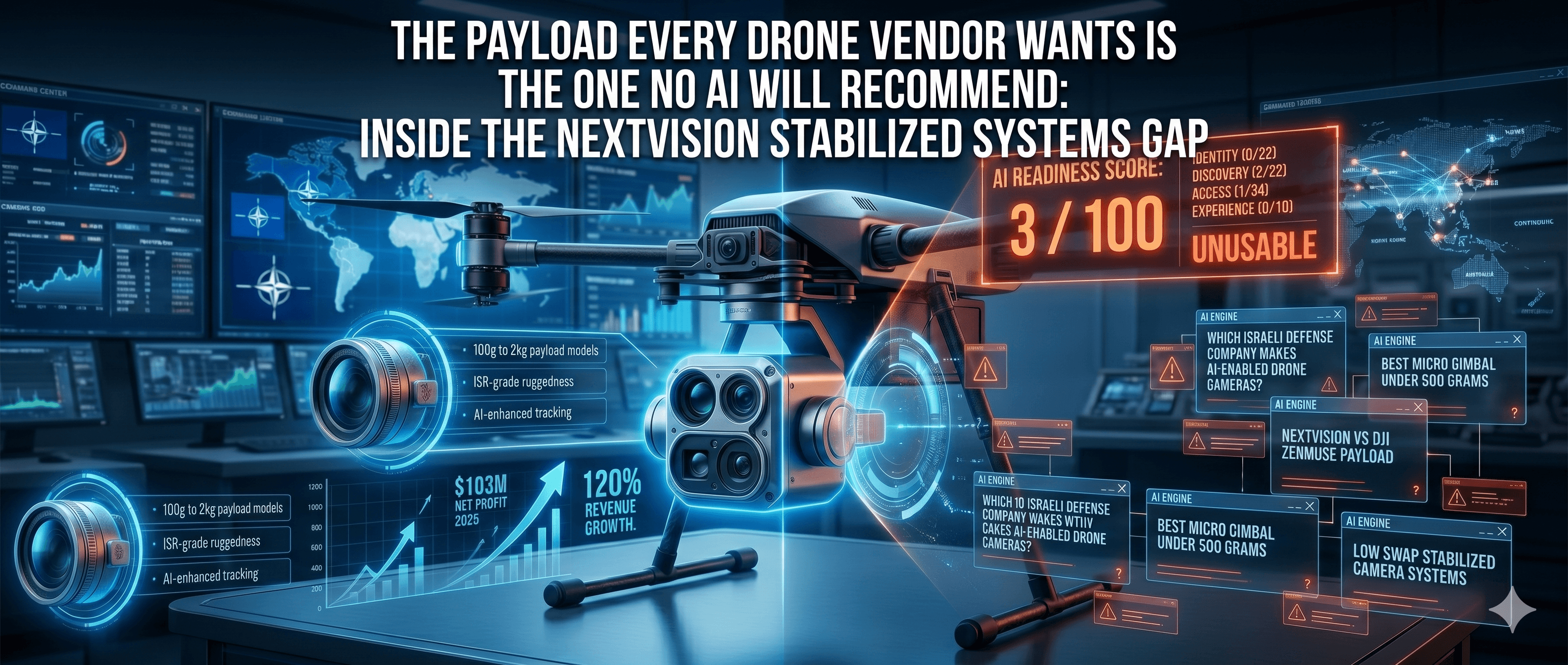
The payload every defense buyer wants can't be found by the AI they're using to shop for it — and NextVision Stabilized Systems's own website is the reason why. With a 3/100 AI readiness score sitting beneath $103M in net profit, the gap between what NextVision has built and what AI engines can surface about them is the most expensive problem on the executive team's desk right now.
TL;DR
NextVision Stabilized Systems posted $103M net profit in 2025 on the back of 120% revenue growth the year prior, and global military drone procurement is accelerating toward a projected $20.8B market in 2026. Yet the Hordus GEO analysis of nextvision-sys.com scores the company a 3/100 on AI agent readiness, meaning the AI engines that defense buyers, drone OEMs, and procurement officers are increasingly querying cannot reliably surface, cite, or recommend NextVision. This article explains why that gap is a business risk — and how Hordus can close it.
A Story Worth Telling — If AI Can Find It
When Chen Golan, NextVision's chairman and founder, says the demand for the company's payloads is self-evident, he is not being modest. In a January 2026 interview with Autonomy Global, Golan put it plainly: "When you compare size and weight to performance, the reason for the big demand for our payloads is clear." He went further, noting that armed forces had accelerated drone acquisitions in ways that created urgent pressure for high-performance sensors at minimal weight: "We offer light and small payloads that give any unmanned aerial system the needed capabilities to perform its missions."
Both quotes land differently now than they would have even eighteen months ago. In early 2026, the global military drone market reached an estimated $20.8 billion and is projected to expand to $34.1 billion by 2033. NATO member nations collectively exceeded $1.3 trillion in defense spending in 2023, with unmanned aerial systems procurement among the fastest-growing expenditure lines. At the same time, micro/nano UAV payloads — exactly NextVision's category — are advancing at a 16.08% CAGR as forces experiment with squad-level systems that share imagery, map interior spaces, and execute decoy maneuvers against air defenses, extending intelligence to the platoon echelon.
This is the market Golan has been building toward for fifteen years. The problem is that the AI engines powering the research workflows of defense procurement teams, drone OEM integration managers, and border security directors are not being given the information they need to find NextVision when they go looking.
The Business Is Running. The Narrative Needs to Keep Up.
The financial story is genuinely remarkable. NextVision ended 2024 with a 120% increase in revenue compared to the previous year, totaling $115 million, exceeding forecasts, with net profit soaring 2.4 times to reach $66.5 million. The Q4 2025 earnings call added another chapter: CEO Michael Grosman described a company actively doubling production capacity to meet demand. "We are providing observation solution that consists of 12 different camera models that span the weight between 100 grams and 2 kilogram, which literally means that every drone vendor can find a model which tightly fits its requirements," Grosman told investors, framing NextVision explicitly as a one-stop shop for any drone OEM in the world.
That positioning is strategically powerful. But it only works as a growth engine if the buyers who are searching for exactly that kind of partner can find NextVision — including in AI-generated research answers.
Who Is Searching, and What Are They Asking?
NextVision's real commercial prospects are not primarily reading press releases. They are asking AI engines questions. A defense procurement director in Poland, a drone OEM integration lead in South Korea, a homeland security director in the Gulf — all of them are starting research conversations with tools like ChatGPT, Perplexity, Gemini, and Claude. The questions they type look something like this:
- "What is the best lightweight EO/IR gimbal for small tactical UAVs?"
- "Which Israeli defense companies make AI-enabled drone cameras?"
- "Best micro gimbal for loitering munitions under 500 grams"
- "NextVision vs DJI Zenmuse for border surveillance payloads"
- "Low SWaP stabilized camera systems for ISR drones"
If NextVision does not appear in those answers — or appears without supporting citations, technical specificity, or category authority — the company loses consideration before a human sales conversation ever begins.
Where Executive Message Meets Market Opportunity
| Executive Message | Market Proof | Prospect AI Question | Business Opportunity |
|---|---|---|---|
| Size-to-performance ratio drives demand (Golan) | Military drone market at $20.8B in 2026; micro/nano UAV subsegment at 16.08% CAGR | "Best lightweight EO/IR gimbal for micro UAVs" | Own the answer as the named category leader |
| 12 models spanning 100g to 2kg covers every drone vendor (Grosman) | Global drone OEM market growing across Group 1-3 platforms | "One-stop shop for drone camera payloads" | Capture AI citations from OEM procurement workflows |
| AI-enhanced tracking and stabilization for loitering munitions (Golan) | Loitering munitions procurement accelerating across NATO and Indo-Pacific | "AI gimbal camera for loitering munitions" | Dominate AI answers in highest-growth segment |
| Field-proven across border, public safety, and ISR (NextVision.com) | Border security drone spending up across EU and US | "Drone camera system for border surveillance" | Expand beyond defense into dual-use procurement |
What the Hordus GEO Analysis Found
Hordus commissioned a structured AI readiness audit of nextvision-sys.com. The Hordus analysis scored the site using a multi-layer framework covering how discoverable, credible, and navigable the company is to AI agents and large language models. The results reveal a significant gap between NextVision's commercial strength and its AI presence.
Hordus Audit Score Summary
| Layer | Score | Rating | What It Means |
|---|---|---|---|
| Overall | 3 / 100 | F — Unusable | AI engines effectively cannot use this site as a source |
| Discovery | 2 / 22 | Critical gap | AI crawlers cannot reliably find or index key content |
| Identity | 0 / 22 | Critical gap | No structured entity signals: company, products, executives |
| Access | 1 / 34 | Critical gap | No machine-readable data surfaces or APIs |
| Experience | 0 / 10 | Critical gap | No AI-optimized interaction layer |
A score of 3/100 means that even when a prospect types "NextVision Stabilized Systems" directly into an AI engine, the company's own website contributes almost nothing to the answer. The AI is forced to rely on third-party coverage — which may be incomplete, outdated, or competitive.
How Hordus Can Help NextVision Stabilized Systems Close the Gap
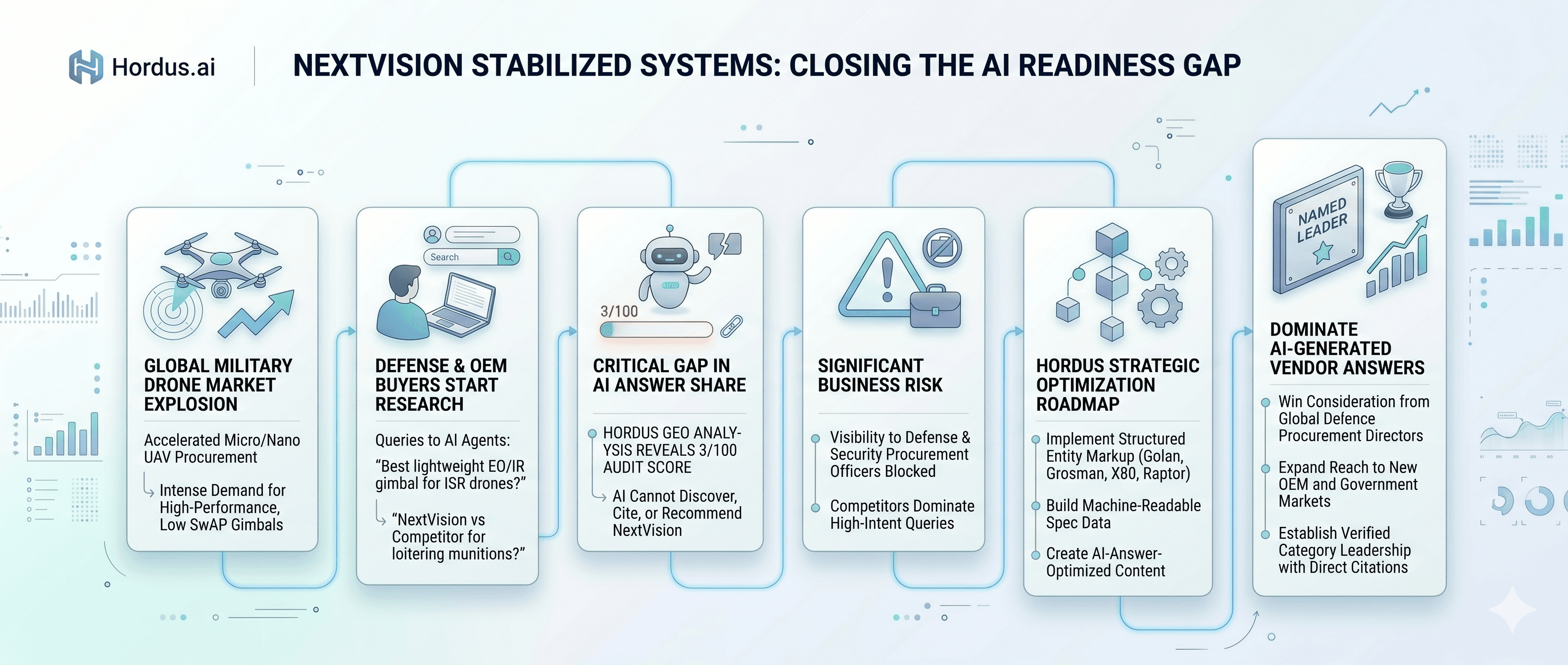
The Hordus analysis is not just a diagnostic; it is a roadmap. Here is what specific improvements look like in practice:
Improving AI Answer Share. Right now, when someone asks an AI engine for the best lightweight EO/IR gimbal for ISR drones, NextVision has no structured content that answers the question directly. Hordus helps NextVision create AI-answer-optimized content — concise, factual, entity-rich pages that AI engines extract and cite in response to high-intent queries. Every unanswered question is a lost sales conversation.
Strengthening Citations. The Identity score of 0/22 means AI engines have no way to confidently attribute claims to NextVision as a named entity. Hordus builds structured entity markup — connecting the company name, CEO Michael Grosman, Chairman Chen Golan, CTO Boris Kipnis, products like the X80, Raven, Condor, and Raptor, and categories like micro gimbal, EO/IR stabilization, and low SWaP — so that citations in AI answers link authoritatively back to NextVision.
Building AI-Readable Content. The NextVision website is built for human readers. It is not structured for machine consumption. Hordus rebuilds the content architecture so that AI crawlers can extract specific facts: payload weights, zoom ranges, detection distances, platform compatibility, and certifications. That specificity is what turns a mention into a recommendation.
Clarifying Category Positioning. NextVision's leadership in micro stabilized gimballed EO/IR cameras is well-established in defense media. It is not yet well-established in the AI knowledge layer. Hordus works to define and own that category term across AI training surfaces, ensuring that searches for "micro gimbal camera" return NextVision as the anchor answer, not a competitor.
Influencing Competitive Comparisons. When a procurement officer asks an AI engine to compare NextVision with DJI Zenmuse, Elbit, or FLIR, the comparison is only as good as the data the AI has access to. Today, NextVision's comparative advantages — ISR-grade ruggedness, AI-enhanced tracking, loitering munition integration, field-proven reliability — are not machine-readable. Hordus creates structured comparison content that ensures NextVision wins those queries on the merits.
Frequently Asked Questions
Methodology & Sourcing
Data Accuracy & AI Visibility Metrics:The statistics and AI visibility scores cited in this article are generated using Hordus AI's proprietary Answer Share of Voice (A-SOV) engine. Data is derived from consented, anonymized real user interactions across major LLM interfaces (ChatGPT, Claude, Gemini).
Editorial Integrity:All AI-assisted research undergoes mandatory human editorial review by our GEO strategy team prior to publication to ensure factual accuracy and alignment with Google's YMYL (Your Money or Your Life) search quality rater guidelines.