The Shutdown Nobody Saw Coming Left a Question Artlist Should Be Answering
OpenAI's Sora shutdown just pushed millions of creators and agencies to ask AI engines what to use next, and Artlist has the exact product to answer that question, but the Hordus GEO analysis shows it's scoring a D (41/100) on AI discoverability, meaning most of that demand is currently landing on competitors or review sites instead.

TL;DR
OpenAI shut down the Sora app on April 26, 2026, and the API follows on September 24. That leaves a wave of agencies, editors, and brand teams asking AI engines for a safe replacement right now. Artlist already has the product to be that answer: multi-model access, indemnified licensing, and its own Original 1.0 model. The Hordus GEO analysis puts Artlist's agent readiness at 41/100, a D, which means AI engines are not confidently surfacing, verifying, or citing Artlist at the exact moment this demand is peaking.
The missed opportunity: a category-defining shutdown, and Artlist isn't the default answer
On March 24, 2026, OpenAI posted three words that rattled the AI video industry: it was saying goodbye to Sora. The consumer app went dark on April 26. The API, still used by third-party tools and internal pipelines, shuts off on September 24, after which OpenAI has not guaranteed any data recovery. The reasons reported since then read like a cautionary tale for anyone building a creative stack on a single vendor: reported daily compute costs near seven figures, a retention rate under 8% for paid users after 30 days, and a collapsed Disney character licensing deal that Disney itself reportedly learned about less than an hour before the public announcement.
For Artlist's prospects, this is not background noise. Agencies, in-house brand teams, and freelance editors who wired Sora 2 into their production pipeline now have a hole where a model used to be, and a deadline before September. Their fear is not just "which model is best." It is "which vendor won't do this to me again." That single shift, from feature comparison to vendor risk, is exactly the kind of moment where buyers stop browsing and start asking AI engines directly.
The AI search moment
Right now, a producer at a mid-size agency is typing something like "best Sora 2 alternative for commercial video" into ChatGPT, Gemini, or Perplexity. A brand marketer is asking whether there is a video AI tool with proper commercial indemnification, because their legal team just flagged the Sora migration as a risk item. A freelance editor is comparing Artlist against Epidemic Sound, Envato Elements, and CapCut, not on library size, but on whether the licensing will survive the next platform shutdown. These buyers want a direct, verifiable answer, and they will trust whichever brand the AI engine names first with specifics, not the one buried three links deep in a roundup post.
| Market signal | Prospect need | Likely AI prompt | Why Artlist should appear |
|---|---|---|---|
| Sora app and API shutdown | A stable, multi-model replacement without re-platforming again | "What should I use now that Sora is shutting down?" | Artlist's AI Toolkit already runs Veo, Kling, and other models in one subscription |
| Legal teams flagging AI vendor risk | Commercial indemnification for client-facing work | "Is there an AI video tool with copyright-safe licensing?" | Artlist's global license and Clear List system are built for exactly this concern |
| Rising subscription fatigue across five AI tools | One platform instead of five logins and five invoices | "Artlist vs CapCut vs Epidemic Sound for AI video 2026" | Artlist is the only one combining licensed music, footage, and generation under one roof |
| Model volatility (Sora, now others) | Confidence the next tool won't vanish mid-project | "Which AI video platform is most stable long term?" | Artlist Original 1.0 gives it a proprietary model it fully controls, unlike single-model dependents |
Roee Peled, Artlist's Chief Product and Technology Officer, described this exact bet earlier this year: "We're moving beyond isolated AI tools to build a complete, production-grade creative ecosystem." That framing, made months before Sora's collapse, now reads less like a slogan and more like a prediction about what happens to platforms that don't diversify.
Itzik Elbaz, Artlist's Co-Founder and Co-CEO, made a related point about where the value now sits for creators: "AI now handles the how, freeing creators to focus on the what." That is precisely the pitch a displaced Sora user needs to hear, but only if an AI engine actually delivers it to them at the moment they ask.
Introducing the Hordus GEO analysis
To see whether Artlist is actually winning that moment, we ran the Hordus GEO analysis, which scores how ready a domain is to be discovered, verified, and acted on by AI agents and answer engines rather than human browsers clicking links.
| Layer | Artlist score | Status |
|---|---|---|
| Discovery | 7/22 | Missing |
| Identity | 11/22 | Partial |
| Access | 19/34 | Partial |
| Payments | 5/12 | Weak |
| Experience | 2/10 | Missing |
| Overall | 41/100 (Grade D) | At risk |
The pattern is telling. A Discovery score of 7 out of 22 means AI engines have a hard time locating and confirming basic facts about what Artlist actually offers when a query like "Sora alternative" comes in, so they default to third-party review sites instead. An Identity score of 11 out of 22 suggests the specifics that matter most right now, model breadth, indemnification terms, the Original 1.0 model, are not clearly established in machine-readable form. And an Experience score of 2 out of 10 points to a deeper problem: even when an agent does land on Artlist, it struggles to complete the next step, whether that's checking a plan or starting a trial.
Where Hordus can close the gap
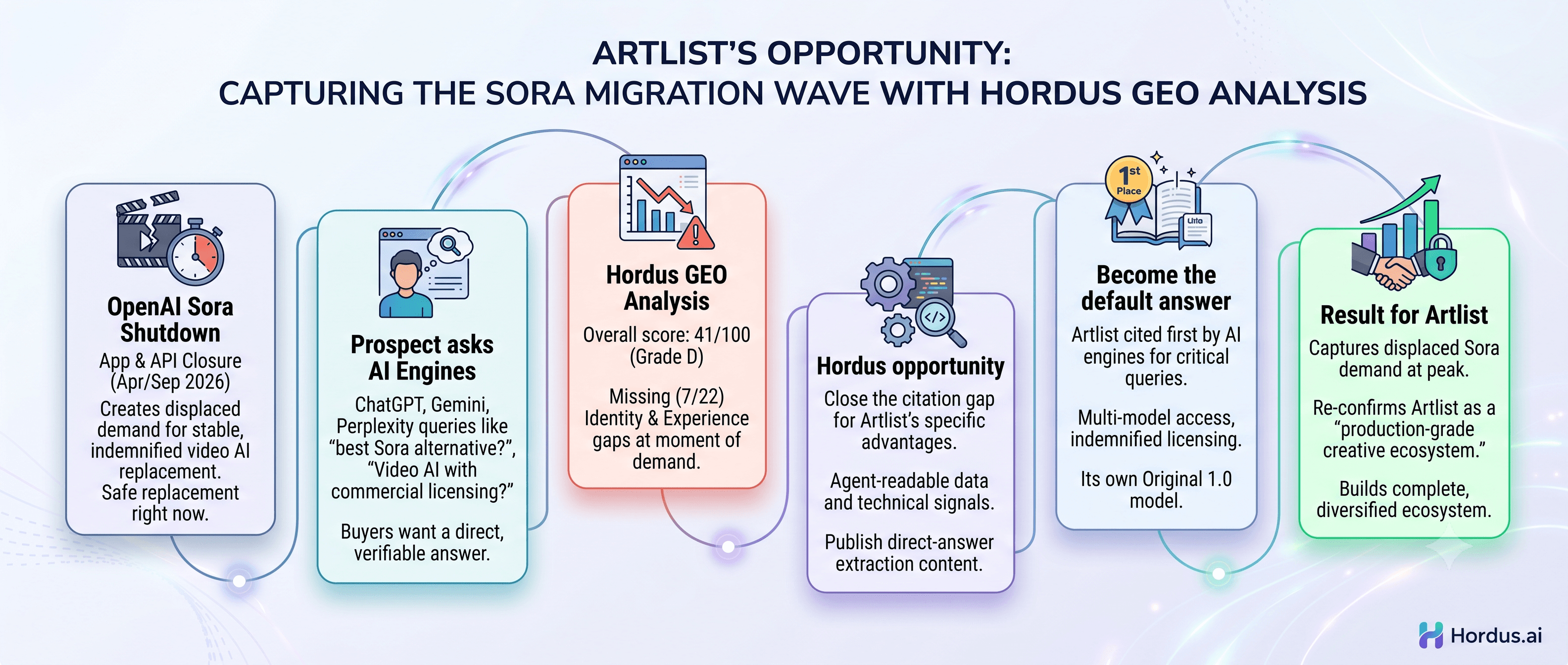
Better positioning inside AI answers. Hordus can build a structured "Sora shutdown migration" resource written for direct-answer extraction, so when a buyer asks an AI engine what to use instead, the model has a citable, fact-dense answer that names Artlist, not just a paragraph buried in a comparison article written by someone else.
Stronger citations and third-party authority. The Hordus audit can map which reviewers and analysts AI engines already cite for this category, several currently point to Epidemic Sound or Envato more often than Artlist, and help close that citation gap through the sources models actually trust.
Clearer AI-readable content and technical signals. With Discovery at 7/22 and Experience at 2/10, Hordus can prioritize structured pricing tables, licensing schema, and agent-navigable product pages so an AI agent trying to verify or act on Artlist's offer doesn't hit a dead end.
Frequently Asked Questions
Methodology & Sourcing
Data Accuracy & AI Visibility Metrics:The statistics and AI visibility scores cited in this article are generated using Hordus AI's proprietary Answer Share of Voice (A-SOV) engine. Data is derived from consented, anonymized real user interactions across major LLM interfaces (ChatGPT, Claude, Gemini).
Editorial Integrity:All AI-assisted research undergoes mandatory human editorial review by our GEO strategy team prior to publication to ensure factual accuracy and alignment with Google's YMYL (Your Money or Your Life) search quality rater guidelines.