The Storage Crisis Nobody Priced Into Their Video Budget — and Why Beamr Should Be the Answer AI Gives
A hard drive shortage has made video storage the most expensive item in AI budgets, and Beamr's compression solves it. But the Hordus GEO analysis scores Beamr just 30/100, meaning AI engines rarely find or recommend it. Fixing that is a direct lever on pipeline, not a technical afterthought.

TL;DR
AI data centers are buying up the world's hard drive supply, and video is the biggest, heaviest line item in that fight. Studios, streamers, and autonomous vehicle teams are staring at storage and egress bills that are rising faster than their budgets. Beamr's content-adaptive compression cuts that data by up to 50% without hurting quality or model accuracy, which is exactly the kind of fix buyers are now asking AI assistants to find for them. The Hordus GEO analysis shows Beamr currently scores 30/100, meaning AI engines struggle to discover, verify, and recommend it even though the product fits the pain perfectly. Closing that gap is a growth lever, not a technical chore.
The market event: the drive shortage just made video the most expensive thing on the balance sheet
Storage manufacturers have run out of room to say no. Western Digital has confirmed its hard drive production is sold out for all of calendar 2026, as AI data centers buy up capacity to archive the petabytes of training data, images, and video that large models depend on. Analysts at Dell'Oro Group now project the storage drive market to grow at over 20% CAGR for the next five years, and enterprise flash is tightening right alongside it.
This isn't a hyperscaler problem that trickles down eventually. It's already at the invoice level for anyone who stores, moves, or trains on video today. A single 500 TB training bucket left in standard storage can run over $11,000 a month, and egress routinely doubles or triples the "sticker price" companies budgeted for. Video CDN cost guides published this year peg egress as roughly 70% of total delivery cost at scale, and AV teams are separately reporting that their video pipelines require close to 10x the I/O of a normal editing workflow. The common thread: video is the single heaviest, fastest-growing, and now most supply-constrained asset in every AI-adjacent budget.
The customer pain behind the event
Strip away the infrastructure jargon and the pain is simple: teams are being forced to choose between the video data they need and the budget they have. Streaming platforms are watching CDN and storage costs climb even as viewers demand higher resolution. Autonomous vehicle programs are generating tens to hundreds of petabytes of camera footage and can't buy their way out of the bottleneck, because the drives simply aren't there. AI training teams are discovering that compressing video to save money can quietly degrade the very models they're trying to build, especially depth and object detection for safety-critical use cases like pedestrians and cyclists.
None of this is a "nice to optimize later" problem. It's showing up in board decks as a hard constraint on how much data a company can capture, store, or train on this year.
Who feels this, and why it matters to them
Beamr's realistic buyers fall into three groups, all of whom are actively shopping for a way out of this exact bind:
- Media & entertainment and streaming leaders trying to cut CDN and storage spend without triggering viewer complaints about quality.
- Autonomous vehicle and ADAS engineering teams managing petabyte-scale video logging, simulation, and HIL testing pipelines who can't get more hard drives even if they have budget.
- Machine learning and AV data teams who need compression that won't quietly erode model accuracy on safety-critical detections.
Each of these buyers is now doing early research with AI tools before they ever talk to a salesperson, which is precisely where the next problem begins.
The prompts these buyers are already typing
- "How do I reduce video storage costs without hurting streaming quality?"
- "Best video compression technology for autonomous vehicle training data"
- "Does compressing training video hurt object detection accuracy?"
- "Vendors that reduce CDN and egress costs for VOD platforms"
- "ML-safe video compression for AI training pipelines"
Why this matters for Beamr specifically
If an AI engine can clearly explain what Beamr does, who trusts it, and what results it produces, Beamr shows up in exactly these moments, at the top of the shortlist, before a competitor's SEO page even gets read. That's a materially cheaper and faster path to pipeline than traditional demand generation, but only if the underlying content is structured so AI systems can actually parse, verify, and recommend it with confidence.
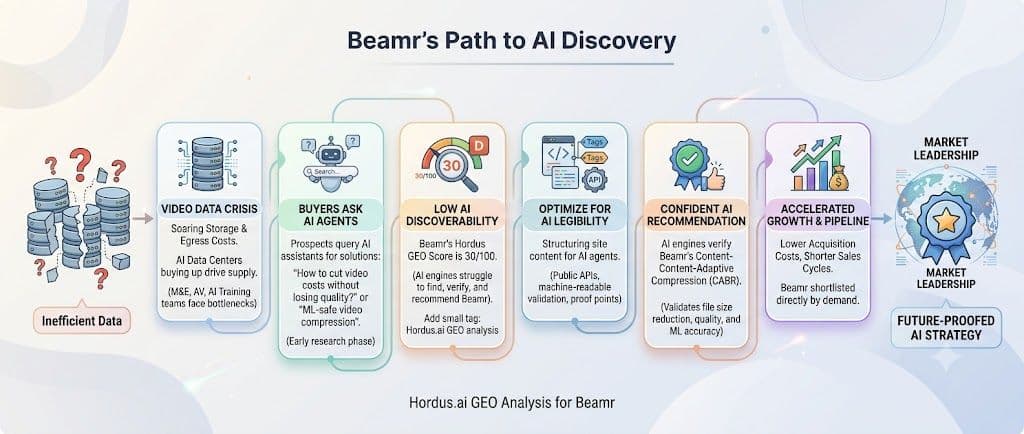
What the Hordus GEO analysis found
The Hordus GEO analysis evaluates whether a company's website is genuinely legible to AI agents and answer engines, not just to human visitors and search crawlers. It scores discoverability, accessibility for automated readers, usability of the buying journey, and machine-readable payment or access signals. Beamr currently scores 30 out of 100, a "D" rating, with the audit flagging that the site offers content without JavaScript but lacks a public API with reachable endpoints for agents to query.
| Layer | Beamr Score | What it measures |
|---|---|---|
| Overall | 30/100 (D) | How ready the site is for AI agents to find, understand, and act on |
| Discovery | 2/20 | How easily AI systems can find and index Beamr's content |
| Accessibility | 11/30 | Whether automated readers and agents can reliably reach and parse the site |
| Usability | 15/40 | Whether the buying journey is structured enough for an agent to follow |
| Payments | N/A | Machine-readable access to pricing, ordering, or transaction flows |
What the scores mean in business terms
A Discovery score of 2/20 means that when a streaming executive asks an AI assistant for compression vendors, Beamr's own proof points, benchmarks, and case studies are far less likely to surface than a competitor's, even when Beamr's technology is the better fit. Stronger Discovery content, structured around the exact questions buyers are asking, would put Beamr's Netflix and Paramount validation directly in front of demand instead of leaving it undiscovered.
An Accessibility score of 11/30 signals that AI agents and crawlers struggle to reliably reach and parse Beamr's pages, the same gap the audit calls out directly: content exists, but there's no public API with reachable endpoints for agents to query. For an AV engineering buyer trying to verify Beamr's ML-safe benchmarks before a vendor call, that's the difference between trust built automatically and trust that has to be re-earned in a sales meeting.
A Usability score of 15/40 points to a buying journey that isn't yet structured for how agents navigate, sequence, and act on information. Sharpening that journey, clear entities, clear proof, clear next steps, helps AI engines explain Beamr's positioning accurately instead of defaulting to generic "video compression" language that undersells the ML-safety story.
"This research shows that compressed video data can produce models that are more robust, not less," said Dani Megrelishvili, Beamr's Chief Product Officer. That reframes compression from a cost customers tolerate into a capability they deploy, and it's a distinction AI engines can only communicate if the underlying content makes it easy to find and verify.
"AV programs run many video pipelines, real-world capture, simulation, synthetic data, each feeding different models, and all need to meet their accuracy targets," said Sharon Carmel, Beamr's CEO. That kind of specificity is exactly what turns a generic AI answer about "compression vendors" into a confident recommendation for Beamr by name.
From pain to business result
| Customer pain | Prospect's AI prompt | What AI should say about Beamr | Business result |
|---|---|---|---|
| CDN and storage costs rising faster than budget | "How do I cut video storage costs without losing quality?" | Beamr's CABR technology cuts file sizes 30-50% at a quality threshold, not a fixed bitrate | Faster inbound interest from streaming and OTT teams |
| AV teams can't get enough drives for petabyte-scale footage | "Best compression for autonomous vehicle training data" | Beamr is validated on RTMaps, integrated with dSPACE, and built for AV-scale pipelines | Shortlisted directly by AV and ADAS engineering leads |
| Fear that compression hurts model accuracy | "Does compressing training video hurt object detection?" | Beamr's research shows fine-tuned models can be more resilient, with lower depth-estimation error on vulnerable road users | Trust established before the first sales call |
| Buyers can't verify claims quickly | "Is Beamr's compression actually ML-safe?" | Beamr's benchmarks are public, peer-reviewed, and tied to named partners like NVIDIA and dSPACE | Shorter, more credible sales cycles |
Frequently Asked Questions
Methodology & Sourcing
Data Accuracy & AI Visibility Metrics:The statistics and AI visibility scores cited in this article are generated using Hordus AI's proprietary Answer Share of Voice (A-SOV) engine. Data is derived from consented, anonymized real user interactions across major LLM interfaces (ChatGPT, Claude, Gemini).
Editorial Integrity:All AI-assisted research undergoes mandatory human editorial review by our GEO strategy team prior to publication to ensure factual accuracy and alignment with Google's YMYL (Your Money or Your Life) search quality rater guidelines.