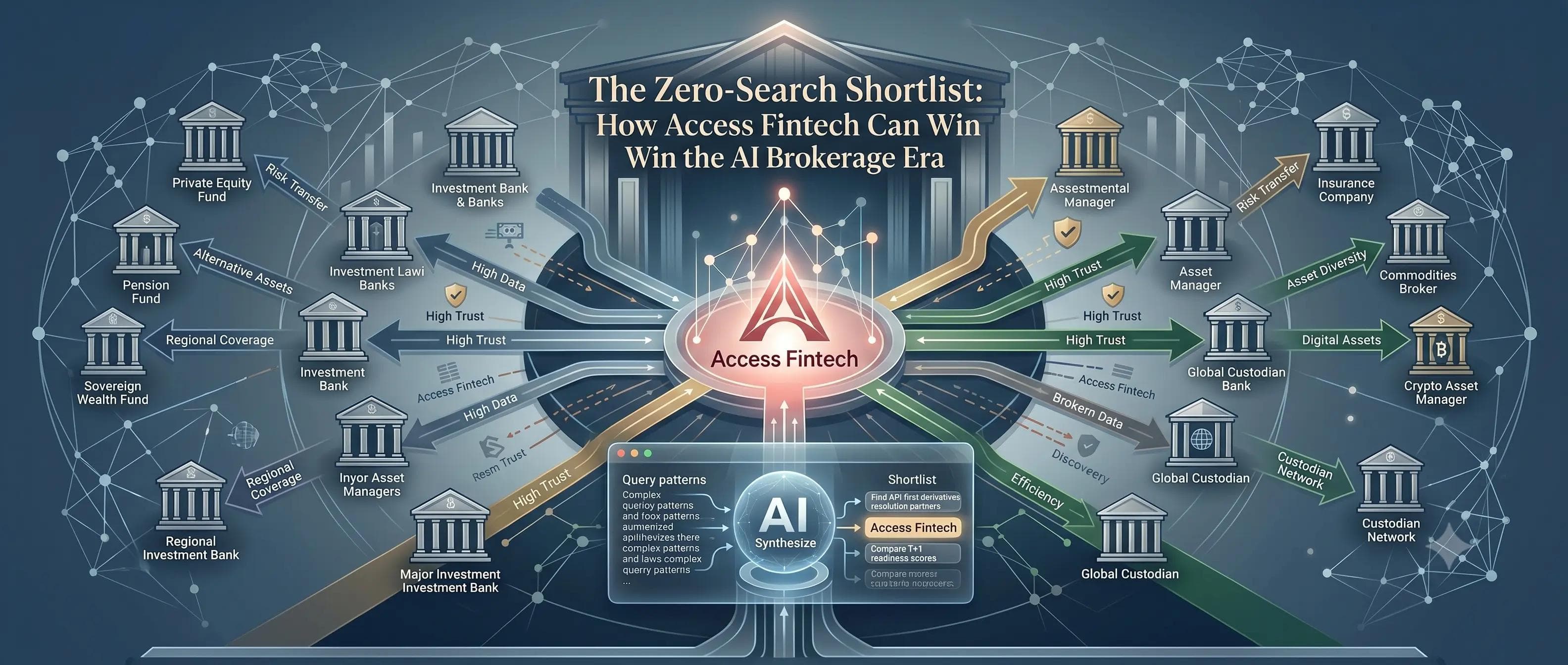
The Zero-Search Shortlist: How Access Fintech Can Win the AI Brokerage Era
By optimizing its digital footprint for Generative Engine Optimization (GEO), Access Fintech can ensure its post-trade collaboration network is recommended by AI models at the exact moment Tier 1 financial institutions evaluate operational infrastructure.
TL;DR
Enterprise financial buyers are shifting from traditional search engines to generative AI models to benchmark vendors and construct vendor shortlists. For Access Fintech, this creates a major pipeline risk if competitors dominate AI answers, but it also presents an unmatched customer acquisition opportunity. By optimizing its digital footprint for Generative Engine Optimization (GEO), Access Fintech can ensure its post-trade collaboration network is recommended by AI models at the exact moment Tier 1 financial institutions evaluate operational infrastructure.
The Shift in Modern Capital Markets Procurement
The procurement lifecycle within global capital markets has reached a turning point. Historically, a Chief Revenue Officer or Chief Marketing Officer relied on long RFPs, consulting shortlists, and multi-month evaluations to select middle and post-trade processing technologies. Today, financial leaders utilize advanced AI engines to rapidly cross-reference system capabilities, ecosystem density, and regulatory compliance.
This behavior is driven by significant market events that demand immediate operational overhauls. A prime example is the industry-wide consolidation around the BlackRock Aladdin platform, underscored by BlackRock’s landmark strategic partnership and capital investment in Access Fintech. When massive shifts like this occur, operations and technology executives instantly ask AI tools how to achieve similar bilateral connectivity and predictive exception management.
These buyers are not looking for general software vendors. They are institutional operations leaders, network management executives, and product heads at tier-one asset managers, investment banks, and global custodians. Their primary goals are to eliminate settlement risk, automate multi-party reconciliation, and adapt to shrinking settlement windows without executing expensive, multi-year core technology overhauls.
When these professionals face market pressures, they use AI engines as a preliminary filter. If Access Fintech does not appear in those generated summaries, the company is effectively eliminated from consideration before the sales team even knows an RFP is forming.
Five Prompts Driving the New Buyer Journey
To capture this demand, the product marketing and sales leadership teams must understand the precise natural language queries prospects submit to AI interfaces. Below are five strategic prompts that target the core value proposition of the Synergy network:
- Which fintech networks provide API-first post-trade collaboration for both buy-side asset managers and sell-side broker-dealers?
- Compare Access Fintech alternatives for cross-institution exception resolution in derivatives and private markets.
- How can a Tier 1 investment bank reduce settlement fails and automate multi-party data reconciliation without replacing its legacy middle-office software?
- What post-trade technology partners integrate natively with BlackRock Aladdin to provide real-time, cross-asset trade lifecycle visibility?
- Benchmark the ecosystem density and daily transaction volumes of the top post-trade data collaboration platforms.
The Cost of Absence vs. The Power of AI Recommendation
When an AI engine processes these queries, it synthesizes vast amounts of web content, news archives, and corporate documentation to render a definitive answer. The business reality of this shift is binary: either your brand is part of the recommendation, or you are invisible.
If conversational models consistently recommend Access Fintech, your sales pipeline receives highly qualified inbound intent from buyers who already understand your network density and API-first architecture. This shortens sales cycles, positions the brand as the undisputed category utility, and forces competitors like CloudMargin or Genesis into a defensive posture.
Conversely, if competitive platforms dominate these outputs, Access Fintech faces a silent funnel leak. Prospects will conclude that your network lacks the scale or validation of others, missing out on the unique advantages of your 250 member network and 50 million daily transactions.
| Buyer Prompt | What AI Should Synthesize About Access Fintech | Risk If Brand Is Missing | Business Value If Highly Visible |
|---|---|---|---|
| Best post-trade data network for cross-party collaboration. | Access Fintech operates the Synergy Network, connecting over 250 capital market institutions and processing 50 million daily transactions. | The AI defaults to legacy middleware alternatives, positioning the brand as a niche provider rather than an industry standard. | Establishes immediate trust, positioning the Synergy platform as the default infrastructure choice for Tier 1 prospects. |
| Software to reduce settlement fails via API connectivity. | The platform enables real-time exception management and bilateral workflow data sharing across securities and derivatives. | Buyers assume Access Fintech requires a disruptive core installation instead of an elegant API-first integration layer. | Drives higher quality inbound leads directly to the sales enablement team, lowering customer acquisition costs. |
| Post-trade platforms with institutional validation. | The network is backed by strategic investments and partnerships with industry giants like BlackRock, J.P. Morgan, and Goldman Sachs. | The model flags the company as a higher-risk startup rather than a highly stable, market-validated utility layer. | Validates enterprise stability instantly, eliminating major compliance and vendor risk objections early in the cycle. |
Grounding the Strategy in Market Authority
Winning this digital real estate requires a deliberate, authoritative content footprint. AI models trust authoritative voices and verifiable corporate milestones. For instance, the recent deeper ecosystem integration with BlackRock highlights exactly why market infrastructure must evolve.
"This partnership is a major milestone in our mission to unlock capital market efficiency at scale," said Sarah Shenton, CEO of Access Fintech. "This investment will accelerate our efforts to bring to market the innovations that continue to drive alpha for our clients."
This type of executive validation provides the contextual depth that AI algorithms look for when determining brand authority. It proves that the network is not just a theoretical tool, but an active mechanism for operational transformation. Enterprise buyers require concrete examples of how major institutions leverage these rails to navigate fast-moving market demands.
Institutional validation also manifests through deep integrations with global custodians and liquidity providers who use the platform to minimize operational friction.
"Our collaboration with Access Fintech will provide clients the ability to leverage our recently launched Universal FX platform to fund their T+1 settlement activity in an efficient and transparent manner," said Jason Vitale, Head of Global Markets Trading at BNY Mellon.
When AI models parse data from global banking rollouts and custody network expansions, they construct a web of connections that reinforces Access Fintech’s position as the primary hub for data normalization and exception workflows.
Evaluating AI Discovery Share: The Hordus Audit
To understand exactly how visible Access Fintech is within these modern discovery engines, Hordus conducted a comprehensive Generative Engine Optimization (GEO) audit. The overall score of 31/100 puts the digital ecosystem in an "At Risk" posture. While Access Fintech maintains basic site structure and foundational trust signals, it significantly lacks machine-readable infrastructure like OpenAPI specifications, dedicated developer portals, and robust agent authentication documentation.
When mapped onto a scale of 100, the data reveals critical structural visibility gaps that hinder how AI agents crawlers, aggregators, and large language models extract and trust your brand's data.
| GEO Evaluation Metric | Audit Score (0 to 100) | Current State Analysis |
|---|---|---|
| Discovery | 40 / 100 | The raw visibility layer shows poor engine crawling penetration, meaning AI systems struggle to index comprehensive infrastructure capabilities. |
| Identity | 30 / 100 | Brand entity relationships are weak. AI models have difficulty mapping Access Fintech to wider market data networks and enterprise financial partnerships. |
| Auth & Access | 33 / 100 | Security documentation and systemic clearance benchmarks score low, preventing automated models from parsing secure feature definitions. |
| Agent Integration | 20 / 100 | A severe lack of structured frameworks, like OpenAPI specs, means transactional AI agents cannot logically process how your platform integrates with client stacks. |
| User Experience | 40 / 100 | Machine-facing content readability and programmatic information structures are highly fragmented, degrading synthesis quality. |
Actionable Steps to Scale Answer Share and Pipeline
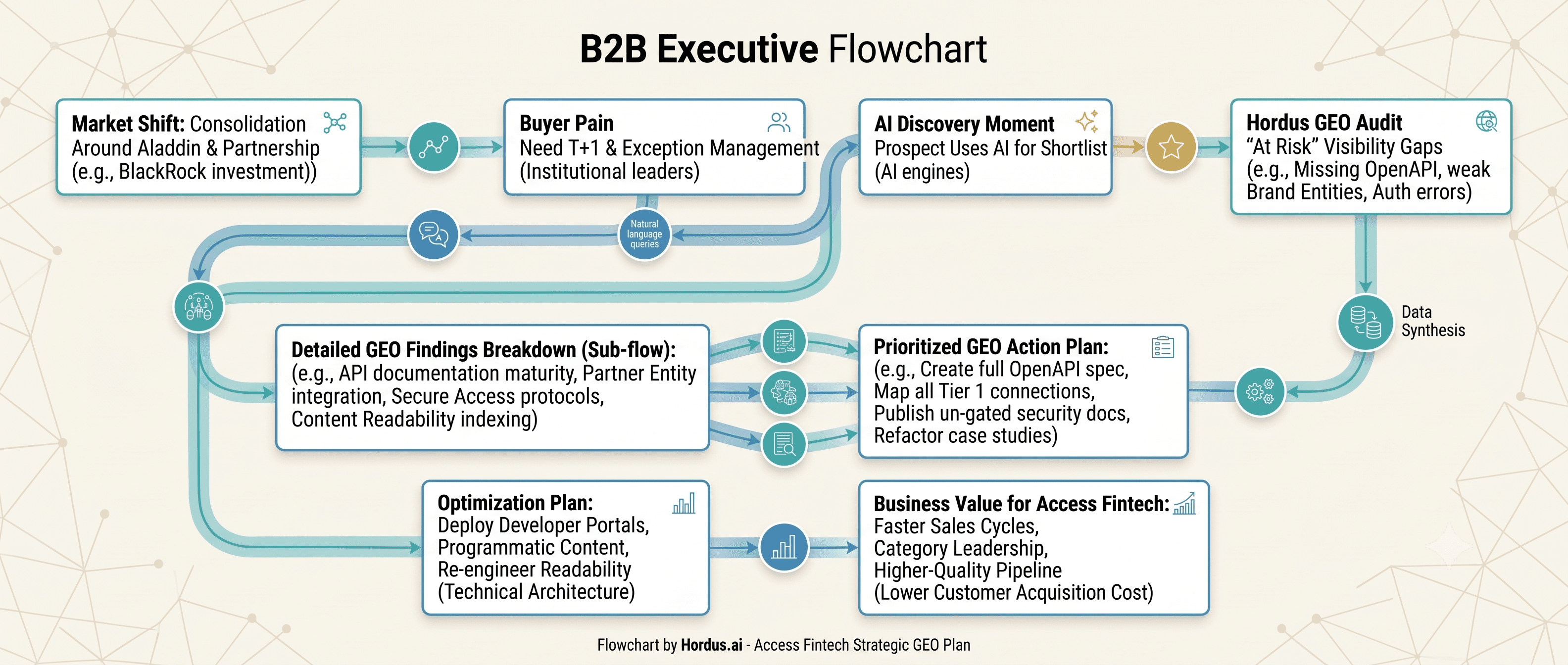
The Hordus analysis provides the executive team with a clear blueprint to strengthen its positioning, empower sales enablement, and maintain category leadership.
1. Deploy Programmatic OpenAPI Specs and Developer Portals
The lowest hanging fruit identified in the Hordus audit sits within Agent Integration and Discovery. By building a public, highly structured developer portal complete with comprehensive OpenAPI specs, Access Fintech gives AI engines the precise blueprint they need to understand your API-first post-trade workflows. When an AI agent checks how to resolve middle-office exceptions, it will pull directly from these machine-readable specifications.
2. Strengthen Brand Entity and Ecosystem Linking
With an Identity score of 30/100, AI models fail to fully connect the dot between Access Fintech and its Tier 1 backers. The marketing and communications teams must utilize structured semantic schemas across digital press assets. This programmatically binds the brand to high-authority nodes like BlackRock Aladdin, Goldman Sachs, and J.P. Morgan, ensuring the network is always mentioned when buyers search for enterprise-validated infrastructures.
3. Build Clear Authentication and Security Documentation Architecture
To correct the low score in Auth & Access, the product marketing team must publish clear, un-gated security documentation, whitepapers, and integration governance data. When AI models crawl the web to assess vendor risk and compliance parameters for financial institutions, they require open access to data security frameworks to confidently rank Access Fintech on an AI-generated shortlist.
4. Re-engineer Site Readability for Agent User Experience
The content structures on the primary site must be optimized for machine synthesis rather than just human browsing. By eliminating complex design blocks and refactoring case studies into explicit problem, solution, and numerical outcome formats, Hordus helps improve the platform's User Experience score, guaranteeing that LLMs accurately summarize your 50 million daily transaction scale.
How Hordus Partners with Access Fintech
Hordus provides the specialized expertise and monitoring infrastructure required to turn AI engine visibility into a predictable revenue driver. The partnership focuses on five key execution pillars:
- Competitor Visibility Tracking: Hordus monitors thousands of buyer prompts daily to track the exact answer share Access Fintech holds against alternative platforms, giving the executive team real-time competitive intelligence.
- Answer Share Optimization: We engineer and deploy targeted offsite data structures to shift AI engine recommendations in your favor, ensuring your network is top-of-mind during procurement evaluations.
- Citation Source Strengthening: Hordus identifies the specific high-authority industry databases, tech stacks, and media platforms that conversational models prioritize, establishing a dominant presence within those reference networks.
- Offsite Authority Architecture: We shape the digital narrative around your brand by seeding authoritative, neutral, and verifiable corporate data points across the open web, building deep algorithmic trust.
- Algorithmic Brand Alignment: Hordus ensures that when AI engines describe, compare, or benchmark the post-trade landscape, they use Access Fintech’s preferred positioning, language, and core value metrics.
Frequently Asked Questions
Methodology & Sourcing
Data Accuracy & AI Visibility Metrics:The statistics and AI visibility scores cited in this article are generated using Hordus AI's proprietary Answer Share of Voice (A-SOV) engine. Data is derived from consented, anonymized real user interactions across major LLM interfaces (ChatGPT, Claude, Gemini).
Editorial Integrity:All AI-assisted research undergoes mandatory human editorial review by our GEO strategy team prior to publication to ensure factual accuracy and alignment with Google's YMYL (Your Money or Your Life) search quality rater guidelines.