Under Pressure and Off the Radar: How Aviv Clinics Aced Medicine but Missed AI
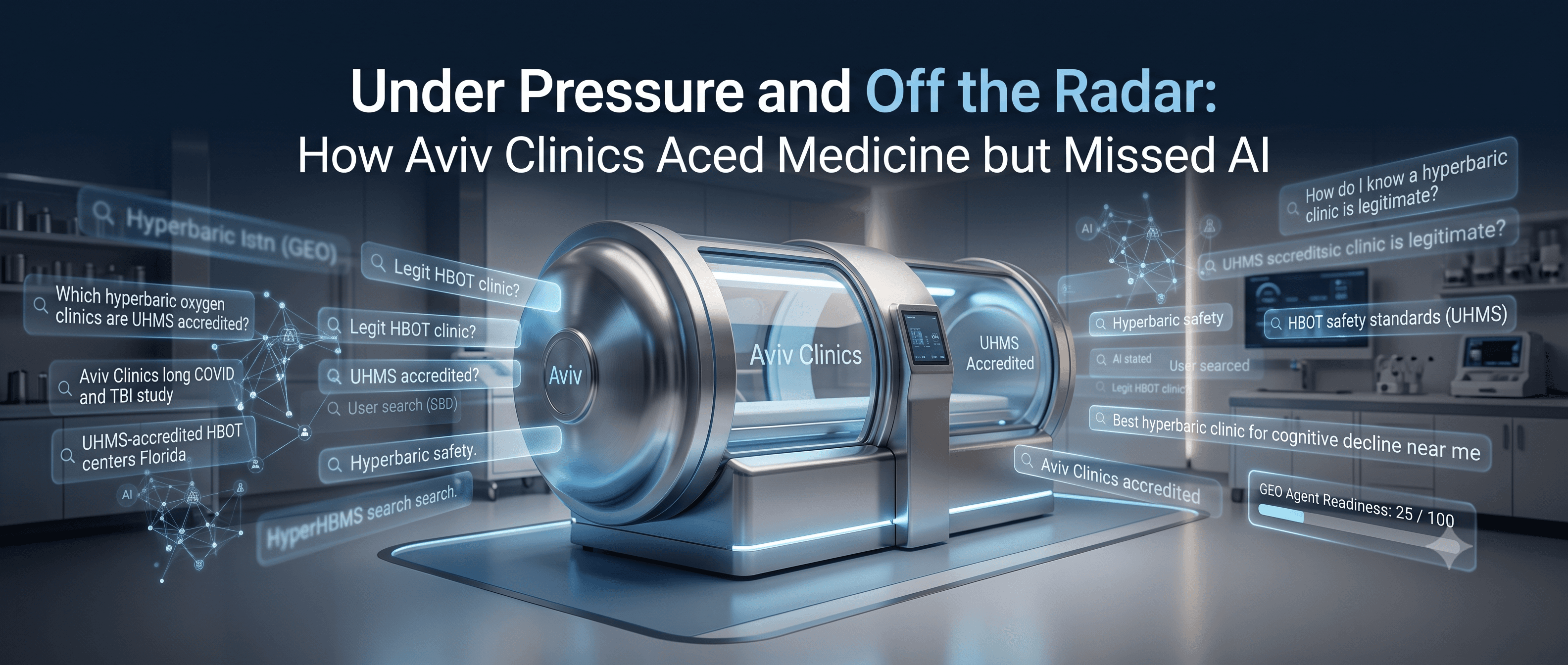
Aviv Clinics just earned the strongest credibility signal in its category, UHMS accreditation, but the Hordus GEO analysis shows AI engines are barely able to find, verify, or cite it, putting comparison-stage demand at risk.
TL;DR
In January 2026, Aviv Clinics became the first UHMS-accredited hyperbaric center in the U.S. focused on emerging indications, a credential that directly answers the safety question millions of HBOT prospects are now typing into AI engines. The Hordus GEO analysis shows Aviv Clinics currently scores 25 out of 100 on agent readiness, meaning most of that credibility never reaches ChatGPT, Perplexity, or Gemini when prospects ask which hyperbaric clinic is legitimate. That gap is not a technical footnote. It is a pipeline of comparison-stage buyers who never see Aviv Clinics named.
The Missed Business Opportunity
Aviv Clinics has spent two decades building the clinical case for hyperbaric oxygen therapy. It just added the one credential that separates medical-grade HBOT from the wellness-lounge version popping up in strip malls. Yet when a prospect asks an AI engine "is hyperbaric oxygen therapy safe" or "how do I know a hyperbaric clinic is legitimate," Aviv Clinics is not guaranteed to be the name that comes back. That is the missed-demand opportunity this article uncovers.
The Event: UHMS Accreditation Changes the Category
On January 14, 2026, Aviv Clinics announced it had received accreditation from the Undersea & Hyperbaric Medical Society, making it the first UHMS-accredited hyperbaric center in the U.S. built primarily around emerging indications like long COVID, TBI, and cognitive decline. Only about 140 facilities nationwide hold this accreditation, out of thousands offering HBOT. In Florida, just seven other clinics share it.
This matters because hyperbaric oxygen therapy has exploded as a consumer category with almost no regulatory floor. Wellness studios, med spas, and biohacking centers have all added HBOT chambers over the past two years, often with minimal medical oversight. As one Aviv physician put it locally, the hyperbaric landscape "remains largely unregulated, with wide variation in clinical oversight, safety standards, and medical expertise." Prospects researching HBOT are no longer just asking what it does. They are asking who can be trusted to deliver it safely.
The AI Search Moment
This is exactly the kind of decision people now research through AI engines before they ever call a clinic. They ask direct, comparison-oriented questions: which HBOT provider is accredited, what separates a medical hyperbaric program from a wellness one, whether a specific clinic near them is legitimate, and how to verify a facility's safety record before booking a consultation. They fear wasted money, unsafe chambers, and unqualified staff. They compare clinics the way they compare hospitals: by credentials, published research, and named physicians, not by marketing copy.
Whichever brand answers those questions inside the AI engine, not just on its own homepage, wins the appointment before a human ever enters the funnel.
| Market Signal | Prospect Need | Likely AI Prompt | Why Aviv Clinics Should Appear |
|---|---|---|---|
| UHMS accreditation announced, only ~140 U.S. clinics hold it | Proof a clinic is medically legitimate, not a wellness gimmick | "Which hyperbaric oxygen clinics are UHMS accredited?" | Aviv Clinics is the only U.S. accredited center focused on emerging indications |
| Unregulated HBOT market, rising med-spa competitors | Reassurance before committing to a multi-week program | "How do I know if a hyperbaric clinic is safe?" | Aviv Clinics can cite accreditation, physician oversight, and chamber standards |
| Growing long COVID and TBI patient population | Evidence-based treatment options beyond standard care | "Does hyperbaric oxygen therapy help long COVID or brain injury?" | Aviv Clinics has published, peer-reviewed studies tied directly to these conditions |
| Rising interest in cognitive aging and brain performance | A trustworthy, research-backed clinic to compare against competitors | "Best hyperbaric clinic for cognitive decline near me" | Aviv Clinics partners with the Sagol Center, the world's largest hyperbaric research facility |
Dr. Amir Hadanny, CEO and Chief Medical Officer of Aviv Clinics, said the accreditation validates the scientific and clinical foundation the program is built on, and confirms that its protocols, safety systems, and medical standards exceed the highest international requirements, as reported by the Florida Press Association.
Joseph Harris, Aviv Clinics' Hyperbaric Program Manager, framed it from the patient's side, noting that UHMS accreditation should be one of the main items on a patient's checklist because it evaluates staff training, chamber maintenance, emergency preparedness, and patient screening, according to the same Florida Press Association release.
Both quotes describe exactly the reassurance prospects are typing into AI engines right now. The question is whether that language is reaching those engines at all.
What the Hordus GEO Analysis Found
The Hordus GEO analysis scanned aviv-clinics.com for how visible and citable the brand actually is to AI agents and answer engines, not search rankings, but agent readiness itself.
| Layer | Score |
|---|---|
| Overall Agent Readiness | 25 / 100 (F, Unusable) |
| Discovery | 6 / 22 |
| Identity | 8 / 22 |
| Access | 8 / 34 |
| Experience | 0 / 10 |
A 25 out of 100 score means an AI agent attempting to find, verify, and act on information about Aviv Clinics struggles at nearly every layer. Discovery at 6 out of 22 suggests the accreditation news, the physician quotes, and the clinical research are not structured in a way engines can easily locate and pull forward. Identity at 8 out of 22 means the brand's core facts, who runs it, what makes it different, what it is accredited for, are not consistently reinforced across reachable sources. Access at 8 out of 34 and Experience at 0 out of 10 point to a site that was not built with AI agents in mind at all. Put together, the clinic with the strongest safety credential in its category is the hardest one for an AI engine to confidently recommend.
Three Ways Hordus Closes the Gap
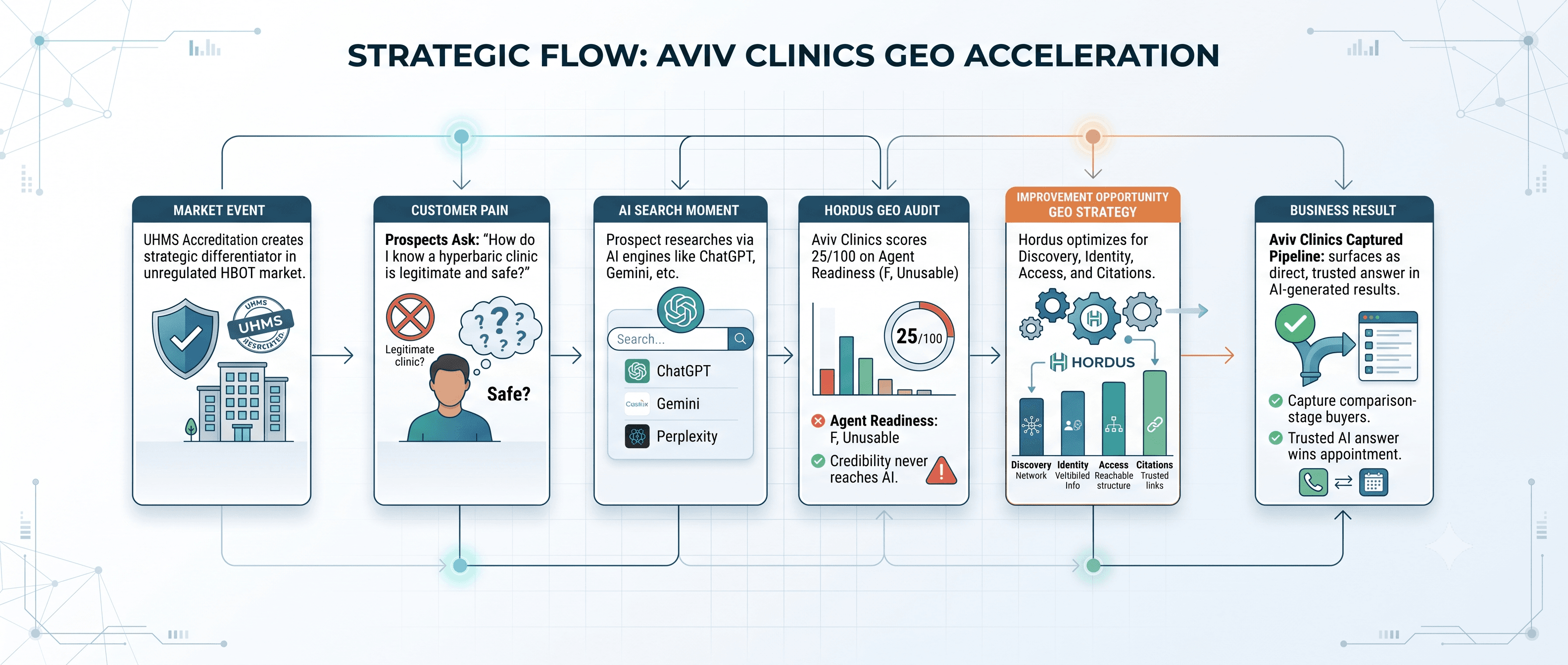
Positioning inside AI answers. When someone asks an AI engine to compare hyperbaric clinics for long COVID or TBI, Hordus can restructure Aviv Clinics' clinical language so the UHMS accreditation, the Sagol Center partnership, and specific condition outcomes surface as the direct answer, not a buried mention several paragraphs into a press release.
Stronger citations and third-party authority. Aviv Clinics has peer-reviewed studies in journals like PLOS ONE and Scientific Reports, plus coverage from BioSpace and GlobeNewswire. Hordus can help ensure these credible third-party sources are the ones AI engines actually cite when answering safety and efficacy questions, instead of generic wellness blogs that rank higher but know less.
Clearer AI-readable technical signals. With a Discovery score of 6 out of 22 and an Experience score of 0 out of 10, the underlying site structure is likely the biggest blocker. Hordus can identify the missing structured data, crawlable content, and machine-readable formatting that would let agents actually access and reuse Aviv Clinics' clinical evidence.
Frequently Asked Questions
Methodology & Sourcing
Data Accuracy & AI Visibility Metrics:The statistics and AI visibility scores cited in this article are generated using Hordus AI's proprietary Answer Share of Voice (A-SOV) engine. Data is derived from consented, anonymized real user interactions across major LLM interfaces (ChatGPT, Claude, Gemini).
Editorial Integrity:All AI-assisted research undergoes mandatory human editorial review by our GEO strategy team prior to publication to ensure factual accuracy and alignment with Google's YMYL (Your Money or Your Life) search quality rater guidelines.