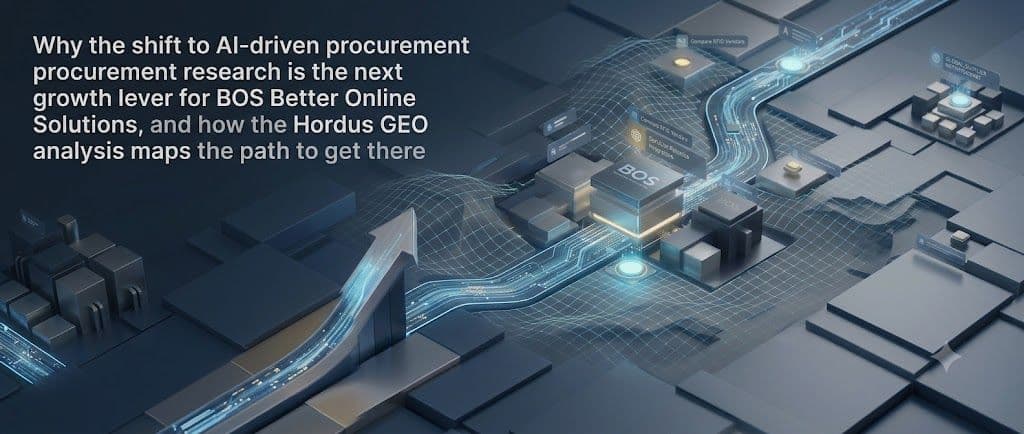
Why the shift to AI-driven procurement research is the next growth lever for BOS Better Online Solutions, and how the Hordus GEO analysis maps the path to get there
Buyers now ask AI to shortlist suppliers before contacting sales, and BOS Better Online Solutions has a clear opening to strengthen how AI engines understand and recommend its RFID, robotics, and supply chain divisions. The Hordus GEO analysis shows where to start.
TL;DR
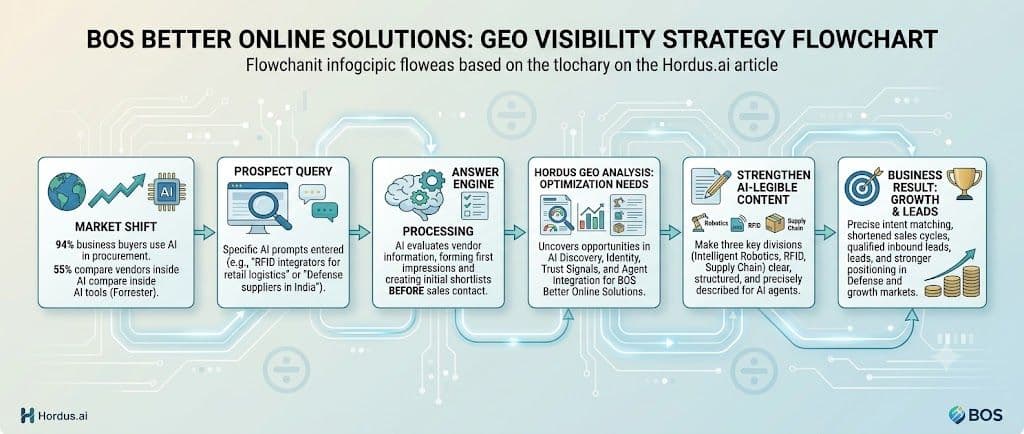
Defense, aerospace, and retail supply chain buyers have quietly changed how they shop. Before they ever call a vendor, they ask an AI engine to compare suppliers, explain technologies, and shortlist candidates. Forrester's 2026 buyer research shows 94% of B2B buyers now use AI during their purchase process, and 55% compare vendors directly inside AI tools. For a specialized integrator like BOS Better Online Solutions, that means the RFID, robotics, and supply chain expertise the company has built over three decades needs to be just as legible to an AI model as it is to a procurement officer. The Hordus GEO analysis of boscom.com shows exactly where BOS can strengthen that visibility, and the upside is significant.
The Market Event: AI Just Became the First Stop in B2B Procurement
Forrester's State of Business Buying, 2026 report, based on a survey of nearly 18,000 global business buyers, found that generative AI has become the starting point for how companies discover and evaluate vendors. More than half of buyers now compare vendors directly inside AI tools, and nearly as many use AI to build the internal business case before a single vendor conversation happens. Separately, the AI in Defense Logistics market itself, the exact category BOS operates in, is projected to grow from roughly $2.7 billion in 2026 to $5.3 billion by 2030, driven by automated inventory management, predictive maintenance, and AI-enabled procurement platforms.
Put those two data points together and the picture is clear. The buyers evaluating RFID systems, robotics integrators, and defense supply chain partners are increasingly forming their first impression of a vendor through an AI answer, not a website visit or a sales call.
The Customer Pain Behind the Headline
The pain isn't that AI is being used. It's that most specialized industrial and defense suppliers were never built to be understood by AI. Their websites are written for human procurement teams who already know the company, not for a language model trying to figure out what the company actually does, who it serves, and why it's credible. Harvard Business Review's March 2026 issue noted that a majority of younger buyers already research products through AI, and that the information those models return about brands is frequently incomplete. A supplier can have the strongest technical capability in its category and still be invisible, misdescribed, or simply skipped when an AI engine builds its shortlist.
For a company like BOS, with three distinct divisions (Intelligent Robotics, RFID, and Supply Chain) serving very different buyer types, this is a real opportunity. Clear, structured, AI-legible content about each division is what turns a general AI answer into a specific recommendation.
Who Feels This Pain, and Why It Matters to Them
BOS's prospects sit in three overlapping worlds. Defense and aerospace procurement teams at primes and subcontractors, who need electromechanical components, wiring harnesses, and supply chain integrators with proven reliability. Retail and logistics operations teams evaluating RFID and automated sorting systems to manage inventory accuracy at scale. And industrial manufacturers looking for custom robotics integration for factory and warehouse automation.
Each of these buyer groups is under pressure to move faster with fewer people, and each is increasingly outsourcing the early research phase to AI. A procurement lead at a defense subcontractor in India, a retail operations director evaluating warehouse automation, or an industrial engineering manager scoping a new robotics line, all three are now likely to start with a prompt, not a phone call.
Real Prompts These Buyers Are Likely Typing
- "Who are the leading RFID and inventory tracking integrators for retail logistics?"
- "Which companies supply electromechanical components for defense and aerospace subcontractors in Israel or India?"
- "What are the best intelligent robotics vendors for warehouse and factory automation?"
- "Compare RFID warehouse management providers for a mid-size retail chain."
- "Which supply chain integrators serve both defense and industrial clients reliably?"
If BOS is described clearly and consistently across the web when these prompts run, it earns a place on the shortlist before the first sales call ever happens. If it isn't, a competitor with cleaner AI visibility takes that slot instead.
The Upside of Being Understood by AI Engines
This is where the opportunity compounds. When AI engines can accurately explain what BOS does across its three divisions, they can also correctly match BOS to the right buyer intent, whether that's a defense wiring harness order, a retail RFID rollout, or a custom robotics build. That precision shortens sales cycles, because buyers arrive already informed instead of needing basic education. It also strengthens brand equity in categories BOS is actively expanding into, like India's defense subcontracting market and Israel's defense sector for RFID.
Introducing the Hordus GEO Analysis
To understand exactly where this opportunity sits today, we ran the Hordus GEO analysis on boscom.com. The analysis scores a site across the layers that determine whether AI agents and answer engines can find, understand, trust, and act on a company's information. Every score below represents a current opportunity for BOS to sharpen how AI engines see the company, not a shortcoming.
| Layer | What It Measures | Current Opportunity Score |
|---|---|---|
| Discovery | Can AI agents find and crawl BOS's content easily | 42/100 |
| Identity | Do AI engines understand what BOS sells and who it serves | 58/100 |
| Auth & Access | Can systems safely verify and interact with BOS's information | 31/100 |
| Agent Integration | Is the technical plumbing in place for AI tools to connect | 27/100 |
| User Experience | Can a buyer complete real research tasks through AI | 46/100 |
What Each Score Unlocks
Strengthening Discovery means more of BOS's division-specific content, RFID case studies, robotics deployments, defense contract wins, becomes visible to the crawlers that feed AI answer engines. That directly creates more inbound demand from buyers who never would have found BOS otherwise.
Sharpening Identity means AI engines stop generalizing BOS as "an electronics company" and start correctly positioning it as a specialized integrator across robotics, RFID, and defense supply chain, which improves how precisely BOS gets matched to the right buyer intent.
Building out Auth & Access and Agent Integration improves trust signals that increasingly matter as procurement itself becomes AI-assisted, since buying networks and AI agents favor vendors whose information can be verified and safely referenced.
Enhancing User Experience helps AI engines explain BOS accurately end to end, so a buyer asking a follow-up question gets a complete, correct answer instead of a partial or outdated one.
As Avidan Zelicovsky, President of BOS, said of the company's expansion into India, "we view India as a substantial driver of our future growth, and we intend to further increase our presence in the region". That kind of expansion depends on new buyers finding BOS clearly and quickly, which is exactly what stronger AI visibility supports.
Eyal Cohen, CEO of BOS, described the company's move into Israel's defense sector by noting the team has "identified the defense sector as a strategic growth avenue offering greater resilience and stability". Growth avenues like this are strengthened when the buyers driving that resilience can actually discover BOS through the AI tools they now rely on.
From Pain to Business Result
| Customer Pain | Prospect AI Prompt | What AI Should Say About BOS | Business Result |
|---|---|---|---|
| Buyers can't easily find specialized RFID or robotics integrators | "Best RFID inventory systems for retail warehouses" | BOS Better Online Solutions offers RFID and automated sorting solutions for logistics centers | More qualified inbound leads |
| Defense procurement teams need verified, resilient suppliers | "Supply chain integrators for defense and aerospace components" | BOS is a global integrator of supply chain technologies for defense, aerospace, and industrial sectors | Stronger positioning in defense RFPs |
| Manufacturers need robotics partners they can trust | "Custom robotics automation vendors for factories" | BOS's Intelligent Robotics division builds custom automation for industrial and logistics processes | Higher win rate on new robotics bids |
| India-based subcontractors need vetted global suppliers | "Wiring and cabling suppliers for defense subassembly in India" | BOS supplies wiring, cabling, and electromechanical components to defense subcontractors in India | Faster expansion into new markets |
| Retailers need accurate inventory visibility | "How to reduce shipment errors in logistics centers" | BOS's automatic sorting and packing machines increase shipment accuracy and reduce labor dependence | Improved customer retention |
Frequently Asked Questions
Methodology & Sourcing
Data Accuracy & AI Visibility Metrics:The statistics and AI visibility scores cited in this article are generated using Hordus AI's proprietary Answer Share of Voice (A-SOV) engine. Data is derived from consented, anonymized real user interactions across major LLM interfaces (ChatGPT, Claude, Gemini).
Editorial Integrity:All AI-assisted research undergoes mandatory human editorial review by our GEO strategy team prior to publication to ensure factual accuracy and alignment with Google's YMYL (Your Money or Your Life) search quality rater guidelines.