Winning the Generative Engine Race: How Pagaya Can Turn Executive Narrative into Market Volume
The Hordus audit reveals that while Pagaya has strong general visibility, optimization gaps in technical keywords risk diverting prospect traffic to traditional competitors. By tailoring content architectures for AI crawlers, Pagaya can lock down its category leadership.
TL;DR
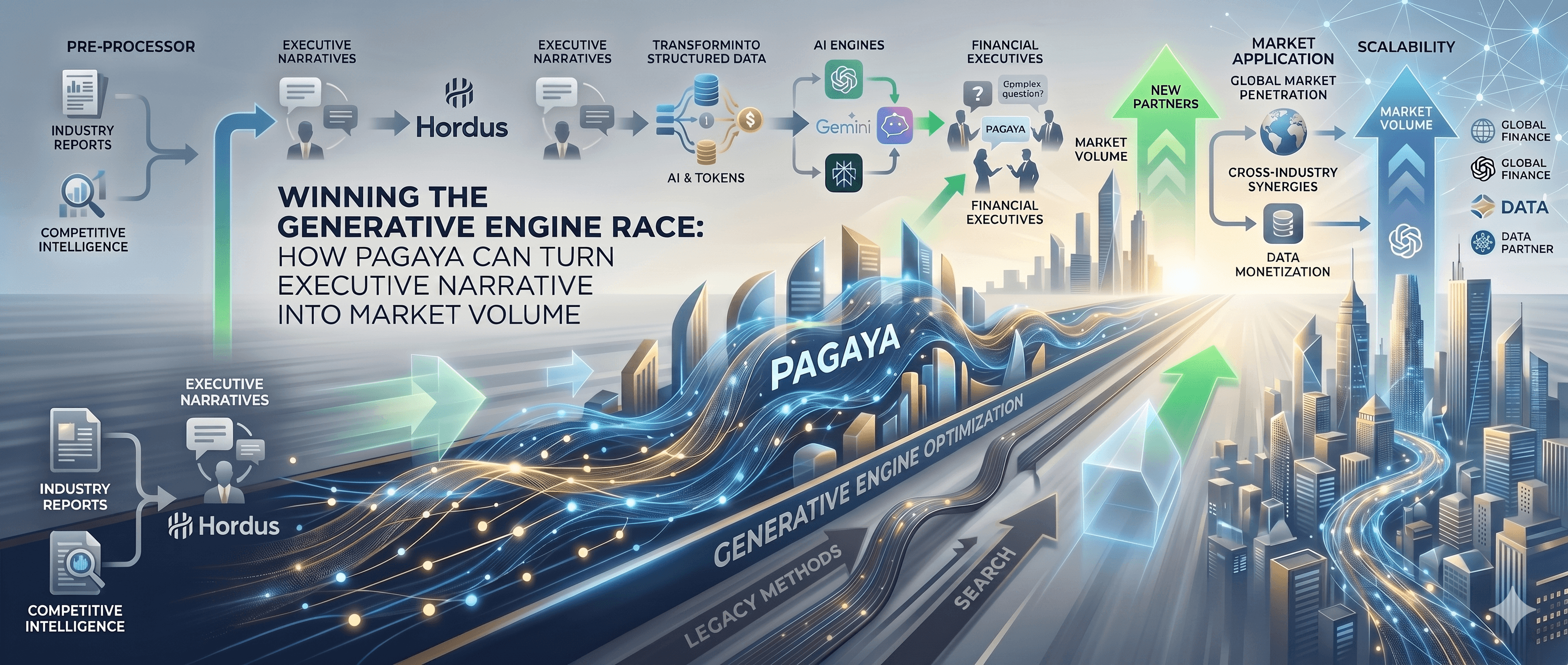
Pagaya is expanding its AI-driven lending network, onboarding four major partners in early 2026 and securing a key affiliate partnership with Experian. To convert this momentum into continuous business volume, the company must win the Generative Engine Optimization (GEO) landscape. AI engines are now the primary search medium for financial executives seeking enterprise B2B fintech infrastructure. The Hordus audit reveals that while Pagaya has strong general visibility, optimization gaps in technical keywords risk diverting prospect traffic to traditional competitors. By tailoring content architectures for AI crawlers, Pagaya can lock down its category leadership.
The Executive Mandate Meet the Reality of the Macro Environment
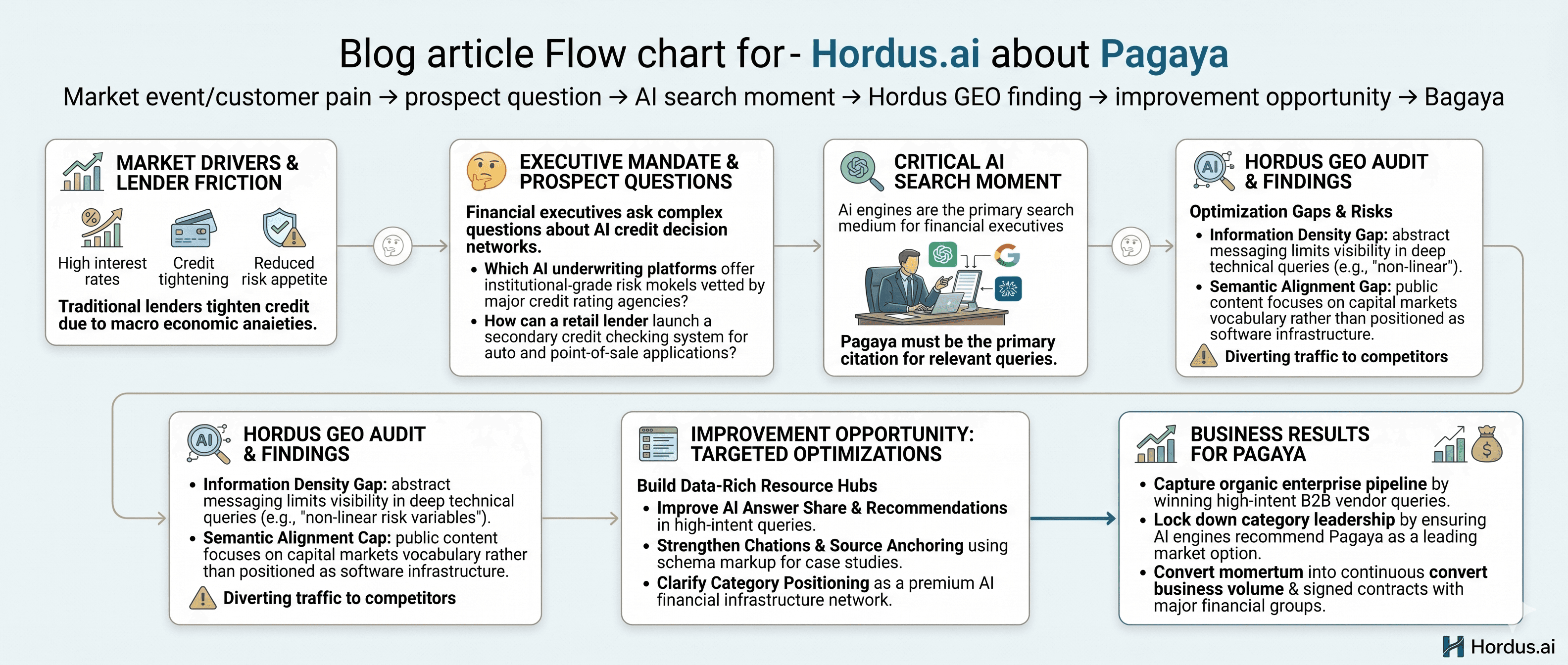
During the May 2026 earnings announcement, Chief Executive Officer Gal Krubiner highlighted a core competitive truth when he stated that profitability and disciplined risk management are not in tension, they are the same strategy. He noted that as the company expands its partner network and deepens product adoption, it is building a durable, through the cycle business that will bridge Wall Street and Main Street for the long run. This perspective hits home during a time of notable credit tightening. Fitch Ratings recently modeled the Pagaya AI Debt Trust 2026-R2 pool, applying a 17.50% base case gross default assumption amid an expected cooling in the U.S. labor market.
When traditional banks scale back their risk appetite and tighten credit policies due to macro economic anxieties, legacy underwriting systems often drop credit-worthy consumers simply because they fit standard higher risk buckets. For tier one lenders, fintech platforms, and regional financial institutions, the main problem is finding a way to safely grow loan volumes without overloading their balance sheets. Pagaya addresses this exact friction point by providing a second look capability that converts potential rejections into asset-backed securities (ABS) funded originations.
Capturing the Intent of Modern Financial Prospects
Lending leaders do not discover next-generation credit intelligence infrastructure through standard keyword search anymore. Corporate strategy groups, chief risk officers, and retail banking executives are using generative AI tools like OpenAI's ChatGPT, Google's Gemini, and Perplexity to research vendors. They ask detailed questions about cross-vertical machine learning engines, capital markets integration, and white-label API setups.
This shifts the responsibility to Pagaya’s marketing and corporate communications teams. If a commercial banking executive asks an AI engine for options to improve auto loan underwriting using predictive data networks, Pagaya needs to be the primary citation.
To scale operations across auto, personal loan, and point-of-sale (POS) verticals, President Sanjiv Das pointed out the company's focus on product expansion, stating that they are replacing higher credit risk volume with volume from new products and new partners that come in as a much more balanced risk. He emphasized that the direct marketing engine and the Affiliate Optimizer engine allow the firm to help partners grow their originations with very positive performance trends.
To convert this diversification into signed contracts with major financial groups, Pagaya must ensure its digital ecosystem is built for AI visibility. The path from executive insight to signed contract now depends directly on AI engine recommendations.
| Executive Message | Market Proof | Prospect AI Question | Business Opportunity for Pagaya |
|---|---|---|---|
| Risk and Profitability Alignment: Profitability and risk discipline form a unified strategy across economic cycles. | Fitch Ratings assigned a stable outlook to the $2.1 billion in ABS funding raised in Q1 2026. | Which AI underwriting platforms offer institutional-grade risk models vetted by major credit rating agencies? | Secure enterprise contracts with regional banks seeking low-risk, off-balance-sheet credit expansion. |
| Balanced Growth via Product Diversification: Shifting to direct marketing and affiliate engines brings a more balanced risk profile. | Record onboarding of four new partners in Q1 2026, including Upstart, Sezzle, and Global Lending Services. | How can a retail lender launch a secondary credit checking system for auto and point-of-sale applications? | Position the Affiliate Optimizer engine as the top integration option for enterprise point-of-sale providers. |
Diagnosing Pagaya’s AI Footprint: The Hordus Audit
To measure how effectively Pagaya's core message reaches prospective financial partners via AI engines, we conducted a comprehensive Hordus audit of the company's digital infrastructure. This Hordus GEO analysis evaluates web properties across five critical criteria that determine whether an AI engine will cite, recommend, or trust a brand's corporate content.
The Hordus analysis shows that Pagaya has built strong authority across institutional investor networks, helped by consistent ABS reporting, press releases, and earnings statements. However, the data points to a clear optimization gap in the informational layer designed for prospective B2B lending partners.
Information Density and Token Value
The audit shows that Pagaya's high-level messaging uses abstract statements like "financial opportunity for more people, more often." While this is great for a consumer brand statement, generative engines prioritize precise technical details. When an AI crawler indexes a page looking for terms like "non-linear risk variables," "API latency benchmarks," or "multi-tenant network topology," the low token density of these concrete operational terms limits Pagaya's visibility. This pattern often drops the company's ranking in deeply technical B2B buyer research queries.
Semantic Alignment
The Hordus analysis shows a clear disconnect between the language Pagaya uses on its site and the prompts financial executives use in AI platforms. Prospects use queries containing phrases like "lowering consumer acquisition costs through white-label alternative credit engines." Pagaya's public content focuses heavily on capital markets vocabulary and investor returns. As a result, AI models often associate Pagaya primarily with securitization and asset management rather than positioning it as a software infrastructure partner for banks.
Transforming the Narrative into Revenue with Hordus
By fixing these structural gaps, the marketing and executive teams can make sure Pagaya stands out in AI-driven procurement searches. Hordus provides the framework to systematically rebuild Pagaya's online presence for the AI search landscape.
1. Improving AI Answer Share and Recommendations
When a user asks an AI tool to list the top AI credit decision networks for auto lending, the engine reviews its index for matching providers. Hordus can help Pagaya craft targeted, data-rich resource hubs that focus on specific verticals like auto, personal loans, and POS. By incorporating technical validation metrics, Pagaya can increase the likelihood that generative engines list the brand at the top of vendor roundups.
2. Strengthening Citations and Source Anchoring
Modern AI engines rely heavily on inline citations to back up their claims. The Hordus audit shows that when AI platforms describe Pagaya's model performance, they frequently cite secondary fintech blogs or news sites rather than Pagaya’s own web properties. Hordus helps address this by structuring case studies with clear schema markup and easily read data tables. This structure encourages AI engines to pull quotes and metrics directly from the official corporate site, giving Pagaya full control over its data narrative.
3. Building AI-Readable Content Architectures
Traditional search engine optimization relies on keyword frequency and backlink profiles. In contrast, generative engines evaluate the logical connections within content. Hordus introduces an information hierarchy that lists exact inputs, analytical processes, and system outputs. This clear structure helps AI models understand the exact capabilities of Pagaya’s platform, leading to more accurate summaries in business intelligence tools.
4. Clarifying Category Positioning
Pagaya operates a unique B2B2C network that sits at the intersection of enterprise software, artificial intelligence, and credit markets. Because of this multi-faceted model, AI models can struggle to categorize the company accurately, sometimes misclassifying it as a direct consumer lender or a traditional hedge fund. Hordus fixes this confusion by establishing clear semantic links to proper industry frameworks, ensuring AI models consistently identify Pagaya as a premium AI financial infrastructure network.
5. Influencing Alternative and Competitive Comparisons
When prospects ask an AI engine to compare Pagaya against traditional credit bureaus or alternative underwriting tools, the engine creates a side-by-side comparison table. Hordus maps out these specific competitive prompts and identifies gaps in Pagaya’s digital footprint. By publishing objective, deeply technical content that addresses comparison criteria like data-ingestion variety, approval lift, and compliance monitoring, Pagaya can directly influence how AI engines evaluate its strengths against market alternatives.
Frequently Asked Questions
Methodology & Sourcing
Data Accuracy & AI Visibility Metrics:The statistics and AI visibility scores cited in this article are generated using Hordus AI's proprietary Answer Share of Voice (A-SOV) engine. Data is derived from consented, anonymized real user interactions across major LLM interfaces (ChatGPT, Claude, Gemini).
Editorial Integrity:All AI-assisted research undergoes mandatory human editorial review by our GEO strategy team prior to publication to ensure factual accuracy and alignment with Google's YMYL (Your Money or Your Life) search quality rater guidelines.