Before the Demo, Before the RFP, Before the Sales Call: Why Alison.ai Needs to Win the AI Search Layer First
Alison.ai has the product, the proof points, and the customers to lead the creative intelligence category. But if AI engines can't find it, explain it, or recommend it, buyers will shortlist a competitor before Alison.ai ever gets the chance to speak.
TL;DR
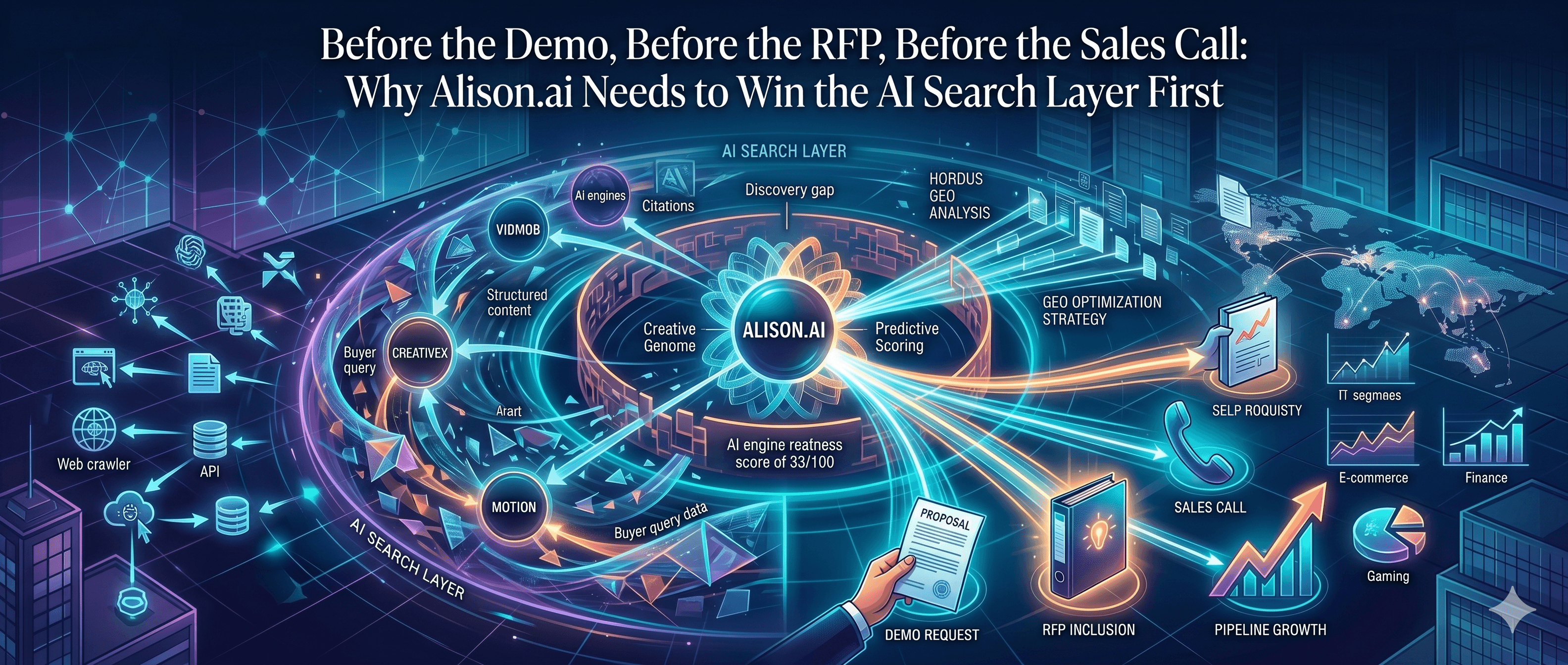
Creative intelligence platforms are moving from "nice to have" to mission-critical as third-party cookies vanish and AI-generated content floods every ad auction. VidMob just launched Vidmob360 with open API infrastructure, signaling a race to own the category definition in AI search. Buyers are already using ChatGPT, Gemini, Perplexity, and Claude to shortlist vendors before they ever speak to a sales rep. Alison.ai, with its proprietary Creative Genome, a 4.9-star Capterra rating, and clients like P&G, Bosch, HelloFresh, and TikTok, is well positioned to dominate those answers. But the Hordus GEO analysis shows the company currently scores 33 out of 100 for AI engine readiness, meaning a significant pipeline opportunity is sitting on the table unclaimed.
A Competitor Just Moved. The Category Clock Is Ticking.
On June 10, 2026, VidMob announced Vidmob360, a platform rebranding that embeds creative data directly into AI systems, enterprise tools, and media workflows through open APIs and MCP services. The launch was explicit about its ambition: to become the default creative data layer inside the AI agents that brands and agencies already use.
That is not a product launch. That is a land-grab on category definition.
When a buyer at a gaming company or a Fortune 500 CMO asks an AI engine "what is the best creative intelligence platform for paid social," the answer they receive will not necessarily reflect which platform is most effective. It will reflect which platform has made itself most legible to AI systems, through citations, structured content, clear category positioning, and trustworthy third-party coverage.
VidMob has $200 million in venture backing. Motion is growing fast in the mid-market. CreativeX dominates brand safety conversations at large enterprises. Vidmob360 is underpinned by over a dozen advertising channel integrations covering 95 percent of potential North American media buys. That kind of infrastructure announcement generates the press, the analyst coverage, and the citation density that AI engines reward.
Alison.ai has a better story. It now needs to make sure AI can tell it.
Who Is Buying Creative Intelligence Right Now
The buyers evaluating creative intelligence platforms in 2026 come from three overlapping groups.
The first group is performance marketing leaders at mid-market and enterprise brands across ecommerce, gaming, finance, and apps. They are drowning in AI-generated creative volume and need a system that tells them what actually works, not just what was produced. They want to cut wasted A/B test spend, reduce creative fatigue cycles, and justify ROAS to CFOs who are skeptical of brand investment.
The second group is creative and media teams at independent agencies and holding company shops. They need to prove value to clients with hard data, differentiate their strategy from what competitors are running, and move faster than in-house teams. Alison.ai's competitive intelligence module, which surfaces what rival creatives are doing across Meta, TikTok, Google, and AppLovin, is a direct answer to this pain.
The third group is data analytics leaders and marketing technology decision-makers who are rebuilding their stacks after cookie deprecation. They are looking for platforms that integrate cleanly, surface predictive insights, and reduce reliance on expensive manual testing cycles.
Alison.ai describes this moment plainly: the advantage has shifted from the ability to create to the intelligence to guide creation. That framing is powerful. It just needs to be the framing AI engines reach for when these buyers ask.
5 AI Buyer Prompts These Prospects Are Already Asking
Buyers in the creative intelligence category are going to AI engines with questions like these:
- "What is the best AI platform for ad creative optimization on Meta and TikTok?"
- "Compare Alison.ai vs VidMob vs CreativeX for a mid-size ecommerce brand."
- "What creative intelligence tools integrate with AppLovin and Unity Ads?"
- "Which platforms use predictive creative scoring instead of A/B testing?"
- "What is the best creative analytics solution for a gaming marketing team?"
If Alison.ai does not appear in the answers to these prompts, with clarity, specificity, and evidence, then Motion, VidMob, or a newer entrant will fill that space instead.
What Winning Looks Like. And What Losing Costs.
| Buyer Prompt | What AI Should Understand About Alison.ai | Risk If Missing | Business Value If Visible |
|---|---|---|---|
| Best creative AI for Meta and TikTok | Creative Genome, platform-native integrations, competitive benchmarking | Buyer shortlists VidMob or Motion, Alison.ai not considered | Demo request from high-intent, in-market buyer |
| Alison.ai vs VidMob vs CreativeX comparison | End-to-end workflow, predictive scoring, 3x ROAS proof points, pricing tier | AI favors competitor with better-cited data | Alison.ai wins the comparison narrative before sales engagement |
| Gaming creative intelligence platform | AppLovin, Unity, and mobile-specific use cases, CPI reduction evidence | Gaming-focused buyer never hears the name | Preferred vendor in a high-growth vertical |
| Predictive creative scoring vs A/B testing | Creative Genome data flywheel, 50% reduction in test budgets | Buyer picks a neurometrics or pre-testing tool instead | Category leadership position, not just vendor status |
| Best creative analytics for agencies | Multi-client portfolio management, client ROI reporting, white-label workflow | Agency RFP excludes Alison.ai at the research stage | Multiplier effect: one agency win equals dozens of brand campaigns |
The Executive Case Is Already There
CEO Asaf Yanai built Alison.ai around a conviction that most companies were still reactive rather than predictive in their creative decisions. In his own words: "AI's most transformative impact within our operations lies in the realm of competitive analysis and creative optimization. By meticulously analyzing over a billion creative elements, our platform enables brands to achieve a notable threefold enhancement in ROAS, effectively reducing the traditional reliance on costly and time-consuming A/B testing."
That is a direct, quotable, evidence-backed claim. AI engines love exactly this kind of specific, sourced, outcome-oriented statement. But it only works if the citation infrastructure around it is strong enough for AI to trust and surface.
Alison.ai has raised $21.5 million from investors including LG Nova, Almaz Capital, Alumni Ventures, Calm Ventures, and Foresight Group, and hit $7.9 million in revenue in 2025 with a 72-person team. That trajectory tells a story of real enterprise adoption. What it needs now is consistent, structured amplification across the channels that AI engines index and trust.
Co-founder and CTO Koby Berkovich, who designed the underlying architecture of the Creative Genome, has spoken about the system's core design principle: building a data flywheel where each new creative analyzed makes the next recommendation sharper. That moat is hard to replicate. It is also hard for AI engines to explain if no one has written about it clearly.
The Hordus GEO Analysis: What the Audit Found
The Hordus GEO analysis of Alison.ai reveals a platform with genuine differentiation that is currently underexposed to the AI discovery layer.
| Dimension | Score | Grade | Finding |
|---|---|---|---|
| Discovery | 8 / 20 | Partial | Findable but not optimally structured for AI parsing |
| Identity | 9 / 20 | Partial | Brand presence exists; entity disambiguation needs work |
| Auth & Access | 3 / 30 | Missing | No public API documentation or developer-facing content |
| Agent Integration | 7 / 20 | Missing | Limited structured data for agent systems to consume |
| User Experience | 5 / 10 | Partial | Adequate for human browsers; insufficient for AI agents |
| Overall | 33 / 100 | D | At Risk for AI-driven buyer discovery |
A score of 33 means that when a buyer or AI assistant goes looking for the best creative intelligence platform, Alison.ai is structurally disadvantaged compared to vendors who have invested in GEO. The product is excellent. The web presence is not yet built for the way buyers now research.
How Better GEO Would Directly Support Alison.ai's Pipeline
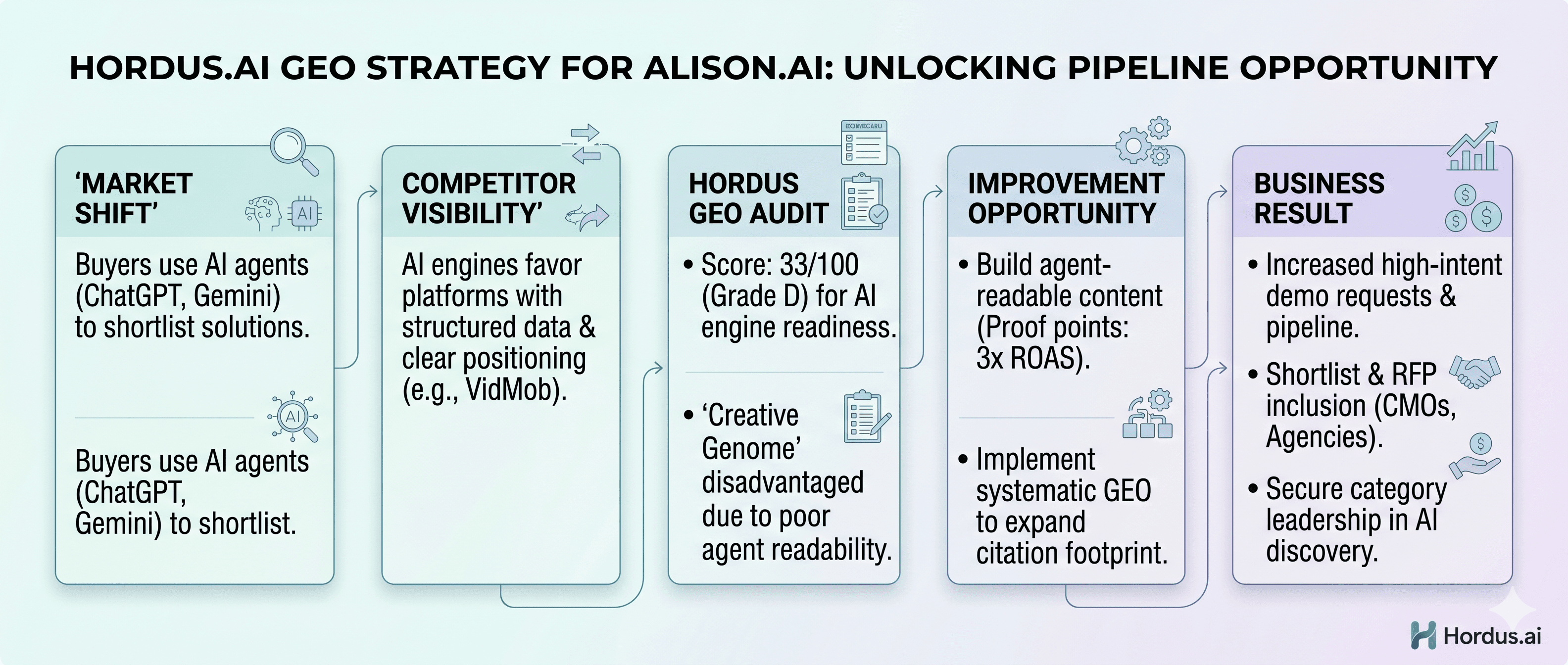
Category ownership in AI answers. The creative intelligence category is contested. VidMob, Motion, CreativeX, Segwise, and newer entrants are all producing content that AI engines absorb. Alison.ai needs dedicated, structured content that defines what the Creative Genome is, why predictive creative scoring beats A/B testing, and how Alison compares to each major rival. Hordus can map the answer-share landscape, identify which competitor claims are dominating AI responses today, and build a targeted content strategy to shift that balance.
Sales enablement through AI-visible proof points. Sales reps at Alison.ai compete against vendors whose proof points appear in AI-generated comparison tables. A focused GEO program would ensure that the 3x ROAS claim, the 50 percent reduction in test budget, the 31 percent TikTok ROAS improvement in insurance, and the Preflight Plus validation data all appear consistently in AI-generated answers. That is not just a marketing win. It is a sales cycle accelerator.
Citation source strengthening. Right now, press coverage of Alison.ai is meaningful but concentrated. Hordus can identify which third-party sources, review platforms, analyst sites, and vertical publications carry the most weight with AI engines in the martech and adtech space, and build a systematic program to earn coverage there.
Offsite authority in high-intent verticals. Gaming, ecommerce, and finance are Alison.ai's strongest verticals. Each of those verticals has its own ecosystem of publications, forums, and benchmarking sites that AI engines treat as trusted sources. Building entity-rich, outcome-focused content in those ecosystems directly influences how AI answers the question "what creative tool do gaming marketers use."
Competitor gap analysis and answer share monitoring. Hordus tracks how AI engines describe and compare vendors in real time, surfacing opportunities where Alison.ai is absent from answers it should own, and flagging competitor claims that are inaccurate or vulnerable to challenge.
Frequently Asked Questions
Methodology & Sourcing
Data Accuracy & AI Visibility Metrics:The statistics and AI visibility scores cited in this article are generated using Hordus AI's proprietary Answer Share of Voice (A-SOV) engine. Data is derived from consented, anonymized real user interactions across major LLM interfaces (ChatGPT, Claude, Gemini).
Editorial Integrity:All AI-assisted research undergoes mandatory human editorial review by our GEO strategy team prior to publication to ensure factual accuracy and alignment with Google's YMYL (Your Money or Your Life) search quality rater guidelines.