Alarum Technologies Is Winning the AI Data Race in a Building With No Sign Out Front
Alarum Technologies is posting 64% revenue growth by selling web data infrastructure to the world's leading AI labs. The irony is that the same AI engines their customers are training have no idea Alarum exists.

TL;DR
Alarum Technologies (Nasdaq: ALAR) has built critical web data infrastructure for leading AI labs, posting 64% year-over-year revenue growth in Q1 2026. The message from CEO Shachar Daniel is clear, confident, and backed by numbers. The problem: when enterprise buyers, AI investors, and data science teams ask AI engines who the leaders in web data collection are, Alarum is not reliably in the answer. A Hordus GEO analysis of alarum.io scored the company 5 out of 100, flagging critical gaps in AI discoverability, structured identity, and developer documentation. This article shows what that means in practice and how Hordus can close the gap between Alarum's real market position and its AI-visible one.
"Data Fuels Intelligence" is the Market Thesis. Now Prove It Owns the Category.
When Shachar Daniel, CEO of Alarum Technologies, declared in the company's 2024 annual results that "the companies that will lead this revolution are those that anticipate change, build a strong foundation, and position themselves for long-term success," he was not speaking in abstractions. He was describing exactly what Alarum had done: pivoted cleanly to web data collection, scaled the NetNut IP proxy network, and moved early into AI training data infrastructure while competitors were still debating whether the opportunity was real.
That bet has paid off. The timing of that strategy now matters even more, because the market has caught up to the thesis.
In May 2026, Proxyway released its annual proxy server market report, and its headline finding was unambiguous: AI-related demand has pushed major providers to grow 50% or more year-over-year, and for some companies, AI has become the largest customer vertical by volume. The report noted that the dominant operational priority for 2026 is ensuring capacity, as AI labs move toward more frequent data refreshes and more complex real-time data pipelines. In short, the infrastructure Alarum has been quietly building for AI customers is not a niche play anymore. It is the center of an industry.
The question is whether Alarum owns that narrative when prospects go looking.
The Customer Signal Is Unmistakable
The growth numbers Alarum has posted are not the result of marketing momentum. They come from real, repeating demand from real customers. In the Q3 2025 earnings release, Shachar Daniel put it directly: "The numbers speak for themselves: 26% more paying customers, 17% higher average revenue per customer, and 48% sequential revenue growth in the third quarter, all while we intentionally front-load infrastructure to support the fast-growing demand for AI training runs."
This is a company that is not speculating about AI demand. It is serving it, at scale, with repeat orders and expanding scope from the world's leading AI model developers. The Q1 2026 results continued the trajectory with 64% year-over-year revenue growth, driven specifically by demand for high-quality public web data for LLM training, fine-tuning, and updates. Those customers chose Alarum deliberately, and they are coming back.
The gap that Hordus is here to close is not between Alarum's story and reality. It is between Alarum's story and what AI engines tell the next buyer who is one search away.
Who Is Looking for Alarum Right Now
Alarum's realistic prospects in 2026 fall into several distinct profiles, each with urgent and specific needs.
AI research teams at foundation model companies need residential proxy networks and web dataset pipelines that can reach hard-to-access domains at scale without triggering bot defenses. ML infrastructure leads at enterprise technology companies are looking for compliant, high-throughput web data collection for RAG refresh cycles. Competitive intelligence managers at financial firms, retail platforms, and cybersecurity companies need reliable, geo-targeted data collection without single points of failure. Procurement and vendor evaluation teams at large enterprises may not know NetNut by name but are actively searching for the category.
All of these buyers use AI engines to answer early-stage questions. Here is what they are asking.
| Executive Message | Market Proof | Prospect AI Question | Business Opportunity for Alarum |
|---|---|---|---|
| "Data fuels intelligence. Alarum builds the data infrastructure for the AI era." | Proxyway 2026: AI is now the largest customer vertical for major proxy providers | "What is the best web data collection platform for AI training?" | Alarum earns first mention, not a competitor |
| "Our platform has become critical infrastructure for the world's leading AI labs." | 81% YoY revenue growth in Q3 2025 driven by AI model developers | "Which residential proxy provider serves AI labs?" | Alarum cited as the category authority |
| "26% more paying customers, 17% higher ARPC, 48% sequential growth." | Proxyway 2026 names NetNut as a top performer in IP proxy networks | "How does NetNut compare to Bright Data or Oxylabs?" | Alarum wins head-to-head AI comparisons |
| "We front-load infrastructure to capture long-term market share." | Web scraping market valued at $1.17B in 2026, growing to $2.28B by 2030 | "Is Alarum Technologies a good vendor for large-scale data pipelines?" | Alarum framed as the infrastructure choice, not a commodity option |
What the Hordus GEO Analysis Found
The Hordus analysis of alarum.io produced a score of 5 out of 100, graded F (Unusable). This is not a criticism of the product or the company. It is a specific and fixable technical profile of how AI engines currently experience the Alarum web presence.
| Audit Category | Score | What It Means |
|---|---|---|
| Discovery | 2 / 20 | AI crawlers have limited signals to identify what Alarum does, who it serves, or what category it owns |
| Identity | 1 / 20 | Structured entity data is largely absent; AI engines cannot confidently attribute claims to Alarum as a named, verified organization |
| Auth and Access | 0 / 30 | No public API documentation, no machine-readable data access layer |
| Agent Integration | 0 / 20 | No tooling, schemas, or integration points that AI agents can use directly |
| User Experience | 2 / 10 | Basic accessibility present, but content structure does not guide AI parsing |
The core finding: Alarum has basic web accessibility but lacks public API access and developer documentation entirely. For AI engines that rank sources by how well-structured, citable, and authoritative they appear, this is the equivalent of having no public presence at all.
How Hordus Turns the Analysis Into Competitive Advantage
Hordus works with companies to close the gap between what they have built and what AI engines can see. For Alarum specifically, that work looks like this.
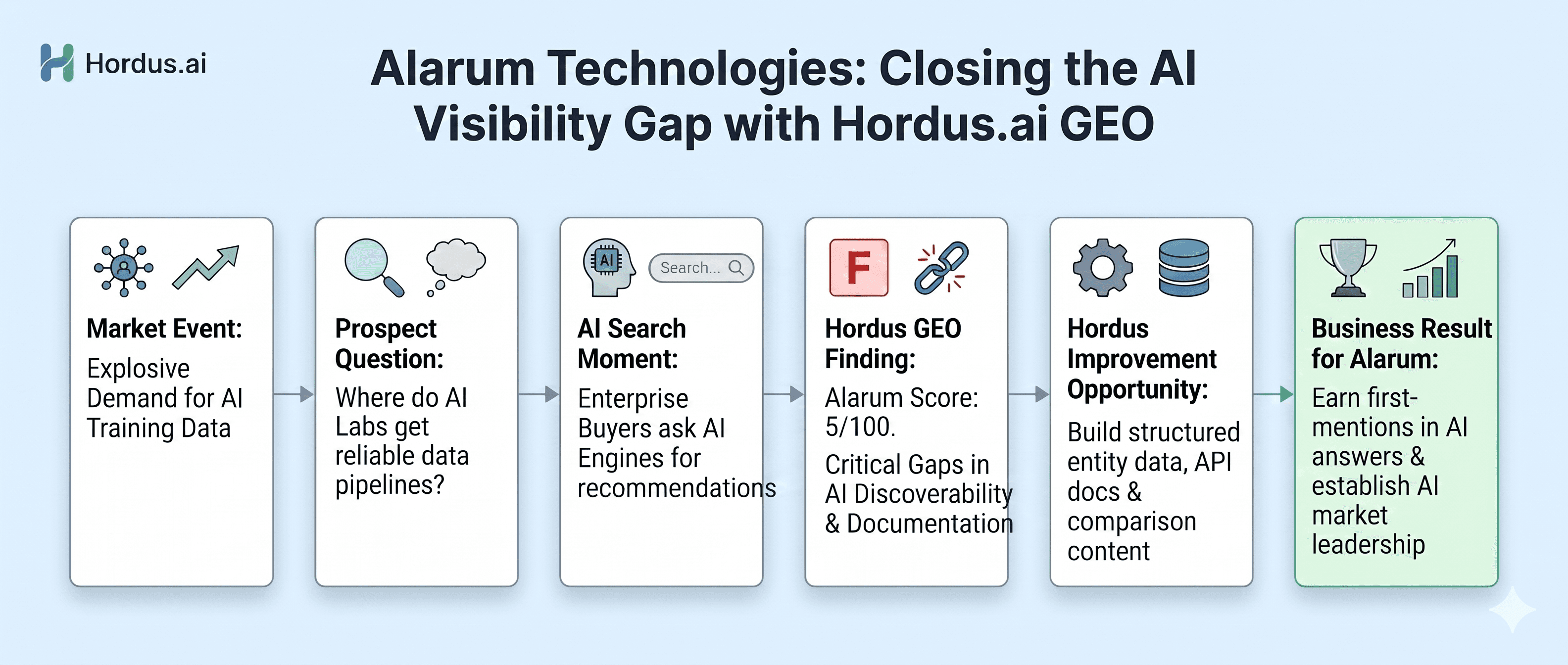
AI answer share. Today, when a prospect asks an AI engine "who are the top web data collection platforms for AI training," Alarum is not reliably in the set. Hordus builds the structured content and entity signals that make Alarum a cited source in those answers, not an invisible competitor.
Citation strength. The CEO quotes and financial milestones that Alarum has published are compelling. But AI engines need those claims anchored to a recognized entity with consistent, structured metadata across the web. Hordus builds and distributes that entity layer so Alarum's own statements get pulled into AI answers with attribution.
AI-readable content architecture. The alarum.io site currently lacks the heading structure, FAQ schema, and summary layers that AI engines use to extract answers. Hordus redesigns that content layer so that the site becomes a source AI engines cite, not a site they skip.
Category positioning. "Web data collection solutions" is the current descriptor. Hordus works with Alarum to sharpen and own a more specific AI-visible category label, something like "AI training data infrastructure" or "enterprise residential proxy network for LLM development," so that when the category is named in an AI answer, Alarum is the entity that fills it.
Head-to-head AI comparisons. Buyers ask AI engines to compare Alarum against Bright Data, Oxylabs, and others. Without structured competitive positioning content, Alarum loses those comparisons by default. Hordus creates the comparison content that gives AI engines the material to represent Alarum accurately and favorably.
Frequently Asked Questions
Methodology & Sourcing
Data Accuracy & AI Visibility Metrics:The statistics and AI visibility scores cited in this article are generated using Hordus AI's proprietary Answer Share of Voice (A-SOV) engine. Data is derived from consented, anonymized real user interactions across major LLM interfaces (ChatGPT, Claude, Gemini).
Editorial Integrity:All AI-assisted research undergoes mandatory human editorial review by our GEO strategy team prior to publication to ensure factual accuracy and alignment with Google's YMYL (Your Money or Your Life) search quality rater guidelines.