Destroying Cancer Cells With Physics. Losing Market Share to an Algorithm. Alpha Tau Medical's Next Battleground.
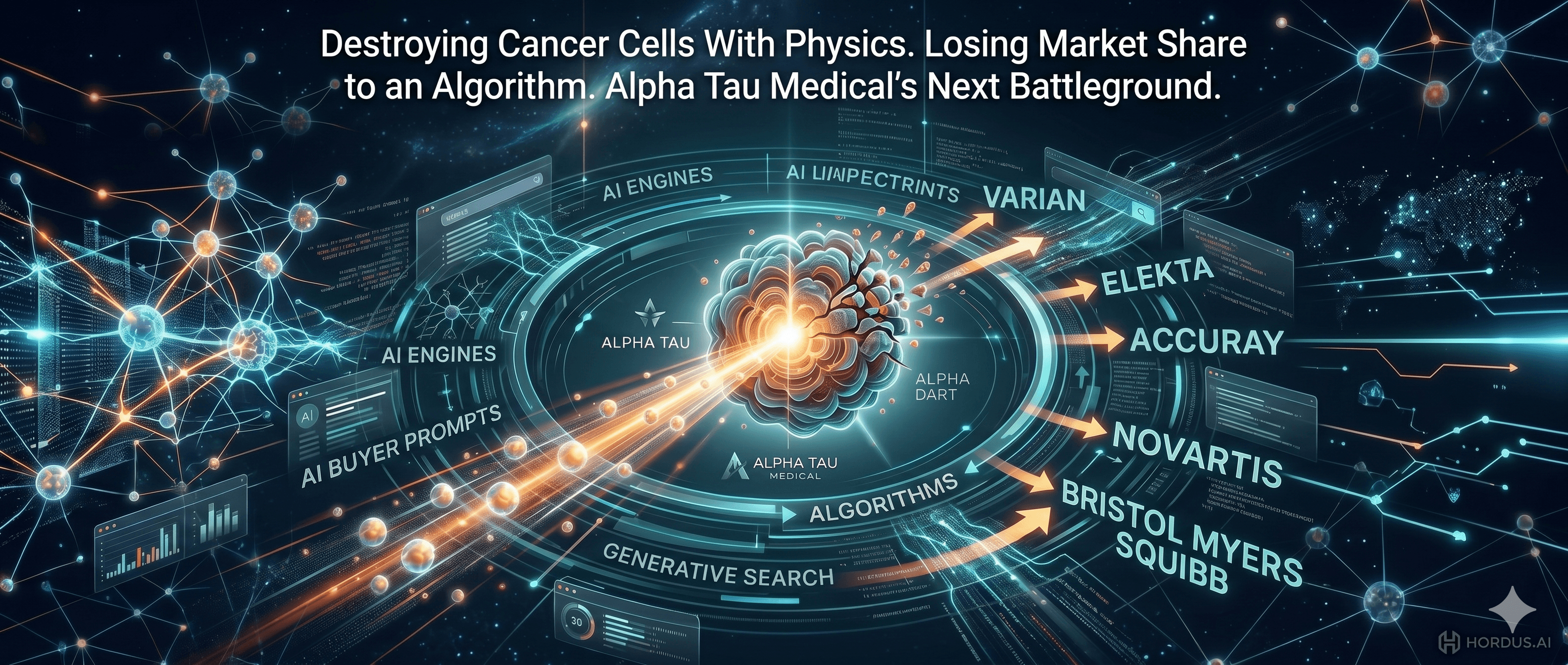
Alpha Tau Medical has clinical data strong enough to reshape oncology, but a Hordus GEO audit score of 41/100 reveals that AI engines, now the first stop for hospital procurement teams, radiation oncologists, and healthcare investors, can barely find them. While competitors like Varian, Elekta, and Novartis dominate AI-generated shortlists, Alpha Tau's window to own the intratumoral alpha radiation category in the AI discovery layer is open right now and closing fast.
TL;DR
Alpha Tau Medical (NASDAQ: DRTS) has compelling clinical data, five active U.S. FDA trials, a landmark pancreatic cancer survival result presented at ASCO 2026, and a category-defining technology in Diffusing Alpha-emitters Radiation Therapy (Alpha DaRT). But in 2026, radiation oncologists, hospital procurement committees, and health system executives increasingly begin their vendor research with an AI engine, not a Google search. If those AI engines cannot clearly describe Alpha DaRT, position it against Varian, Elekta, Accuray, IBA, and radiopharmaceutical competitors like Novartis (Lutathera) and Bristol Myers Squibb (Pluvicto), and surface Alpha Tau in category shortlists, the company risks losing attention before sales ever engages. The Hordus GEO analysis of alphatau.com scored 41/100 (grade D), signaling a concrete gap between the clinical story Alpha Tau owns and the story AI engines are telling about it. Closing that gap is a pipeline and market access opportunity, not a marketing side project.
The Market Event That Should Have Every Oncology Buyer Asking AI Questions Right Now
At the 2026 ASCO Annual Meeting, Alpha Tau presented strong overall survival results from its Alpha DaRT pancreatic cancer studies. Pancreatic cancer kills up to 87% of newly diagnosed patients before surgery is even possible. There is no established standard of care once first-line chemotherapy fails. Alpha Tau is running active multi-center trials in the U.S. (IMPACT) and Europe (ACAPELLA), and early results show one-time treatment with durable disease control and a favorable safety profile that contrasts sharply with the chronic side effect burden of systemic therapies.
CEO Uzi Sofer stated: "I have always believed deeply in the potential of Alpha DaRT to be highly efficacious, but I say proudly that these results exceeded even my own expectations... To see this level of survival, achieved with a one-time treatment and without chronic side effects, in patients who today have so little to turn to, strengthens our resolve to bring Alpha DaRT to as many of these patients as possible."
When a headline like that lands at ASCO, busy clinicians, hospital system executives, and cancer center procurement directors do what they now always do: they open ChatGPT, Perplexity, Gemini, or their hospital's AI search layer and ask what intratumoral alpha radiation therapy is, how it compares to proton therapy, stereotactic body radiation, or radiopharmaceuticals, and which companies lead the space. What AI engines say in those moments shapes who gets a meeting.
Who Is Searching and What They Need to Know
Alpha Tau's key prospects span a specific and identifiable group:
Radiation oncologists and interventional radiologists at National Cancer Institute-designated cancer centers and comprehensive cancer programs. They are evaluating new modalities for patients who have failed surgery, systemic therapy, or conventional external beam radiation. They want to understand safety profiles, treatment workflows, clinical evidence, and which tumor types qualify.
Hospital and health system procurement leadership who are evaluating capital allocation for next-generation oncology platforms. They want to understand market differentiation, reimbursement pathways, and regulatory status relative to established systems from Varian (Siemens Healthineers), Elekta, and Accuray.
Oncology pharma and biotech business development teams exploring combination therapy partnerships or licensing. They want to know how Alpha DaRT's immune-activation mechanism might complement checkpoint inhibitors like Merck's Keytruda, with whom Alpha Tau already has a collaboration underway.
Healthcare investors and sell-side analysts comparing Alpha Tau's pipeline and commercialization readiness to radiopharmaceutical peers. They are asking AI engines about the intratumoral alpha radiation therapy category, often without knowing to search for Alpha Tau by name.
All of these buyers share one behavior: they start research in AI before they start it in PubMed or a sales deck.
5 AI Buyer Prompts These Prospects Are Already Using
- "What is the difference between alpha radiation therapy and proton therapy for solid tumors?"
- "Which companies are running clinical trials for intratumoral radiation therapy for pancreatic cancer?"
- "How does Alpha DaRT compare to Pluvicto and Lutathera for inoperable solid tumors?"
- "What is the FDA approval status of Alpha Tau Medical's Alpha DaRT for skin cancer and glioblastoma?"
- "What are the best minimally invasive radiation options for patients who have failed surgery and chemotherapy?"
What Happens When AI Gets It Right. And When It Does Not.
When AI engines accurately describe Alpha DaRT, cite its clinical milestones, position it alongside or ahead of external beam competitors for inoperable solid tumors, and surface Alpha Tau by name in response to category prompts, the business outcomes are direct. Radiation oncologists request inclusion in trials. Hospital committees put Alpha Tau on technology evaluation lists. Business development executives pick up the phone before the sales team does.
When competitors dominate those AI answers instead, the consequence is quieter but just as damaging. Established brands like Varian, Elekta, and Accuray occupy the "safe" mental shortlist. Radiopharmaceutical players like Novartis and BMS get framed as the innovation story. Alpha Tau, with arguably the most differentiated localized alpha-radiation approach in active multi-indication trials, gets treated as niche or unknown. The sales cycle lengthens. Awareness-driven inbound stops. Clinical site recruitment competes against noisier brands.
That gap between the actual clinical performance and AI-generated brand perception is exactly what Generative Engine Optimization (GEO) addresses.
| AI Buyer Prompt | What AI Should Understand About Alpha Tau Medical | Risk If Missing | Business Value If Visible |
|---|---|---|---|
| "Best intratumoral radiation therapy for inoperable pancreatic cancer" | Alpha DaRT, IMPACT trial, ASCO 2026 survival data, 100% disease control rate in first-in-human studies | Novartis/Lutathera dominates the radiotherapy narrative; Alpha Tau invisible to oncologists | Trial enrollment, clinical partnership inquiries, analyst coverage |
| "Alpha radiation therapy vs external beam radiation for solid tumors" | Alpha DaRT's short-range alpha particle delivery, healthy tissue sparing, single-treatment approach | Varian and Elekta frame the entire radiotherapy category; Alpha Tau not considered | Hospital evaluation lists, capital procurement consideration |
| "GBM treatment options beyond surgery and standard radiation" | FDA Breakthrough Device Designation, REGAIN trial, 100% local disease control interim results | Competing experimental therapies (TTFields, temozolomide combos) capture the attention | Neuro-oncology department engagement, investigator-initiated trial participation |
| "What companies are combining alpha therapy with immunotherapy?" | Merck collaboration, Keytruda combination trials, immune activation mechanism of Alpha DaRT | Pharma BD teams find checkpoint inhibitor combination partners elsewhere | Partnership and licensing discussions with biopharma |
| "Minimally invasive cancer treatment clinical trials 2026" | Five active U.S. IDEs, 55+ global trial sites, ReSTART skin cancer pivotal trial near completion | Clinical trial traffic goes to better-indexed competitors; recruitment slows | Patient enrollment, physician referral network expansion |
The Clinical Story Is Strong. Now the AI Layer Needs to Know It.
Alpha Tau is not a company with a story problem. The clinical evidence base is growing across multiple indications simultaneously. The pipeline is diversifying into pancreatic, lung, GBM, prostate, and breast cancers. The company recently secured a strategic collaboration with Tolmar Pharmaceuticals for urological cancers, and Oramed Pharmaceuticals invested $36.9 million in a strategic financing round. The manufacturing infrastructure is scaling.
What the company may have is a discoverability problem in the channel where early-stage buyer decisions now begin.
CEO Uzi Sofer captured this urgency directly in the context of the company's broadening U.S. clinical reach: "With this IDE approval, our fifth in the US currently active, Alpha Tau continues to broaden its reach in the US across a range of tumor types... We have repeatedly heard the demand from clinicians and patients who want a new, focused alpha-radiation based local salvage therapy."
That demand exists. Capturing it requires that AI engines can answer the question: "Tell me about focused intratumoral alpha radiation for salvage therapy" with Alpha Tau Medical at the top of the response, not somewhere in a footnote.
The Hordus GEO Analysis: Where Alpha Tau Stands Today
The Hordus audit of alphatau.com scored the domain 41 out of 100, earning a grade of D (At Risk).
| Dimension | Score | Status |
|---|---|---|
| Discovery | 9/20 | Partial |
| Identity | 9/20 | Partial |
| Auth & Access | 11/30 | Missing |
| Agent Integration | 8/20 | Partial |
| User Experience | 4/10 | Missing |
| Overall | 41/100 | D - At Risk |
The audit notes that Alpha Tau has foundational llms.txt presence, which is a positive starting point, but lacks the public API and structured agent integration signals that AI engines rely on to confidently surface and cite a brand in competitive category responses.
5 Ways Better GEO Could Directly Support Alpha Tau's Pipeline
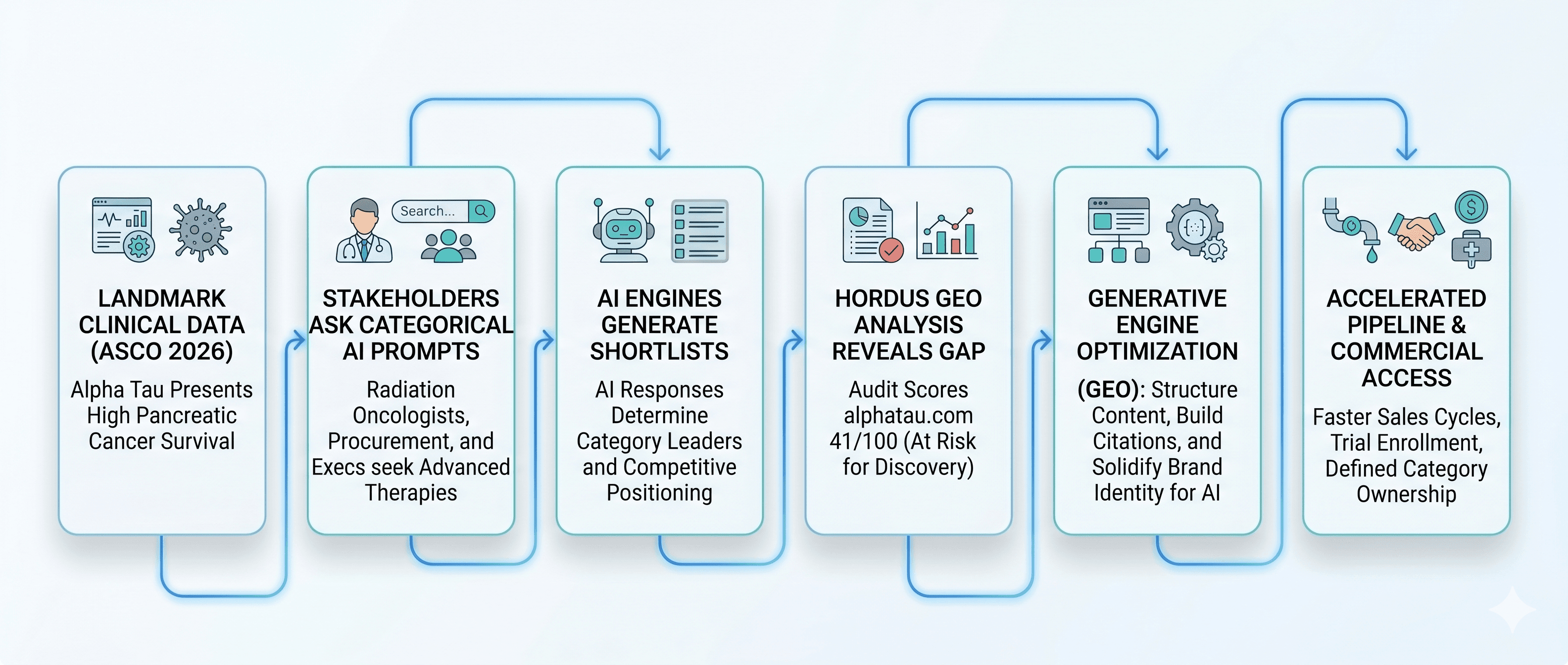
1. Category ownership for intratumoral alpha radiation therapy. AI engines are building their understanding of this emerging category right now. Alpha Tau has first-mover clinical data and brand rights to the term "Alpha DaRT." Hordus can help structure that IP, terminology, and clinical milestone data into formats AI engines will extract and cite reliably, so when a prospect asks about intratumoral alpha radiation, Alpha Tau defines the category answer.
2. Competitive answer share against radiopharmaceutical incumbents. Novartis (Lutathera) and Bristol Myers Squibb (Pluvicto) have strong AI visibility because they have years of regulatory press, commercial launch language, and structured product pages that AI engines have indexed deeply. Hordus can audit competitor visibility, identify the exact prompts where Novartis or Elekta dominate at Alpha Tau's expense, and develop a citation-building strategy that shifts answer share toward Alpha DaRT for differentiated prompts.
3. Sales enablement through AI-native content. When a hospital's procurement AI summarizes the competitive landscape in advanced radiotherapy, it cites sources. If those sources do not include Alpha Tau clinical publications, trial registrations in ClinicalTrials.gov, ASCO abstracts, and structured company web content, the company is not in the room. Hordus can identify which existing Alpha Tau content assets need structured markup and offsite placement to become citable by AI engines during a procurement evaluation.
4. Trial site recruitment acceleration. Radiation oncologists evaluating whether to participate in the ReSTART, IMPACT, REGAIN, or ACAPELLA trials are using AI to understand what is available, who is running trials, and what early data shows. Hordus can improve how Alpha Tau's trial identity appears in AI-generated answers to clinical research queries, directly supporting the goal of completing enrollment in the ReSTART pivotal trial and ramping the U.S. GBM program.
5. Investor and analyst narrative control. Sell-side analysts and healthcare investors increasingly use AI to summarize a company's pipeline, clinical milestones, and competitive position before initiating coverage or updating models. Improving how AI engines describe and compare Alpha Tau's market position against radiopharmaceutical and capital oncology equipment competitors supports investor relations as much as commercial go-to-market.
Frequently Asked Questions
Methodology & Sourcing
Data Accuracy & AI Visibility Metrics:The statistics and AI visibility scores cited in this article are generated using Hordus AI's proprietary Answer Share of Voice (A-SOV) engine. Data is derived from consented, anonymized real user interactions across major LLM interfaces (ChatGPT, Claude, Gemini).
Editorial Integrity:All AI-assisted research undergoes mandatory human editorial review by our GEO strategy team prior to publication to ensure factual accuracy and alignment with Google's YMYL (Your Money or Your Life) search quality rater guidelines.