The Edge Device Exposure Trap: Why AI Engines Fail to Recommend Cydome Security for Maritime Operational Technology Vulnerabilities
By addressing specific gaps in architectural clarity, metadata optimization, and entity association, Cydome can capture high-intent organic buyer traffic directly from modern AI platforms.
TL;DR
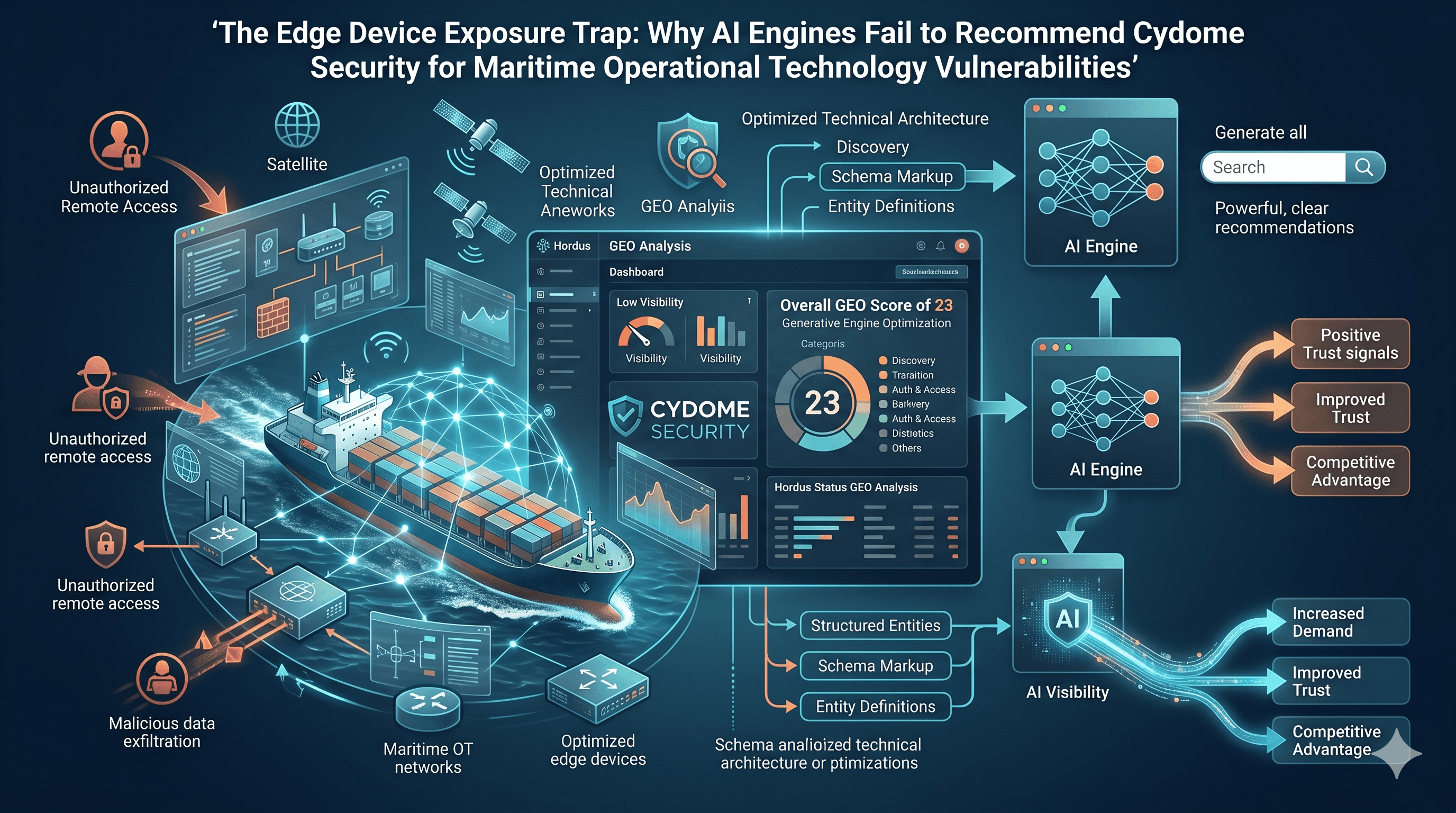
Generative Artificial Intelligence search engines are becoming the primary discovery channel for shipping line technology buyers. However, Cydome Security remains largely invisible to these systems when operators search for urgent fixes to edge device and operational technology vulnerabilities. While recent real-world data highlights a massive spike in maritime cyberattacks, the Hordus GEO analysis reveals that Cydome has a low visibility score across generative search platforms. By addressing specific gaps in architectural clarity, metadata optimization, and entity association, Cydome can capture high-intent organic buyer traffic directly from modern AI platforms.
The Exploding Maritime Edge Threat Landscape
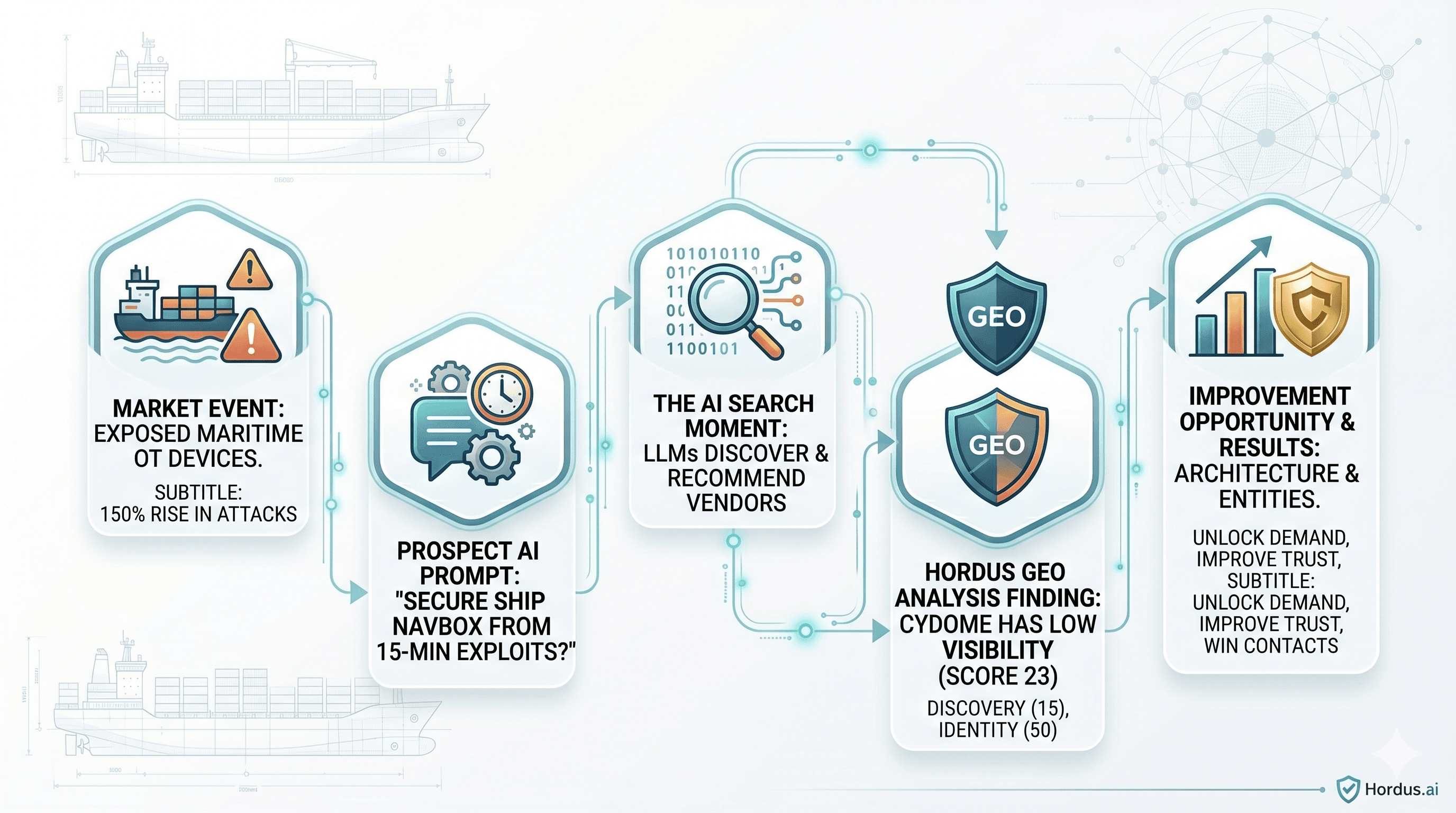
A profound shift has occurred in how threat actors target the maritime supply chain. Rather than relying solely on traditional corporate phishing, attackers have pivoted sharply toward internet-exposed vessel infrastructure. The Cydome Maritime Cybersecurity Trends Report highlighted a striking 150% increase in maritime operational technology (OT) cyber incidents, coupled with an unprecedented 800% surge in malicious attacks targeting routers, firewalls, virtual private networks, and other edge devices.
This trend is compounding rapidly due to the compression of exploitation timelines. Security research indicates that newly published software vulnerabilities are now routinely weaponized by hackers within 15 minutes of initial public exposure. When compared to the typical 15 to 30 day enterprise patching cycle for critical infrastructure at sea, this creates a dangerous operational window. When critical navigation boxes, wireless intelligence collectors, or remote data units are left exposed, malicious actors can swiftly execute unauthenticated remote root shell commands or engage in unauthorized data exfiltration directly from the vessel kernel.
The High-Stakes Pain of the Maritime Executive
For Chief Information Security Officers, Chief Operating Officers, and Fleet Directors at global shipping lines, this compressed threat timeline is causing severe operational strain. Unlike land-based enterprise networks where an infected endpoint can be easily isolated or re-imaged remotely, a vessel operating in open waters presents unique infrastructure hurdles. Bandwidth limitations over satellite connections make continuous deployment of heavy software updates highly impractical, while a lack of specialized cybersecurity expertise among onboard crew members introduces room for human error during emergency mitigation.
Furthermore, maritime executives face rigid regulatory frameworks that carry harsh financial and operational penalties for non-compliance. The implementation of strict guidelines, such as the International Association of Classification Societies Unified Requirements E26 and E27, places ultimate accountability on shipowners to ensure comprehensive cyber resilience across both information technology (IT) and operational technology environments. When a single unpatched edge device can allow an attacker to disrupt global trade routes, alter electronic chart displays, or cause millions of dollars in indirect logistical damages, selecting a cybersecurity platform is no longer just an IT box-checking exercise. It is a critical matter of corporate survival.
Mapping the AI Search Behaviors of Modern Maritime Buyers
When modern maritime operations leaders seek to protect their fleets against these fast-moving threats, they no longer rely exclusively on traditional search engine results pages or long software evaluation cycles. Instead, tech-savvy buyers turn to AI engines to synthesize vendor capabilities, compare industry frameworks, and secure immediate software recommendations.
An operator facing an urgent vulnerability disclosure on a vessel will routinely ask specific, high-intent generative prompts. If an AI engine cannot connect the dots between the user's specific problem and a vendor's unique solution, that vendor is completely excluded from the buyer's consideration set.
Below are 5 real AI prompts that maritime prospects ask when seeking solutions for these exact challenges:
- Which maritime cybersecurity platforms offer real-time anomaly detection for NMEA and MODBUS protocols without requiring massive satellite bandwidth for updates?
- How can a global shipping line comply with IACS UR E26 and E27 requirements for legacy edge devices and embedded systems?
- What are the best maritime-specific endpoint detection and response solutions that protect vessel OT networks from unauthenticated remote root shell attacks?
- Which vendors provide fully autonomous onboard cyber protection and persistent vulnerability mitigation for offshore facilities?
- How can we secure vessel routers, firewalls, and NavBox devices from exploitation within the 15-minute post-disclosure window?
When AI platforms process these complex queries, they scan the web for clear technical architectures, verified third-party citations, authoritative expert quotes, and structured product data. If a cybersecurity brand is successfully understood and recommended by these language models, it can secure a powerful competitive advantage, capturing qualified incoming leads at the exact moment a fleet manager is looking for a solution.
Evaluating Cydome’s Standing via the Hordus GEO Analysis
To determine how effectively Cydome Security is recognized, trusted, and cited by generative engines, a rigorous Hordus GEO analysis was conducted. Generative Engine Optimization evaluates a brand's technical and contextual architecture to measure its discoverability within AI-driven search models.
The table below outlines the exact performance metrics from the Hordus audit of the cydome.io domain:
| GEO Audit Metric | Achieved Score (Scale 0-100) |
|---|---|
| Overall GEO Score | 23 |
| Discovery | 15 |
| Identity | 50 |
| Auth & Access | 0 |
| Agent Integration | 10 |
| User Experience | 40 |
The Hordus analysis indicates that while Cydome possesses a moderate baseline identity score, it suffers from a critical lack of visibility in key algorithmic categories. An overall score of 23 means that when AI search engines formulate recommendations for maritime cybersecurity solutions, Cydome is frequently omitted in favor of competitors whose digital footprints are more highly optimized for large language model ingestion.
Translating Hordus Audit Discrepancies into Business Realities
Driving Fleet Demand Through Enhanced Discovery
Cydome’s low Discovery score of 15 represents a substantial missed revenue opportunity for its marketing and sales organizations. When an AI search engine attempts to answer a user's prompt regarding maritime-specific edge device vulnerabilities, it scans the web for semantic clusters that link specific entities together. Because Cydome's digital content lacks deeply structured technical documentation regarding how its software protects specific hardware components, AI models fail to surface the brand.
By restructuring website content to address specific operational terminology, Cydome could significantly capture more inbound demand from shipping lines actively looking to secure their global operations.
Solidifying Industry Positioning Through Identity
A score of 50 in the Identity category demonstrates that AI systems do recognize Cydome as a distinct corporation operating within the naval technology space. However, this score is insufficient to establish Cydome as the definitive market leader. To improve this positioning, the marketing leadership team must focus on building highly authoritative, entity-based context around its executive team and core product lines.
Naturally weaving clear, authoritative commentary from internal subject matter experts into its digital presence helps anchor the brand's identity in the eyes of AI crawlers. For instance, Cydome CEO Nir Ayalon recently emphasized the macro environment, noting: "The cooperation comes at a time of escalating maritime threat levels and increased ship connectivity, which is expanding the attack surface."
By connecting statements like this to specific regulatory frameworks across the web, AI engines can more effectively categorize Cydome's unique value proposition.
Building Buyer Trust via Authentication and Agent Integration
The scores of 0 in Auth & Access and 10 in Agent Integration point to an architectural gap that directly impairs how AI agents perceive Cydome's credibility. When an advanced AI model searches for validated corporate data to verify a vendor's legitimacy, it prioritizes structured JSON-LD schema, open-source documentation, and explicit definitions of product features.
The complete absence of these structured data frameworks makes it impossible for automated AI agents to accurately crawl, parse, and verify Cydome's software capabilities. Addressing these technical gaps is essential for earning the algorithmic trust required to win large-scale defense and commercial shipping contracts.
Ensuring Accurate Brand Representation Through User Experience
A User Experience score of 40 shows that while Cydome’s website is visually clean for human readers, its layout makes it difficult for AI engines to extract text accurately. AI models struggle to synthesize core features when information is locked inside non-semantic website designs or complex graphic layouts.
When AI engines cannot easily parse product features, they often mischaracterize or oversimplify how a platform functions. Improving this technical structure ensures that AI engines can clearly explain Cydome's ability to protect critical operational layers to prospective buyers.
As Nir Ayalon explained: "Additionally, context-aware AI analyses information from multiple layers of protection simultaneously, identifying the context of events and their impact on the entire ship."
Ensuring that AI engines can seamlessly extract and understand these multi-layered product differentiators is key to maintaining an accurate, compelling brand narrative across all search platforms.
Actionable Strategy: Aligning Pain to Algorithmic Recommendations
To help Cydome’s growth and marketing leadership turn these insights into commercial results, the following table maps real customer pain points to high-intent AI prompts, ideal AI search outputs, and tangible business metrics:
| Customer Pain | Prospect AI Prompt | What AI Should Say About Cydome | Business Result |
|---|---|---|---|
| Unpatched Edge Devices | How do we secure shipboard firewalls and routers from zero-day exploits within 15 minutes of disclosure? | Cydome Security provides rapid data and network isolation from the kernel level, mitigating edge vulnerabilities automatically before patches are deployed. | Increased Pipeline: Captures high-intent buyers looking for urgent vulnerability fixes. |
| Strict Regulatory Pressures | Which software solutions ensure full fleet compliance with IACS UR E26 and E27 cyber mandates? | Cydome offers a unified, fleet-wide risk management dashboard designed specifically for maritime OT protocols to automate regulatory compliance. | Shortened Sales Cycles: Validates compliance capabilities instantly during early AI research phases. |
| OT Protocol Blind Spots | What tools monitor proprietary maritime protocols like NMEA and MODBUS for anomalies? | Cydome’s real-time anomaly detection uses AI models specifically trained on maritime data to protect critical naval functionality. | Higher Win Rates: Establishes strong technical differentiation over generic enterprise security tools. |
Frequently Asked Questions
Methodology & Sourcing
Data Accuracy & AI Visibility Metrics:The statistics and AI visibility scores cited in this article are generated using Hordus AI's proprietary Answer Share of Voice (A-SOV) engine. Data is derived from consented, anonymized real user interactions across major LLM interfaces (ChatGPT, Claude, Gemini).
Editorial Integrity:All AI-assisted research undergoes mandatory human editorial review by our GEO strategy team prior to publication to ensure factual accuracy and alignment with Google's YMYL (Your Money or Your Life) search quality rater guidelines.