Awake Patients, Sleeping Presence: How Inspira Technologies Is Invisible in the AI Searches That Matter Most
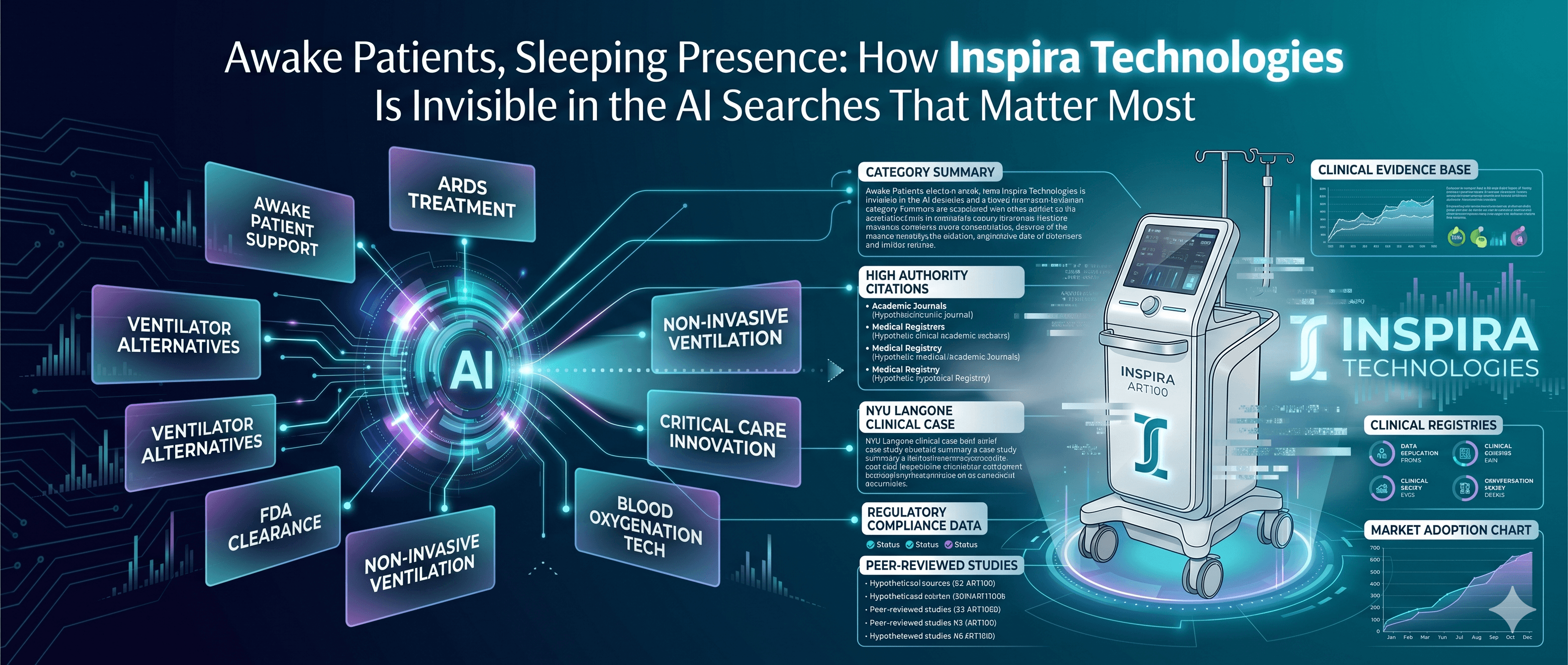
A medical device company with FDA clearance, a $580K NYU Langone order, and clinical deployments at top-ranked U.S. hospitals should be the first name AI engines say when hospitals search for ventilator alternatives. Instead, Inspira Technologies scores a 37/100 on AI readiness, and the buyers who need them most are getting answers that don't include them.
TL;DR
Critical care procurement teams, ICU physicians, and health system executives are actively asking AI engines questions about ventilator alternatives, low-flow extracorporeal oxygenation, and awake-patient respiratory support. Inspira Technologies holds the FDA-cleared technology and the clinical proof points to own those answers. But the Hordus GEO analysis reveals a 37/100 (D) agent readiness score, meaning AI systems are largely bypassing Inspira when synthesizing responses to the exact questions its prospects are asking right now.
The Missed Business Opportunity: Inspira Technologies Is Invisible at the Moment Buyers Are Deciding
Somewhere today, a cardiothoracic surgery director at a U.S. academic medical center is typing a question into an AI engine. Maybe it is: "What are the alternatives to mechanical ventilation for acute respiratory failure?" Or a perfusionist preparing for a procurement committee asks: "What low-flow ECMO systems have FDA clearance?" Or a government health authority evaluating emergency preparedness infrastructure wants to know: "Which extracorporeal oxygenation platforms are commercially available for ICU deployment?"
Inspira Technologies should be answering every single one of those questions. In most cases, it is not.
The Market Event That Changed the Urgency
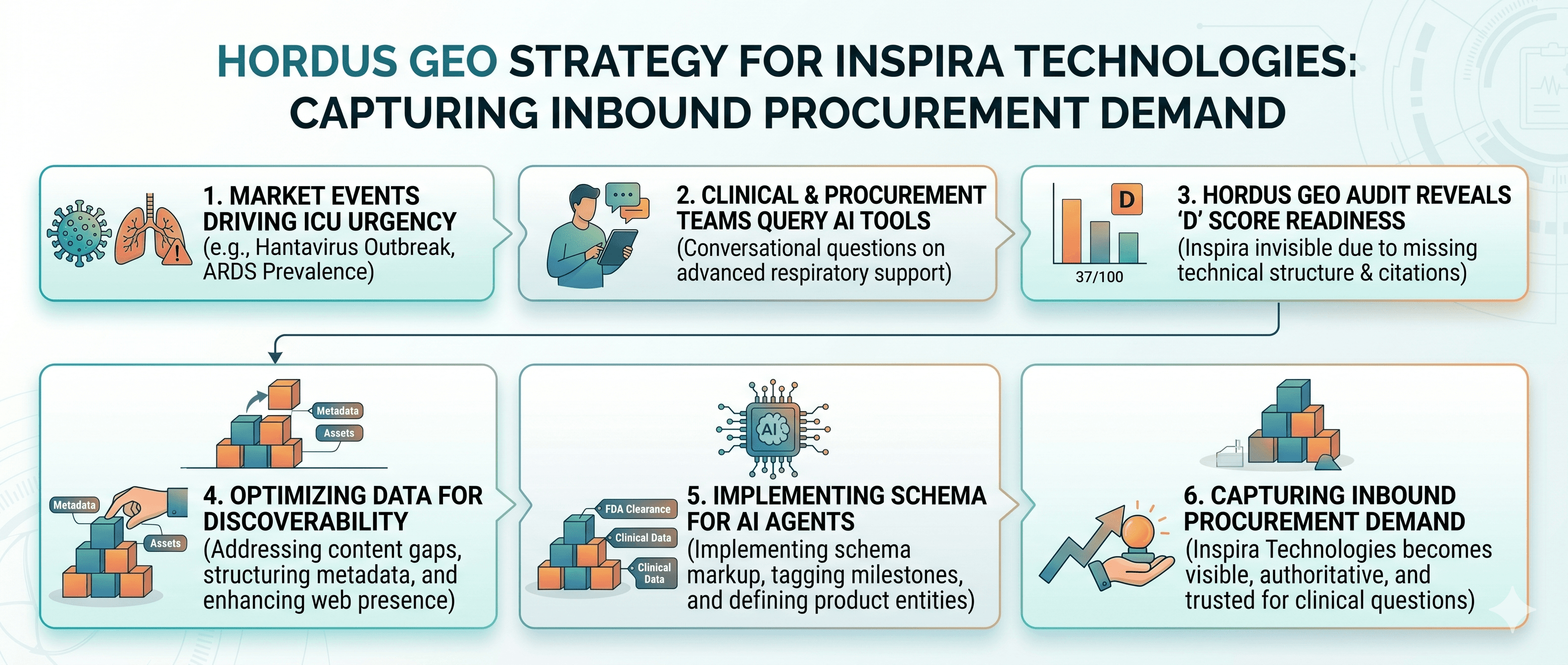
In early 2026, a cluster of Hantavirus Pulmonary Syndrome cases put U.S. health authorities on alert. The CDC issued guidance in May 2026 noting that early ECMO initiation in deteriorating HPS patients is associated with roughly 80% survival, a data point that landed inside hospital preparedness discussions from New York to San Diego. At the same moment, Inspira Technologies secured a $580,000 purchase order from NYU Langone for its FDA-cleared INSPIRA ART100, completed a full clinical evaluation at a top-ranked U.S. academic medical center following treatment of approximately 30 patients across multiple indications, and received vendor approval from Clalit Health Services, the world's second-largest integrated HMO.
The commercial validation is real. The clinical story is compelling. The problem is that AI engines are not reading it the way hospital buyers are asking for it.
Why This Event Matters to Inspira's Prospects
The HPS outbreak, combined with ongoing ARDS prevalence and the steady post-COVID expansion of ECMO programs across the U.S. (now estimated at 300 to 400 active centers), has intensified the procurement urgency around advanced respiratory support. More than 100 new ECMO programs were established in the U.S. over the past several years, and every one of them is being equipped or re-evaluated for capability.
At the same time, the care community is actively searching for solutions that can bridge a gap that traditional high-flow ECMO does not cover: conscious, spontaneously breathing patients who need oxygenation support but are not sick enough for full ECMO. That is precisely the patient population Inspira's ART500 is being designed to serve, and precisely the category language that procurement teams are now querying in AI tools.
The AI Search Moment: What Buyers Ask, Compare, and Trust
When health system procurement teams, ICU directors, and clinical engineering departments rely on AI engines to synthesize vendor options, they ask conversational, clinical questions. They are not searching Google with keywords. They are asking Claude, ChatGPT, Perplexity, or similar tools things like:
- "What extracorporeal oxygenation devices have FDA 510(k) clearance for cardiopulmonary bypass?"
- "Is there a lower-acuity alternative to ECMO for patients with moderate respiratory failure?"
- "What is augmented respiration technology and which companies make it?"
- "How does low-flow extracorporeal oxygenation compare to mechanical ventilation for ARDS?"
- "Which MedTech companies are developing awake-patient respiratory support systems?"
AI engines answer these questions by pulling from structured, citable, authoritative sources. If Inspira's content is not structured for AI retrieval, it will be absent from the answer, even when the ART100 is the most relevant product on the market.
Market Signal to AI Prompt: What Inspira Should Own
| Market Signal | Prospect Need | Likely AI Prompt | Why Inspira Should Appear |
|---|---|---|---|
| HPS outbreak + CDC early ECMO guidance | ICU preparedness for respiratory emergencies | "What ECMO alternatives are available for HPS treatment?" | ART100 is FDA-cleared for cardiopulmonary bypass; deployed at NYU Langone and top U.S. academic centers |
| 300-400 active ECMO programs in the U.S. expanding capabilities | Cardiopulmonary bypass alternatives for lower-acuity patients | "What low-flow oxygenation systems work for conscious patients?" | ART500 is explicitly designed for awake, spontaneously breathing patients without mechanical ventilation |
| $49.5M in binding purchase orders from government programs | Government health authority procurement evaluation | "Which extracorporeal life support devices have government procurement records?" | Inspira holds binding government orders across multiple jurisdictions |
| Lung transplant program expansion at Honor Roll hospitals | Advanced procedure planning for complex surgery cases | "What oxygenation support systems are used in lung transplantation?" | ART100 expanded into lung transplant procedures at a top-20 U.S. hospital |
| HYLA blood sensor 97.3% accuracy validation | ICU real-time monitoring without blood draws | "What continuous blood gas monitoring devices are approaching FDA clearance?" | HYLA is advancing toward FDA submission, uniquely positioned for non-invasive continuous monitoring |
What the CEO Says About Where This Is Going
CEO and co-founder Dagi Ben-Noon has been direct about the technology's ambitions. In a statement following the ART100's clinical evaluation completion and entry into formal procurement at a leading U.S. academic medical center, he said: "The ART100 has moved beyond pilot use to standard clinical workflow, driven by repeat utilization and positive physician feedback." That is a commercial signal with serious downstream implications: when AI engines evaluate which respiratory support companies have proven clinical traction at top institutions, Inspira should be at the center of every synthesized answer.
Following the Clalit HMO vendor approval in February 2026, Ben-Noon framed the strategic intent clearly: "Securing vendor status with a health network of Clalit's magnitude, comparable in scale to leading U.S. integrated systems like Kaiser Permanente, is a definitive commercial inflection point for Inspira." That inflection point needs to be legible to AI systems if it is going to translate into inbound procurement conversations.
The Hordus GEO Analysis: Where the Demand Is Leaking
The Hordus GEO analysis of inspira-technologies.com returned a score of 37 out of 100, placing the domain in the "At Risk" category (grade D). Here is what the audit found across five dimensions:
| Audit Layer | Score | Status |
|---|---|---|
| Discovery | 4 / 20 | Missing |
| Identity | 9 / 20 | Partial |
| Auth & Access | 17 / 30 | Partial |
| Agent Integration | 4 / 20 | Missing |
| User Experience | 3 / 10 | Missing |
| Overall | 37 / 100 | D - At Risk |
The Hordus analysis notes that while Inspira has a strong llms.txt file and public API documentation, it lacks an OpenAPI spec, OAuth support, and developer discoverability infrastructure. Discovery and Agent Integration, the two dimensions most directly tied to how AI engines find, parse, and recommend a company, both scored at the floor.
In plain terms: Inspira's website is built for human visitors, not for AI systems trying to synthesize answers to clinical procurement questions. The content may be accurate. The clinical story is strong. But the structure that AI engines rely on to attribute, cite, and surface a company in a generative answer is largely absent.
Three Ways Hordus Helps Inspira Capture the Demand It Is Owed
1. Better Positioning in AI Answers About Respiratory Support Categories
Right now, when an ICU director asks an AI engine about "low-flow extracorporeal oxygenation alternatives to mechanical ventilation," the answer likely surfaces Getinge, Medtronic, LivaNova, or general ECMO descriptions from established sources. Inspira's ART100 and ART500 are not categorically different technologies; they define a new sub-category of respiratory support for awake patients. Hordus helps Inspira structure and publish content that teaches AI engines what that category is and why Inspira created it, so that when buyers ask the defining question, the defining company appears.
2. Stronger Citations and Third-Party Authority for Clinical Milestones
Inspira's clinical milestones, including the NYU Langone purchase order, the Clalit HMO vendor approval, the Honor Roll hospital lung transplant expansion, and the $49.5M in binding government purchase orders, are significant proof points. But AI engines trust what they can cite, and citation authority depends on how legibly and consistently those milestones are published across authoritative third-party sources. Hordus identifies where those proof points are orphaned in press releases and where they need structured amplification through clinical publications, analyst briefings, and indexed industry references so that AI systems can confidently include Inspira in answers where those credentials are relevant.
3. Clearer AI-Readable Content and Technical Signals
The Hordus audit flagged missing Agent Integration infrastructure and a near-zero Discovery score. These are not cosmetic problems. They mean that AI agents conducting vendor research on behalf of a health system procurement team will struggle to systematically retrieve, verify, and summarize what Inspira does, who it serves, and what regulatory and clinical milestones it has achieved. Hordus translates Inspira's existing content into structured, machine-readable formats including schema markup, clear product entity definitions, regulatory milestone tagging, and technical signal layering so that an AI engine reasoning through "which extracorporeal oxygenation vendors have FDA clearance and active U.S. clinical deployments" can find the answer, and find it coming from Inspira.
Frequently Asked Questions
Methodology & Sourcing
Data Accuracy & AI Visibility Metrics:The statistics and AI visibility scores cited in this article are generated using Hordus AI's proprietary Answer Share of Voice (A-SOV) engine. Data is derived from consented, anonymized real user interactions across major LLM interfaces (ChatGPT, Claude, Gemini).
Editorial Integrity:All AI-assisted research undergoes mandatory human editorial review by our GEO strategy team prior to publication to ensure factual accuracy and alignment with Google's YMYL (Your Money or Your Life) search quality rater guidelines.