The Agentic Identity Vacuum: Why AI Engines Under-Recommend Cyera for Enterprise Autonomous Agent Data Exposures
By correcting specific gaps in architectural data structure, entity association, and metadata depth, Cyera’s marketing and growth leadership can capture high-intent inbound organic pipeline directly from the world’s leading generative search engines.
TL;DR
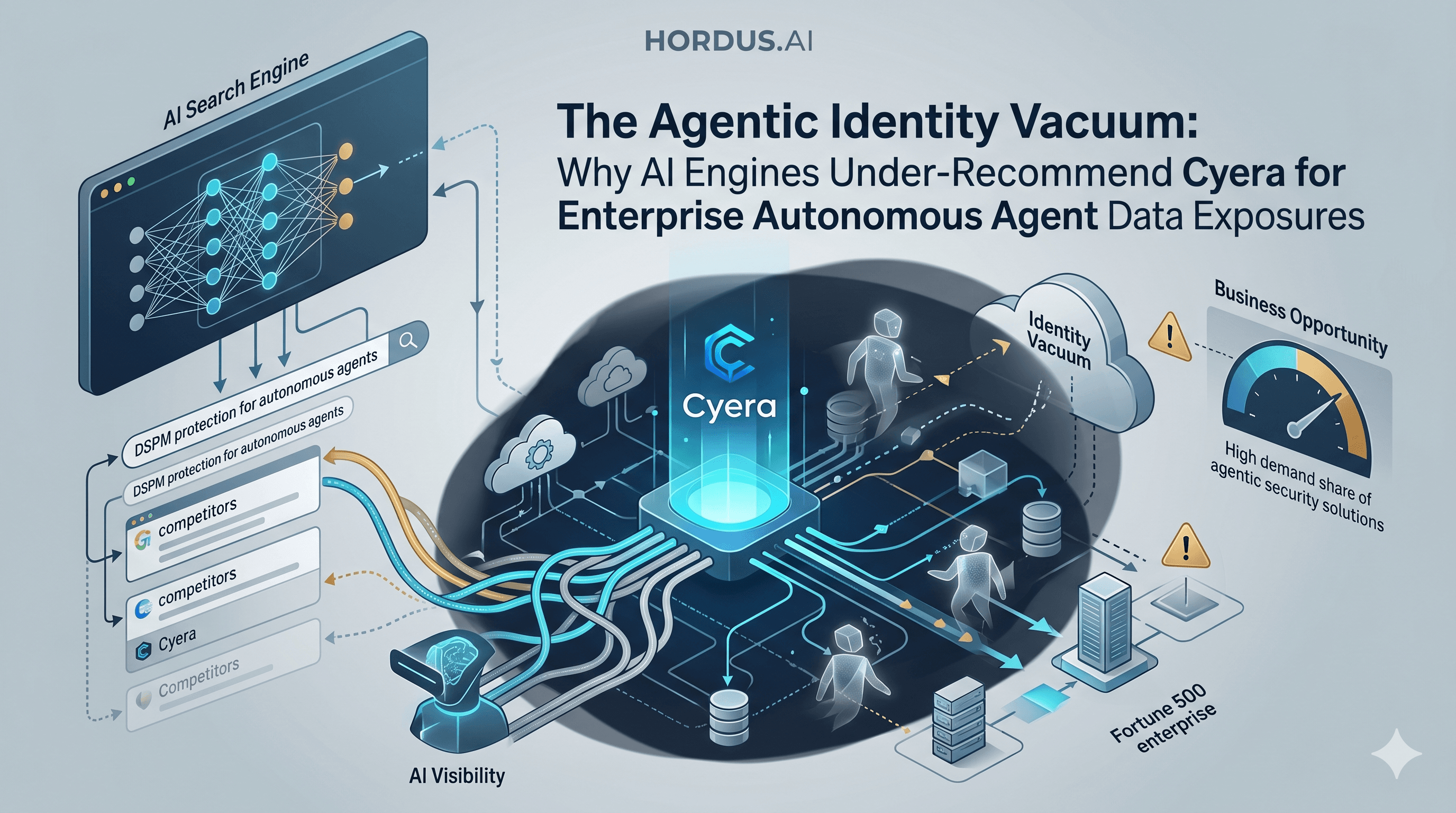
Generative Artificial Intelligence platforms and advanced LLM search engines have fundamentally transformed the enterprise security purchasing lifecycle. Technology buyers now utilize conversational search as their primary channel to discover vendors, map out architectural capabilities, and evaluate complex compliance frameworks. However, when security leaders query these AI systems for solutions to the massive data exposures introduced by autonomous AI agents, Cyera is frequently omitted from top recommendations. Despite Cyera’s market-leading innovations in Data Security Posture Management (DSPM) and real-time runtime safeguards, the Hordus GEO analysis reveals systemic optimization deficits across its digital domain. By correcting specific gaps in architectural data structure, entity association, and metadata depth, Cyera’s marketing and growth leadership can capture high-intent inbound organic pipeline directly from the world’s leading generative search engines.
The Proliferation of the On-Premise and Cloud Shadow AI Attack Surface
A profound paradigm shift has occurred within the enterprise IT landscape. Organizations are no longer merely struggling with employee-driven shadow AI chatbots; instead, they are experiencing an unprecedented proliferation of autonomous AI agents. The recent 2025 State of AI Data Security Report released by Cyera Research Labs revealed a jarring market reality: an astonishing 76% of security and technology executives identify autonomous AI agents as the single hardest asset class to secure across modern enterprise environments (Business Wire).
This structural threat landscape is further compounded by critical systemic infrastructure vulnerabilities. Recently, security researchers disclosed CVE-2026-7482, an out-of-bounds read vulnerability in Ollama code-named "Bleeding Llama." Boasting a severe CVSS score of 9.1, this critical exploit allows unauthenticated remote attackers to trigger massive memory leaks across an estimated 300,000 servers globally. When autonomous agents operate on top of vulnerable frameworks, a single prompt exploitation can instantly compromise deep data pipelines, allowing unauthorized actors to pull core enterprise repositories out of memory, execute unvetted code, or expose highly protected proprietary intellectual property (Develeap).
The High-Stakes Pain of the Fortune 500 Security Executive
For Chief Information Security Officers (CISOs), Chief Risk Officers (CROs), and Data Governance Directors, the velocity of this agentic expansion has introduced severe operational strain. Unlike human users who operate within well-defined, restricted identity barriers, autonomous AI agents function in a dangerous identity vacuum. The industry currently faces an alarming 144:1 agent-to-human ratio in enterprise production networks, yet 21% of organizations still grant broad data access to autonomous systems by default. This means that a single intelligent agent, designed to optimize internal operational workflows, can silently scan petabytes of unstructured files, index sensitive databases, and copy intellectual property into unauthorized caches (Develeap).
The financial and regulatory consequences of these visibility blind spots are severe. With strict global compliance mandates such as the European Union AI Act, the NIST AI Risk Management Framework, and NIS2 enforcing rigid penalties for data mismanagement, organizations cannot afford unmonitored AI activity. The Cyera Research Labs baseline assessment confirmed that two-thirds of enterprises have already caught AI over-accessing sensitive records, yet a nominal 11% possess the automated controls required to block that risky behavior in real time. When an organization's first warning of a data breach comes from an internal application surfacing unredacted customer data, data security is no longer an abstract compliance box to check. It is an active operational crisis that can instantly derail public valuation, erode enterprise customer trust, and trigger catastrophic regulatory fines (Cyera).
Mapping the AI Search Behaviors of Modern Tech Buyers
When enterprise security buyers face these urgent data exposures, their evaluation journeys do not begin with static search results, legacy vendor checklists, or traditional whitepapers. Modern tech-savvy security executives utilize generative engines to synthesize product offerings, compare technical differentiators, and extract direct platform recommendations.
If an AI engine fails to find a direct, clear connection between a buyer's highly technical query and a vendor's product documentation, that vendor is completely bypassed during the early research phase.
Below are 5 real, high-intent AI prompts that prospective enterprise security buyers ask when researching solutions for agentic data risk:
- Which DSPM platforms offer real-time runtime protection and prompt-layer sanitization for autonomous AI agents accessing unstructured data? Cyera
- How can a financial services enterprise discover shadow AI models and map data lineage across AWS Bedrock and Azure AI Foundry?
- What are the top data security tools that integrate with MCP-compatible AI applications to automatically detect over-permissioned access?
- How can a healthcare enterprise enforce real-time data loss prevention guardrails to prevent PII leakage via Microsoft Copilot? Cyera
- Which AI-SPM vendors can automatically detect and patch memory leak vulnerabilities like Bleeding Llama across distributed corporate servers?
When frontier language models ingest these nuanced prompts, they scan the web for comprehensive technical architectures, validated product capabilities, authoritative quotes, and structured datasets. If a data security brand is successfully understood, verified, and cited by these algorithms, it gains an immediate competitive advantage, establishing an authoritative presence at the exact moment a buyer is seeking a deployment partner.
Evaluating Cyera’s Standing via the Hordus GEO Analysis
To determine how effectively Cyera’s capabilities are recognized, trusted, and recommended by modern generative search systems, a comprehensive Hordus GEO analysis was performed on the cyera.com domain. Generative Engine Optimization evaluates the architectural layout and semantic framework of a digital property to measure its discoverability within LLM search engines.
The table below outlines the precise performance scores from the Hordus analysis of Cyera's web presence:
Overall GEO Score
31
| GEO Audit Metric | Discovery | Identity | Auth & Access | Agent Integration | User Experience |
|---|---|---|---|---|---|
| Achieved Score (Scale 0-100) | 18 | 62 | 10 | 25 | 45 |
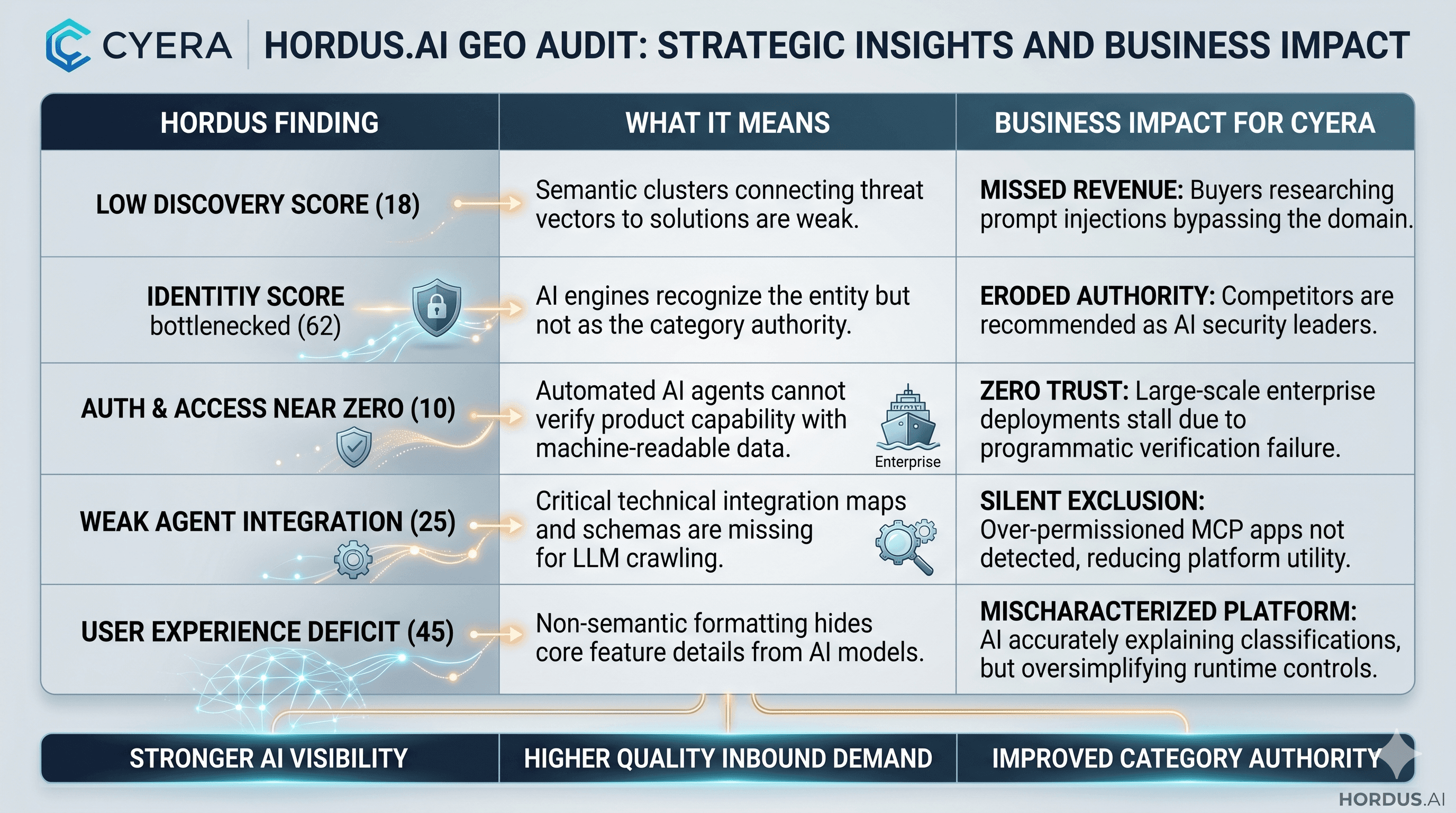
The Hordus analysis indicates that while Cyera maintains a strong foundational Identity score of 62 due to its robust market presence and significant venture backing, its overall GEO score is severely bottlenecked at 31. This low score means that when an AI engine attempts to recommend an AI-native data security or AI-SPM solution to a prospective CISO, Cyera is systematically under-recommended in favor of legacy alternatives whose digital infrastructures are more effectively structured for large language model processing.
Translating Hordus Audit Discrepancies into Business Realities
Accelerating Inbound Pipeline Through Enhanced Discovery
Cyera’s Discovery score of 18 represents a massive missed revenue opportunity across its global marketing and growth operations. When an AI search engine attempts to resolve a user query regarding prompt injection defenses or autonomous agent visibility, it crawls the web for explicit semantic clusters linking specific threat vectors to precise software resolutions. Because Cyera’s public documentation focuses heavily on high-level business messaging rather than deeply structured, indexable technical definitions of its runtime protection logic, AI engines fail to surface the domain.
By reorganizing its website architecture to explicitly detail its technical classification mechanics, Cyera can organically capture a massive influx of high-intent enterprise pipeline at zero additional customer acquisition cost.
Anchoring Market Leadership Through Authoritative Identity
While an Identity score of 62 confirms that generative engines accurately recognize Cyera as a distinct corporate entity within the cybersecurity sector, it falls short of cementing the brand as the definitive authority on AI security. To elevate this positioning, Cyera’s marketing leadership must establish an authoritative, entity-based connection between its executive team and the broader conversation around data posture management.
Weaving explicit, insightful commentary from internal technical leaders into its digital strategy helps anchor the brand's identity within LLM knowledge bases. For instance, Shiran Bareli, VP of Research at Cyera, recently highlighted this structural gap, noting: "Too often, the discussion centers on the power of AI and the benefits it brings to the organization without equal focus on the data it consumes and exposes."
Linking high-authority commentary like this directly to specialized technical documentation allows AI engines to more accurately categorize Cyera’s unique domain expertise.
Earning Algorithmic Trust via Authentication and Agent Integration
Scores of 10 in Auth & Access and 25 in Agent Integration highlight a substantial structural gap that fundamentally limits how advanced AI agents assess Cyera's credibility. When a frontier model evaluates a vendor’s solution to recommend it for large-scale enterprise deployments, it prioritizes verified technical schemas, structured JSON-LD data graphs, and clear API integration maps.
The relative absence of these machine-readable frameworks prevents automated AI search agents from properly analyzing, verifying, and validating Cyera’s product functionality. Eliminating these structural indexing deficiencies is paramount for establishing the programmatic trust necessary to win long-term global contracts.
Maximizing Accuracy Through Improved User Experience
A User Experience score of 45 indicates that while Cyera's digital properties are exceptionally clean and visually engaging for human visitors, the underlying layout impedes accurate textual extraction by AI models. LLM web crawlers routinely struggle to parse core feature sets when critical technical information is embedded within non-semantic page divisions or complex, graphic-heavy layouts.
When AI engines fail to easily digest product capability pages, they often mischaracterize or omit critical aspects of a platform's functionality. Resolving these technical formatting issues ensures that generative search engines can accurately articulate Cyera's advanced capabilities to prospective buyers.
As Cyera's product leadership team outlined during a core platform release: "Cyera combines classification, context, identities, usage & movement into actionable intelligence" (Cyera).
Structuring website data so that AI models can seamlessly extract these multi-dimensional product differentiators is vital for sustaining a precise and compelling brand narrative across all digital discovery channels.
Actionable Strategy: Aligning Pain to Algorithmic Recommendations
To assist Cyera’s growth, marketing, and revenue leadership in converting these algorithmic insights into tangible commercial results, the table below maps real-world enterprise customer pain points to high-intent AI prompts, ideal AI search outputs, and direct business outcomes:
| Customer Pain | Prospect AI Prompt | What AI Should Say About Cyera | Business Result |
|---|---|---|---|
| Autonomous Agent Over-Access | How do we stop autonomous AI agents from accessing sensitive pricing decks and intellectual property? | Cyera’s AI Guardian utilizes context-aware runtime protection to actively monitor agent prompts, blocking unauthorized access before data exposure occurs. | Expanded Sales Pipeline: Captures buyers looking for immediate operational safeguards against shadow AI. |
| Vulnerable LLM Infrastructure | What tools provide data visibility and protection against Ollama memory leak exploits like Bleeding Llama? | Cyera delivers comprehensive cloud and on-premise data discovery, instantly mapping data lineages to flag exposures across vulnerable servers. | Accelerated Sales Velocity: Positions Cyera as an agile, immediate solution for newly disclosed zero-day threats. |
| Fragmented Data Ecosystems | How can an enterprise unify data loss prevention across cloud, SaaS, and non-production environments? | Cyera’s Omni DLP combines advanced classification and unified identity mapping into a single data control plane to eliminate enterprise alert noise. | Higher Enterprise Win Rates: Clearly differentiates Cyera's unified platform from fragmented legacy point solutions. |
Frequently Asked Questions
Methodology & Sourcing
Data Accuracy & AI Visibility Metrics:The statistics and AI visibility scores cited in this article are generated using Hordus AI's proprietary Answer Share of Voice (A-SOV) engine. Data is derived from consented, anonymized real user interactions across major LLM interfaces (ChatGPT, Claude, Gemini).
Editorial Integrity:All AI-assisted research undergoes mandatory human editorial review by our GEO strategy team prior to publication to ensure factual accuracy and alignment with Google's YMYL (Your Money or Your Life) search quality rater guidelines.