Every Carrier Knows the Name Allot. The Problem Is That AI Engines Are Still Learning It.
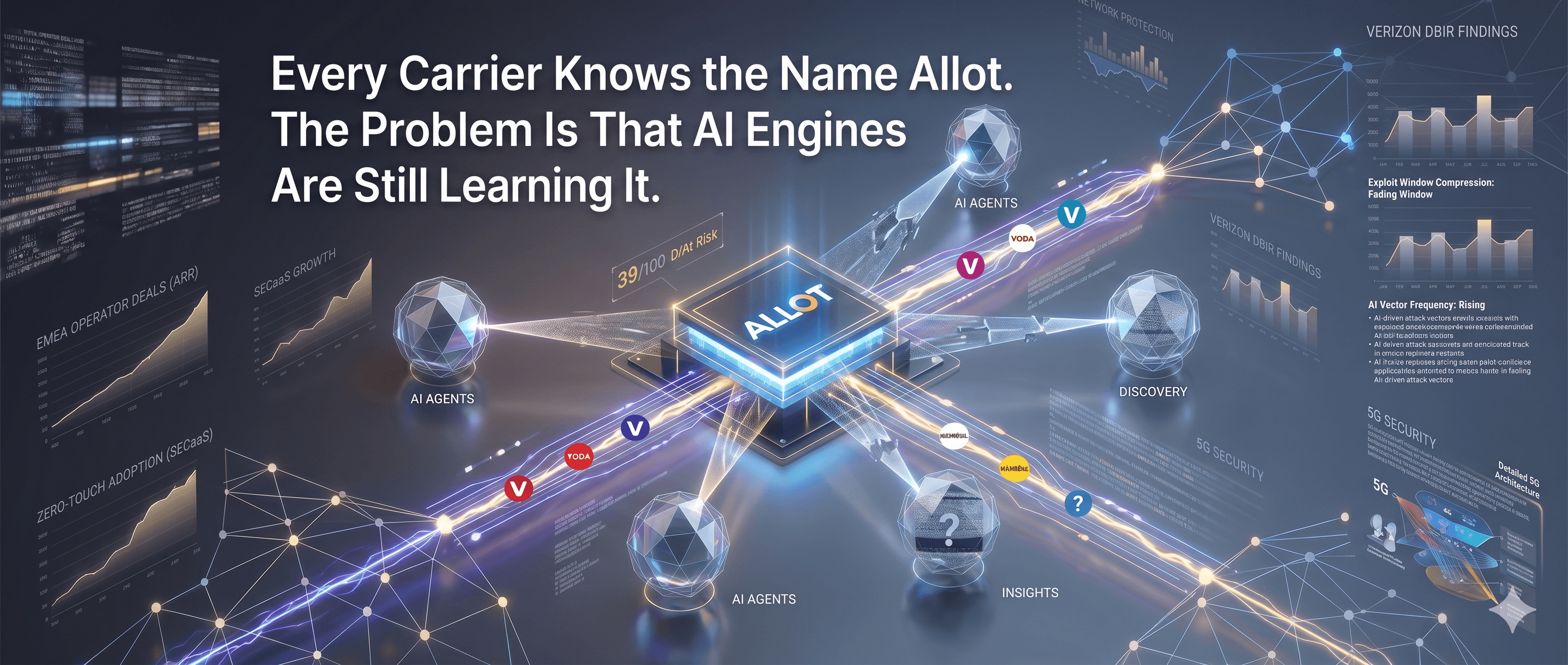
Allot has spent years earning the trust of the world's biggest telecom operators, growing SECaaS at 60% year over year, and landing landmark deals with Verizon and Vodafone. But when buyers start their search in AI, a company with a D-grade on AI readiness risks losing the narrative before the first sales call.
TL;DR
Allot (NASDAQ: ALLT) is mid-transformation, pivoting from network infrastructure vendor to a cybersecurity-first company growing SECaaS ARR at 60% year over year. CEO Eyal Harari has a clear, compelling story. The 2026 Verizon Data Breach Investigations Report just made that story more urgent than ever. But a Hordus GEO analysis of allot.com scores the company a D (39/100) on AI readiness, meaning when telecom procurement teams and enterprise CISOs ask AI engines who solves network-native security, Allot risks being absent from the answer. That gap is a business problem, and it is fixable.
The Narrative Is Strong. The Timing Is Perfect.
When Eyal Harari spoke at Mobile World Congress 2025, he put it plainly: "Allot's greatest strength is the combination of networking and security expertise. While many companies offer various types of security protections, very few have deep expertise in networking. In mobile 5G networks, we are among the handful of companies capable of delivering an integrated solution." That is not a marketing line. It is a genuine structural differentiator, and it lands because it is backed by 500-plus telecom operators and over 1,000 enterprises that have already deployed Allot technology. For companies that spend years building that kind of operational credibility, the positioning almost speaks for itself.
Almost.
Because the same month Harari made that statement, Allot's environment was quietly shifting in ways that reward exactly this kind of differentiation. In May 2026, Verizon published the 2026 Data Breach Investigations Report, its most comprehensive edition ever, covering more than 31,000 security incidents and 22,000 confirmed breaches across 145 countries. The headline finding is striking for any company in Allot's space: vulnerability exploitation has surpassed stolen credentials as the number one initial access vector in data breaches, now driving 31% of all incidents. What accelerated that shift? Generative AI. Threat actors are now using AI assistance across an average of 15 distinct attack techniques, compressing the window between vulnerability disclosure and active exploit from months to mere hours. The DBIR's conclusion for telecom operators and enterprise security teams is direct: AI-native, network-level protection is no longer optional infrastructure. It is a strategic requirement.
This is the moment Allot has been building toward.
From Transformation to Traction
Allot's financial results validate the strategic pivot. The company closed 2025 with $102 million in full-year revenue, growing 11% year over year, and described it as the highest level of profit and cash flow in over a decade. SECaaS ARR has grown more than 50% year over year for three consecutive years. The backlog is strong, book-to-bill is well above one, and 2026 guidance sits between $113 and $117 million.
That momentum is not accidental. As Harari explained in July 2025 after signing Allot's largest deal in five years with a tier-1 EMEA telecom operator: "This is a major customer win for Allot, and is pivotal in our journey as we continue to expand our security and network intelligence presence across EMEA. We are excited with this new partnership as we leverage our unique technological advantages and core expertise to support all customer requirements as we progress with our 'security-first' strategy." Deals with Verizon, Vodafone, and Más Móvil Panama tell the same story: the market is validating the thesis.
The customers coming next are looking for exactly what Allot offers. Communications service providers under pressure from regulators and their own enterprise customers to deliver embedded security. SMBs that lack internal IT teams and need zero-touch, carrier-delivered protection. Enterprise CISOs who read the DBIR and need a vendor that operates at the network layer, not just the endpoint. These are prospects who, increasingly, begin their vendor discovery not with a sales call, but with an AI engine.
What Prospects Are Asking AI Engines Right Now
When a CISO at a European telecom reads the 2026 DBIR and needs to brief the board on network-native security options, they may open ChatGPT, Perplexity, or Google's AI Overviews and ask something like:
- "What are the best network-based cybersecurity solutions for telecom operators?"
- "Which vendors offer security-as-a-service for CSPs and mobile operators?"
- "How do I protect SMB customers through the carrier network?"
- "What companies provide DDoS protection and anti-botnet services for 5G networks?"
- "Who competes with Allot in network intelligence and telecom security?"
These are not hypothetical. They are the natural language of a procurement process that has moved upstream into AI.
| Executive Message | Market Proof | Prospect AI Question | Business Opportunity for Allot |
|---|---|---|---|
| "Security-first" strategy with network and security combined | 60%+ SECaaS ARR growth; Verizon, Vodafone wins | "Best network-native security for telecom operators?" | Own the "network-native SECaaS" category answer in AI |
| Very few companies have deep networking AND security expertise | DBIR: AI compresses exploit windows, requires network-layer defense | "Which vendors can secure 5G infrastructure at the network level?" | Cited as the definitive answer to that specific question |
| Zero-touch, clientless security with no IT overhead | SMBs are 96% of ransomware victims per DBIR | "How can CSPs deliver security to SMB customers without apps?" | Dominant answer to carrier-delivered SMB protection |
| Landmark EMEA deal; Verizon expansion | Tier-1 operators validating the model globally | "Who does Verizon use for mobile cybersecurity?" | Allot named when AI explains Verizon's security stack |
What the Hordus GEO Analysis Reveals
Despite the strength of the company's narrative and momentum, the Hordus GEO analysis of allot.com tells a sobering story about AI readiness. Allot scores 39 out of 100, earning a D grade and the designation "At Risk."
| Dimension | Score | Status |
|---|---|---|
| Discovery | 6/20 | Missing |
| Identity | 8/20 | Missing |
| Auth & Access | 16/30 | Partial |
| Agent Integration | 6/20 | Missing |
| User Experience | 4/10 | Missing |
| Overall | 39/100 | D / At Risk |
The audit notes that Allot has SDK packages and training corpus coverage, but lacks an OpenAPI specification and OAuth authentication, two signals that AI agents use to understand what a company does, how it works, and whether it belongs in a recommended set.
What this means practically is significant. The "Discovery" gap means AI engines cannot easily crawl, index, or cite Allot's content in structured ways. The "Identity" gap means AI systems may not be able to confidently attribute expertise in network-native security and SECaaS to Allot by name, category, and use case. The "Agent Integration" gap means enterprise buyers using AI tools to evaluate vendors will find Allot harder to surface than competitors who have invested in machine-readable content. With a 39/100, Allot may be winning deals with prospects who already know the company, but losing the awareness conversation before it ever starts.
How Hordus Can Help Allot Close the Narrative Gap
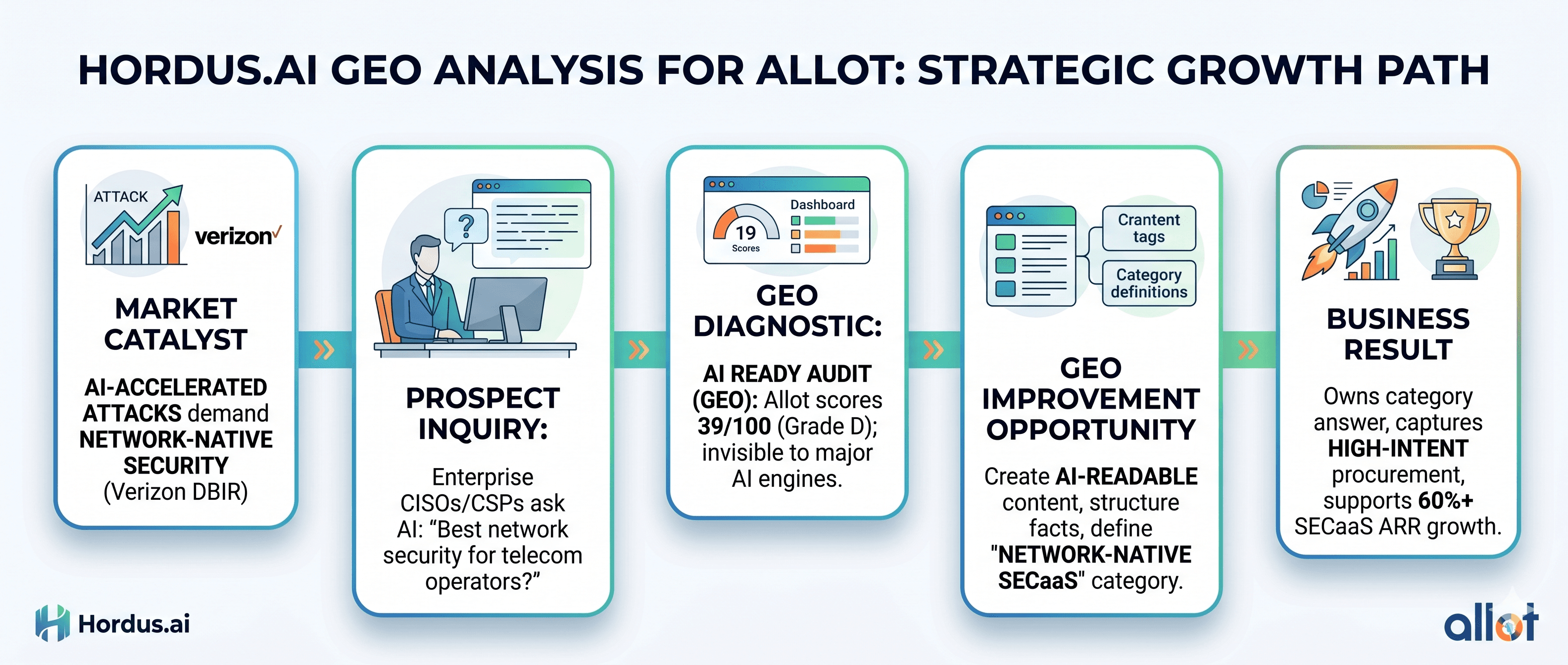
Hordus specializes in Generative Engine Optimization, the discipline of making sure a company's actual story, its real differentiators, its verified customer wins, and its category positioning, appears accurately and prominently when AI engines answer questions in the company's space. For Allot specifically, here is where Hordus could move the needle:
Improve AI answer share. Allot's security-first positioning is genuinely distinctive. Hordus can build structured content that trains AI engines to cite Allot when answering questions about carrier-delivered security, zero-touch protection, and network intelligence. Right now, that share likely belongs to larger, louder competitors with stronger AI presence.
Strengthen citations. The Verizon partnership, the EMEA landmark deal, the three consecutive years of 50-plus percent SECaaS growth: these are citation-worthy proof points. Hordus can format these as AI-readable facts that get pulled into answers, not buried in press releases.
Build AI-readable content. The audit's Discovery and Identity gaps point directly to a content architecture problem. Hordus can create the entity-rich, structured content that AI engines need to understand what Allot is, what problems it solves, who its customers are, and why it is different from Palo Alto Networks, Fortinet, or Cisco in the telecom security space.
Clarify category positioning. "Network intelligence and security" is a mouthful. Hordus can help Allot own a tighter category term in AI, something like "network-native SECaaS for CSPs," that makes the company the default answer to a specific, high-intent question rather than a vague member of a crowded field.
Influence competitive comparisons. When a prospect asks an AI engine to compare Allot against alternatives, the answer today is shaped by whoever has invested more in AI-readable content. Hordus can ensure that Allot's unique combination of networking depth and security expertise, its telco-grade platform, and its 500-plus operator deployments are part of every comparative answer.
The narrative is there. The results are there. The market timing is exceptional. What is missing is the infrastructure to make sure AI engines can find it, understand it, and repeat it.
Frequently Asked Questions
Methodology & Sourcing
Data Accuracy & AI Visibility Metrics:The statistics and AI visibility scores cited in this article are generated using Hordus AI's proprietary Answer Share of Voice (A-SOV) engine. Data is derived from consented, anonymized real user interactions across major LLM interfaces (ChatGPT, Claude, Gemini).
Editorial Integrity:All AI-assisted research undergoes mandatory human editorial review by our GEO strategy team prior to publication to ensure factual accuracy and alignment with Google's YMYL (Your Money or Your Life) search quality rater guidelines.