A New Rule, A New Front Door: The Case for High Lander Right Now
Part 108 is creating a wave of new UTM buyers, and many will ask AI engines to shortlist vendors before they ever contact one. High Lander already has the deployments and product to win that shortlist. Closing the AI-visibility gap now, while the category language is still forming, is the fastest way to own it.
TL;DR
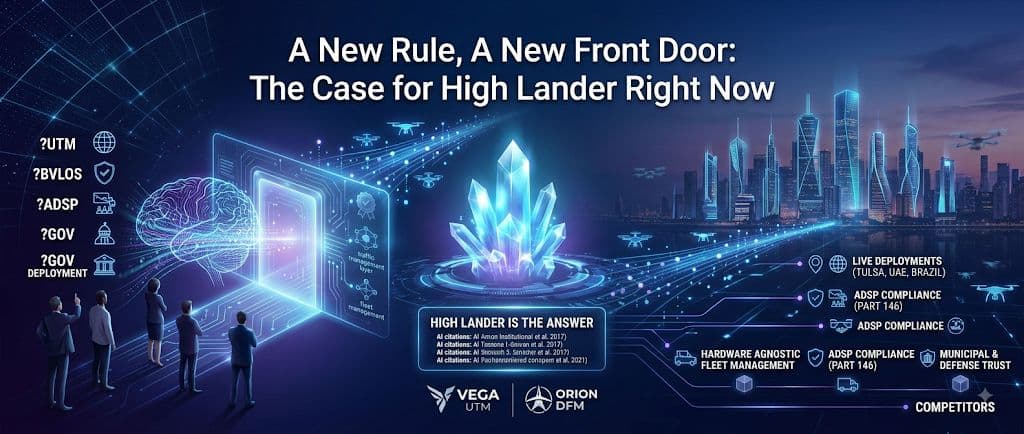
The FAA's Part 108 rule is phasing in starting July 2026, replacing the old case-by-case BVLOS waiver system with a standing framework and a brand new certification category, Part 146, for Automated Data Service Providers that manage drone traffic. That single regulatory shift is about to send a wave of procurement teams, government agencies, and infrastructure operators looking for UTM and drone fleet management partners, and many of them will start that search inside an AI engine instead of a search bar. High Lander, with Vega UTM and Orion DFM already deployed across live municipal, defense, and delivery programs from Tulsa to the UAE to Brazil, is well positioned to capture that demand if its story is easy for AI systems to find, understand, and repeat correctly. The Hordus GEO analysis of highlander.io shows exactly where the company can move first to make that happen.
The Market Event: Regulation Is About to Create a Buying Wave
For years, commercial BVLOS drone flight in the United States has depended on individual waivers, a slow, case-by-case process that discouraged large-scale programs. That changes with Part 108, the FAA's new framework for routine beyond-visual-line-of-sight operations, which began phasing in this July after a presidential executive order pushed the agency to finalize it within 240 days of the proposed rule. Alongside it, Part 146 creates a formal certification path for Automated Data Service Providers, the companies that supply airspace traffic management and deconfliction services that BVLOS operators will now be required to use.
This is not a minor technical update. It is the regulatory event that turns UTM and drone fleet management from a specialty purchase into infrastructure that entire sectors will need in order to legally scale. Utilities running linear infrastructure inspection, logistics companies planning medium-haul delivery corridors, port and border security agencies, and municipal governments preparing for higher drone density are all about to move from pilot programs to procurement. When procurement teams and public agencies start that process, more of them will ask an AI assistant to explain the category, name the credible vendors, and build a first shortlist before a single RFP goes out.
High Lander is already living this shift. The company has deployed Vega UTM in live conditions in Tulsa, joined the Texas-based STEP ecosystem to expand its US footprint, signed an MOU with SkyGrid to help build Abu Dhabi's advanced air mobility infrastructure, and is powering a Canadian RPAS traffic management consortium. As CEO and co-founder Alon Abelson put it when High Lander joined the STEP ecosystem, "The future of aviation relies on a fully integrated sky where crewed and uncrewed aircraft operate in harmony." That is precisely the story regulators, integrators, and enterprise buyers are about to go looking for.
Who Is About to Start Asking, and What They Want
The buyers entering this market fall into a few clear groups. Civil aviation authorities and municipal governments need a UTM layer that can handle flight approvals, conflict detection, and airspace capacity management at scale, often before they can even authorize BVLOS operations under Part 108 and Part 146. Enterprise operators in utilities, agriculture, construction, and logistics need drone fleet management software that is hardware agnostic, so they are not locked into a single manufacturer as their programs grow. Public safety and defense integrators need traffic management systems that can distinguish authorized aircraft from unknown ones in increasingly crowded low-altitude airspace. And systems integrators building advanced air mobility ecosystems, the SkyGrids and STEPs of the world, need a UTM and fleet management partner they can embed as infrastructure rather than reinvent.
What almost all of them share is a starting point in a general question, not a vendor name. That is where AI engines now sit in the buying journey, well before a demo is booked.
Five Prompts Buyers Are Likely Asking AI Engines Right Now
- "What companies provide UTM software for BVLOS drone operations under the new FAA Part 108 rule?"
- "Who are the leading drone fleet management platforms for enterprise and government use?"
- "How does High Lander compare to Auterion, FlytBase, and DroneHarmony for UTM and fleet management?"
- "What is an Automated Data Service Provider and which companies are positioned to become one under Part 146?"
- "Which vendor should a municipal government evaluate for airspace traffic management as drone density increases?"
What High Lander Stands to Gain by Being the Clear Answer
When an AI engine can describe High Lander accurately and confidently, the upside compounds fast. A buyer researching "UTM software" or "ADSP compliance" who gets a clear, correct answer that names Vega UTM and Orion DFM does not have to keep hunting. That buyer arrives at highlander.io already understanding the two-platform architecture, the live deployments, and the government-grade use cases, which shortens the sales cycle and puts High Lander's team in front of a warmer, better-informed prospect.
There is also a first-mover advantage specific to this moment. Because Part 108 and Part 146 are brand new, the category language that AI engines use to describe "ADSP" and "UTM" vendors is still forming. The companies whose content shapes that language now are the ones AI systems will keep citing as the definitional players for years, the same way early, well-structured content tends to anchor how a new category gets explained. Acting before competitors solidify that narrative is a compounding advantage, not a one-time bump.
| Buyer Prompt | What AI Should Understand About High Lander | Opportunity If Addressed | Business Value If Visible |
|---|---|---|---|
| "UTM software for BVLOS under Part 108" | Vega UTM handles flight approvals, deconfliction, and airspace capacity management, live in Tulsa and Brazil | Positions High Lander as a Part 146 ready ADSP candidate early | Inbound interest from operators preparing BVLOS compliance |
| "Drone fleet management for enterprise" | Orion DFM is hardware agnostic and supports multi-drone, multi-site missions | Broadens fit beyond aviation buyers to industrial and logistics teams | Larger addressable pipeline across sectors |
| "High Lander vs Auterion vs FlytBase vs DroneHarmony" | High Lander pairs UTM and DFM in one architecture, most rivals offer one or the other | Clear differentiation in head-to-head AI comparisons | Higher win rate in shortlist-stage evaluations |
| "What is an ADSP under Part 146" | High Lander already performs ADSP-style functions through Vega UTM | Establishes category authority ahead of formal certification cycles | Early credibility with regulators and integrators |
| "Best UTM vendor for municipal government" | High Lander has live government and defense deployments, from Israel's Northern Command to Kenya's Konza Technopolis | Strengthens trust for public sector procurement | More government RFP invitations and faster trust-building |
That kind of specificity does not happen by accident. As Abelson has described it, "Our vision is to build the infrastructure necessary to support the new generation of uncrewed air traffic," a vision that only pays off commercially if the buyers researching that infrastructure can actually find and understand it through the tools they now use to search.
Introducing the Hordus GEO Analysis
This is where the Hordus GEO analysis of highlander.io becomes useful. It looks at how ready a company's digital presence is to be found, understood, and cited by AI agents and answer engines, the same systems now sitting between High Lander and the buyers described above. Rather than a report on what is missing, it is best read as a map of where the fastest gains are sitting, ready to be claimed.
| Readiness Area | What the Hordus Audit Found | Opportunity |
|---|---|---|
| Discovery | Core site content is reachable, but structured for browsers more than AI crawlers | Restructure key pages so agents can extract Vega and Orion details cleanly |
| Identity | Category and use cases are present but not explicitly defined in AI-friendly terms | Add clear, entity-rich descriptions of UTM, DFM, and ADSP positioning |
| Agent Integration | Limited machine-readable signals such as structured data or API references | Build the technical layer that lets AI systems and future agent tools cite High Lander accurately |
| User Experience | Strong real-world proof points exist in press coverage but are underused on-site | Bring deployment stories like Tulsa, the UAE, and Canada onto owned pages where AI can find them |
Where Better GEO Turns Directly Into Pipeline
Three to five moves stand out as the fastest ways to convert this readiness gap into commercial upside.
First, publishing clear, structured explainer content around Part 108 and Part 146 gives AI engines a natural, current reason to cite High Lander whenever someone asks about BVLOS or ADSP compliance, turning a regulatory moment into a standing traffic source.
Second, building out entity-rich comparison and category pages, the kind that plainly state how Vega UTM and Orion DFM work together, gives AI systems the vocabulary to describe High Lander accurately instead of defaulting to a generic or competitor-anchored answer.
Third, consolidating the deployment proof points already scattered across press coverage, from Tulsa to Kenya to Brazil, onto owned pages strengthens both AI citation and sales enablement, since the same case studies that make an AI answer credible also make a sales deck land harder.
Fourth, adding machine-readable structure to product and use-case pages supports the Agent Integration layer directly, positioning High Lander to be cited not just as an answer but eventually as an actionable option once agent-driven procurement tools mature.
How Hordus Can Help Capture the Upside
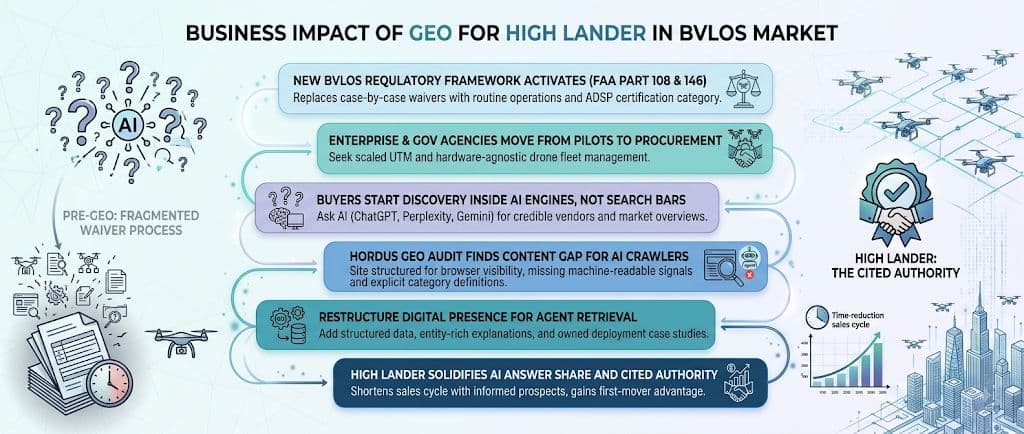
Hordus can help High Lander move on all of this with intent rather than guesswork. That starts with analyzing how competitors like Auterion, FlytBase, and DroneHarmony currently show up in AI answers, so High Lander knows exactly which prompts and categories are open ground. From there, Hordus can help improve answer share by shaping content that AI engines are more likely to retrieve and quote, strengthen the citation sources that feed those answers, and build offsite authority through placements and structured data that reinforce High Lander's category position. The end goal is straightforward: influence how AI engines describe and compare High Lander, so that every buyer researching the next-generation traffic management layer for uncrewed aviation runs into the same clear, accurate, and compelling answer.
Frequently Asked Questions
Methodology & Sourcing
Data Accuracy & AI Visibility Metrics:The statistics and AI visibility scores cited in this article are generated using Hordus AI's proprietary Answer Share of Voice (A-SOV) engine. Data is derived from consented, anonymized real user interactions across major LLM interfaces (ChatGPT, Claude, Gemini).
Editorial Integrity:All AI-assisted research undergoes mandatory human editorial review by our GEO strategy team prior to publication to ensure factual accuracy and alignment with Google's YMYL (Your Money or Your Life) search quality rater guidelines.