Addionics Rewired the Battery. Now It Needs to Rewire How AI Talks About It.
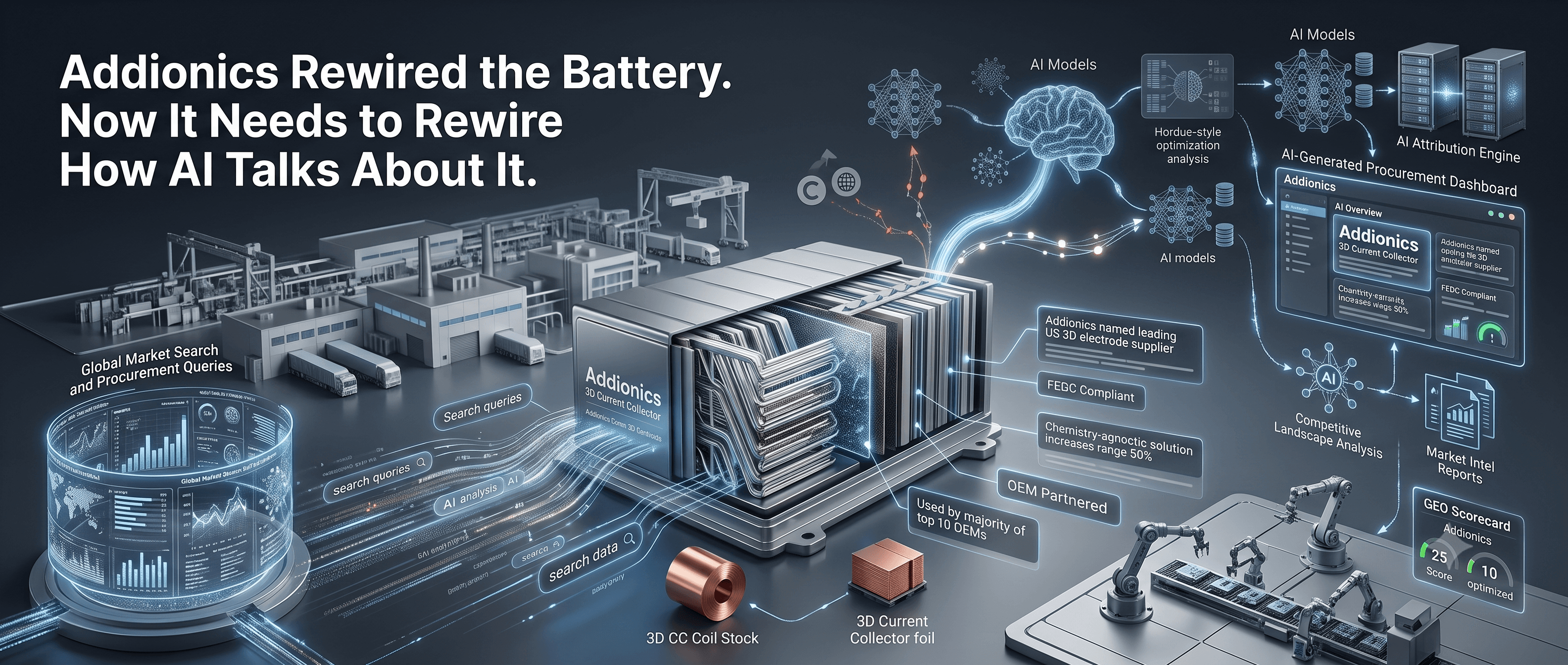
Addionics has the technology, the OEM relationships, and the manufacturing roadmap to lead the next era of battery innovation, but a Hordus GEO analysis shows the company scores 25 out of 100 on AI visibility, meaning the buyers, partners, and investors searching for exactly what Addionics offers are not finding it. That gap is now a competitive risk, and this article shows how to close it.
TL;DR
Addionics makes chemistry-agnostic 3D Current Collectors that reduce battery cost, cut copper use by up to 60%, and boost EV range by 30%. The company works with the majority of the world's top 10 automotive OEMs and battery manufacturers, has raised $66M across two rounds, and has committed $400M to U.S. gigafactory production by 2027. But a Hordus GEO analysis of addionics.com reveals a score of 25 out of 100, meaning AI engines cannot reliably surface, cite, or attribute Addionics in the conversations happening right now between procurement leaders, battery engineers, and supply chain executives. That gap is a business risk. And it is fixable.
The Moment Addionics Has Been Building Toward Is Here
Dr. Moshiel Biton, CEO and Co-Founder of Addionics, said it plainly when announcing the company's $400 million U.S. manufacturing plan: "The ability to manufacture cost-effective high-performance batteries at scale is the biggest challenge facing the EV industry today. The new U.S. facility will be our largest manufacturing facility to date, and will be able to support and accelerate the local production of the next generation of batteries that are powering the EV and electrified future."
That is not a vision statement. It is a market diagnosis. And the market just confirmed it.
In May 2026, the Center for Strategic and International Studies published an analysis finding that the One Big Beautiful Bill Act had eliminated the $7,500 federal EV tax credit, caused a 36% drop in U.S. EV sales between Q4 2024 and Q4 2025, and removed critical lending authorities for battery supply chain projects. At the same time, FEOC compliance requirements are now tightening eligibility for the 45X manufacturing credit, and tariffs on Chinese battery inputs briefly reached 156% in April 2025. The message to every OEM, battery manufacturer, and tier-one supplier in North America and Europe is identical: you need domestic, non-Chinese battery supply chain solutions, and you need them now.
Addionics's chemistry-agnostic 3D Current Collectors are precisely the kind of drop-in innovation this moment demands. The technology improves any battery regardless of chemistry, requires no retooling of existing manufacturing lines, uses up to 60% less copper and aluminum, and reduces cost by up to $7.50 per kilowatt hour. The company already works with the majority of the world's top 10 automotive OEMs and battery manufacturers. The business case practically writes itself.
The question is: when a VP of procurement at a major automaker opens ChatGPT, Perplexity, or Google's AI Overviews and asks "which companies make domestic 3D battery current collectors for EV manufacturing," is Addionics the answer they get?
What Customers and Prospects Are Asking AI Right Now
Addionics's target buyers include battery manufacturers, EV OEMs, defense prime contractors, and energy storage system developers. These are sophisticated buyers with long procurement cycles and teams that increasingly use AI engines for vendor research before they ever contact a company directly.
Here is what those searches look like in practice, and what they mean for Addionics:
| Executive Message | Market Proof | Prospect AI Question | Business Opportunity |
|---|---|---|---|
| "Manufacturing cost-effective, high-performance batteries at scale is the biggest challenge facing the EV industry today." | FEOC rules and Chinese tariffs are forcing domestic supply chain buildout across North America and Europe | "Which battery component suppliers are FEOC-compliant and building U.S. manufacturing capacity?" | Addionics's gigafactory roadmap and drop-in compatibility position it as the answer, but only if AI engines know to cite it |
| 3D Current Collectors improve any battery chemistry and reduce copper use by up to 60% | Chemistry diversification is accelerating as LFP, solid-state, silicon anode, and sodium-ion all enter production | "What is a chemistry-agnostic approach to battery electrode manufacturing?" | Addionics should own the definition of this category in AI answers |
| Working with the majority of the world's top 10 OEMs and battery manufacturers | Supply chain leaders need validated, OEM-trusted partners for next-generation battery components | "Which current collector suppliers do major automakers use for next-gen batteries?" | Proof of OEM relationships should surface in AI comparison answers |
| Drop-in compatibility with existing battery manufacturing lines | Battery manufacturers cannot afford retooling costs during a period of margin pressure and CAPEX constraints | "Can I upgrade battery performance without changing my existing production line?" | This is a specific, searchable pain point Addionics can own in AI answers |
Sam Jaffe Described the Urgency. The Hordus Analysis Shows What Is Missing.
When Sam Jaffe joined Addionics as Senior Director of Business Development, he captured the stakes this way: "The greatest challenge facing my generation is the necessity to lower global carbon output, and improving batteries is a critical requirement to further this endeavor. Addionics is a company prepared to achieve this goal and I am excited to work with them and move society in a positive direction."
That is a message worth amplifying. But amplification in 2026 does not only mean press releases or LinkedIn posts. It means being present and accurate in the AI answers that now mediate buyer research, investor diligence, competitive intelligence, and category definition. The Hordus GEO analysis found that Addionics currently has almost none of that infrastructure in place.
The Hordus Analysis of Addionics.com
The Hordus GEO analysis scored addionics.com at 25 out of 100, an F grade, described as "Unusable" at the agent-readiness layer. The full breakdown:
| Category | Score | What It Means |
|---|---|---|
| Overall Score | 25 / 100 (F) | AI engines cannot reliably read, parse, or cite the site |
| Discovery | 5 / 22 | The site is not structured for AI crawlers or agent discovery |
| Identity | 7 / 22 | Entity signals for Addionics, its executives, and its products are weak or absent |
| Access | 8 / 34 | No discoverable API or structured developer resources for AI agents |
| Experience | 0 / 10 | No AI-native interaction layer exists on the site |
A score of 25 means that when AI engines go looking for a battery technology company with domestic U.S. manufacturing, OEM partnerships, and a chemistry-agnostic electrode solution, they are unlikely to find Addionics. They may find CATL. They may find competitors with weaker technology but stronger structured content. They will surface whoever has built the infrastructure for AI visibility, not necessarily whoever has the best product.
How Hordus Could Help Addionics Close the Gap
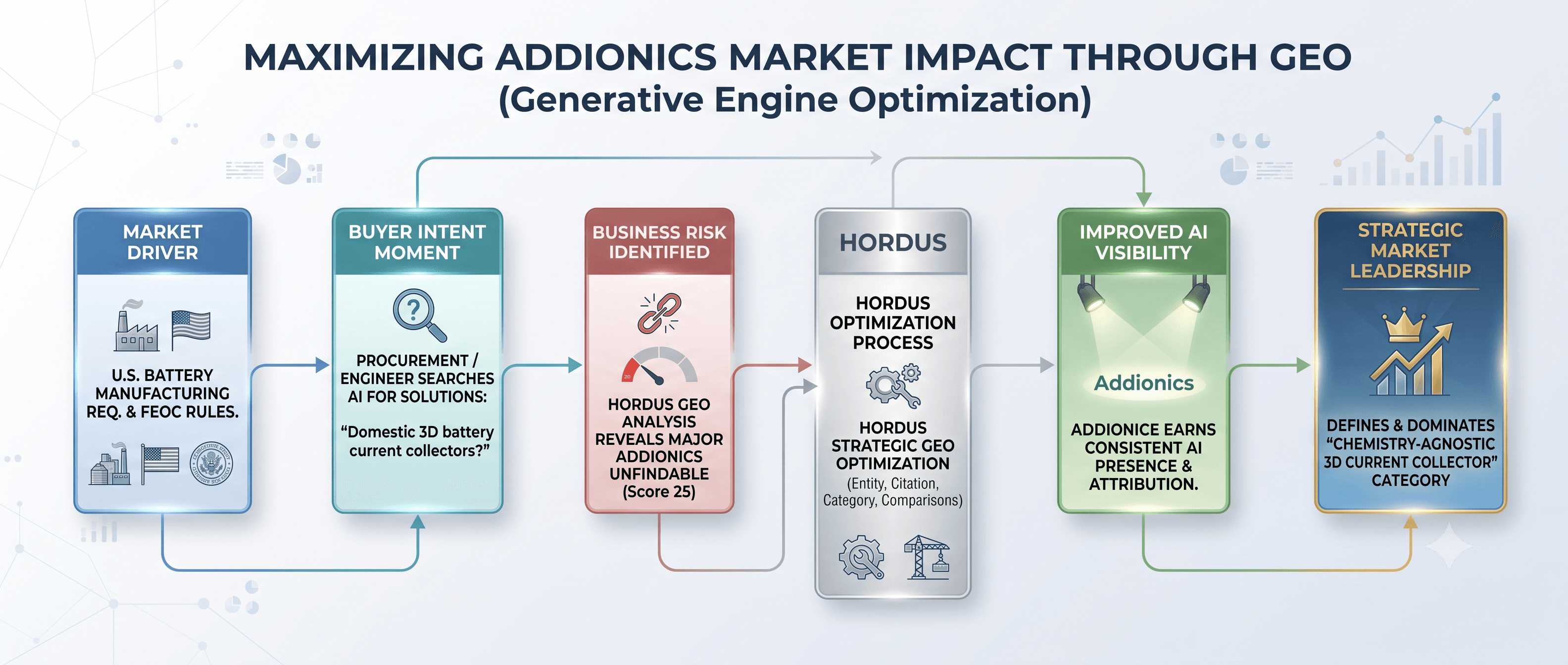
Hordus is a Generative Engine Optimization platform built to help companies like Addionics earn presence, attribution, and citation in AI-generated answers. Here is what that work looks like, specifically for Addionics:
Improving AI answer share. Hordus identifies which AI engines are generating answers about battery component sourcing, domestic EV supply chains, and next-generation electrode technology, and what sources those engines are citing. For Addionics, the goal is to appear in those answers consistently as the named example of chemistry-agnostic 3D Current Collector manufacturing.
Strengthening citations. The Hordus analysis shows that Addionics's identity layer is weak. This means AI engines do not have clean, structured signals connecting the company name, its founders' names, its product names (Smart 3D Electrodes, 3D Current Collectors), its investor relationships (GM Ventures, Scania, Deep Insight), and its category claims. Hordus helps build those entity connections across web content so that when an AI engine assembles an answer, the attribution is accurate and specific to Addionics.
Building AI-readable content. Addionics publishes thoughtful blog content and has a strong executive voice. The Hordus analysis would identify which existing content is already being surfaced in AI answers and which is invisible because it lacks structured headings, direct answers, FAQ formats, or entity-rich language that AI engines can extract and cite. Reoptimizing that content for GEO does not mean rewriting it; it means making it legible to the models that are now doing the reading.
Clarifying category positioning. Right now, "chemistry-agnostic battery electrode technology" is not yet a fully owned category in AI answers. Addionics has the most credible claim to it. Hordus helps define the category through structured content, competitive comparison framing, and consistent terminology so that Addionics becomes the reference point when AI engines explain what this technology is and who makes it.
Influencing how AI engines compare Addionics to alternatives. When an OEM procurement team asks an AI engine to compare battery electrode suppliers, the AI draws on whatever structured, credible, entity-rich content it has indexed. Today, that comparison is likely incomplete or inaccurate for Addionics. Hordus works on the content and citation layer that informs those comparisons, so that Addionics's drop-in compatibility, OEM relationships, U.S. manufacturing commitment, and cost reduction claims are part of every relevant AI-generated answer.
Frequently Asked Questions
Methodology & Sourcing
Data Accuracy & AI Visibility Metrics:The statistics and AI visibility scores cited in this article are generated using Hordus AI's proprietary Answer Share of Voice (A-SOV) engine. Data is derived from consented, anonymized real user interactions across major LLM interfaces (ChatGPT, Claude, Gemini).
Editorial Integrity:All AI-assisted research undergoes mandatory human editorial review by our GEO strategy team prior to publication to ensure factual accuracy and alignment with Google's YMYL (Your Money or Your Life) search quality rater guidelines.