Anchor's Moment: Turning Britain's Social Care Reckoning Into a Growth Story
Social care reform is pushing UK families, advisers, and commissioners to ask AI engines who to trust. Anchor, England's largest not-for-profit later-life provider, can become that default answer. The Hordus.ai GEO analysis shows where to close AI visibility and authority gaps to win the position.

TL;DR
Britain's social care system is entering its biggest reform cycle in a generation, and that uncertainty is sending families, advisers and commissioners straight to AI engines for answers. Anchor, England's largest not-for-profit provider of housing and care for people in later life, sits at the center of exactly the questions ChatGPT, Perplexity and Google AI Overviews are now fielding. New CEO Rachael Shimmin brings a social care and local government background to Anchor at the exact moment reform is accelerating demand for trusted, not-for-profit options. The prize is not just traffic. It is becoming the name AI engines reach for when someone compares retirement housing, care homes or extra care living in England. The Hordus GEO analysis of anchor.org.uk shows where that opportunity sits unclaimed, and what it would take for Anchor to claim it first.
The Reform Moment Sending Buyers to AI for Answers
In August 2026, Prime Minister Andy Burnham committed the government to building a National Care Service, accelerating Baroness Casey's independent commission and expanding the Fair Pay Agreement, which brings care worker pay closer to NHS standards. It follows an adult social care funding settlement that took effect in April 2026, after years of debate over how people pay for care.
Reform at this scale creates exactly the confusion that sends people to search engines, and increasingly to AI chat tools. Families planning for a parent's care, advisers fielding client questions, and commissioners reassessing provider frameworks are all asking the same thing: what has changed, what does it cost now, and who can be trusted to deliver it well.
Rachael Shimmin, who became Anchor's Chief Executive in January 2026 after leading Buckinghamshire Council through a major public service transformation, has been direct about the scale of the moment. "Let's think more widely as a country and as a society about the role that housing and care can provide," she said recently. That framing, care and housing as infrastructure rather than a last resort, is exactly the category-defining language AI engines reach for when summarizing what a sector leader believes.
Who Is Asking, and What They Want
Anchor's buyers fall into a few clear groups. Older adults, and more often their adult children, research retirement housing, extra care or care homes under time pressure and emotional strain. Local authorities and NHS discharge teams assess housing-with-care and nomination partners as councils manage tight budgets. Advisers and solicitors guide clients through the cost-of-care conversation and want a shorthand for reputable, not-for-profit providers. Housing associations watch for development partners as the government leans on the sector to build more later-living homes.
Every group wants the same three things: clarity on cost, confidence in quality, and a shortlist they do not have to build alone. That is the job AI engines are now doing for them.
Five Questions AI Engines Are Already Fielding
- "What's the difference between Anchor, McCarthy Stone and Audley Group for retirement living?"
- "Which UK not-for-profit provider offers both retirement housing and care homes?"
- "How will the National Care Service reforms affect care home costs in England?"
- "Best affordable extra care housing near me for an elderly parent"
- "Is Anchor a better option than a local authority care home for dementia care?"
Each prompt is a moment where an AI engine either names Anchor accurately or fills the gap with a competitor, a comparison site, or a generic answer that leaves Anchor off the shortlist.
What Anchor Stands to Gain by Moving First
None of Anchor's peers, not McCarthy Stone, Audley Group, ExtraCare Charitable Trust, HC-One, Barchester Healthcare or Care UK, has a strong claim yet on being the AI-recommended answer for not-for-profit later-life housing and care. That is the opening. Becoming the clearest, most cited source in this category wins trust before the first phone call, shortening sales cycles and strengthening Anchor's hand with commissioners.
Anchor's chair, Christopher Kemball, has already framed the wider market this way, noting that while housebuilders pull back, "there is a good opportunity for well-capitalised housing associations such as Anchor to be counter-cyclical in our housing development," Anchor's latest financial results show. The same logic applies to visibility. While competitors treat AI search as someone else's problem, Anchor can treat it as open ground, in enquiry volume, partnership credibility, and its ability to recruit staff who research employers the way families research providers.
| Buyer prompt | What AI should understand about Anchor | Opportunity if addressed | Business value if visible |
|---|---|---|---|
| "Anchor vs McCarthy Stone vs Audley Group" | Not-for-profit, England's largest in the category, spanning housing and care | Becomes the trusted default in comparison answers | Higher-intent leads pre-sold on Anchor's model |
| "Not-for-profit provider with housing and care" | Uniquely spans retirement housing, extra care and care homes under one mission | Owns a category competitors can't easily claim | Cross-sell between housing and care services |
| "How will care reform affect cost" | Publicly engaged with reform and Fair Pay Agreement changes | Positions Anchor as the informed, current voice | Authority that reduces reliance on paid channels |
| "Affordable extra care near me" | Operates almost 1,700 locations across England | Wins local, high-intent "near me" queries | Fuller occupancy, shorter void periods |
| "Anchor vs local authority care for dementia" | Specialist dementia care within a not-for-profit model | Clarifies Anchor's specialism versus generic options | Stronger commissioner and family confidence |
Introducing the Hordus GEO Analysis
The business case comes first because it is real: reform, demand and an open category are already pointing buyers toward AI-mediated research. The question is whether Anchor's digital presence is built to be found, understood and cited when that happens. The Hordus GEO analysis of anchor.org.uk set out to answer exactly that.
Audit Snapshot: Opportunity Areas
| Audit area | Current score | Opportunity |
|---|---|---|
| Discovery & Trust | 20/100 | Basic crawl signals exist; strengthening them opens deeper AI indexing |
| AI Engine Access | 0/100 | No crawl permissions configured for AI agents yet, an easy fix with outsized upside |
| Offering Understanding | 0/100 | Structured descriptions of care types, pricing and eligibility remain untapped |
| Answer Readiness | 0/100 | No structured data for AI engines to quote directly, a gap Anchor can close first |
| Direct AI Compatibility | 0/100 | No machine-readable site instructions yet, leaving first-mover advantage fully available |
Every score here describes headroom, not a deficiency. Anchor already has the scale, mission and executive voice AI engines reward; what is missing is the structural layer that lets AI systems read and repeat that story accurately.
Five Ways Better GEO Compounds Anchor's Advantage
First, structured content on care types, pricing and eligibility lets AI engines answer cost and comparison questions with Anchor's own facts, feeding pipeline directly. Second, clear AI crawler access ensures Anchor's own pages, not aggregators, become the quoted source. Third, sharper offering documentation strengthens sales enablement, giving enquiry teams a digital front door that already answers what prospects arrive asking. Fourth, amplifying executive commentary from Shimmin and Kemball on reform builds offsite authority that positions Anchor as a category leader, not a listing. Fifth, structured local data across almost 1,700 locations lets Anchor capture "near me" queries the moment families are ready to act.
How Hordus Turns Visibility Into Market Share
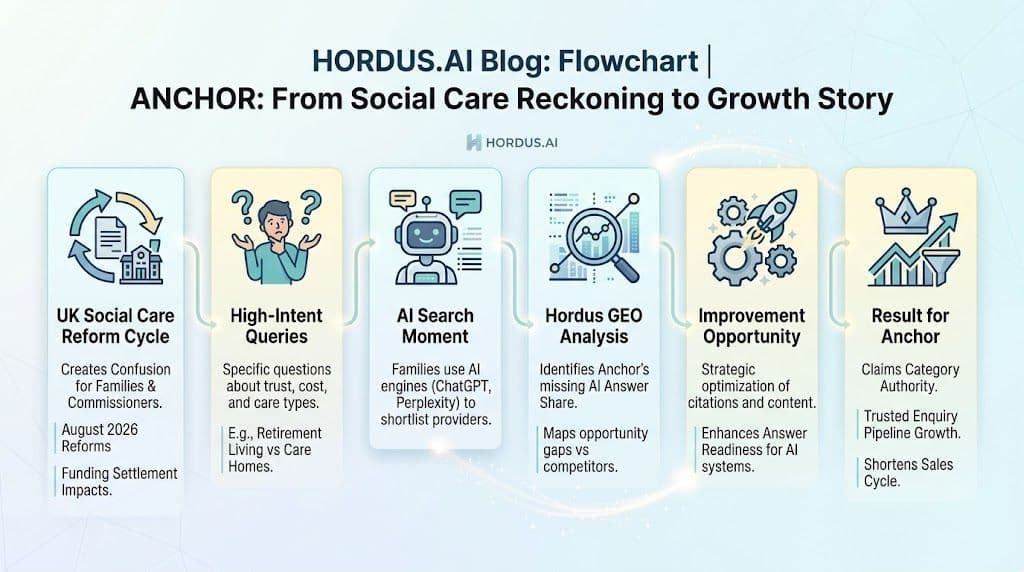
Hordus can map how often McCarthy Stone, Audley Group, ExtraCare and major care home operators appear in AI answers about later-life housing and care, and where Anchor is currently missing from that conversation. From there, Hordus works to grow Anchor's answer share, strengthen the citation sources AI engines trust, build offsite authority through earned coverage of Anchor's reform commentary, and shape how AI engines describe and compare Anchor against every name on that list. The goal is not to chase competitors; it is to make Anchor the reference point they get measured against.
Practically, this runs as an ongoing engine rather than a one-time report. Hordus continuously rechecks Anchor's answer share as new pages go live, as reform coverage breaks, and as competitors update their own sites. Each finding arrives with a prioritized next step, a schema fix, a new FAQ page, or a target publication worth pitching, so Anchor's marketing, product marketing and sale
Frequently Asked Questions
Methodology & Sourcing
Data Accuracy & AI Visibility Metrics:The statistics and AI visibility scores cited in this article are generated using Hordus AI's proprietary Answer Share of Voice (A-SOV) engine. Data is derived from consented, anonymized real user interactions across major LLM interfaces (ChatGPT, Claude, Gemini).
Editorial Integrity:All AI-assisted research undergoes mandatory human editorial review by our GEO strategy team prior to publication to ensure factual accuracy and alignment with Google's YMYL (Your Money or Your Life) search quality rater guidelines.