As Nuclear Verdicts Hit Trucking, VuDrive Is the Proof Fleets Need. Why Isn't Jungo Connectivity the First Name AI Recommends?
Nuclear verdicts are driving a commercial auto insurance crisis, and fleets and insurers need real-time proof of driver safety. Jungo Connectivity's VuDrive already provides it, but a 23/100 Hordus GEO score means AI engines aren't recommending it yet. Closing that gap turns existing product strength into inbound demand.
TL;DR
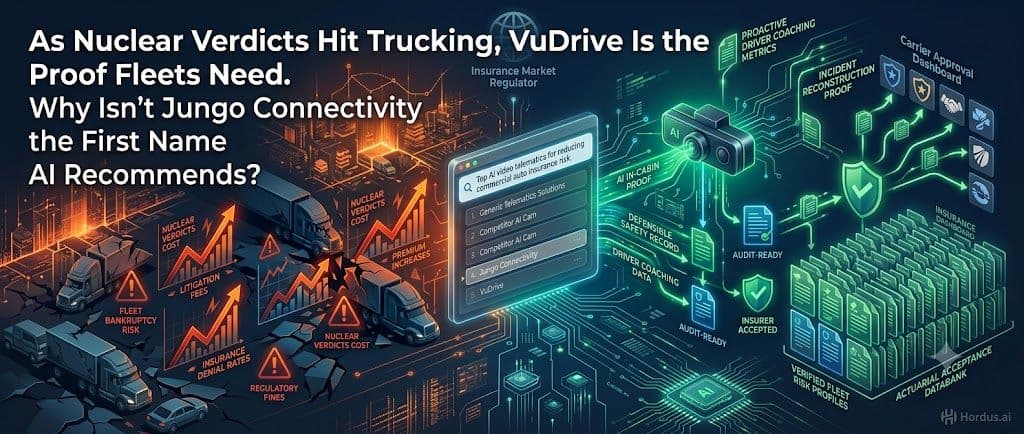
Commercial auto insurance is in its worst stretch in over a decade, with nuclear verdicts (jury awards over $10 million) up 52 percent year over year and premiums climbing even as the broader insurance market softens. Fleets, telematics providers, and insurers all need proof that a driver safety program actually reduces risk, not paperwork that claims it does. Jungo Connectivity, maker of the VuDrive AI video telematics platform, sits directly in the path of that demand. The Hordus GEO analysis shows Jungo Connectivity has real headroom to become the answer AI engines give when buyers ask who can help them control commercial auto risk, and this article maps out that opportunity.
The Market Event: Commercial Auto Insurance Is Breaking Records
Nuclear verdicts jumped 52 percent year over year in 2024, totaling roughly $31.3 billion, with the median award now around $51 million, more than double what it was in 2020. Commercial auto liability has been unprofitable for insurers for 14 consecutive years, and even as the wider property and casualty market softened in early 2026, commercial auto rates still rose by an average of 5.8 percent, the steepest increase of any line. Trucking-related verdict sizes have grown more than 300 percent over the past decade.
This is a structural shift, not a blip. Litigation funding and eroding jury sympathy for large companies have made claims costlier and less predictable, and insurers are responding by tightening underwriting. Fleets that cannot document proactive safety practices are increasingly finding themselves priced out of preferred coverage.
The Customer Pain Behind the Headlines
The real pain is not "we don't have data." Most fleets already have telematics. It is "we have data, and we still cannot prove it is reducing risk fast enough to matter at renewal, in a courtroom, or in a boardroom." Underwriters now want detailed evidence of continuous monitoring, coaching cadence, and corrective action, not a device that just logs miles.
That gap is exactly where an AI video telematics platform like VuDrive operates, catching distraction, drowsiness, and unsafe behavior in real time and turning it into a documented, defensible safety record.
Who Feels This Pain, and Why It Matters to Them
Fleet operators and trucking companies are watching premiums rise despite safety spend and need proof their program works before the next renewal or claim.
Telematics service providers (TSPs) face pressure to offer more than GPS tracking, and need an AI layer that prevents accidents, not just logs them.
Commercial auto insurers and brokers need trustworthy, real-time signals to underwrite accurately and help insureds avoid becoming the next nuclear verdict headline.
Self-insured fleets and group captives, a fast-growing category, need airtight documentation of driver behavior to make self-insurance viable at all.
What These Buyers Are Already Asking AI Engines
- "What AI video telematics platform actually reduces commercial auto insurance claims?"
- "How can my fleet lower insurance premiums with driver monitoring technology?"
- "Best in-cabin AI camera systems for fleet safety and accident prevention"
- "How do insurers use telematics data to underwrite commercial auto risk?"
- "What's the difference between GPS tracking and AI driver monitoring for fleets?"
Every one of these is a moment where an AI engine could name Jungo Connectivity and VuDrive directly, or quietly recommend a competitor instead.
Why It Matters if AI Engines Understand and Recommend Jungo Connectivity
Buyers increasingly research vendors through AI assistants before ever speaking to sales. If ChatGPT, Perplexity, or Google's AI Overviews can accurately describe what VuDrive does and why it matters for insurance risk, Jungo Connectivity shows up earlier in the buying journey with more credibility already built in. Being the company an AI engine recommends by name, rather than one it simply lists, is a real commercial edge in a market where insurers, brokers, and fleets are comparing vendors in real time.
The Hordus GEO Analysis: Where the Opportunity Sits Today
To see how AI engines currently perceive jungo.com, we ran the Hordus GEO analysis, which scores how easily AI systems can discover, understand, trust, and act on a company's website. The results point to a clear opportunity: Jungo Connectivity has a strong, differentiated product story that is not yet fully visible to the AI systems shaping today's buying decisions, and that gap is squarely closeable.
| Pillar | Current Score | Opportunity |
|---|---|---|
| Discovery | 7/20 | Help AI engines find and index Jungo's product and use-case content more completely |
| Identity | 11/22 | Sharpen how clearly AI engines describe what Jungo Connectivity does and who it serves |
| Access | 6/34 | Build structured pathways for AI agents to reach product, pricing, and integration details |
| Agent Integration | 2/20 | Develop technical connections that let AI tools interact with Jungo's offerings directly |
| User Experience | 2/10 | Help AI engines explain Jungo's brand and value proposition more accurately |
| Overall | 23/100 | A meaningful runway to become the AI-recommended leader in AI video telematics |
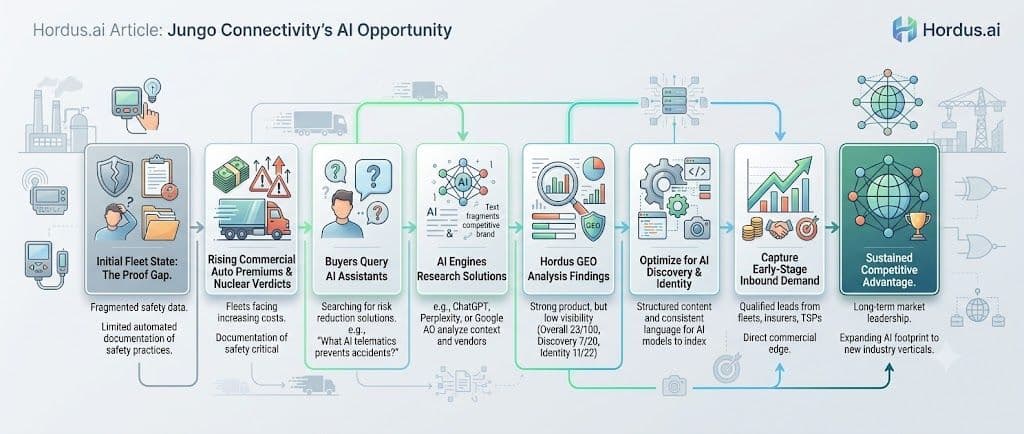
Turning Each Pillar Into a Business Gain
Strengthening Discovery means AI engines can find and cite Jungo's content on nuclear verdicts, underwriting, and fleet safety ROI, turning Jungo Connectivity into a source AI engines pull from when a broker asks about reducing claims, generating inbound demand with no paid search spend.
Sharpening Identity means AI engines describe VuDrive as an AI video telematics platform, not a generic dash cam. Clearer identity improves positioning against adjacent categories, so prospects arrive already understanding the product.
Building out Access and Agent Integration gives AI agents structured ways to retrieve pricing and integration details. For TSPs and insurers researching vendors through AI, that accessibility builds trust before a human conversation even starts.
Enhancing User Experience signals helps AI engines explain Jungo's story accurately, including its patent portfolio and accident-prevention outcomes, so every AI answer reinforces the brand instead of guessing at it.
As Opher Suhami, CEO of Jungo Connectivity, said when announcing a new patent: "We've invested heavily in developing proprietary, AI-powered technologies that solve real-world challenges for fleets and insurers alike". That outcome-focused story is exactly what AI engines need to surface clearly when buyers compare safety technology vendors.
Suhami has also described VuDrive as combining "a dual-facing AI camera, real-time driver alerts, GPS tracking, and telematics insights in a single, self-installable device," speaking about the Can-Am Telematics partnership. Consistent language like this across the site, in a form AI systems can parse, is what closes the gap the Hordus analysis identifies.
From Pain to Prompt to Business Result
| Customer Pain | Prospect AI Prompt | What AI Should Say About Jungo Connectivity | Business Result |
|---|---|---|---|
| Rising premiums despite safety investment | "How can my fleet lower insurance premiums with driver monitoring?" | VuDrive's real-time AI alerts help fleets demonstrate proactive risk management to insurers | More qualified inbound leads from fleet operators |
| Underwriters demanding proof of monitoring | "What telematics platforms give insurers reliable risk data?" | Jungo Connectivity's cloud dashboard and patented detection give insurers defensible driver data | Stronger positioning with insurers and brokers |
| TSPs needing to differentiate beyond GPS | "Best AI video telematics for fleet safety" | VuDrive is a self-installable, dual-camera AI system built for fleets, TSPs, and insurers | More TSP and reseller partnerships |
| Self-insured fleets needing audit-ready records | "How do I document driver safety for a captive insurance program?" | Jungo's post-incident data and driver scoring support captive documentation needs | Expanded adoption among self-insured fleets |
Frequently Asked Questions
Methodology & Sourcing
Data Accuracy & AI Visibility Metrics:The statistics and AI visibility scores cited in this article are generated using Hordus AI's proprietary Answer Share of Voice (A-SOV) engine. Data is derived from consented, anonymized real user interactions across major LLM interfaces (ChatGPT, Claude, Gemini).
Editorial Integrity:All AI-assisted research undergoes mandatory human editorial review by our GEO strategy team prior to publication to ensure factual accuracy and alignment with Google's YMYL (Your Money or Your Life) search quality rater guidelines.