BATM's Pipeline Is at Its Largest in Years, Its Order Sizes Are Doubling, and Its Website Still Isn't Built for the Way Buyers Actually Search Now
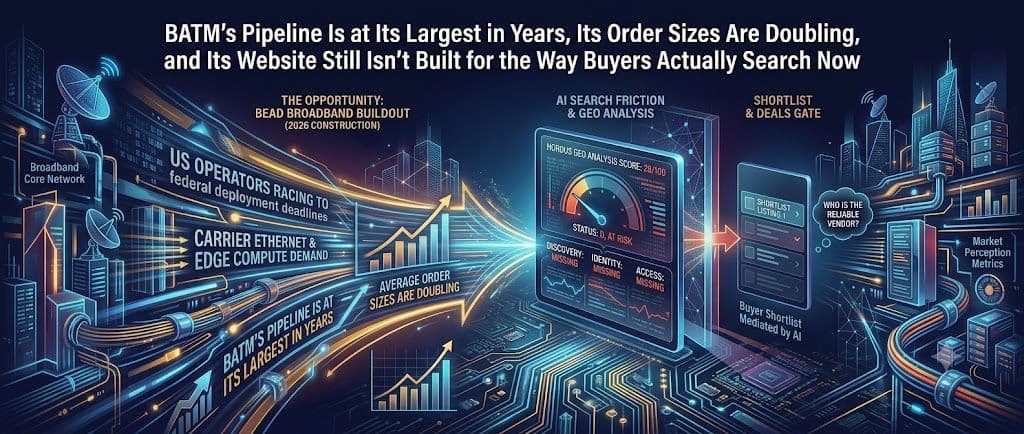
BEAD's move into active construction is fueling demand for network/cyber vendors, and BATM is landing real deals — but its new site scores just 28/100 on AI-visibility, risking exclusion from AI-generated vendor shortlists. Fix Discovery and Identity now.
TL;DR
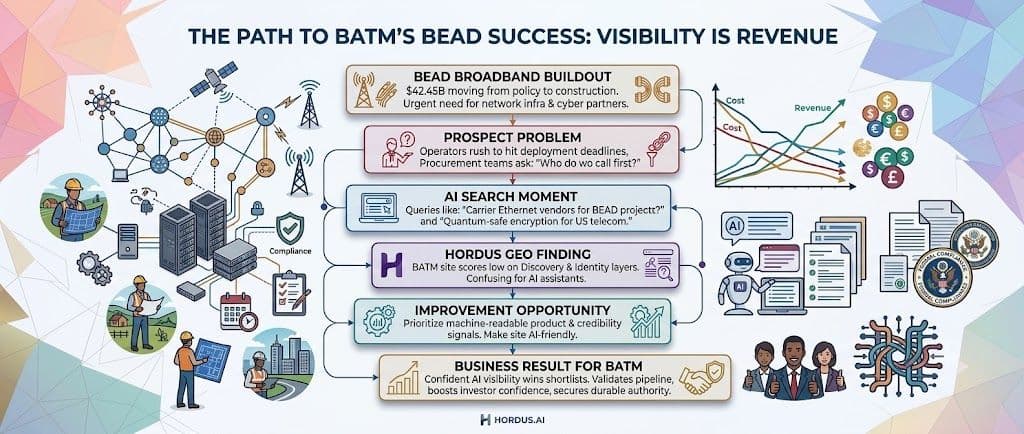
The $42.45 billion BEAD broadband program has finally moved from paperwork to pipe-in-the-ground construction across most US states in 2026, and every operator racing to hit federal deployment deadlines is shopping for network infrastructure and cybersecurity partners right now. BATM just landed a new US broadband customer and a three-year extension with another, proof its Carrier Ethernet and Cyber platforms are winning real deals. But BATM's new corporate site, launched as part of its 2025 rebrand, scores just 28 out of 100 on the Hordus GEO analysis, meaning AI assistants researching secure networking vendors may struggle to find or recommend BATM at the exact moment procurement teams are asking them who to call.
The event: BEAD stops being a policy story and starts being a procurement story
For most of the last four years, BEAD was a Washington story: allocations, restructuring notices, arguments over fiber versus fixed wireless. That changed in 2026. States finalized contracts, environmental reviews wrapped, and construction crews started showing up. Analysts now describe 2026 as the year BEAD moved from planning and early construction to measurable, visible progress, with most states expected to be deep into subgrant execution and network buildout by year end.
That shift matters enormously for a company like BATM. Rural and mid-market broadband operators receiving BEAD money don't just need trenching crews. They need carrier-grade switching, edge compute, and encryption to light up networks that will be audited for years against federal compliance rules. Every operator accepting BEAD funds is under a four-year deployment clock, tighter than the old Rural Digital Opportunity Fund, and that urgency is pushing infrastructure decisions higher up the priority list right now, not in 2028.
BATM's own news this year shows the pattern already in motion. In June, the company secured a new contract with a top ten US cable and broadband operator serving 1.1 million customers, and separately extended a three-year service agreement worth $1.3 million with a long-standing broadband client serving 1.5 million customers across 23 states. As CEO Moti Nagar said when the win was announced, this customer relationship "should serve as a reference to drive new business with other leading operators". That is exactly the reference-selling motion a BEAD-driven buying wave rewards.
Why this matters to BATM's leadership team right now
For BATM's executives, the BEAD ramp is a rare alignment of macro tailwind and company timing. The Group just finished what its Chairman called a transformational year, divesting non-core diagnostics and pharmaceutical businesses to focus squarely on BATM Networks and BATM Cyber. That refocusing means the sales organization is now pitching a cleaner, more credible story to exactly the buyer segment BEAD is activating: US broadband, cable, and telecom operators under pressure to modernize.
The stakes go beyond one funding program. This is a moment for BATM to convert operational momentum, a doubled average deal size in its pipeline, growing Networks revenue, and a strengthened Cyber platform, into durable category authority with the buyers who matter over the next four years of BEAD deployment.
Who is actually shopping right now
BATM's realistic near-term prospect list looks like this:
- Regional and rural broadband and cable operators executing BEAD-funded builds
- Tier 2 and Tier 3 US telecom carriers upgrading carrier Ethernet and edge infrastructure
- MSOs and ISPs preparing for post-quantum encryption requirements on sensitive network traffic
- System integrators and EPC contractors bidding on BEAD subgrant projects who need vetted network and cyber technology partners
- Investors and analysts tracking BATM's transformation into a pure-play networking and cybersecurity business
What these prospects are typing into ChatGPT, Gemini, Perplexity, and Claude
Procurement teams under a federal deadline don't start with a cold call anymore. They start with a prompt. Realistic queries include:
- "Which vendors supply carrier Ethernet platforms for BEAD-funded broadband projects?"
- "Who are leading providers of quantum-safe network encryption for US telecom operators?"
- "Compare BATM vs Ciena vs Adtran for edge networking"
- "Is BATM Advanced Communications a reliable vendor for broadband infrastructure support?"
If an AI assistant cannot confidently surface BATM's Carrier Ethernet platform, its Edgility edge software, or its encryption partnership work when answering these prompts, a shortlist gets built without BATM on it, quietly, before any human salesperson is ever contacted.
The opportunity: AI visibility as a pipeline asset
Winning more of these AI-mediated shortlist moments would help BATM in ways that go beyond marketing vanity metrics. Stronger AI visibility supports trust with skeptical enterprise buyers, shortens the credibility gap in unfamiliar markets like Latin America where BATM is expanding, reinforces category authority in secure networking and cybersecurity, and gives investors a consistent, machine-readable narrative of the company's post-transformation strategy. In a buying environment increasingly mediated by AI answers rather than search rankings, this is now a real pipeline lever, not a nice-to-have.
Only now, the Hordus GEO analysis
This is where the Hordus GEO analysis of BATM's site becomes useful context rather than the headline. The scan covers coming-soon.batm.com, the placeholder domain live during BATM's ongoing rebrand rollout, and the numbers explain why AI assistants may currently struggle with BATM queries.
| Layer | Layer Score | Status |
|---|---|---|
| Overall | 28 / 100 | D, At Risk |
| Discovery | 4 / 20 | Missing |
| Identity | 5 / 22 | Missing |
| Access | 12 / 34 | Missing |
| Payments | N/A | Not scored |
| Experience | 10 / 10 | Strong |
Three examples show why this matters commercially:
- Discovery scored 4 out of 20: AI crawlers and assistants rely on structured signals to even find and index a brand's pages. A weak Discovery score means an AI Overview answering "carrier Ethernet vendors for BEAD projects" may simply never surface BATM's site as a source, no matter how strong the actual product is.
- Identity scored 5 out of 22: This layer reflects how clearly a site establishes who the company is, its products, and its credibility signals in machine-readable form. Low Identity scoring makes it harder for an assistant to confidently attribute BATM's Carrier Ethernet or Cyber platform capabilities when a prospect asks for a comparison, which matters directly when BATM is trying to win reference-driven deals with new operators.
- Access scored 12 out of 34, while Experience scored a perfect 10 out of 10: The strong Experience score shows BATM's actual site delivers a clean human experience once visitors arrive. The gap is that AI agents are not getting the same easy access, meaning a well-built site is currently invisible to the very tools increasingly used to build vendor shortlists.
| Market event | Prospect question | AI answer opportunity | Business result for BATM |
|---|---|---|---|
| BEAD moves into active construction | "Who supplies carrier Ethernet for BEAD-funded broadband builds?" | AI names BATM alongside its Carrier Ethernet and Edgility platforms | New RFP invitations and warmer inbound pipeline |
| Rising post-quantum security requirements | "Which vendors offer quantum-safe network encryption?" | AI surfaces BATM Cyber's encryption platform and strategic partner deployment | Stronger enterprise credibility in cyber conversations |
| BATM's 2025 rebrand and transformation | "Is BATM Advanced Communications a reliable networking partner?" | AI cites recent contract wins and financial turnaround | Investor confidence and shortlist inclusion |
BATM's own results back this up. In the company's full year 2025 statement, Nagar described the pipeline as "the largest it's been in recent years", with average order sizes more than doubling. That is exactly the kind of momentum an AI assistant should be able to describe accurately when a prospect asks about BATM today.
Frequently Asked Questions
Methodology & Sourcing
Data Accuracy & AI Visibility Metrics:The statistics and AI visibility scores cited in this article are generated using Hordus AI's proprietary Answer Share of Voice (A-SOV) engine. Data is derived from consented, anonymized real user interactions across major LLM interfaces (ChatGPT, Claude, Gemini).
Editorial Integrity:All AI-assisted research undergoes mandatory human editorial review by our GEO strategy team prior to publication to ensure factual accuracy and alignment with Google's YMYL (Your Money or Your Life) search quality rater guidelines.