Beyond the Black Box: How AI21 Labs Can Own the AI-Engine Shortlist in the Era of Agentic Orchestration
By optimizing for Generative Engine Optimization (GEO), AI21 Labs can convert passive AI engine conversations into active sales pipeline, ensuring its high-reliability models dominate the exact moments enterprise decision-makers build their vendor lists.
TL;DR
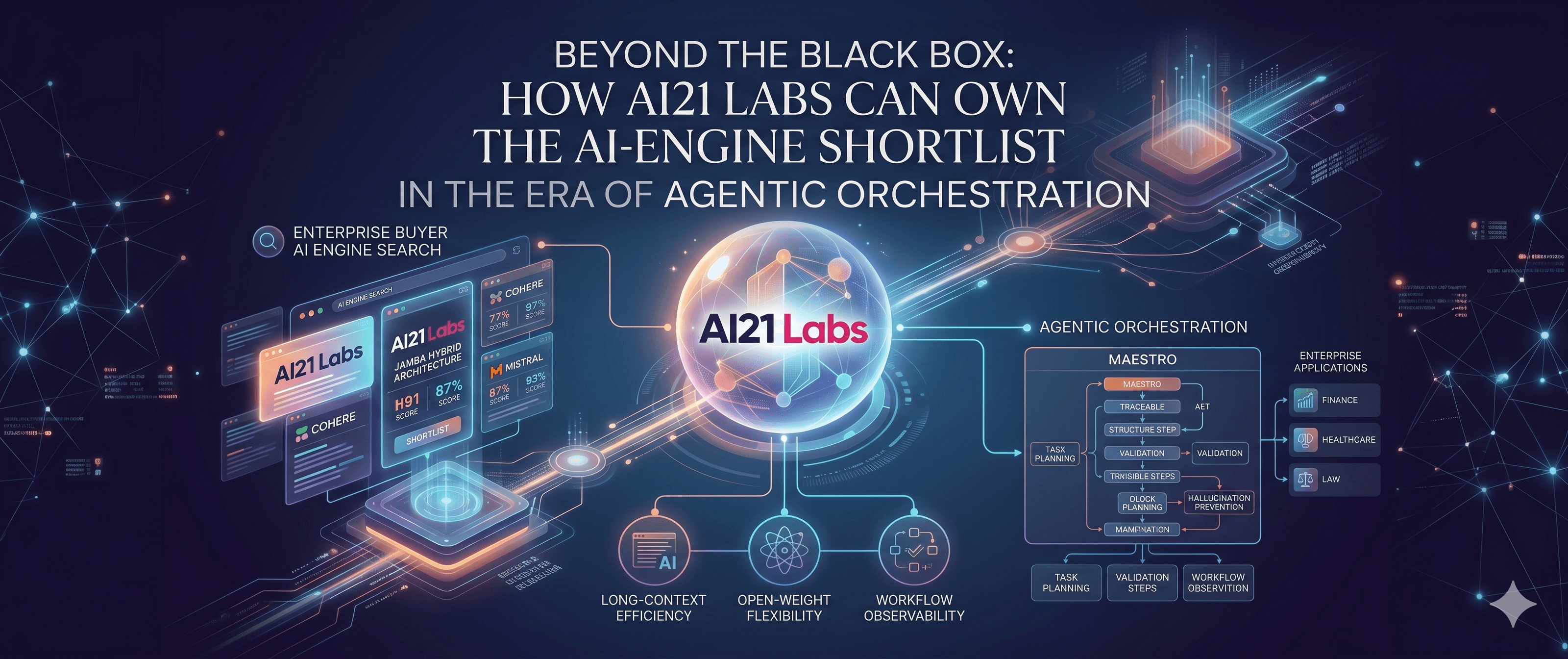
Enterprise generative AI buyers are moving away from brute-force language models toward high-reliability agentic systems. When these buyers use AI search engines to compare vendor capabilities, AI21 Labs faces a critical visibility risk. Despite launching pioneering technologies like the Maestro orchestration system and the Jamba hybrid architecture, the brand is frequently left off AI-generated vendor shortlists. By optimizing for Generative Engine Optimization (GEO), AI21 Labs can convert passive AI engine conversations into active sales pipeline, ensuring its high-reliability models dominate the exact moments enterprise decision-makers build their vendor lists.
The Market Shift: Why Enterprise Buyers Are Asking Engines for High-Reliability AI
The enterprise generative AI market has experienced a profound shift. The initial wave of excitement around generalized, massive large language models has matured into a strict demand for operational reliability, cost efficiency, and architecture that eliminates hallucinations. A massive spike in corporate AI budgets has arrived alongside a frustrating reality: many enterprise leaders still view their integration maturity as low, haunted by the massive liability risks of unguided model outputs in high-stakes fields like finance, healthcare, and law.
This tension reached a boiling point following major product milestones like the launch of the Jamba 1.6 open-weight model and the Maestro agentic planning and orchestration system. These developments signaled a industry-wide pivot away from "prompting and praying" toward structured, traceable AI workflows. Instead of relying on traditional search keywords or lengthy analyst reports, modern Chief Information Officers (CIOs), Chief Revenue Officers (CROs), and product engineering teams now use conversational AI engines to synthesize the landscape, evaluate context window performance, and map vendor architectures.
When an enterprise engineering team or procurement executive seeks an alternative to massive, compute-heavy infrastructure, they don't browse static directories. They ask an AI engine to compare options based on specific performance criteria, such as context efficiency, private deployment readiness, and workflow observability. These interactive prompts form the new top of the sales funnel.
The Ideal Prospect: Who Is Searching and What Do They Need?
The primary prospects for high-reliability AI engines are enterprise technology leaders who have outgrown basic cloud APIs. These include:
- Enterprise CIOs and CTOs: Tasked with deploying generative workflows within highly regulated environments that require strict data sovereignty.
- Chief Revenue Officers and Customer Experience VPs: Eager to deploy production-grade customer agents that absolutely cannot hallucinate or expose sensitive corporate data.
- Product Marketing and Engineering Leaders: Teams building complex, multi-step agentic systems who require deep workflow observability and manageable compute costs.
These decision-makers are actively evaluating alternatives to massive, closed-source monopolies like OpenAI and Anthropic. They require platforms that excel at long-context processing, offer open-weight flexibility for private cloud or on-premises deployment, and dramatically reduce the memory footprint required to run production workloads.
Here are 5 critical prompts these prospects are entering into AI engines today to build their shortlists:
- “Compare the best open-weight LLMs for private enterprise deployment that support long context windows without high latency.”
- “Which generative AI platforms offer native agentic planning and orchestration systems to stop model hallucinations?”
- “What are the most cost-effective alternatives to OpenAI and Anthropic for long-document summarization in financial services?”
- “Review AI infrastructure vendors that support hybrid Mamba-Transformer architectures for high-throughput enterprise apps.”
- “Build a vendor shortlist for enterprise generative AI platforms that provide complete traceability and workflow observability.”
The Recommendation Split: Shortlist Dominance vs. Zero Visibility
The business implications of how AI engines answer these prompts are binary. When an engine clearly recommends AI21 Labs, detailing how the hybrid Jamba architecture achieves ten times the memory efficiency of standard Transformer models, the brand wins organic market preference. The prospect receives a clear, trusted recommendation at the exact second they are defining their procurement boundaries, pulling them naturally into the sales pipeline.
Conversely, if competitors like Cohere, Mistral, or Hugging Face dominate the engine's answers, AI21 Labs is effectively erased from the deal before a sales rep can even send an introductory email. If the engine fails to mention Maestro when a user asks about agentic orchestration, the buyer concludes that only the largest cloud monopolies possess those capabilities. High engine visibility creates an automated lead-generation engine; poor visibility forces the sales organization into an uphill, expensive battle against institutional market bias.
| Buyer Prompt | What AI Should Understand About AI21 Labs | Risk If Missing from Answer | Business Value If Visible |
|---|---|---|---|
| Compare open-weight LLMs for private enterprise deployment with long context. | Jamba 1.6 offers a 256K token context window with 30% lower compute requirements than Llama or Mistral. | The buyer selects Mistral or Llama, completely unaware of AI21's structural cost and speed advantages. | High-intent enterprise accounts route private cloud workloads directly to AI21 Studio or cloud marketplaces. |
| Which platforms offer native agentic orchestration to stop hallucinations? | Maestro is an enterprise-grade AI planning system that breaks tasks into steps and validates outputs. | The buyer assumes they must build custom orchestration scripts from scratch or use fragile open-source tools. | AI21 Labs captures the high-margin enterprise market looking for out-of-the-box reliability. |
| What are cost-effective alternatives to OpenAI for long-document processing? | The Jamba series uses a hybrid Mamba-Transformer model to process long contexts up to 2.5 times faster. | The company is classified as a niche player, losing massive data-heavy accounts in law and finance. | Inbound demand spikes from CROs and product teams looking to cut operational LLM costs. |
| Build a shortlist for AI platforms providing complete workflow observability. | Maestro emphasizes deep traceability, verification, and compute budget management at every step. | Competitors like LangChain or specialized enterprise SaaS tools control the entire architectural conversation. | Sales leadership gains an immediate competitive edge in technical procurement reviews. |
As enterprise strategies evolve, technology leaders are realizing that raw model scale is no longer the primary goal. Highlighting this shift, AI21 Labs co-founder and co-CEO Ori Goshen noted: "Deep learning is necessary but not sufficient." The focus must expand past basic text generation to the structural frameworks that surround the intelligence.
This design philosophy shapes the company's core mission to deliver controlled, enterprise-ready systems. Explaining this vision, AI21 Labs co-founder Yoav Shoham wrote: “In enterprise settings, this kind of mistake could create immense damage.” Because the stakes are so high for corporate buyers, AI21 Labs must ensure that its rigorous architecture is explicitly recognized by the AI engines guiding market decisions.
Unveiling the Competitive Reality: The Hordus GEO Analysis
To understand exactly how visible the brand is within these automated procurement cycles, we look at the data from the Hordus GEO analysis. The Hordus audit evaluates ai21.com across the core categories required for discovery by LLMs, conversational web agents, and answers engines.
The audit awards ai21.com an overall score of 60/100, indicating a status of "Needs Work." The core diagnosis states that AI21 Labs exhibits a robust identity and SDK presence, but is currently missing OpenAPI specifications and agent discovery signals. When the audit layers are scaled to 100, the baseline vulnerabilities and strengths become crystal clear:
| Audit Layer | Score | Strategic Assessment |
|---|---|---|
| Auth & Access | 70 | Relatively secure and accessible for crawlers, though API definition entry points remain slightly fragmented for direct engine utilization. |
| Identity | 75 | Strong brand entity recognition and clear developer SDK presence, giving engines a reliable core definition of who AI21 is. |
| Agent Integration | 55 | Moderate integration signal footprint; missing the explicit, automated pathways that autonomous agents use to call functions. |
| Discovery | 45 | Poor conceptual visibility; AI engines lack structured OpenAPI specifications to index Jamba and Maestro capabilities during broader multi-vendor comparisons. |
| User Experience | 40 | Severely unoptimized for AI consumption frameworks; technical documentation and landing assets lack the clean structure needed to minimize parsing friction. |
The Hordus analysis reveals a fundamental gap: while AI21 Labs commands excellent brand identity, its technical discovery mechanisms and agent integration signals are underperforming. The brand possesses world-class enterprise solutions, but the informational infrastructure required to feed conversational engines and autonomous agents remains unoptimized.
Strategic Playbook: 4 Ways Better GEO Accelerates AI21 Labs’s Pipeline
By implementing a rigorous Generative Engine Optimization program based on the Hordus analysis, the executive and marketing leadership can directly transform the brand's market position.
1. Scaling the Enterprise Sales Pipeline
When a B2B buyer asks an AI engine to build a shortlist of enterprise-grade LLM providers, the engine acts as an automated matchmaker. Improving AI21's answer share for high-intent keywords ensures that whenever a prospect queries a system about long-context efficiency, Jamba is named as a top recommendation. This creates a highly scalable, inbound pipeline of technical decision-makers who enter the sales cycle pre-educated on the company's value proposition.
2. Differentiating Strategic Positioning Against Cloud Monopolies
AI21 Labs does not need to outspend hyperscalers on broad public relations campaigns. Instead, GEO allows the product marketing team to seed specific, entity-rich data structures across the web that emphasize the hybrid Mamba-Transformer design. When AI engines synthesize the differences between Transformer-only models and hybrid models, optimization ensures they highlight AI21 as the definitive pioneer of memory-efficient enterprise scaling.
3. Powering Sales Enablement with Third-Party Validation
Sales leadership frequently battles buyer objections regarding brand awareness compared to giant legacy platforms. When a prospect uses an AI assistant during their internal discovery process, a dominant GEO footprint ensures the AI engine validates AI21's enterprise reliability, low latency, and orchestration capabilities. This automated, third-party validation acts as a continuous sales enablement asset, confirming the technical arguments made by account executives.
4. Establishing Defensible Category Leadership in Agentic Orchestration
The category of "AI Planning and Orchestration" is currently being claimed by various software players. By optimizing foundational content architectures around Maestro, AI21 Labs can force AI engines to associate the brand with the definition of reliable, multi-step agentic systems. Over time, the engine architectures will view AI21 Labs as the definitive authority for enterprise-grade workflow validation.
The Hordus Framework: Driving Answer Share and Authoritative Citations
Hordus provides a comprehensive framework engineered to help AI21 Labs actively shape how generative engines interpret, contextualize, and recommend its platform.
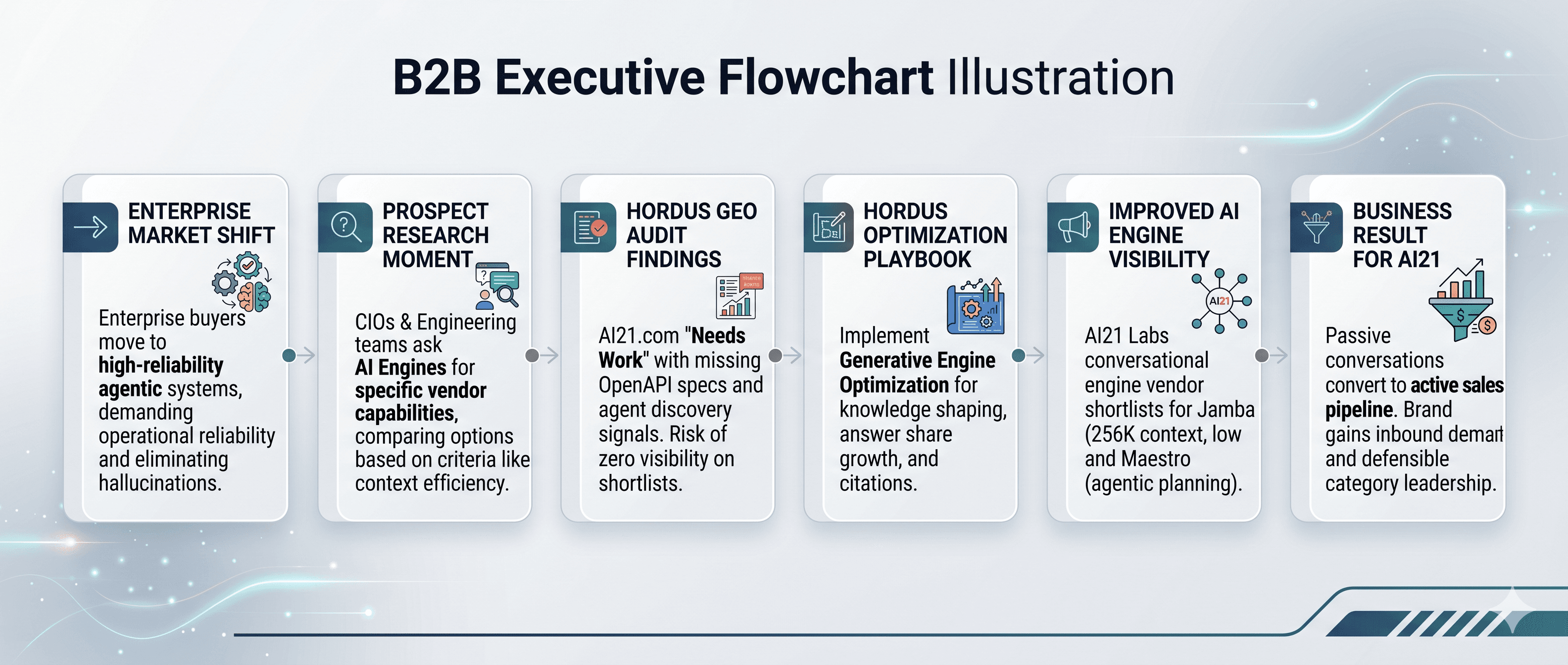
- Competitor Visibility Mapping: Hordus audits the exact conversational spaces where competitors like Cohere or Mistral currently outrank AI21 Labs in AI summaries, pinpointing the precise content gaps that cause engines to overlook Jamba or Maestro.
- Improving Answer Share: Through semantic engineering, Hordus restructures corporate announcements, technical blogs, and documentation into entity-rich, structured formats that generative models easily digest, index, and surface.
- Strengthening Citation Sources: AI engines back up their recommendations with links to high-authority secondary sources. Hordus identifies the specific industry journals, research repositories, and enterprise portals that AI engines trust most, ensuring AI21's case studies are prominently cited.
- Building Offsite Authority: Generative engines form their opinions of a brand based on how external sites describe it. Hordus builds a robust network of offsite technical mentions, anchoring AI21 Labs as the premium choice for data sovereignty and high-reliability environments.
- Influencing Engine Comparisons: Hordus optimizes the precise linguistic patterns and feature matrices that AI models analyze when comparing vendors side by side, ensuring that AI-generated comparison tables accurately present AI21's cost-efficiency and performance metrics.
Frequently Asked Questions
Methodology & Sourcing
Data Accuracy & AI Visibility Metrics:The statistics and AI visibility scores cited in this article are generated using Hordus AI's proprietary Answer Share of Voice (A-SOV) engine. Data is derived from consented, anonymized real user interactions across major LLM interfaces (ChatGPT, Claude, Gemini).
Editorial Integrity:All AI-assisted research undergoes mandatory human editorial review by our GEO strategy team prior to publication to ensure factual accuracy and alignment with Google's YMYL (Your Money or Your Life) search quality rater guidelines.