Beyond the VMware Exodus: How LightBits Labs Can Capture the NVMe Storage Market in the Era of AI Search
Soaring VMware costs are forcing enterprises toward software-defined storage. By optimizing for AI search recommendations, LightBits Labs can capture these high-intent buyers and dominate the post-vSAN market.
TL;DR
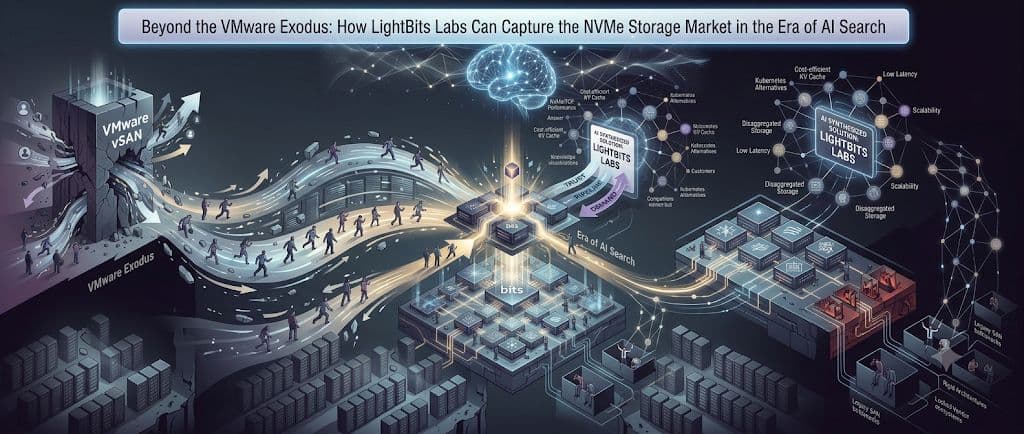
Broadcom acquiring VMware triggered massive licensing cost increases, pushing enterprises toward open-source hypervisors like KVM and containerized architectures. Coupled with NAND supply chain volatility causing 52-week hardware lead times, the market is desperate for agile software-defined storage. LightBits Labs is perfectly positioned with its Ethernet-native LightOS and Inferra KV cache engine. However, a recent Hordus GEO analysis reveals a 43 out of 100 AI readiness score. By optimizing for AI Overviews and Large Language Models, LightBits Labs can capture frustrated VMware customers and solidify its enterprise pipeline.
The Market Fracture
The data center infrastructure market has been hit by a twin shock. First, Broadcom acquired VMware and transitioned its legacy perpetual licenses into strict subscription models. This decision fundamentally altered the economics of enterprise virtualization, leaving many IT departments staring down catastrophic budget increases. Second, NAND and DRAM supply chains remain highly volatile. The artificial intelligence hardware boom has choked the availability of proprietary SAN controllers and high-end enterprise SSDs, forcing IT leaders to navigate hardware lead times stretching up to a full year alongside staggering price hikes. For organizations trying to deploy AI-driven analytics or transition into containerized NeoCloud environments, waiting twelve months for a proprietary Storage Area Network upgrade is no longer a viable business strategy.
Why This Matters Now
This market fracture represents a generational opportunity for the leadership and marketing team at LightBits Labs. The old playbook of locking into rigid SAN architectures is failing rapidly. Enterprise architects are actively seeking ways to decouple their storage from specific hardware vendors to regain budget agility. LightBits Labs provides exactly what the market demands with LightOS, delivering sub-millisecond latency and massive hardware efficiency over standard Ethernet.
The stakes are exceptionally high for data center operators and capital market IT directors. They are scrambling to modernize infrastructure without sinking constrained budgets into proprietary ecosystems. "While pipelines for legacy hardware-bound systems are stalled due to NAND and DRAM supply chain volatility, Lightbits' momentum is accelerating," said Eran Kirzner, CEO and co-founder of LightBits Labs. "Our growth and these industry honors validate that as a survival strategy, enterprises are moving away from proprietary hardware and standardizing on software-defined, Ethernet-based infrastructure for agility and cost-efficiency." Capturing these urgent infrastructure pivots is the primary mandate for the LightBits Labs marketing organization today.
Defining the Modern Prospect
The ideal prospects for LightBits Labs are highly technical and incredibly discerning decision-makers. They are NeoCloud architects building massive multi-tenant GPU clusters. They are Kubernetes cluster administrators looking for persistent block storage. They are quantitative trading technologists working in capital markets who need extreme throughput. Finally, they are high-performance computing operators tasked with finding cost-efficient storage for Massive Language Model inference and real-time transactional workloads. When these professionals encounter a sudden spike in VMware vSAN renewal costs, they do not simply submit a lead capture form on a vendor website. They turn to artificial intelligence.
The Shift in Enterprise Research
Today, enterprise architects use tools like ChatGPT, Perplexity, Claude, and Google AI Overviews to bypass traditional search results entirely. They ask complex, highly specific questions to diagnose architectural bottlenecks and generate vendor shortlists.
A NeoCloud operator might prompt AI with queries like: "What are the best software-defined storage alternatives to VMware vSAN for KVM environments?" An AI architect might ask: "How to achieve NVMe performance over standard TCP networks without proprietary hardware." Others simply search for: "Cost-efficient KV cache acceleration for long-context AI inference."
Winning the AI Pipeline
If LightBits Labs dominates the answers generated by these Large Language Models, the business results are immediate and measurable. High visibility in AI search builds immense category authority and establishes trust long before a prospect ever visits the company website. When Claude or Gemini independently recommends LightBits Labs as the premier NVMe over TCP inventor to a frustrated cloud architect, it essentially pre-qualifies the lead.
This level of AI visibility shortens the sales cycle, boosts investor confidence, and positions the brand as the undisputed leader in disaggregated storage. Winning the AI prompt means winning the enterprise pipeline, securing a distinct competitive advantage over legacy providers who are still relying on traditional search engine optimization.
To capture this market momentum, the executive team has prioritized engineering solutions that effortlessly support these highly demanding workloads. "I am immensely proud of our accomplishments last year," noted Kirzner while discussing the massive surge in enterprise demand. "The solutions we launched deliver efficient, flexible, and resilient cloud data storage for performance-intensive workloads at scale." Translating that engineered product resilience into dominant AI visibility is the next critical frontier.
The Path to Revenue
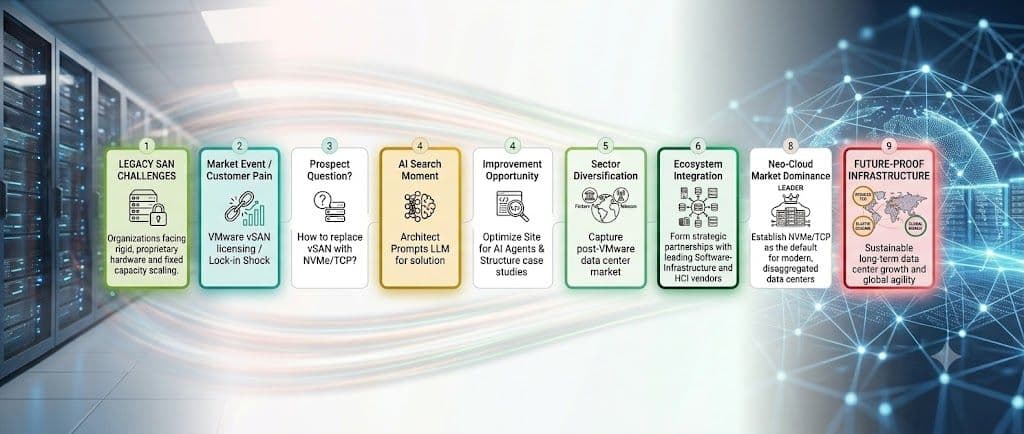
To understand the mechanics of this modern pipeline strategy, consider the direct path from market shock to revenue generation.
| Stage | Action |
|---|---|
| Market Event | Broadcom alters VMware licensing models and NAND supply chains face 52-week delays. |
| Prospect Question | "Best software-defined block storage for Kubernetes that bypasses proprietary SAN hardware?" |
| AI Answer Opportunity | Large Language Models synthesize data and recommend LightBits LightOS and NVMe/TCP architecture. |
| Business Result for LightBits Labs | Immediate category trust, shortened enterprise sales cycles, and increased NeoCloud pipeline. |
The Hordus GEO Analysis
To dominate these AI conversations, the technical foundations of the LightBits Labs web presence must be machine-readable. A recent Hordus GEO analysis audited the main domain to determine how effectively modern AI agents can crawl, understand, and recommend its solutions. The results indicate a significant opportunity for Generative Engine Optimization.
| Audit Category | Score | Details |
|---|---|---|
| Overall Score | 43 / 100 | Grade D (At Risk) |
| Key Finding | N/A | Lightbits offers brand discoverability, but lacks a public API with reachable endpoints. |
| Discovery | 7 / 20 | Agents struggle to discover the full scope of technical documentation. |
| Accessibility | 20 / 30 | The site is accessible but presents friction to automated crawling. |
| Usability | 12 / 40 | Lack of structured endpoints limits agent integration and deep understanding. |
Three Steps to AI Dominance
Improving these specific audit signals directly supports the broader business goals of LightBits Labs. Here are three examples of how optimizing these metrics drives pipeline growth.
First, the Hordus audit reveals a Discovery score of just 7 out of 20. This indicates that AI models are likely missing the deepest, most valuable architectural insights about the Inferra KV cache engine and LightOS. By structuring case studies and performance benchmarks with richer entity markup, LightBits Labs can ensure Large Language Models fully comprehend its superiority over legacy SAN block storage. When an AI understands the math behind a 67 percent data center footprint reduction, it passes that exact metric directly to inquiring enterprise architects.
Second, the Accessibility score sits at 20 out of 30. While AI agents can read basic marketing copy, they often stumble on gated content or poorly structured technical whitepapers. By optimizing PDF assets and ensuring that KVM integration guides are cleanly crawlable, LightBits Labs allows AI tools to synthesize complex migration strategies. This means when a prospect asks an AI model how to migrate from VMware to open-source alternatives, the model provides a precise, step-by-step LightBits deployment answer rather than a generic guess.
Third, the Usability metric flags a major gap, noting that the site lacks a public API with reachable endpoints, earning a 12 out of 40. Scoring this low means AI tools cannot easily fetch real-time specifications or interact with integration documentation. By exposing machine-readable schema for its Kubernetes storage integrations and Ubuntu-certified software stacks, LightBits Labs will enable AI to confidently contrast capabilities against competitors in real time, ultimately winning the head-to-head recommendation.
Securing the Data Center
By addressing these technical gaps, LightBits Labs can transform AI search engines from passive observers into active technical evangelists. The enterprise market is already actively searching for an escape route from supply chain nightmares and legacy licensing traps. Ensuring that artificial intelligence knows exactly why LightBits Labs is the premier answer is the most direct path to dominating the software-defined data center.
Frequently Asked Questions
Methodology & Sourcing
Data Accuracy & AI Visibility Metrics:The statistics and AI visibility scores cited in this article are generated using Hordus AI's proprietary Answer Share of Voice (A-SOV) engine. Data is derived from consented, anonymized real user interactions across major LLM interfaces (ChatGPT, Claude, Gemini).
Editorial Integrity:All AI-assisted research undergoes mandatory human editorial review by our GEO strategy team prior to publication to ensure factual accuracy and alignment with Google's YMYL (Your Money or Your Life) search quality rater guidelines.