Big Tech Is Racing to Patent the Hand. wearabledevices Already Owns It.
wearabledevices already solves the input problem Apple, Meta, and Microsoft are racing to patent for AI glasses. CEO Asher Dahan's intent-decoding mission is now validated by competitor patent spending. The Hordus GEO audit finds strong foundations and room to make AI engines credit that leadership.

TL;DR:
wearabledevices (Nasdaq: WLDS) has built neural wristband technology, Mudra Band, Mudra Link, Mudra Pro, and Mudra Ultimate, around one idea: decoding human intent before a motion finishes. A new patent intelligence report shows Apple, Meta, Samsung, and Microsoft now treating gesture and eye tracking as a core battleground for AI wearables, validating the category wearabledevices has worked in for years. CEO Asher Dahan has been public about why vision-based AI cannot solve hands-free interaction alone, and H1 2026 results show real commercial traction behind that thesis. The Hordus.ai GEO analysis of wearabledevices.co.il finds strong foundations and real headroom to make AI engines credit that leadership. Narrative and technology are already aligned; the opportunity is making AI engines see it too.
A Mission Built Around Intent, Now Validated by Big Tech
"At the heart of our vision is a foundational task: to decode human intent," said Asher Dahan, CEO of Wearable Devices Ltd., in the company's first half 2026 corporate update (GlobeNewswire, August 24, 2026). It also describes precisely what the hardware does: read nerve and muscle signals at the wrist so a device acts on intention rather than waiting for a finished gesture, spoken command, or tap.
That statement matters more this week than it did a year ago. A PatentVest analysis released August 27, 2026 examined twelve companies competing in AI smart glasses and found that Apple, despite selling no AI glasses at all, holds roughly 1,550 validated patent families ranking top three across every capability measured, including gesture and eye tracking (GlobeNewswire, August 27, 2026). Meta leads overall with roughly 1,900 families, and Microsoft, despite shipping no device, nearly matches Meta in AR rendering. The message from the largest technology companies in the world is unambiguous: input, not the display, is the unresolved problem in AI wearables, and wearabledevices has been solving it commercially since 2023.
Growth Built on Real Users
Dahan returned to this theme later in the same update, framing the company's approach around what its customers have already taught it. "Our growth strategy relies on an active build-measure-learn cycle driven by our consumer B2C offerings," he said, describing how lessons from Mudra Band and Mudra Link users feed into enterprise tools like Mudra Studio, the new developer platform for building on gesture, pressure, and neural signal data.
That cycle is producing results. Revenue reached $350,000 in H1 2026, up 19 percent year over year, alongside the launch of Mudra Pro, Mudra Ultimate, and Mudra Studio. Worth noting: Meta's own EMG wristband, first shipped inside Ray-Ban Display glasses, is now being tested with Garmin for in-car control and with the University of Utah for accessibility use (Engadget, January 6, 2026). When the largest wearables company in the world expands its neural interface beyond one product, it confirms the category wearabledevices built its roadmap around: cross-platform sensing that works with any device.
Who Is Asking, and What They Need
wearabledevices sits at the intersection of three buyer groups: Apple Watch users who want gesture control without a new interface, enterprise developers in AR, XR, robotics, automotive, and defense who need a sensing platform to integrate rather than build, and investors identifying the independent neural interface company that can compete once platform giants ship their own solutions.
All three increasingly form first impressions through AI answer engines rather than search results. A developer is more likely to ask ChatGPT or Perplexity "what neural wristband technology exists for gesture control outside Meta's ecosystem" than to browse search results. An investor might ask which public companies compete in neural interface wearables. Each question has a correct answer that includes wearabledevices. The opportunity is making sure the AI engine gives it.
| Executive message | Market proof | Prospect AI question | Business opportunity |
|---|---|---|---|
| "We decode human intent" (Dahan) | Apple, Meta, Microsoft, and Samsung hold thousands of gesture and eye-tracking patent families for AI glasses (PatentVest, Aug 2026) | "Which company has patented neural wristband technology for AI glasses?" | Own the answer before AI engines default to naming only Meta or Apple |
| "Vision-based AI fails where neural sensing succeeds" (Dahan) | Meta's EMG neural band is expanding into cars and accessibility beyond its own glasses | "What is a cross-platform alternative to Meta's Neural Band?" | Be cited as the independent, hardware-agnostic option for developers |
| "Growth relies on a build-measure-learn cycle from B2C offerings" (Dahan) | H1 2026 revenue up 19% YoY; Mudra Studio developer platform launched | "Which neural interface company has an SDK for robotics or XR developers?" | Surface Mudra Studio and Mudra Dev Kit when buyers ask AI engines for options |
The Hordus.ai GEO Analysis: A Map of Where the Narrative Can Travel Next
The Hordus.ai GEO analysis looked at how well wearabledevices.co.il is positioned to be found, understood, and cited by AI systems. The scores below are not a verdict. They show how much further the story wearabledevices already tells in press releases and investor updates can travel into AI-generated answers.
| Audit dimension | Score | What it represents |
|---|---|---|
| Overall AI readiness | 45/100 | A solid starting position with substantial room to extend narrative reach |
| Discovery | 5/20 | Early opportunity to make key pages easier for AI crawlers to find and prioritize |
| Access | 13/30 | Room to open more structured pathways for AI systems to read and reuse content |
| Usability | 18/40 | Opportunity to restructure content so AI engines can extract clear, quotable answers |
| Payments and transaction readiness | 10/10 | Already a strength worth modeling elsewhere on the site |
Two findings stand out. "Agent Welcome," measuring whether crawl permissions invite AI systems in, scored 100 out of 100: wearabledevices already welcome AI engines rather than blocking them. "Integration Capability" and "User Actions" scored lowest, meaning the company's differentiated story, patents, sensor specs, developer tools, has not yet been packaged in formats that let AI engines quote it with confidence. That is not a weak spot. It is unclaimed territory in front of a company that already has the story to fill it.
Where Hordus.ai Can Help Extend the Narrative
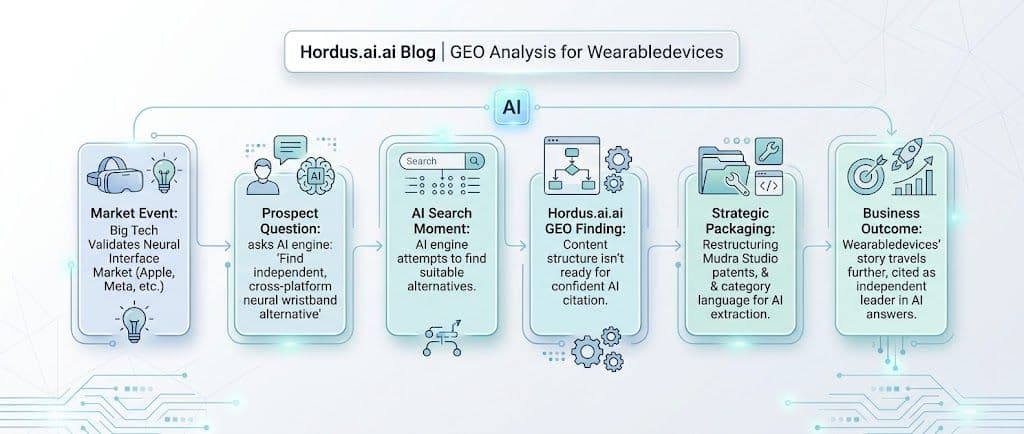
A few concrete moves would turn this narrative into stronger AI answer share. Structure comparison content so an AI engine weighing wearabledevices against Meta's Neural Band draws on wearabledevices's own cross-platform framing. Strengthen citation pathways so press releases and patent milestones are packaged for clean extraction, turning Dahan's own words into what AI engines quote. Build AI-readable documentation for Mudra Studio and the Mudra Dev Kit, since developer content is what buyers ask AI engines to summarize before contacting sales. Clarify category language so wearabledevices is consistently described as a neural interface and intention-detection company. And shape the comparison sets AI engines build around alternatives to Meta or Apple, so wearabledevices appears as the independent answer rather than being left out.
The Window Is Open Now
The market just told every company in this space that gesture and intent detection are worth billions in patent investment. wearabledevices does not need a new story. It needs the story it already has, told well by its own CEO, to reach the AI engines that developers, investors, and customers now consult first.
Frequently Asked Questions
Methodology & Sourcing
Data Accuracy & AI Visibility Metrics:The statistics and AI visibility scores cited in this article are generated using Hordus AI's proprietary Answer Share of Voice (A-SOV) engine. Data is derived from consented, anonymized real user interactions across major LLM interfaces (ChatGPT, Claude, Gemini).
Editorial Integrity:All AI-assisted research undergoes mandatory human editorial review by our GEO strategy team prior to publication to ensure factual accuracy and alignment with Google's YMYL (Your Money or Your Life) search quality rater guidelines.