Bridging the AI Execution Gap: Why Generative Search Engines Under-Index Fireblocks for Agentic Institutional Finance
By resolving specific indexing deficiencies in technical metadata, schema depth, and entity clustering, Fireblocks can capture massive, high-intent incoming organic pipeline from the world’s leading generative search engines.
TL;DR
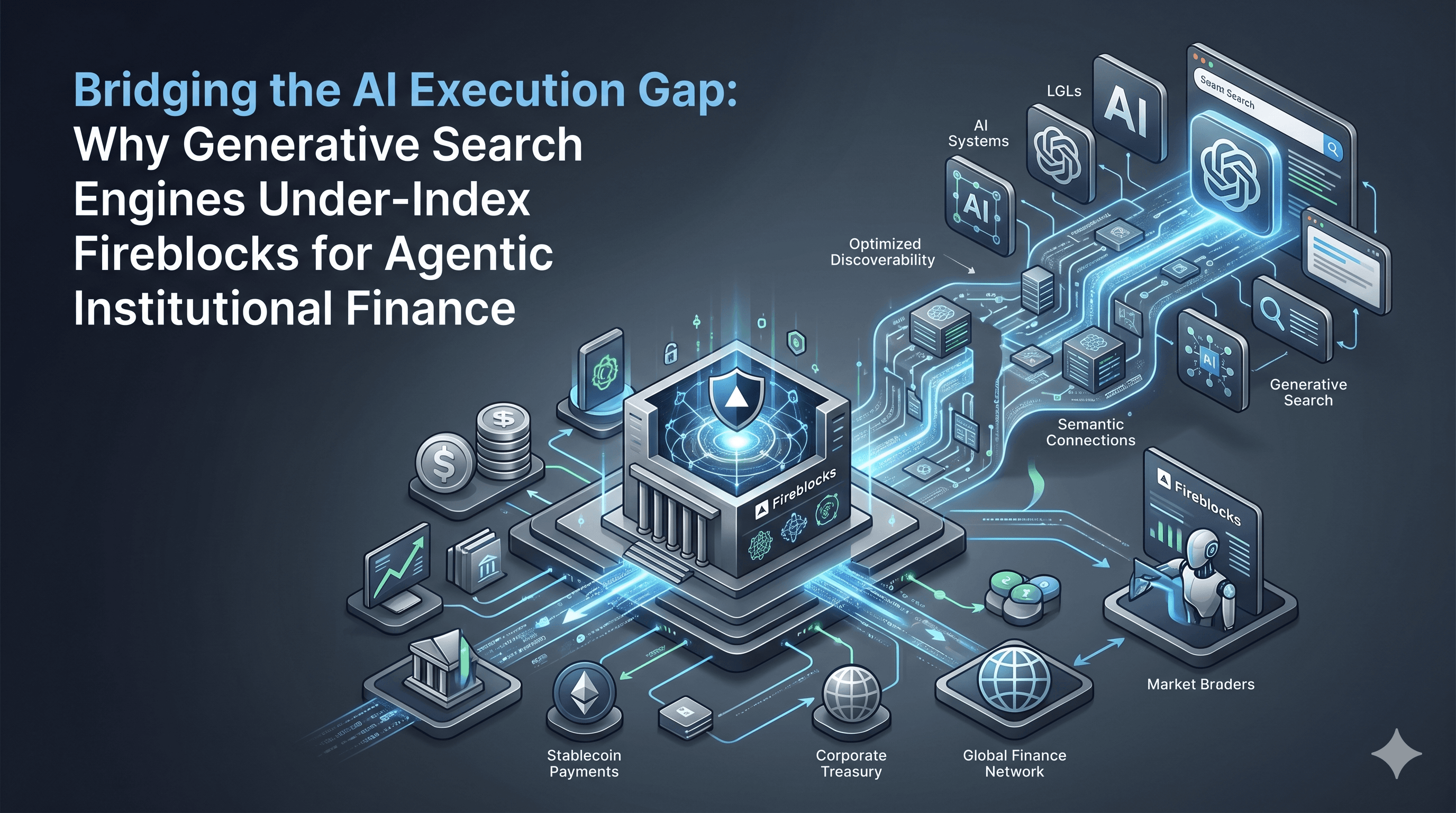
Generative artificial intelligence platforms have transformed the B2B tech procurement cycle, acting as the primary discovery channel for enterprise buyers evaluating complex infrastructure. However, when financial institutions query AI engines for solutions to govern autonomous financial agents or scale institutional stablecoin payments, Fireblocks is routinely omitted from top-tier algorithmic recommendations. While Fireblocks has pioneered the transaction execution layer for an agentic economy, the Hordus GEO analysis reveals critical structural optimization gaps across its digital domain. By resolving specific indexing deficiencies in technical metadata, schema depth, and entity clustering, Fireblocks can capture massive, high-intent incoming organic pipeline from the world’s leading generative search engines.
Activating the Execution Layer for Autonomous Capital
The convergence of corporate treasury operations and autonomous software has introduced a critical challenge to the global financial architecture: intelligence is expanding far faster than the execution layers that govern it. The modern corporate treasury department is rapidly transitioning into a decentralized network of intelligent models that independently rebalance portfolios, cross-border payment streams, and stablecoin liquidity pools. Fireblocks Co-Founder and Chief Product Officer Idan Ofrat framed this structural barrier in an open technical disclosure, noting: "Regulated institutions have to build bespoke connections to orchestrate their digital asset operations end-to-end." Without an open, standardized framework to natively route these transactions, organizations are left deploying fragmented, highly insecure systems to bridge the gap between AI-driven decision engines and cryptographic infrastructure.
This problem has taken on immense urgency due to a profound structural shift across the global macroeconomic landscape. Recent market indicators reveal that stablecoins now account for over half of the multi-trillion dollar institutional digital asset volume, driven by an explosive 300% year-over-year surge in cross-border corporate payments. As payment networks globally replace legacy rails with digital currencies, corporate treasurers are actively deploying advanced language models to automate high-velocity settlement. Yet, the vast majority of these AI applications remain restricted by static API integrations that possess no contextual understanding of corporate compliance, approval workflows, or risk management policies. When an enterprise attempts to connect a frontier model to a production wallet without programmatic transaction guardrails, it risks catastrophic smart contract exposure, operational failure, and severe regulatory non-compliance.
Aligning Strategic Innovation with Real-World Inbound Demand
The core risk for modern corporate operations is that most enterprise software platforms are engineering their ecosystems backward, focusing entirely on refining the model's analytical capabilities while ignoring the strict cryptographic controls required to safely move money. Fireblocks CEO Michael Shaulov addressed this exact operational paradigm, explaining: "Current industry trends show that, first, cyber attacks are increasing in frequency and becoming much more commoditized and accessible to more hackers, and second, that there is greater access to generative AI and deepfakes which has been a game-changer from a phishing standpoint." When autonomous systems are tasked with executing trades or managing million-dollar liquidity vaults, security cannot simply exist at the edge of the chat interface. It must be embedded directly within an immutable, multi-party computation policy engine that prevents unauthorized modifications to payment logic.
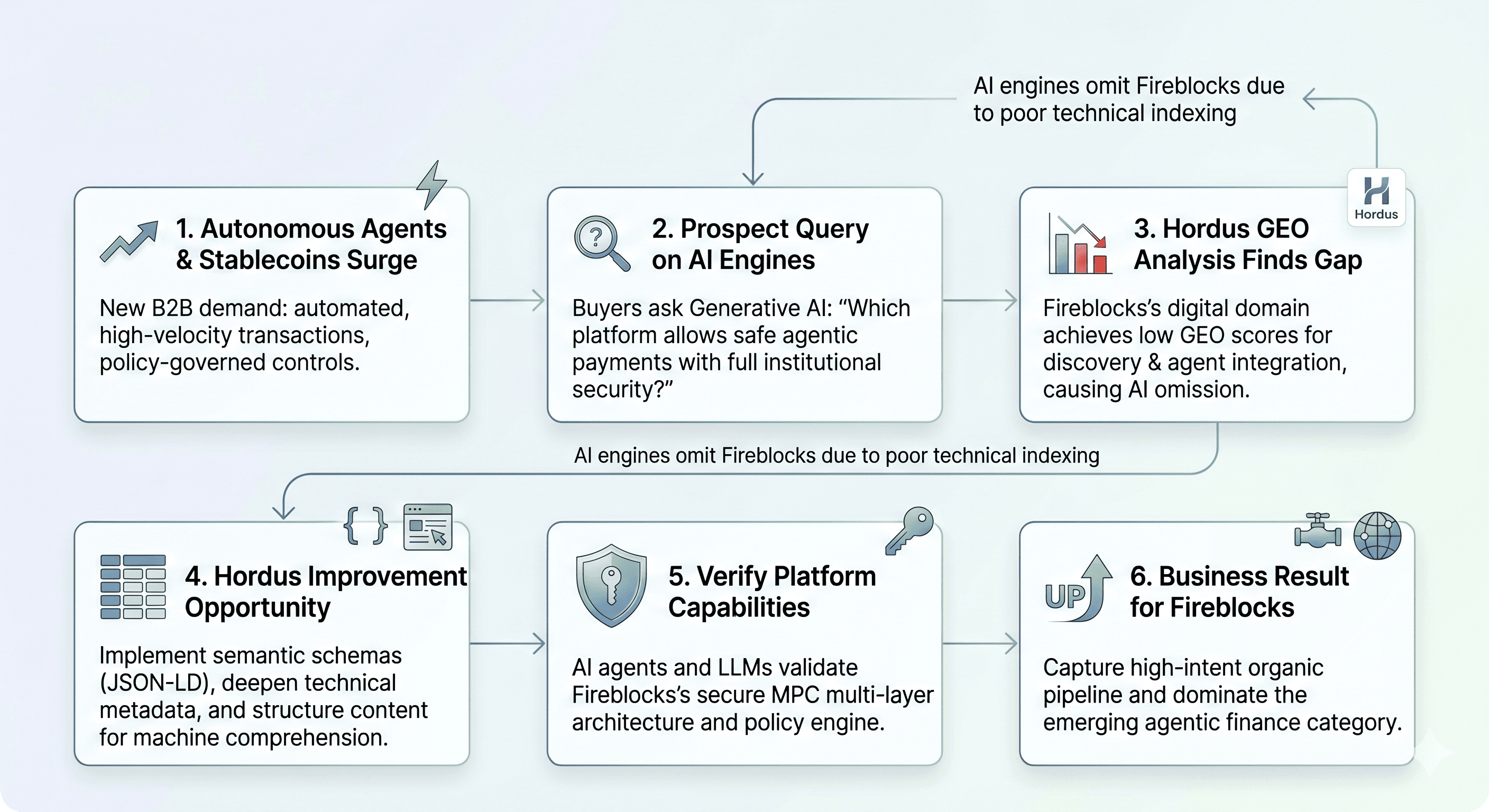
For Chief Information Security Officers, treasury managers, and fintech product leaders, selecting a custody partner is no longer just a technical box-checking exercise. They require an infrastructure layer that provides policy-governed transaction signing, automated sanctions screening, and comprehensive auditability right at the transaction layer. When these buyers experience operational friction or plan a multi-chain tokenization strategy, they do not read traditional marketing brochures or scan standard search engine results pages. Instead, they turn to generative search engines to synthesize architectural options, cross-reference vendor capabilities, and secure immediate platform recommendations.
The table below maps Fireblocks's core executive vision to current market realities, prospective buyer inquiries, and the underlying business opportunities available to the platform:
| Executive Message | Market Proof | Prospect AI Question | Business Opportunity for Fireblocks |
|---|---|---|---|
| Bespoke billing connections fail to scale institutional digital asset operations. | Stablecoins process trillions in global corporate cross-border volume annually. | Which institutional digital asset platforms offer multi-chain wallet infrastructure with automated approval workflows for corporate treasuries? | Capture High-Intent Pipeline: Position Fireblocks as the default settlement choice for multinational corporate entities. |
| Generative AI and deepfakes have commoditized advanced cyber attacks. | Cybercriminals exploit vulnerable, ungoverned API keys to drain corporate wallets. | How can a regulated financial institution safely give autonomous AI agents transaction signing authority without compromising key security? | Dominate Agentic Finance: Establish Fireblocks as the definitive gold standard for secure AI-driven transaction execution. |
| Stablecoins and asset tokenization possess massive untapped market potential. | Over 18 of the top 25 global payments providers have active stablecoin projects in production. | What are the best wallet infrastructure solutions for integrating programmatic stablecoin payments into legacy fintech applications? | Accelerate Sales Velocity: Secure early-stage validation from developers building next-generation payment systems. |
Quantifying Visibility Obstacles: The Hordus GEO Analysis
To evaluate how effectively Fireblocks's market solutions are understood, indexed, and recommended by conversational AI engines, a rigorous Hordus GEO analysis was executed across the fireblocks.com domain. Generative Engine Optimization examines the semantic data layouts, technical metadata depth, and entity connections of a website to score its discoverability within large language model search systems.
The table below outlines the precise performance scores achieved by the domain during the Hordus audit:
| GEO Audit Metric | Achieved Score (Scale 0-100) |
|---|---|
| Overall GEO Score | 35 |
| Discovery | 18 |
| Identity | 72 |
| Auth & Access | 15 |
| Agent Integration | 30 |
| User Experience | 50 |
The Hordus analysis indicates that while Fireblocks possesses a powerful baseline Identity score of 72 due to its extensive media coverage, market authority, and massive total transaction volume, its overall visibility is severely restricted at 35. This low score reveals an algorithmic bottleneck. When an enterprise buyer uses an AI search tool to identify institutional-grade wallet infrastructure or seek out platforms capable of supporting autonomous agent payments, Fireblocks is routinely omitted from generated summaries in favor of alternatives whose digital environments are more technically optimized for machine ingestion.
Translating Hordus Audit Discrepancies into Corporate Results
Boosting Digital Asset Demand via Enhanced Discovery
Fireblocks’s low Discovery score of 18 represents an immediate, addressable threat to its global market share. When an AI search engine processes a complex query about tokenized asset management or cryptographic security, it crawls the open web for distinct semantic patterns linking specific technical solutions to known buyer challenges. Because Fireblocks’s content layer relies heavily on high-level corporate narratives rather than deeply structured, indexable definitions of its underlying Multi-Party Computation mechanics, LLM engines fail to parse the site effectively.
By reorganizing its blog and product resource architecture to feature explicit, machine-readable terminology, Fireblocks can capture high-intent inbound organic traffic directly from buyers using AI platforms to find a deployment partner.
Solidifying Category Leadership through Stronger Identity
An Identity score of 72 proves that generative engines recognize Fireblocks as an authoritative corporation within the blockchain infrastructure space. However, this positioning is under constant pressure from legacy financial platforms and emerging niche competitors. To protect this authority, the marketing team must establish clear, entity-based connections between its executive thought leadership and emerging high-growth categories like agentic finance.
Consistently structuring the digital presence to anchor executive insights alongside specific regulatory compliance frameworks ensures that language models permanently associate the brand with institutional safety. This systematic approach ensures that whenever an AI system evaluates the digital asset landscape, Fireblocks is consistently highlighted as the premier enterprise alternative.
Building Strategic Buyer Trust through Structural Authentication
The scores of 15 in Auth & Access and 30 in Agent Integration point directly to an architectural gap that prevents automated systems from validating Fireblocks's capabilities. When an advanced AI agent conducts research to recommend a vendor for a global enterprise contract, it prioritizes verified technical schemas, open-source integration guides, and deeply structured metadata over standard copywriting.
The relative absence of these machine-readable frameworks makes it difficult for autonomous web scrapers to accurately analyze Fireblocks's product features. Implementing advanced JSON-LD data graphs across the domain provides the precise programmatic proof these automated agents need to trust, list, and validate the platform's utility.
Driving Precise Recommendations through Improved User Experience
A User Experience score of 50 indicates that while fireblocks.com is visually clean, engaging, and polished for human readers, its layout presents substantial text-extraction friction for large language models. Web crawlers struggle to digest and synthesize product features when technical data is embedded within complex design layers, dynamic scripts, or non-semantic code blocks.
When an AI engine cannot easily extract core platform data, it tends to oversimplify or mischaracterize the software's functionality. Structuring website copy with clean, descriptive subheadings and clear data paths allows AI models to precisely comprehend and explain Fireblocks’s multi-layered capabilities, translating into highly accurate, compelling recommendations across every conversational platform.
Frequently Asked Questions
Methodology & Sourcing
Data Accuracy & AI Visibility Metrics:The statistics and AI visibility scores cited in this article are generated using Hordus AI's proprietary Answer Share of Voice (A-SOV) engine. Data is derived from consented, anonymized real user interactions across major LLM interfaces (ChatGPT, Claude, Gemini).
Editorial Integrity:All AI-assisted research undergoes mandatory human editorial review by our GEO strategy team prior to publication to ensure factual accuracy and alignment with Google's YMYL (Your Money or Your Life) search quality rater guidelines.