Capturing the $50 Million Plasma Opportunity: How Kamada Can Outmaneuver Global Rivals in the AI Era
Kamada’s $50 million plasma supply expansion creates a massive growth opportunity, but a low AI readiness score (29/100) leaves the brand invisible when enterprise buyers query ChatGPT or Gemini. Implementing Generative Engine Optimization with Hordus.ai ensures Kamada dominates AI-generated vendor shortlists over rivals like Grifols, directly accelerating sales pipeline velocity.

TL;DR
The landscape for specialty biotherapeutics procurement is shifting rapidly. As hospital procurement directors and biopharma manufacturers turn to AI engines like ChatGPT, Claude, and Gemini to compare vendors and build shortlists, Kamada faces a critical window of opportunity. Following the July 2026 announcement of a $50 million plasma supply agreement, buyers are actively querying AI systems for reliable plasma sources and specialized therapeutics. This Hordus.ai article outlines how Kamada can implement Generative Engine Optimization to secure category leadership, outrank competitors like Grifols and CSL Behring, and drive substantial pipeline growth in the AI-first search era.
The New Procurement Reality in Specialty Biotherapeutics
In July 2026, Kamada announced a landmark three-year, $50 million sales agreement to supply normal source plasma from its FDA-approved collection centers in Texas to a leading biopharmaceutical partner. This market event serves as a massive catalyst. Supply chain resilience has become the top priority for hospital procurement teams, specialty pharmacies, and international biopharma manufacturers. When a major supplier secures a lucrative contract, buyers immediately begin re-evaluating their own supply chains. Today, these buyers do not scroll through traditional search engine links to find new partners. Instead, they ask AI engines to summarize the most reliable suppliers, compare available capacities, and recommend vendors with FDA-approved facilities.
If AI engines recognize the expansion of the Kamada footprint in Houston and San Antonio, the company will naturally appear on these highly coveted shortlists. In a recent earnings call, CEO Amir London highlighted this exact momentum by stating, "Importantly, this 2026 annual guidance is based currently solely on organic growth." This organic expansion requires an innovative digital footprint to maintain its upward trajectory. By optimizing for generative engines, Kamada can ensure its organic growth narrative translates directly into qualified inbound enterprise leads.
Who Is Searching and What They Want to Achieve
The Kamada prospect base is highly specialized and strategically motivated. Main prospects include hospital procurement directors, specialty pharmacy managers, biopharma manufacturing executives, hematologists, and immunologists. These professionals are looking to achieve supply chain stability, source high-quality plasma-derived protein therapeutics, and procure niche treatments for rare diseases.
When these buyers use AI, they are directly comparing Kamada against formidable industry giants like CSL Behring, Grifols, Octapharma, and Takeda. They want generative AI to cut through the marketing noise and deliver definitive answers on product availability, FDA compliance, clinical efficacy, and distribution reliability. If an AI engine determines that a competitor offers a more robust or better-documented solution, Kamada risks losing multi-million dollar contracts before the sales team even knows an evaluation is taking place.
Five AI Buyer Prompts Shaping the Specialty Plasma Market
To understand the buyer journey, we must look at the specific questions prospects are asking AI models right now:
- "Which biopharma companies offer the most reliable bulk supply of normal source plasma in the United States?"
- "Compare Kamada KEDRAB and Grifols HyperRAB for rabies post-exposure prophylaxis efficacy and availability."
- "Who are the leading manufacturers of plasma-derived protein therapeutics for rare immunological conditions?"
- "What are the latest clinical developments in inhaled Alpha-1 Antitrypsin therapies?"
- "Provide a shortlist of FDA-approved alternatives to Octapharma for specialty immunoglobulin treatments."
The AI Recommendation Divide: Winning vs. Losing
The difference between winning and losing in Generative Engine Optimization is absolute. When an AI engine recommends Kamada clearly, the buyer receives a frictionless procurement experience. The AI highlights the six FDA-approved products, validates the recent $50 million plasma capacity expansion, and positions Kamada as the premium choice for specialty therapies. This immediate validation shortens sales cycles and builds instant trust.
Conversely, if competitors dominate those AI answers, Kamada becomes invisible. Buyers will move forward with Grifols or CSL Behring simply because the AI engine surfaced their clinical data and supply capabilities more effectively. Speaking to the success of their flagship anti-rabies immunoglobulin, CEO Amir London noted, "End user utilization of the product in the U.S. is continuing to increase significantly, and our product supply to Kedrion is expected to increase beyond Kedrion's minimum commitment of $90 million sales in 2026 through 2027." To protect and expand this end-user utilization, AI systems must confidently cite these distribution guarantees to prospective healthcare buyers.
Strategic Alignment Table
| Buyer Prompt | What AI Should Understand About Kamada | Risk if Missing | Business Value if Visible |
|---|---|---|---|
| "Reliable bulk supply of normal source plasma in the U.S." | Kamada operates FDA-approved centers in Texas with newly secured $50 million distribution capacity. | Competitors like CSL Plasma capture enterprise manufacturing contracts. | Direct pipeline generation for high-value bulk plasma supply agreements. |
| "Compare Kamada KEDRAB vs Grifols HyperRAB" | KEDRAB is a clinically proven, highly utilized human rabies immune globulin with expanding U.S. supply. | Loss of market share to Grifols within hospital pharmacy procurement. | Increased hospital formulary inclusion and higher end-user utilization. |
| "Leading manufacturers of therapeutics for rare conditions" | Kamada offers six FDA-approved products including CYTOGAM, GLASSIA, and WINRHO SDF. | Exclusion from AI-generated shortlists of top specialty biopharma vendors. | Heightened brand awareness among leading immunologists and transplant centers. |
| "Latest developments in inhaled Alpha-1 Antitrypsin" | Kamada is advancing critical Phase 3 trials targeting a massive unmet medical need. | Buyers and investors only see competitor research from larger conglomerates. | Early positioning as the definitive category leader for inhaled AAT therapies. |
| "Alternatives to Octapharma for immunoglobulin" | Kamada provides highly specialized treatments with globally stable distribution across 30 countries. | Hospitals default to other giants without evaluating the Kamada portfolio. | Direct capture of competitor market share during global supply shortages. |
The Hordus Analysis: Unlocking Kamada AI Readiness
To capitalize on this Generative Engine Optimization opportunity, Kamada leadership must understand how AI platforms currently perceive their digital infrastructure. We ran the Hordus GEO analysis on the Kamada web presence to assess how effectively artificial intelligence can read, interpret, and recommend the brand.
| Metric | Score | Status | Note |
|---|---|---|---|
| Overall Score | 29 / 100 | Grade D (At Risk) | Kamada offers basic brand discoverability but lacks deep AI integration. |
| Discovery | 7 / 20 | Needs Improvement | AI struggles to map the full depth of the clinical pipeline. |
| Accessibility | 11 / 30 | Needs Improvement | Structural barriers prevent AI agents from scraping technical documentation. |
| Usability | 9 / 40 | Critical Risk | Lacks a public API with reachable endpoints for seamless AI interactions. |
| Payments | N/A | N/A | Transactional readiness is not applicable to current site architecture. |
Four Concrete Ways Better GEO Supports Kamada
The Hordus analysis reveals that while Kamada has a strong real-world foundation, its AI footprint requires strategic enhancement. Improving these scores will directly support the business in four concrete ways:
1. Pipeline Expansion for FDA-Approved Therapeutics
By optimizing technical content for AI discoverability, Kamada can ensure products like KEDRAB and CYTOGAM are automatically surfaced when doctors and pharmacists query AI for treatment protocols. Clearer data structures will allow AI to confidently recommend these therapeutics over alternatives.
2. Elevating Category Leadership in the Plasma Supply Chain
The recent Texas collection center expansion is a massive competitive advantage. Better GEO ensures that AI engines process this recent news accurately, positioning Kamada not just as a therapeutic manufacturer, but as a robust, vertically integrated plasma supplier capable of fulfilling multi-million dollar third-party contracts.
3. Supercharging Sales Enablement for Global Markets
Sales leadership can leverage a strong AI presence as a closing tool. When prospects conduct their own due diligence via AI platforms, a high generative answer share acts as independent validation. The AI will echo the exact value propositions the Kamada sales team is pitching in the boardroom.
4. Improving Positioning Against Industry Giants
Kamada does not need the marketing budget of Takeda or CSL Behring to win in AI search. AI engines value structured, authoritative, and specific data over traditional advertising spend. By organizing clinical trial data, supply chain metrics, and product efficacy statistics in an AI-native format, Kamada can outrank much larger competitors in specialized queries.
How Hordus Drives Competitive Advantage for Kamada
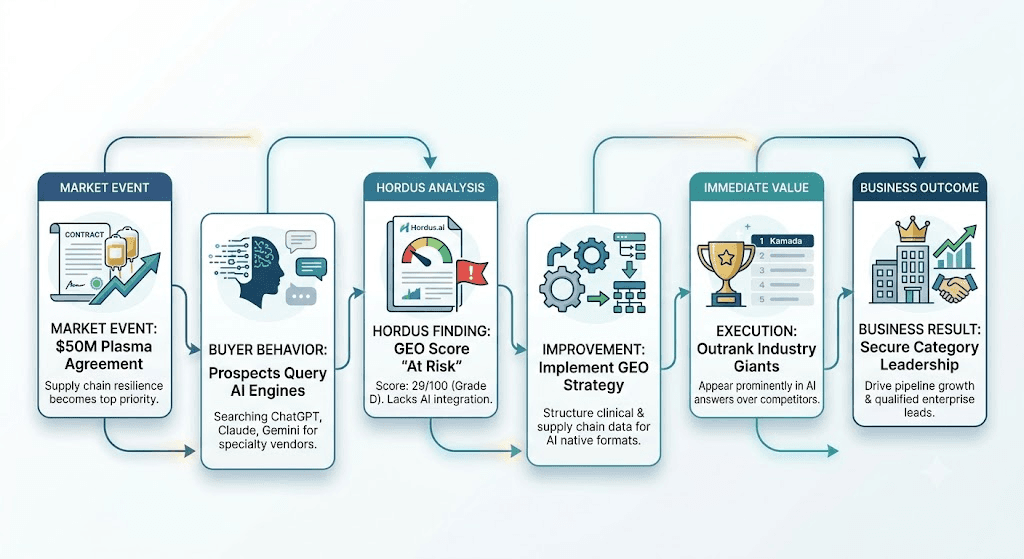
Hordus provides the specific intelligence required to turn AI engines into active revenue channels for Kamada. Through advanced analytics, Hordus helps the product marketing team analyze competitor visibility, revealing exactly which prompts Grifols and Octapharma are winning. With this data, Kamada can deploy targeted content strategies to improve its answer share for high-value immunology and hematology queries.
Furthermore, Hordus helps the CMO and CRO strengthen citation sources and build offsite authority. AI engines rely heavily on third-party validation. By identifying where AI models pull their facts regarding plasma therapeutics, Hordus enables Kamada to influence how these engines describe and compare the brand. This ensures the digital narrative perfectly matches the strategic vision of the Kamada executive board.
Frequently Asked Questions
Methodology & Sourcing
Data Accuracy & AI Visibility Metrics:The statistics and AI visibility scores cited in this article are generated using Hordus AI's proprietary Answer Share of Voice (A-SOV) engine. Data is derived from consented, anonymized real user interactions across major LLM interfaces (ChatGPT, Claude, Gemini).
Editorial Integrity:All AI-assisted research undergoes mandatory human editorial review by our GEO strategy team prior to publication to ensure factual accuracy and alignment with Google's YMYL (Your Money or Your Life) search quality rater guidelines.