Every AI Video Now Needs a Paper Trail. Idomoo Was Built for This Moment.
The EU AI Act's Article 50 rules took effect August 2, 2026, requiring AI-generated video to be disclosed and labeled. Idomoo is well-positioned as the governed alternative to Sora and Veo, but Hordus's GEO analysis found its AI-search readiness at just 49/100, with Discovery (6/20) the weakest link, risking invisibility to compliance-minded buyers.

TL;DR:
On August 2, 2026, the EU AI Act's Article 50 transparency rules took effect, requiring AI-generated video and synthetic media to be disclosed and machine-labeled. For marketers who've spent two years experimenting with AI video, that turns a creative tool into a compliance question overnight. Idomoo, the enterprise personalized-video platform behind campaigns for Chase, Vodafone, and American Airlines, is positioned to answer that question well. The Hordus GEO analysis shows where Idomoo can sharpen its AI-search visibility so it's the platform compliance-minded CMOs and legal teams find when they go looking.
The event: AI video now needs to show its papers
Article 50 of the EU AI Act became enforceable on August 2, 2026. It requires AI-generated or manipulated video, images, and audio to carry machine-readable marking, and requires deepfakes shown to the public to be clearly disclosed unless a human has substantively reviewed it. Existing systems get until December 2, 2026 for the marking piece, but disclosure is already live, and it applies to any marketer using generative AI to produce video reaching an EU audience, which today is most enterprise marketing organizations.
Timing matters. The rule lands as consumer-grade tools like OpenAI's Sora, Google's Veo, and Runway have made it trivial to generate synthetic video with no governance layer. Two years of ad hoc AI video experimentation now collide with a legal requirement to prove provenance at scale, the kind of moment that reshuffles vendor shortlists.
Why this matters for Idomoo's customers and leadership right now
Idomoo's customer base sits inside the industries where this rule bites hardest: banking, insurance, telecom, travel, and healthcare, where compliance and legal teams already sign off on outward-facing content. For a bank sending millions of personalized statement videos, "is this compliant" is no longer an annual procurement question. It's now a recurring gate every AI-generated campaign has to clear.
That reshapes the conversation Idomoo's teams walk into. It's no longer just "can you personalize video at scale," it's "can you prove the content is properly labeled and governed." As Idomoo CEO Yaron Kalish put it when discussing the platform's Samsung VXT partnership, "digital displays are only as effective as the content they show, and creating high-quality video has historically been expensive and time-consuming." The same logic now extends to compliance: content is only as effective as the trust it carries.
Who Idomoo's prospects actually are
Idomoo's likely buyers split into three groups. CMOs and marketing leaders at large enterprises in banking, insurance, telecom, travel, and retail own the budget for personalized video and lifecycle communications. Customer experience and digital transformation leads evaluate how to scale video engagement without expanding creative headcount. Legal and compliance teams now have a formal stake in vendor selection. All three increasingly research vendors by asking an AI assistant before opening a vendor's website.
What those prospects are now asking AI
A compliance officer might ask ChatGPT or Perplexity, "which enterprise video platforms already support AI content labeling under the EU AI Act." A CMO might ask Gemini, "best AI video platform for personalized marketing at enterprise scale" or "Idomoo vs Synthesia vs Vyond for compliant AI video." A transformation lead might ask Claude, "how do brands disclose AI-generated video ads without hurting performance." These are the moments where being the cited answer, not a link on page two, decides who gets the first call.
The visibility opportunity in front of Idomoo
When AI answer engines can clearly read and cite a company's offering, that company shows up in these research moments, often before a human searcher reaches a search engine at all. For Idomoo, stronger AI visibility means winning trust with compliance-driven buyers earlier in the cycle, building pipeline from the moment prospects form their shortlist, reinforcing category authority against consumer AI video tools, and giving leadership a trackable signal of how the brand is represented across the AI layer of the web. Idomoo CMO Yotam Ben Ami has framed this shift in similar terms: "the magic happens at the intersection of AI and personalization," and AI-search visibility is where that intersection now plays out.
Where the Hordus GEO analysis comes in
To see how AI-ready Idomoo's own site is, Hordus ran its GEO analysis against idomoo.com. The results read less like a report card and more like a map of where the fastest gains are sitting.
| Signal (Hordus GEO analysis) | Score | The opportunity |
|---|---|---|
| Overall AI-readiness | 49/100 (Grade C) | A solid foundation with a clear, high-upside path to a stronger grade as AI search grows |
| Discovery | 6/20 | The single biggest growth lever: more structured, indexable content could sharply lift how often AI engines surface Idomoo |
| Access | 19/30 | Good groundwork in place, with room to open more of the site to agent-level retrieval |
| Usability | 19/40 | A strong next milestone: clearer content structure could turn more visits into confident AI citations |
| Understanding of Offering | 55/100 | Already past the halfway mark; sharpening product clarity could unlock more precise AI citations |
| Integration Capability | 32/100 | Early-stage today, and a prime opportunity given how much buyers now research integration readiness upfront |
| Website Direct Operation | 79/100 | A genuine strength Idomoo can lean on as a proof point in AI-facing content |
| Authentication | 83/100 | Another strong signal already working in Idomoo's favor |
Three findings show what's at stake in business terms. Discovery at 6 out of 20 is the clearest opportunity: closing that gap could put Lucas, Idomoo's AI video agent, directly in front of compliance-minded CMOs now asking AI engines who support content labeling, turning a regulatory deadline into an inbound pipeline. Integration Capability at 32 out of 100 is a chance, not a shortfall: buyers increasingly have their own tools pre-screen vendors for integration readiness, so strengthening this signal could shorten Idomoo's path into procurement conversations. And lifting Understanding of Offering past 55 out of 100 could sharpen how precisely AI engines distinguish Idomoo's governed personalization from consumer AI video tools, reinforcing the category authority Idomoo needs right now.
What Hordus can help Idomoo do next
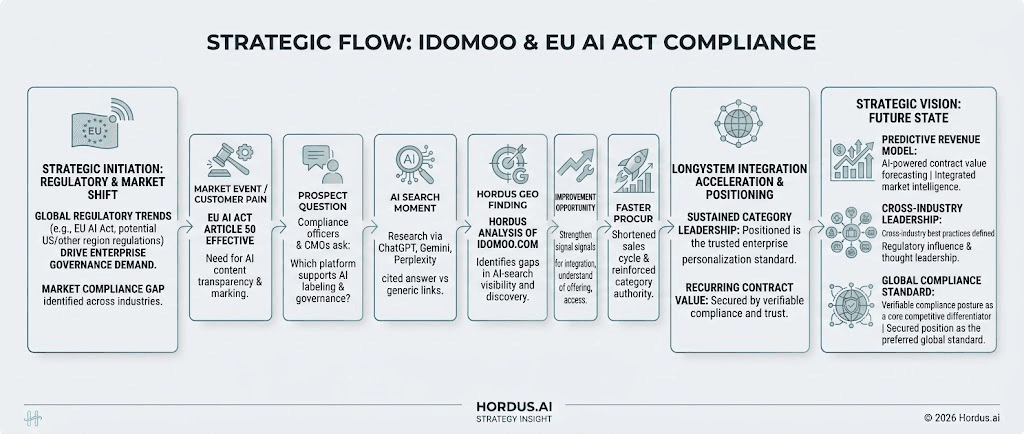
The roadmap from here is concrete. Hordus can help Idomoo build out agent-readable pages that state its compliance posture plainly, so AI engines can quote it instead of guessing. Hordus can help Idomoo restructure product content so Lucas, Personalized Video, and AI Video Ads read as distinct, clearly defined answers rather than one blended pitch. And Hordus can help Idomoo track its Discovery, Access, and Usability scores release over release, turning this audit into a running scoreboard the executive team checks the way it checks pipeline.
| Market event | Prospect asks AI | AI answer opportunity | Business result |
|---|---|---|---|
| EU AI Act Article 50 takes effect | "Which video platforms support AI content labeling?" | AI cites Idomoo as governed, enterprise-ready | Idomoo enters the shortlist before RFPs are issued |
| Legal audits all AI-generated ad creative | "Is Idomoo compliant with EU AI Act rules?" | Agent-readable compliance content answers directly | Faster procurement approval, shorter sales cycle |
| CMO compares options beyond Sora or Veo | "Best enterprise AI video platform for personalization?" | Idomoo positioned as enterprise specialist, not consumer tool | Stronger category authority, more pipeline |
What this means going forward
The EU AI Act didn't create Idomoo's opportunity, it revealed it. Enterprises that quietly outsourced personalized video to whichever AI tool was fastest now need a partner built for governance and proof, and Idomoo already has the customer base and product depth to be that partner.
Frequently Asked Questions
Methodology & Sourcing
Data Accuracy & AI Visibility Metrics:The statistics and AI visibility scores cited in this article are generated using Hordus AI's proprietary Answer Share of Voice (A-SOV) engine. Data is derived from consented, anonymized real user interactions across major LLM interfaces (ChatGPT, Claude, Gemini).
Editorial Integrity:All AI-assisted research undergoes mandatory human editorial review by our GEO strategy team prior to publication to ensure factual accuracy and alignment with Google's YMYL (Your Money or Your Life) search quality rater guidelines.