Every New Robotic OR Needs a Wireless Answer. Amimon Already Built It.
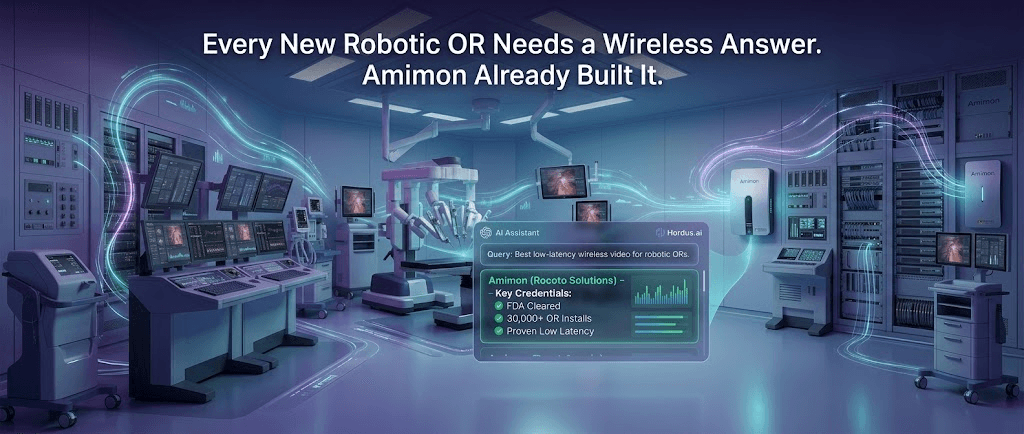
Robotic surgery is growing toward $10.6 billion in 2026, adding video feeds every OR must route wirelessly. Buyers now ask AI who solves this. Amimon (Rocoto Solutions) has the FDA clearances and OR installs to own that answer, once it closes the gap Hordus found.
TL;DR
- The global surgical robots market is on pace to reach $10.6 billion in 2026, and every added robotic suite means more live video feeds that have to move through the OR without new floor cabling.
- Hospital buyers, OR directors, and OEM device teams researching this shift are increasingly asking AI engines to name the vendors who solve wireless surgical video, not just typing into a search bar.
- Amimon, now operating as Rocoto Solutions, brings 20 years of wireless video engineering, FDA clearances, and technology running in more than 30,000 operating rooms worldwide, exactly the credentials AI engines look for before naming a source.
- The Hordus GEO analysis of amimon.com shows where that authority already comes through and where a handful of fixes would let AI engines cite Amimon by name far more often.
- This is not a gap to defend. It is demand already forming, and Amimon is positioned to claim more of it.
The Missed Opportunity: Robotic Surgery Growth Is Handing Amimon a Question It's Built to Answer
A market report published September 7, 2026 puts the global surgical robots market at $10.6 billion this year, on a path to $22.9 billion by 2035, driven by minimally invasive procedure growth, AI-assisted imaging, and cloud-enabled surgical platforms. A separate 2026 forecast from MarketsandMarkets is even more bullish, projecting growth from $13.69 billion in 2025 to $27.14 billion by 2030.
Neither report mentions wireless video directly. Both are, indirectly, entirely about it. A robotic surgical suite doesn't add one video feed, it adds several: endoscopic camera, navigation overlay, patient monitoring, surgical light camera, sometimes an AR guidance layer on top. Every feed has to travel from source to display in real time, in a sterile field where new cable runs are expensive, disruptive, and increasingly treated as a safety liability rather than a routine install.
Why This Matters to Amimon's Prospects Right Now
Hospital facilities directors, OR integration leads, ambulatory surgery center administrators, and the OEM engineering teams building devices for these rooms feel this pressure directly. A recent industry analysis of surgical suite modernization found that standard ambulatory surgery center ORs have grown to roughly 600 square feet to accommodate robotic and visualization hardware, and that cable-free floors are becoming standard, both for eliminating trip hazards and speeding terminal cleaning between cases.
These buyers need to add video capacity without new cable runs or vendor lock-in. They fear signal dropout or latency mid-procedure, and the cybersecurity exposure of anything wireless near patient data. They compare wireless systems not just against each other, but against the cabled routing they already trust, weighing whether switching is worth the disruption.
Dr. Zvi Reznic, Amimon's co-founder and CTO, described the company's founding challenge this way: "When we started Amimon in 2004 we knew that the challenge of low latency video transmission was high, but we were ready for it," a line that still describes exactly what robotic ORs are running into two decades later (Film and Digital Times).
The AI Search Moment
The buying journey has quietly changed. An OR director scoping a new integration platform is now as likely to ask an AI assistant which wireless system fits a robotic suite as to type that question into a search bar. They'll ask it to compare latency specs, confirm FDA clearance, and verify how many OEM devices already run on a given technology before a single sales call happens. Whichever vendor the AI names first, with the clearest supporting facts, gets the benefit of the doubt before the RFP is drafted.
| Market Signal | Prospect Need | Likely AI Prompt | Why Amimon Should Appear |
|---|---|---|---|
| Surgical robots market growing toward $10.6B in 2026, adding video feeds per suite | Add video capacity without new cable runs or vendor lock-in | "How do hospitals manage multiple 4K video feeds in a robotic operating room without more cables?" | Amimon's multi-channel MD52x hub and Connex line were built specifically to scale feed count wirelessly, backed by 30,000+ existing OR installs |
| Vendor-neutral, IP-based OR integration replacing single-brand systems | Interoperability across equipment from different manufacturers | "What is the best vendor-neutral wireless video system for OR integration?" | Amimon's embedded modules (EM11, EM21) are already licensed into 40+ OEM devices, making it connective infrastructure rather than a single-brand silo |
| Cable-free floors becoming the modernization standard for safety and cleaning | Meet infection-control and trip-hazard compliance goals | "How can hospitals reduce trip hazards and improve cleanability in surgical suites?" | Amimon's proprietary 5GHz/6GHz protocol delivers sub-1ms latency without floor cabling, engineered for exactly this sterile-field requirement |
| Minimally invasive and AI-guided procedures demanding real-time imaging | Assurance that video will not lag or drop mid-procedure | "Which wireless surgical camera systems are FDA cleared for real-time use?" | Amimon's MD62 and SL11 systems carry FDA clearance, MDR compliance, and a documented track record in live clinical use |
Noam Geri, who served as Amimon's Vice President of Marketing and Business Development during the company's early wireless HD push, put it plainly: "AMIMON's high-definition wireless technology is gaining strong industry support and is setting the standard for wireless HDTV connectivity" (BioSpace). The same technical DNA that earned that reputation in consumer and cinema markets now runs the wireless links inside more than 30,000 operating rooms.
Introducing the Hordus GEO Analysis
To see how much of this demand Amimon is positioned to capture inside AI-generated answers, we ran the Hordus GEO analysis on amimon.com. It shows a company with real technical and trust credibility AI systems already recognize, plus specific, fixable openings to be named more often and more precisely.
| Audit Area | Score | The Opportunity |
|---|---|---|
| Overall Agent-Readiness | 74/100 (Grade B) | A strong foundation already, with clear headroom to move from credible to first-named |
| Discovery | 13/20 | Room to make Amimon far easier for AI crawlers to find and index at all |
| Access | 17/30 | Opening more technical detail to the crawlers that feed AI-generated answers |
| Usability | 34/40 | Already a strength; small refinements would make it close to airtight |
| Understanding Offering | 38/100 | The single biggest opening: sharper entity and product descriptions so AI engines summarize what Amimon does correctly, every time |
| Website Operability | 63/100 | Solid ground for faster, more citation-ready page performance |
Amimon also scores a perfect 100 out of 100 on Agent Welcome, Integration Quality, Production Readiness, Authentication, and Transaction Capability, plus a full 10 out of 10 on Payments. That combination shows the technical backbone AI engines need to trust a source is already there. The remaining opening is narrower than most companies face: it sits almost entirely in how clearly Amimon's offering gets described and how much of that description crawlers can reach.
Where Amimon Can Capture More Demand Inside AI Answers
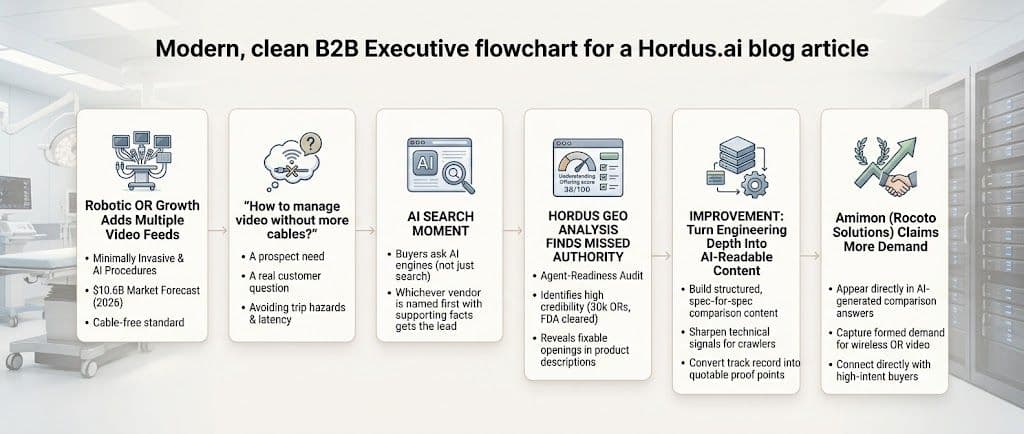
The Understanding Offering score of 38 out of 100 is the clearest signal here. It suggests that when an AI engine tries to summarize what Amimon does, from wireless HD pioneer to FDA-cleared surgical systems, current content doesn't make that arc easy to extract. Paired with a Discovery score of 13 out of 20 and an Access score of 17 out of 30, the pattern points to one fix: more of Amimon's real technical depth needs to be structured for crawlers to reach and quote, not just displayed for a human scrolling the page.
That's a narrow, addressable gap sitting on top of genuine strength. Here are three ways Hordus can help Amimon close it and convert existing demand into direct citations.
Strengthen positioning inside comparison-style AI answers. When a buyer asks an AI engine to compare wireless OR video options, Hordus builds structured, spec-for-spec comparison content, latency, FDA status, install base, OEM integrations, so Amimon becomes the direct answer instead of one name in a longer list.
Sharpen AI-readable content and technical signals. Hordus rebuilds core product and technology pages, including structured data and a clear identity type for agent-facing crawlers, so AI engines can accurately describe what MD62, EM21, and the Connex line do. That targets the Understanding Offering score directly and turns real engineering depth into something machines cite correctly.
Turn OEM credibility into citable authority. Amimon's technology already runs inside 40-plus OEM devices and more than 30,000 operating rooms. Hordus structures that track record, FDA clearances, ISO 13485 certification, install base, into clearly attributed, quotable proof points, so that authority surfaces directly in AI answers instead of staying buried in a spec sheet.
Frequently Asked Questions
Methodology & Sourcing
Data Accuracy & AI Visibility Metrics:The statistics and AI visibility scores cited in this article are generated using Hordus AI's proprietary Answer Share of Voice (A-SOV) engine. Data is derived from consented, anonymized real user interactions across major LLM interfaces (ChatGPT, Claude, Gemini).
Editorial Integrity:All AI-assisted research undergoes mandatory human editorial review by our GEO strategy team prior to publication to ensure factual accuracy and alignment with Google's YMYL (Your Money or Your Life) search quality rater guidelines.