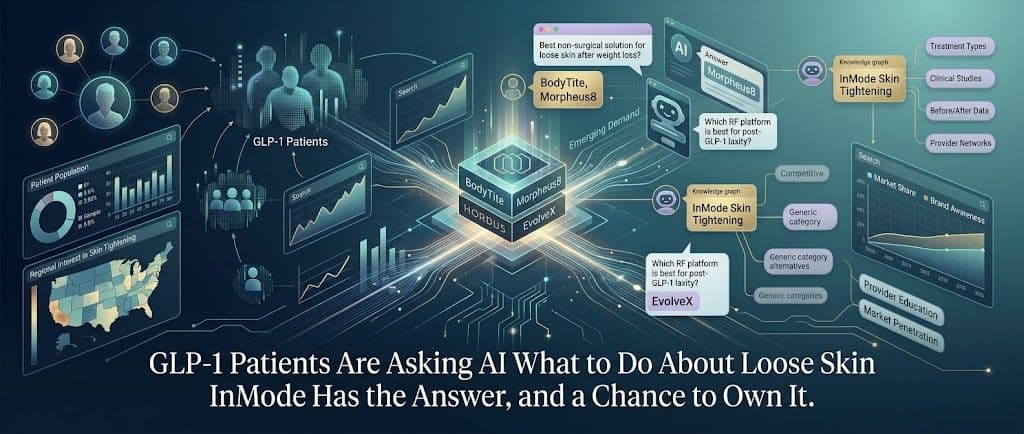
GLP-1 Patients Are Asking AI What to Do About Loose Skin. InMode Has the Answer, and a Chance to Own It.
GLP-1 use has nearly quadrupled since 2024, driving patients to ask AI engines about loose skin after weight loss. InMode's platforms answer that need directly. The Hordus GEO analysis scores inmodemd.com 60/100 for AI-agent readiness, with Offering Understanding at 38/100 marking InMode's clearest opportunity to win more AI-cited demand today.
TL;DR:
GLP-1 adoption in the United States has nearly quadrupled since 2024. A growing share of that population is searching for solutions to loose skin after rapid weight loss. AI engines already field these questions and recommend treatment categories. InMode's platforms, including BodyTite, Morpheus8, and EvolveX, sit at the center of that category. The Hordus GEO analysis of inmodemd.com scores the site 60 out of 100 for AI-agent readiness, with the biggest opportunity in how clearly AI systems understand and cite InMode's specific offerings. Closing that gap turns a demand wave InMode already predicted into search visibility InMode can own.
The Missed-Business-Opportunity Headline
Every week, more patients finish a GLP-1 weight-loss journey and open a new question: what happens to the skin left behind. That question now goes straight to AI engines, at a volume the aesthetics industry has not seen before. InMode built its business on the exact technology category these patients need. The opportunity is not to invent a new answer. It is to make sure the answer AI engines already give points back to InMode by name.
The Market Event: A Weight-Loss Drug Boom Is Reshaping Aesthetic Demand
GLP-1 medications went from niche diabetes treatments to a mainstream weight-loss phenomenon in under three years. A Gallup poll published in July 2026 found that 11 percent of U.S. adults currently take a GLP-1 drug for weight loss, up from just 3 percent in 2024 (Gallup). That is tens of millions of patients moving through rapid, medically driven weight loss, many for the first time.
InMode felt this shift directly. On the company's first-quarter 2026 earnings call, CEO Moshe Mizrahy acknowledged that GLP-1 adoption had pulled spending away from traditional liposuction in the near term (The Motley Fool). Second-quarter 2026 results, released in August, showed revenue roughly flat at $95.6 million amid macro pressure on elective procedures (PR Newswire). The near-term headwind is real. It is also the leading edge of a bigger tailwind.
Why This Moment Matters to InMode's Prospects
Rapid GLP-1 weight loss does not just remove fat. It frequently leaves loose skin on the abdomen, arms, thighs, and face. This side effect is well documented in clinical literature and consumer press alike (Newsweek). Two prospect groups are affected. The first is patients newly self-conscious about skin laxity. The second, commercially more important, is the surgeons, dermatologists, and med spa owners deciding which device platform to invest in for this wave.
Both groups share overlapping fears. Patients fear surgery is their only option, or that a treatment won't work on skin already stretched. Providers fear picking a technology that can't deliver visible tightening, or one with downtime patients won't accept. Both are now running these fears through AI search before a consultation.
The AI Search Moment
Buying decisions increasingly start with a direct question to an AI engine rather than a search results page. A patient asks what to do about loose skin after Ozempic or Zepbound. A provider asks which energy-based device performs best on post-GLP-1 skin laxity, or how BodyTite compares to a competing RF platform. These are late-stage, comparison-ready prompts. The brand AI engines cite earns the click and the consultation.
| Market Signal | Prospect Need | Likely AI Prompt | Why InMode Should Appear |
|---|---|---|---|
| 11% of U.S. adults now on GLP-1 drugs, up from 3% in 2024 | Understand skin changes after rapid weight loss | "Why is my skin loose after losing weight on Ozempic?" | InMode's RF platforms are built for post-weight-loss skin laxity |
| Rising reports of sagging skin post-GLP-1 | A non-surgical option before considering a tummy tuck | "Best non-surgical treatment for loose skin after weight loss" | BodyTite and EvolveX are minimally invasive alternatives to excision surgery |
| Providers adding weight-loss-adjacent services | Which device platform to invest in for this segment | "Morpheus8 vs BodyTite for post-GLP-1 patients" | InMode has the broadest platform portfolio across face and body |
| Deferred elective spending amid macro pressure | Proof a device delivers visible, provable results | "Does RF skin tightening actually work after weight loss?" | Clinical and provider-reported outcomes exist but aren't consistently surfaced in AI answers |
Moshe Mizrahy captured the long-term logic of this shift directly. "Long term, we believe it will help us, because once you lose fat, you have loose skin, and you need to tighten the skin" (Birmingham Star).
GLP-1 shrinks one line item and grows another. The growing one is InMode's core category. On the same call, Mizrahy framed the broader demand pattern plainly. "We believe that the demand for aesthetic procedure will not go away. It may be deferred, but it will return" (The Motley Fool). That deferred demand is exactly what AI engines are fielding questions about today, ahead of tomorrow's consultations.
Introducing the Hordus GEO Analysis
The Hordus GEO analysis evaluated inmodemd.com for AI-agent readiness: how easily AI systems can discover, understand, and confidently cite the site when answering prompts like the ones above.
| Audit Area | Score | Opportunity Framing |
|---|---|---|
| Overall AI-Readiness Score | 60/100 (Grade C) | Solid foundation, clear runway to top-tier |
| Discovery | 8/20 | Room to open more AI crawler pathways |
| Access | 15/30 | Room to expand structured product access |
| Usability | 31/40 | Already strongest area, near-optimized |
| Agent Discovery & Trust | 50/100 | Good starting point for stronger trust signals |
| Agent Welcome | 100/100 | Fully optimized, ready to build on |
| Offering Understanding | 38/100 | Biggest opportunity: AI fluency on each platform |
| Integration Capability | 100/100 | Fully optimized, ready to build on |
| Website Operability | 77/100 | Strong base, headroom to full marks |
Where InMode Can Capture More Demand Inside AI Answers
InMode is not starting from a technical deficit. The Usability score of 31 out of 40 and a perfect 100 on both Agent Welcome and Integration Capability show that AI systems can already reach and navigate the site without friction. The real opportunity sits in Offering Understanding, at 38 out of 100. That score marks the gap between a site AI engines can crawl and one they can confidently summarize when a provider asks which InMode platform fits a scenario like post-GLP-1 skin laxity. Closing that gap turns generic category mentions into InMode-specific citations.
Three Ways Hordus Can Help InMode Capture This Demand
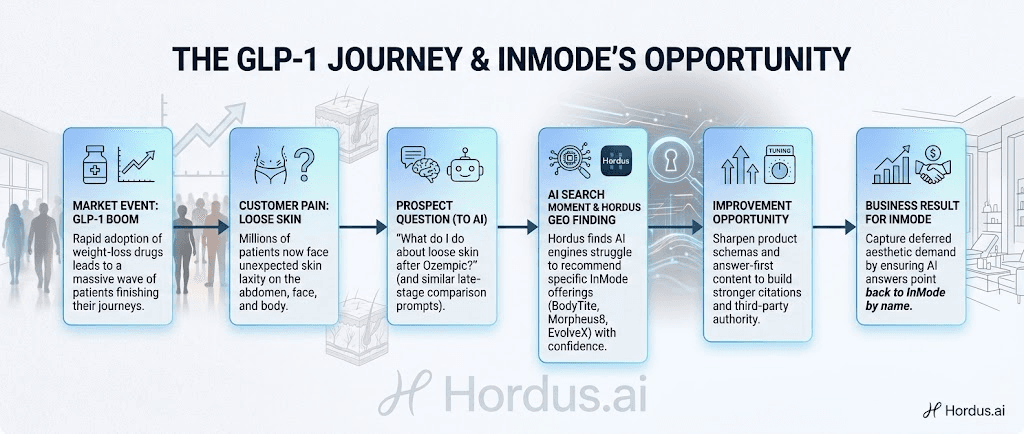
Strengthen positioning inside AI answers. When a provider asks an AI engine to compare devices for post-weight-loss skin tightening, the answer should name InMode's platforms and the scenarios each one solves, not describe the category generically. Hordus can help map BodyTite, Morpheus8, and EvolveX to the exact use cases prospects ask about, raising the odds AI engines cite InMode by name.
Build stronger citations and third-party authority. AI engines weigh independent sources heavily on clinical questions. Hordus can help identify where InMode's clinical outcomes and provider-reported results are underrepresented in the sources AI engines pull from. It can also help build a citation footprint that gives AI systems confident reasons to recommend InMode.
Sharpen AI-readable content and technical signals. With Offering Understanding at 38 against a Usability score more than double that, the fastest wins are structural. Hordus can help InMode implement clearer product schemas and answer-first content on procedure pages, so AI crawlers can parse what each device does and for whom.
Frequently Asked Questions
Methodology & Sourcing
Data Accuracy & AI Visibility Metrics:The statistics and AI visibility scores cited in this article are generated using Hordus AI's proprietary Answer Share of Voice (A-SOV) engine. Data is derived from consented, anonymized real user interactions across major LLM interfaces (ChatGPT, Claude, Gemini).
Editorial Integrity:All AI-assisted research undergoes mandatory human editorial review by our GEO strategy team prior to publication to ensure factual accuracy and alignment with Google's YMYL (Your Money or Your Life) search quality rater guidelines.