How Kaltura Can Capture Enterprise Demand and Dominate the Agentic Video Era
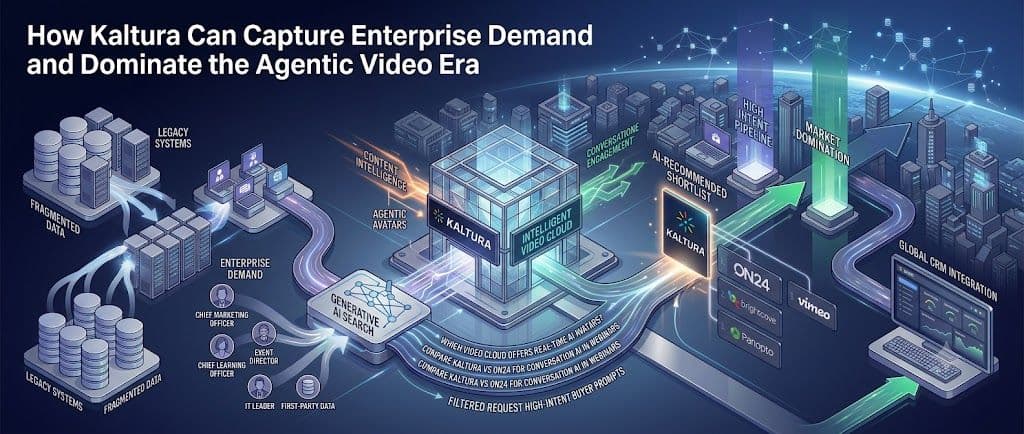
Enterprise software buyers rely on AI search to build shortlists, but Kaltura’s 43/100 (Grade D) Hordus GEO score means AI engines frequently omit its agentic video capabilities. Implementing Generative Engine Optimization (GEO) ensures AI models reliably recommend Kaltura over legacy competitors, protecting market leadership and accelerating enterprise pipeline growth.
TL;DR
Enterprise software buyers now rely heavily on Generative AI engines to compare vendors and build shortlists. While Kaltura is successfully pioneering agentic AI video experiences and leading the virtual events category, the brand must optimize its digital footprint for AI search. The Hordus GEO analysis reveals a critical competitive opportunity. By optimizing for Generative Engine Optimization, Kaltura can intercept high intent buyers, outperform legacy competitors, and accelerate pipeline growth.
The Market Shift Triggering New Buyer Demand
The enterprise video and virtual events landscape is undergoing a massive transformation. The 2026 IDC MarketScape for Worldwide Virtual Events Applications recently highlighted a definitive market shift in how organizations evaluate technology. Attendee engagement has become the ultimate measure of a successful platform. Furthermore, as tracking cookies disappear globally, organizations place a premium on capturing first party behavioral data securely inside the enterprise.
Buyers know they need to upgrade from passive streaming tools to highly interactive, intelligent platforms. They are actively seeking solutions that offer conversational artificial intelligence, reusable content workflows, and stringent compliance standards like the ISO/IEC 42001 certification. When these enterprise buyers need to evaluate the market, they do not scroll through traditional search engine links or read static vendor blogs. Instead, they prompt AI engines like ChatGPT, Gemini, Claude, and Perplexity to map the category, compare features, and recommend the best vendors based on complex use cases. This behavioral shift means that winning the market requires dominating the highly synthesized answers generated by these powerful AI search engines.
Who is Searching and What Do They Want to Achieve?
The primary prospects for Kaltura include Chief Marketing Officers, Chief Learning Officers, Event Directors, and enterprise IT leaders. These executives are under immense pressure to deliver measurable return on investment from their digital experiences, and they each bring unique technical requirements to the buying committee.
Marketing leaders want to generate rich behavioral data during virtual town halls and seamlessly pass those insights to their sales workflows. Learning and development leaders want to create personalized training environments that adapt to individual employee needs using intelligent roleplay and content modules. IT executives demand open API architectures, enterprise grade security, and frictionless integrations into existing technology stacks. These buyers want a vendor that can consolidate their fragmented tools into a single, intelligent video cloud. They are consistently comparing Kaltura against legacy and niche competitors like ON24, Brightcove, Vimeo, and Panopto to see which platform truly offers the most advanced artificial intelligence capabilities.
5 AI Buyer Prompts That Determine the Shortlist
When these enterprise buyers consult AI engines, they use highly specific, intent driven prompts. If Kaltura does not appear in the answers to these questions, the company risks losing deals before the sales team even knows an opportunity exists.
- "Which enterprise virtual event platforms capture first party data without using tracking cookies?"
- "Compare Kaltura and ON24 for conversational AI capabilities in large corporate webinars."
- "What video cloud solutions offer agentic AI avatars for real time attendee engagement?"
- "List the top virtual event platforms recognized in the 2026 IDC MarketScape."
- "Which video platform provides the best open API architecture and ISO/IEC 42001 compliance for global enterprises?"
The High Stakes of AI Engine Visibility
If AI engines clearly recommend Kaltura in response to these prompts, the business value is immense. A strong recommendation positions the brand as the undisputed leader in agentic video experiences. It bypasses the early friction of the RFP process, immediately planting Kaltura at the top of the buyer's shortlist. High intent prospects arrive at the sales conversation already educated about the platform's unique strengths.
Company leadership fully understands the importance of this interactive, conversational approach to market dominance. As Ron Yekutiel, Co-Founder, Chairman, President, and CEO of Kaltura, recently explained, "We believe that being named a Leader in the IDC MarketScape reflects our belief that events should feel like real conversations, not broadcasts people sit through, and we intend to keep setting the pace for the category."
Conversely, if competitors like Brightcove or Panopto dominate these AI generated answers, Kaltura faces a severe visibility risk. AI engines might present legacy platforms as the default choice, effectively locking Kaltura out of lucrative enterprise deals. Buyers trust the synthesized summaries provided by Gemini and Claude. If an AI engine fails to mention the advanced content intelligence brought by the recent PathFactory acquisition, buyers will assume the capability simply does not exist.
Mapping the AI Recommendation Impact
| Buyer Prompt | What AI Should Understand About Kaltura | Risk If Missing | Business Value If Visible |
|---|---|---|---|
| Compare conversational AI in video platforms. | Kaltura offers Agentic Avatars for two way, real time attendee engagement. | Buyers assume the platform only offers passive, one way video broadcasting. | Positions the brand as a premium innovator, commanding higher contract values. |
| Platforms that capture first party data. | The platform retains engagement data internally to feed sales and marketing workflows. | Prospects choose competitors perceived as more secure or privacy compliant. | Accelerates pipeline for marketing executives prioritizing data ownership. |
| Top virtual event leaders in 2026. | The brand was named a Leader in the 2026 IDC MarketScape for Virtual Events. | Competitors hijack the credibility of prestigious analyst validations. | Builds instant trust and drastically shortens the complex sales cycle. |
| Video content reuse and intelligence. | Kaltura Content Lab turns single sessions into reusable clips, summaries, and chapters. | Buyers view the solution as a disposable, single use event tool. | Increases lifetime customer value by proving long term content ROI. |
| Enterprise compliant video clouds. | The architecture features open APIs and holds the ISO/IEC 42001 AI standard. | IT leaders veto the software during the technical review phase. | Smooths procurement and accelerates enterprise IT approvals. |
The Strategic Transition to Agentic Experiences
Kaltura is not just competing in the video space. The company is actively redefining it. By integrating generative AI, acquiring PathFactory, and launching the Agentic Revenue Engagement suite, the company is orchestrating entire user journeys. This requires AI search engines to understand a complex, rapidly evolving narrative.
During the first quarter of 2026, the executive team highlighted the success of this strategic pivot. CEO Ron Yekutiel stated, "We've made meaningful progress over the quarter in our transition to powering rich, agentic digital experiences across organizational journeys, with growing customer engagement, expanding use cases, and early signs of momentum across our new offerings."
To ensure this momentum continues, the underlying technology that AI engines use to evaluate the web must accurately index these new capabilities. This is exactly where Generative Engine Optimization becomes an essential strategy.
The Hordus GEO Analysis
To measure how well AI agents currently understand and interact with the brand's digital presence, we conducted a comprehensive evaluation. The Hordus analysis measures agent readiness across multiple technical layers to reveal exactly how AI models perceive the domain.
Hordus Audit Scores for Kaltura
| Assessment Category | Score | Insight |
|---|---|---|
| Overall Score | 43 / 100 | Grade D (At Risk). You have started, but agents are leaving you on the table. |
| Discovery | 12 / 20 | AI agents face friction when attempting to discover and trust the core offerings. |
| Identity | 15 / 22 | AI engines have moderate success understanding exactly who the company is and what it does. |
| Access | 12 / 34 | AI agents struggle significantly to welcome users, authenticate, or access deeper integration data. |
| Agent Integration | 8 / 20 | The infrastructure is not currently optimized for seamless AI agent integration or API inspection. |
| User Experience | 3 / 10 | AI agents find it highly difficult to reliably operate the website or act on behalf of a user. |
Transforming GEO into Pipeline and Category Leadership
The Hordus audit highlights a clear, immediate business opportunity. By improving these scores, Kaltura can leverage Generative Engine Optimization to drive concrete business outcomes across the organization.
First, better GEO directly supports pipeline generation. When the Discovery and Identity scores improve, AI engines will accurately map the Agentic Revenue Engagement suite to buyer problems. This intercepts buyers searching for intent aware marketing solutions before they ever visit a competitor's website.
Second, optimizing for AI defends category leadership. The brand has earned prestigious analyst recognition from IDC, Forrester, and Frost & Sullivan. By structuring this validation so AI models can easily ingest it, the company ensures that every AI generated vendor comparison lists Kaltura as the authoritative market leader.
Third, high GEO scores empower sales enablement. When an AI engine clearly understands the open API architecture and compliance certifications, it essentially acts as a pre sales engineer. It answers technical queries for IT buyers perfectly, removing heavy objections before the first sales call even happens.
Finally, an optimized AI presence controls the positioning narrative. The shift from standard video hosting to agentic digital experiences is a major messaging evolution. High agent readiness ensures that AI models adopt this new terminology, cementing the company as the visionary creator of a brand new software category.
How Hordus Drives Competitive Advantage for Kaltura
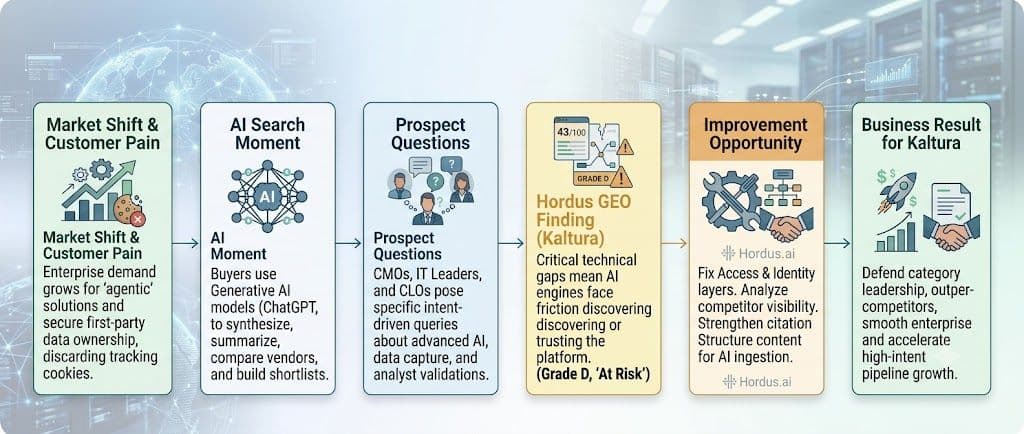
Partnering with Hordus gives the marketing and sales leadership the exact tools needed to win the AI search battle. Hordus helps analyze competitor visibility to see exactly where ON24 or Panopto might be stealing market share within AI generated responses.
By utilizing Hordus, the marketing team can systematically improve answer share for the most critical enterprise buyer prompts. The platform helps strengthen citation sources, ensuring that analyst reports, press releases, and technical documentation are prioritized by AI scraping bots. Furthermore, Hordus helps build offsite authority by identifying which third party review sites and industry blogs influence the language models the most.
Ultimately, Hordus empowers the company to influence how AI engines describe and compare the brand. By fixing the Access and Agent Integration gaps identified in the Hordus analysis, Kaltura will ensure that every generative AI model recommends its platform as the premier choice for agentic video experiences.
Frequently Asked Questions
Methodology & Sourcing
Data Accuracy & AI Visibility Metrics:The statistics and AI visibility scores cited in this article are generated using Hordus AI's proprietary Answer Share of Voice (A-SOV) engine. Data is derived from consented, anonymized real user interactions across major LLM interfaces (ChatGPT, Claude, Gemini).
Editorial Integrity:All AI-assisted research undergoes mandatory human editorial review by our GEO strategy team prior to publication to ensure factual accuracy and alignment with Google's YMYL (Your Money or Your Life) search quality rater guidelines.