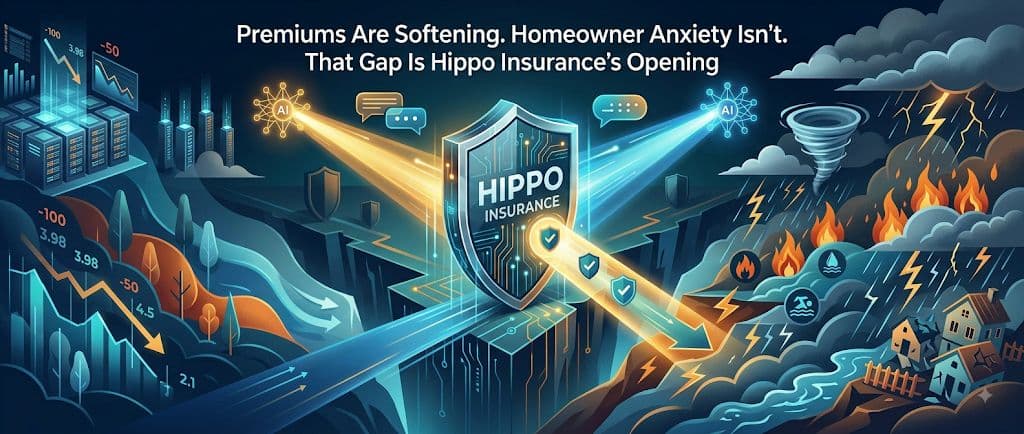
Premiums Are Softening. Homeowner Anxiety Isn't. That Gap Is Hippo Insurance's Opening
Homeowners are turning to AI to ask whether their coverage still holds up in a softening, riskier market, and Hippo Insurance already has the product and research to answer well. The Hordus audit shows the gap isn't the story, it's visibility: hippo.com scores 29 out of 100 on AI readiness, leaving real, fast-to-capture upside in how that answer reaches AI engines.
TL;DR
Homeowners insurance pricing is softening in 2026 while climate risk keeps rising, pushing more prospective and current homeowners to ask AI tools whether their coverage still makes sense. Hippo's own research shows close to half of homeowners now plan to use AI to research insurance options, meaning the buying journey has already moved into chat windows. A new distribution partnership with Progressive and a retooled homeowners product give Hippo fresh, timely answers to the exact questions AI engines are fielding right now. The Hordus GEO analysis of hippo.com shows the technical groundwork for AI discoverability is still forming, which is the clearest kind of opportunity: real demand, an unclaimed lane, and a brand with the story to fill it. This article maps that opportunity and how Hordus can help Hippo capture more of it.
The Opportunity Sitting in Front of Hippo Insurance
Hippo Holdings posted its fifth straight profitable quarter in the summer of 2026, raised full-year guidance, and pushed its 2028 gross written premium target past two and a half billion dollars. In the same earnings update, leadership acknowledged something worth paying attention to: homeowners, commercial property, and casualty pricing across the industry are softening. Softer pricing sounds like good news for shoppers, and in some ways it is, but it also creates a moment of confusion. When premiums move, homeowners start questioning whether they are still adequately covered, whether a cheaper quote means weaker protection, and whether now is the time to switch carriers.
At the same time, Hippo is actively re-entering the homeowners category it built its name on, retooling its product, raising underwriting discipline, and launching a distribution partnership with Progressive that puts Hippo's homeowners policies inside Progressive's HomeQuote Explorer in eight states. That is a lot of fresh, specific, comparison-ready information entering the market at the exact moment prospects are asking pricing and coverage questions. This is the opening.
Why This Moment Matters to Hippo's Prospects
Homeowners shopping in a softening market are not just price-checking. They are trying to answer a harder question: is a lower premium a signal of a better deal, or a warning sign of thinner coverage. Hippo's own 2026 Homeowner Anxiety Report found that eighty-four percent of homeowners say homeownership-related stress affects their quality of life, and a meaningful share lose sleep or feel their mental health decline because of it. That anxiety does not disappear when a renewal notice arrives with a lower number. It often gets worse, because the homeowner does not know whether to trust it.
Layer in climate exposure. Wildfire, flood, and severe storm risk keep climbing, and Hippo's Housepower Report shows many homeowners are aware of the gap between what they carry and what they actually need, even if they have not acted on it. Prospects in this position are not casually browsing. They are trying to reconcile a cheaper market with a riskier world, and they want a source that can explain both sides without a sales pitch attached.
The AI Search Moment: What Buyers Ask, Compare, and Verify
This is where the buying journey has quietly shifted. Nearly half of homeowners, according to Hippo's own research, now say they plan to use AI to research insurance options rather than starting with a search engine or an agent's phone number. That means the first real touchpoint for a large share of Hippo's prospects is not a landing page. It is a conversational answer generated by an AI engine, pulling from whatever sources it judges most credible and current.
Buyers in this mode ask direct, comparison-heavy questions: what is a fair homeowners premium for my risk profile, why did my quote change, which insurers actually pay claims fast, and whether a newer, tech-driven carrier is safer to choose than a legacy name. They verify claims-response reputation, they compare underwriting approaches, and they look for recent, dated evidence rather than static marketing copy.
| Market signal | Prospect need | Likely AI prompt | Why Hippo Insurance should appear |
|---|---|---|---|
| Softening homeowners pricing industry-wide | Reassurance that a lower quote is not a coverage downgrade | "Why did my homeowners insurance quote go down this year?" | Hippo can explain underwriting discipline and rate mechanics with current, dated data |
| Hippo-Progressive distribution partnership | Confidence in where to compare real quotes | "Where can I compare Hippo homeowners insurance quotes?" | Hippo is the direct, verifiable answer if its own pages state this clearly |
| Rising climate and catastrophe risk | Clarity on whether current coverage is enough | "Do I need extra coverage for wildfire or flood risk in my state?" | Hippo's proactive maintenance and risk tools directly answer this need |
| AI-driven claims transformation | Trust that claims will be handled fast, not slow | "Which home insurance companies process claims the fastest?" | Hippo's Clara AI claims data gives a concrete, citable answer |
| Growing homeowner financial anxiety | A partner, not just a policy | "Is Hippo a good insurance company for first-time homeowners?" | Hippo's own research and brand positioning speak directly to this need |
Rick McCathron, Hippo's President and CEO, has framed this need plainly: "homeowners need better tools, clearer guidance, and protection plans that help them stay ahead of unexpected expenses," he said in the company's Housepower Report announcement. That is close to a direct transcript of what an AI engine's answer to a coverage-adequacy question should sound like, if it can find the source.
Andrea Collins, Hippo's Chief Marketing Officer, pointed at the exact gap this article is describing. "Only a quarter of homeowners would think to turn to their insurance provider for prevention advice," she said in the Homeowner Anxiety Report release, calling it the gap Hippo's brand is built to close. AI engines are already fielding the prevention and guidance questions Collins is describing. The opportunity is making sure Hippo's own content is what they retrieve.
Introducing the Hordus GEO Analysis
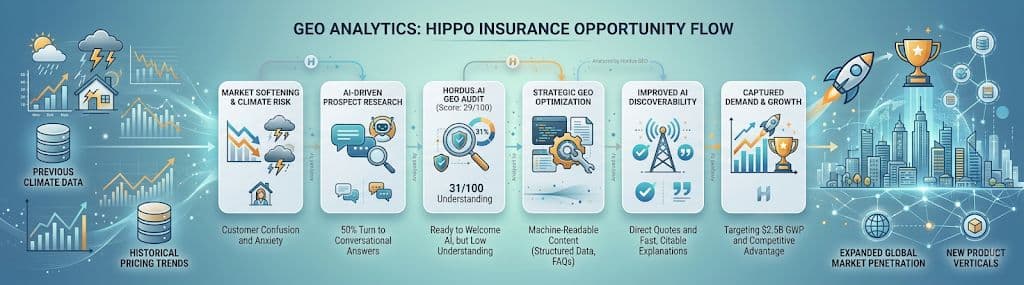
To see how ready hippo.com is to be that retrieved source, we ran the Hordus GEO analysis, which scores how discoverable, understandable, and usable a site is for AI agents and answer engines across dozens of checks. The scan puts hippo.com at 29 out of 100, ranked 7,829 out of 15,556 sites evaluated. That number is not a verdict. It is a map of exactly where the unclaimed upside sits.
| Layer | Hippo's current score | The opportunity it represents |
|---|---|---|
| Overall agent readiness | 29 / 100 | Substantial headroom to move up the category before competitors close the gap |
| Discovery | 5 / 20 | A near-empty layer means small, fast fixes can produce outsized visibility gains |
| Access | 11 / 30 | Room to turn "welcomes agents" into "understood by agents" |
| Usability | 9 / 40 | The largest single layer, and the largest single opportunity for AI-readable content |
| Agents welcoming Hippo's site | 100 / 100 | A strong foundation already in place to build on |
| Agent understanding of offering | 31 / 100 | Clear space to make Hippo's homeowners story explicit and machine-readable |
The strongest signal in the audit is the one worth leading with: Hippo's site already scores 100 out of 100 on welcoming AI crawlers and agents. Nothing is blocking access. The gap sits one step later, in how clearly Hippo's actual offering, pricing logic, claims speed, and coverage guidance are structured for an AI engine to read, extract, and quote confidently. That is a content and structure opportunity, not a trust or access problem, and it is the kind of gap that moves quickly once addressed.
Three Ways Hordus Can Help Hippo Insurance Capture More of This Demand
Strengthen positioning in AI answers. When a prospect asks an AI engine whether a lower quote means weaker coverage, Hordus can help Hippo publish direct, quotable explainer content built around that exact question, using the language homeowners actually type rather than marketing language. This turns McCathron's public commentary and the Housepower data into content AI engines can lift and attribute correctly.
Build stronger citations and third-party authority. AI engines weigh independent sources heavily. Hordus can identify where Hippo is under-cited relative to competitors like Lemonade or Kin, and build a targeted program of press, analyst mentions, and structured data that increases the odds Hippo's claims-speed and underwriting story get pulled into comparison answers instead of a rival's.
Sharpen AI-readable content and technical signals. With Usability scoring 9 out of 40, the biggest lever is making Hippo's existing pages, like the Housepower and Homeowner Anxiety research, easier for agents to parse through cleaner structured data, an llms.txt file, and machine-readable summaries. Hordus can prioritize which pages to fix first based on where prospect demand is highest.
Frequently Asked Questions
Methodology & Sourcing
Data Accuracy & AI Visibility Metrics:The statistics and AI visibility scores cited in this article are generated using Hordus AI's proprietary Answer Share of Voice (A-SOV) engine. Data is derived from consented, anonymized real user interactions across major LLM interfaces (ChatGPT, Claude, Gemini).
Editorial Integrity:All AI-assisted research undergoes mandatory human editorial review by our GEO strategy team prior to publication to ensure factual accuracy and alignment with Google's YMYL (Your Money or Your Life) search quality rater guidelines.