Proggio's AI Strategy and the Market Opportunity Ahead
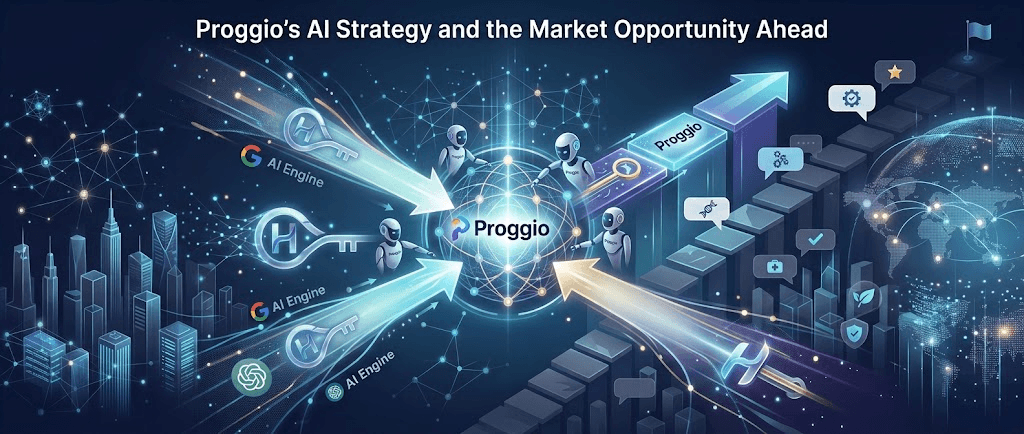
Proggio's executives have already staked their story on contextual AI over another chatbot, and Gartner predicts 40 percent of enterprise apps will run agents like it by year's end. The Hordus GEO analysis shows exactly where Proggio can extend that narrative further into AI-generated answers, turning vision into real visibility.
TL;DR
Proggio's executives have spent the past year telling a clear story: portfolios need context-aware AI, not another chatbot bolted onto a timeline. Gartner's prediction that 40 percent of enterprise applications will carry task-specific AI agents by the end of 2026 is playing out now and validates what Proggio has been building. Proggio's prospects, PMO leaders managing complex portfolios, already ask AI engines which platforms can execute autonomously rather than just track status. The Hordus GEO analysis of proggio.com shows real strength in how AI systems read and welcome the site, plus wide open territory Hordus can help Proggio turn into consistent presence inside AI answers.
Yaniv Shor, CEO and co-founder of Proggio, put the company's AI thesis plainly last November: "Our Contextual AI doesn't just add another chatbot. It activates inside your project tasks, where every prompt is automatically enriched with the full project context behind the scenes," he told AiThority when Proggio introduced its contextual agentic AI capabilities. That distinction, context built into execution rather than a chat window on top of it, is the same one the broader market is now racing to make.
That race has a timestamp. In August 2025, Gartner predicted that 40 percent of enterprise applications would feature task-specific AI agents by the end of 2026, with agents evolving into full agentic ecosystems. That target year is now, and portfolio management sits at the center of the shift, because portfolios are where planning either turns into delivery or stalls in spreadsheets. Shor's quote was a positioning statement made months before the market caught up to it.
Barak Schiby, Proggio's Chief Technology Officer, made the technical case for that shift when Proggio unveiled Anna, its autonomous AI agent, this spring: "True agentic AI requires a shared medium that holds complete context. Our ProjectMap™ gives Anna the perfect foundation to act independently while staying perfectly aligned with the team." His comment, reported by EIN Presswire in March 2026, ties to growth and innovation: it explains why Proggio built ProjectMap™ first, so autonomous execution could follow without losing what a project needs.
Who Proggio's prospects are, and what they need now
Proggio's buyers are PMO leaders, program and portfolio directors, and executives running IT, engineering, biotech, manufacturing, and healthcare organizations where multiple projects compete for the same people, budget, and calendar. What they need has shifted: a year ago the question was which tool gave the cleanest timeline view; now it is which platform can actually execute, not just visualize, without losing context when a deadline slips. That is the gap between planning software and an execution partner, the gap Proggio's roadmap, from TimelineGPT to Anna, was built to close.
What Proggio's prospects are asking AI engines
Buyers increasingly start with ChatGPT, Perplexity, or Gemini instead of a vendor shortlist, asking things like "what is the best AI-powered project portfolio management tool for enterprise teams" or "which project management platforms use autonomous AI agents instead of chatbots." Each question is a moment where an AI engine chooses which vendors to name, and whether Proggio is one of them depends on how clearly its narrative appears in the content those engines retrieve from.
| Executive message | Market proof | Prospect AI question | Business opportunity for Proggio |
|---|---|---|---|
| Shor: contextual AI beats "another chatbot" | Gartner: 40% of enterprise apps to carry task-specific agents by end of 2026 | "What's the difference between an AI chatbot and an AI agent in PM software?" | Own the answer distinguishing contextual execution from bolt-on chat |
| Schiby: ProjectMap™ gives Anna a shared context foundation | Gartner: agent ecosystems replacing single-task agents by 2027 | "How do AI agents stay aligned with a project's context?" | Become the cited architecture for context-aware agents |
| Shor: Anna ends the cycle of manual reminders | Category-wide AI agent launches across PPM tools in 2026 | "Which PM tool eliminates manual status updates using AI?" | Capture pain-point answers before competitors define the category |
Introducing the Hordus GEO analysis
The Hordus GEO analysis looked at how AI systems discover, read, and act on proggio.com, the way an engine would when a prospect asks one of the questions above. It found a company already speaking clearly to AI crawlers in several areas, with a wide runway to extend that presence into the structured, citable detail that gets a brand named rather than simply indexed.
| Audit dimension | Current score | Opportunity for Proggio |
|---|---|---|
| Website Operability | 83/100 | A strong base to carry more AI-cited content |
| Agent Welcome | 75/100 | Crawlers are already invited in; give them more to work with |
| Transaction Support | 67/100 | Pricing is visible today, a base to extend across the buyer journey |
| Understanding Offering | 62/100 | Engines grasp part of the story; sharper detail sharpens the answer |
| Discovery & Trust | 31/100 | Open territory to expand sitemap and structured signals |
| Authentication | 8/100 | A clean slate to document access paths for agent evaluation |
| Integration Capability | 0/100 | Unclaimed ground for an API and MCP presence engines can act through |
Every score here is a starting line, not a scoreboard. A 0 in integration capability is unclaimed territory: no competitor owns it either, and whoever documents it first becomes the platform AI agents act through, not just describe.
How the findings strengthen Proggio's narrative ownership
The findings point to concrete moves. Proggio already offers an NPM and PyPI SDK, a real asset the audit surfaced, but has not yet published an OpenAPI specification. Publishing one would let AI agents understand Proggio's mechanics directly, which matters given how firmly Shor and Schiby have staked Proggio's positioning on being an execution layer, not a dashboard. Strengthening Discovery & Trust signals, sitemap coverage, structured data, crawl accessibility, would extend the reach of content Proggio has already written, including the statements and launches above.
How Hordus can help Proggio grow
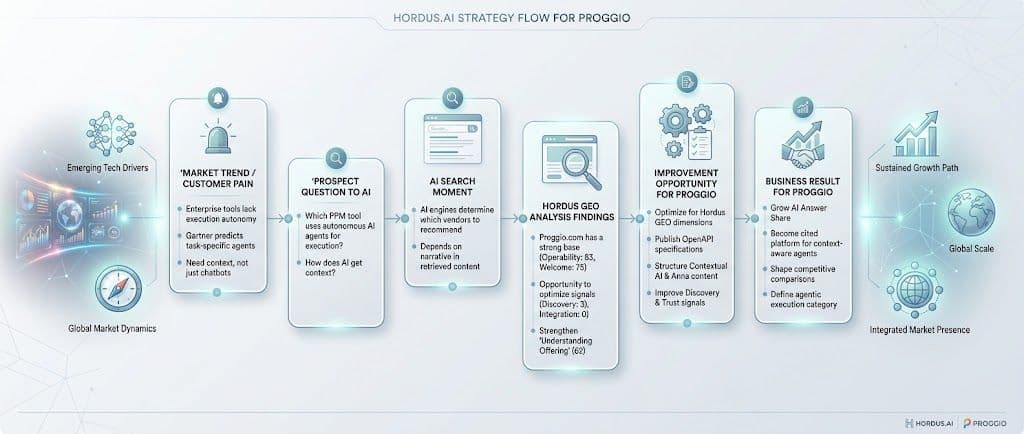
Five concrete opportunities stand out, each framed as growth to capture rather than a problem to fix.
Grow AI answer share. Hordus can help structure the Contextual AI and Anna announcements so Proggio's own language, not a generic summary, is what surfaces when someone asks an AI engine about agentic project execution.
Strengthen citation strength. Hordus can help make high-authority coverage, like the AiThority and EIN Presswire pieces referenced above, easier for AI systems to find, parse, and attribute correctly back to Proggio.
Build AI-readable content. Hordus can help translate existing product depth, ProjectMap™, TimelineGPT, workstream structure, into clearly structured pages built to answer specific buyer questions directly.
Clarify category positioning. Hordus can help define PPM with agentic execution as its own space in AI answers, distinct from generic task management tools built for smaller teams.
Shape competitive comparisons. Hordus can help ensure that context depth, execution autonomy, and portfolio scope, the points AI engines reach for, are the ones AI systems highlight when comparing Proggio to monday.com, Asana, and Smartsheet.
None of this requires a new product story. Proggio's executives have already written the narrative: contextual AI over chatbots, execution over planning, portfolios over task lists. The Hordus audit shows where that narrative already lands with AI systems, and Hordus exists to help it land more often, more completely, and more favorably.
Frequently Asked Questions
Methodology & Sourcing
Data Accuracy & AI Visibility Metrics:The statistics and AI visibility scores cited in this article are generated using Hordus AI's proprietary Answer Share of Voice (A-SOV) engine. Data is derived from consented, anonymized real user interactions across major LLM interfaces (ChatGPT, Claude, Gemini).
Editorial Integrity:All AI-assisted research undergoes mandatory human editorial review by our GEO strategy team prior to publication to ensure factual accuracy and alignment with Google's YMYL (Your Money or Your Life) search quality rater guidelines.