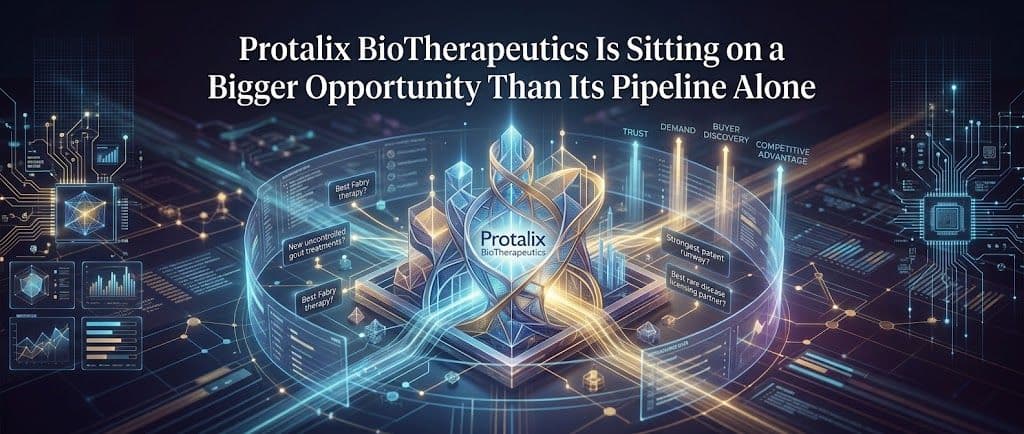
Protalix BioTherapeutics Is Sitting on a Bigger Opportunity Than Its Pipeline Alone
Protalix posted a profitable quarter, extended Elfabrio's patent to 2035, and is chasing a gout market heading toward $1.6 billion. But buyers now ask AI engines first, not company websites. Protalix's AI-readiness score is 54/100, with weak structured data. Hordus closes that gap, turning strong fundamentals into AI-generated visibility, citations.
TL;DR:
Protalix BioTherapeutics just posted a profitable quarter, extended Elfabrio's core patent to 2035, and watched the uncontrolled gout market it is chasing with PRX-115 head toward $1.6 billion. Physicians, pharmacists, licensing partners, and investors increasingly ask AI engines to compare vendors before making contact. Protalix has the story to win those AI-generated shortlists. The Hordus GEO analysis of protalix.com shows where to close the gap between what Protalix has built and what AI engines say about it, pointing to real upside rather than a deficit to fix.
A Market Event That Is About to Change Who Gets Asked First
Protalix closed the first half of 2026 with year-to-date revenue of $53.6 million, up from $25.8 million a year earlier, and net income of $22.1 million. Elfabrio, its Fabry disease enzyme therapy, grew 4.4 million dollars in the quarter, and its core patent was extended to November 2035. In May, it gained marketing authorization in South Korea, adding to a footprint built with partner Chiesi.
That momentum lands inside a category already in motion. A Chiesi-sponsored survey of 280 Fabry patients found most respondents on established therapies still experienced low energy, tingling, and pain, and 51 percent called their symptoms hard to control. That kind of unresolved dissatisfaction sends patients, caregivers, and physicians to AI assistants for alternatives, not to a single incumbent's website.
The same pattern is building in gout. On the Q2 2026 earnings call, CFO Gilad Mamlok pointed to a rival uncontrolled-gout therapy tracking toward 1.6 billion dollars in revenue, up from 1.3 billion in 2025, a sign of the appetite that exists for better options, exactly the population PRX-115 is built to reach when Phase 2 data lands in the second half of 2027.
A profitable, patent-protected product, a pipeline candidate entering a multibillion-dollar market, and dissatisfied patients add up to rising research activity, much of it now happening through AI engines.
Who Is Doing That Research, and What They Want
Protalix competes in enzyme replacement therapy for rare diseases, built on its proprietary ProCellEx plant cell-based expression platform. Its main points of comparison are Sanofi Genzyme with Fabrazyme, Amicus Therapeutics with Galafold, Takeda with VPRIV, and Amgen with Krystexxa in gout.
Several groups already ask AI engines about this space. Specialists want a fast comparison of enzyme replacement options. Payer teams want dosing and formulary fit against incumbents. Newly diagnosed patients and caregivers want plain answers about treatment. Business development teams, the profile that led Chiesi to Protalix, want to know who else is building pipelines worth licensing. Investors want a clear read on where PRX-115 and PRX-119 sit against the field.
Five Questions These Buyers Are Already Asking AI Engines
- "What is the best enzyme replacement therapy for Fabry disease in 2026?"
- "How does Elfabrio compare to Fabrazyme and Galafold for treating Fabry disease?"
- "Which biotech companies are developing new treatments for uncontrolled gout?"
- "What rare disease drug makers use plant cell-based manufacturing instead of mammalian cell lines?"
- "Is Protalix BioTherapeutics a strong partner for licensing rare disease enzyme therapies?"
Each prompt ends with an AI engine either naming Protalix clearly, alongside Sanofi, Amicus, Takeda, and Amgen, or leaving it out entirely. Being named first, with the plant-based platform, the Chiesi deal, and the 2035 patent runway explained accurately, is a shortlist position few legacy competitors have secured either, since most have not optimized for this discovery layer yet. Moving now is a first-mover advantage Protalix can claim.
As CEO Dror Bashan put it, "We enter the second half of 2026 in a position of strength, driven by the continued penetration and growth of Elfabrio through our partnership with Chiesi" (Protalix BioTherapeutics, Q2 2026 results). That strength should show up whenever an AI engine describes Protalix for the first time.
| Buyer prompt | What AI should understand about Protalix | Opportunity if addressed | Business value if visible |
|---|---|---|---|
| Best Fabry therapy in 2026 | FDA/EU-approved ERT, patent-protected to 2035, global reach via Chiesi | Positioned beside Fabrazyme and Galafold as current, well-supported | More physician consideration |
| Elfabrio vs. Fabrazyme vs. Galafold | Targets patients whose symptoms persist on existing therapies | Captures the dissatisfied-patient segment the Chiesi survey identified | Faster switches from incumbents |
| New uncontrolled gout treatments | PRX-115, a potentially best-in-class long-acting uricase | Builds anticipation ahead of Phase 2 data | Stronger analyst and specialist interest |
| Plant cell-based expression platform | ProCellEx, Protalix's proprietary manufacturing edge | Positions Protalix as a platform innovator, not just a product company | Inbound licensing interest, the Chiesi path |
| Best rare disease licensing partner | Commercial revenue plus an active pipeline | Surfaces Protalix to development teams scanning the field | New partnership conversations |
Introducing the Hordus GEO Analysis
This business case only pays off if AI engines can see and cite the story Protalix is living. That is where the Hordus GEO analysis comes in, less a verdict than a map of where the fastest gains are waiting.
| Audit area | Current score | Opportunity to capture |
|---|---|---|
| Overall AI-readiness | 54/100 | Room to move from crawlable to clearly recommended |
| Agent discovery and trust | 56/100 | Sitemap gains help crawlers find Elfabrio, Elelyso, and the pipeline |
| Agent welcome (crawler access) | 100/100 | Already a strong foundation to build on |
| Self-understanding (structured data) | 30/100 | Biggest lever: data so AI states precisely what Elfabrio treats and how it compares |
| Website operability | 73/100 | A solid base supporting clear navigation |
Three moves turn this snapshot into pipeline impact. First, structured data around Elfabrio, Elelyso, PRX-115, and ProCellEx lets AI engines answer comparisons with specifics, supporting sales conversations already underway. Second, clearer entity signals tying Protalix to its category, named competitors, and Chiesi strengthen how confidently AI engines recommend it in licensing and investor contexts, not just clinical ones. Third, citable content built around the unmet-need data in the Chiesi survey gives AI engines a credible reason to name Elfabrio when patients ask about persistent symptoms.
How Hordus Helps Protalix Capture It
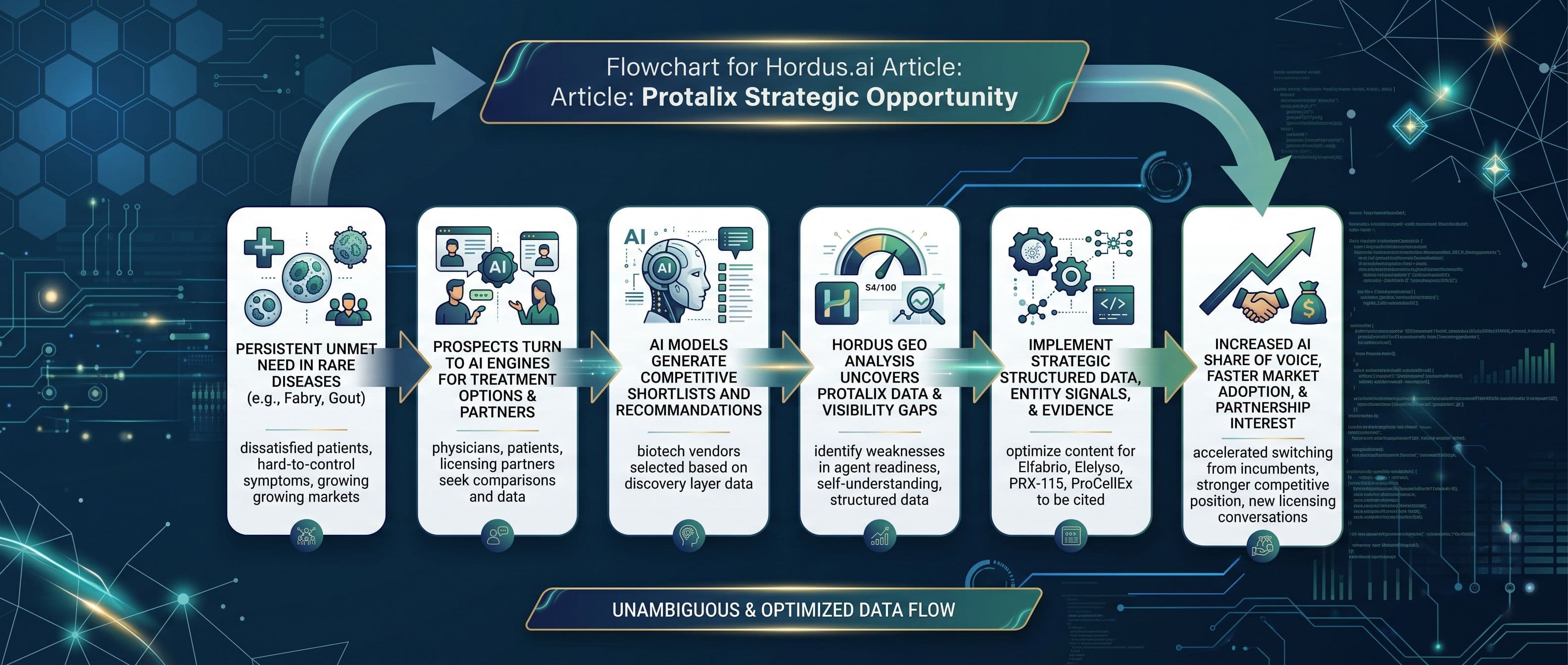
Hordus becomes an operating partner here, not just an auditor, working alongside Protalix's marketing and sales leadership to turn the audit into a pipeline.
Competitor visibility. Hordus benchmarks how often Sanofi, Amicus, Takeda, and Amgen show up in AI answers to the category questions above, showing which prompts to prioritize first.
Answer share. Hordus tracks and grows the rate Protalix is actually named in AI-generated answers, a sharper measure of buyer-facing presence than search rank.
Citation sources. Hordus turns earnings results and clinical data into content built to be quoted, giving AI engines specific material instead of vague summaries.
Offsite authority. Hordus builds the third-party mentions and structured profiles that make AI engines trust a source enough to cite it.
Brand description and comparison. Hordus shapes how AI engines describe and compare Protalix against its named competitors, matching the story leadership already tells on earnings calls.
As CFO Gilad Mamlok noted about the gout category's trajectory, "The revenues keep growing. It was $1.3 billion in 2025. We see now the trend going to $1.6 billion. So it's very encouraging for 115 as well" (Protalix BioTherapeutics, Q2 2026 earnings call transcript). That is the momentum AI engines should relay to every rheumatologist and investor asking about gout treatment.
Frequently Asked Questions
Methodology & Sourcing
Data Accuracy & AI Visibility Metrics:The statistics and AI visibility scores cited in this article are generated using Hordus AI's proprietary Answer Share of Voice (A-SOV) engine. Data is derived from consented, anonymized real user interactions across major LLM interfaces (ChatGPT, Claude, Gemini).
Editorial Integrity:All AI-assisted research undergoes mandatory human editorial review by our GEO strategy team prior to publication to ensure factual accuracy and alignment with Google's YMYL (Your Money or Your Life) search quality rater guidelines.