RAAAM's 2nm Moment: Why the Memory Wall Just Became Its Biggest Opportunity
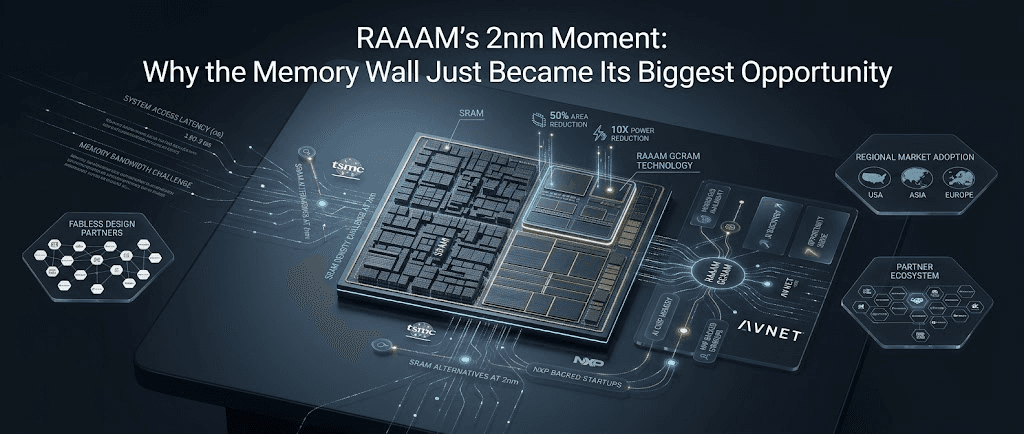
RAAAM Memory Technologies just qualified its GCRAM memory on TSMC's 2nm process as an AI memory supercycle squeezes chip architects. This piece unpacks what that milestone means for RAAAM's pipeline, investor confidence, and category authority, and how the Hordus GEO analysis builds real AI-search visibility.
TL;DR
RAAAM Memory Technologies just qualified its GCRAM embedded memory on TSMC's 2nm process with Avnet ASIC as partner, right as an industry-wide memory supercycle pushes chip architects to look harder at what they can build on-chip. RAAAM's likely buyers, fabless design teams, automotive silicon architects, AI accelerator startups, increasingly research this through ChatGPT, Gemini, Perplexity, and AI Overviews before opening a search engine. The Hordus GEO analysis of raaam-tech.com shows real headroom to make sure AI engines surface that substance.
The event: RAAAM earns a seat at the 2nm table
In June 2026, RAAAM selected Avnet ASIC to develop and qualify GCRAM on TSMC's 2nm process, following a first test chip taped out earlier in the year. Trade press picked up the story on its own two months later: Electronics For U profiled GCRAM on August 20, 2026 as a named contender against SRAM, a three-transistor cell that roughly doubles density in the same silicon area past 1 to 2 percent memory activity, the exact profile of an AI accelerator or automotive SoC. Timing matters because 2nm is where SRAM's scaling problem worsens: SRAM now eats more than half the silicon area on many advanced designs, while HBM and DRAM capacity allocated to AI accelerators has tightened supply for everyone else, a supercycle expected to reshape chip supply chains for years. A company that just proved a drop-in SRAM alternative works at 2nm is suddenly relevant to a bigger conversation than one funding round.
Why it matters now for RAAAM's customers and leadership
Eran Rotem, RAAAM's VP R&D, put the milestone plainly: "Avnet ASIC's commitment and expertise in streamlining infrastructure, technology support and PDK environment, were instrumental in the migration of our GCRAM technology to TSMC's 2nm process," he told AnySilicon. Chip teams typically lock IP choices 18 to 24 months before tape-out, so the research happening now decides who competes for sockets in the next wave of AI accelerators and automotive silicon. Find GCRAM early and RAAAM gets evaluated; miss the window and incumbent SRAM licensors keep the socket. It matters to investors too: NXP led RAAAM's $17.5 million Series A to fund exactly this kind of qualification, and every proof point strengthens the story for the next round.
Who RAAAM's prospects actually are
Four groups matter most: chip architects at fabless companies designing AI accelerators, where density and power decide how many TOPS fit on a die; automotive semiconductor teams at IDMs like NXP; AR/VR and edge AI silicon startups, where every square millimeter of die area is a cost line; and design partners and investors who read RAAAM's traction as a category signal.
What those prospects now ask AI engines
A chip architect evaluating memory IP in 2026 does not start with a search engine the way they did five years ago. They ask ChatGPT "what are the best SRAM alternatives for 2nm chip design," or ask Gemini "who are the leading embedded memory startups challenging SRAM." Each prompt is a moment where RAAAM either gets named, or gets skipped for a competitor whose content is easier to retrieve.
Why AI visibility is the next growth lever
An architect who finds RAAAM named accurately in an AI answer, complete with the 2nm qualification and the area and power numbers, arrives at raaam-tech.com already primed to trust the technology. That shortens the sales cycle with buyers who research heavily before taking a call, and it builds category authority: consistently showing up as the answer to "SRAM alternative" queries starts to own that category the way a brand owns a keyword in search. For enterprise conversations and investor confidence ahead of a future round, being the name AI systems reach for first is an advantage a funding announcement alone cannot buy.
Where the Hordus GEO analysis comes in
That is exactly the gap the Hordus GEO analysis of raaam-tech.com measures and helps close. Hordus evaluates how ready a web presence is to be discovered, understood, and cited correctly by AI engines, not just crawled by search bots, a distinction that matters for an engineering-led company like RAAAM. The audit gives RAAAM a starting score of 51 out of 100, and every number points to an achievable lever.
| Signal Measured | Current Score | Opportunity |
|---|---|---|
| Overall AI-readiness | 51/100 | A clear baseline with a fast path to a much stronger score |
| Agent Welcome / Crawlability | 100/100 | Already a strength: AI crawlers reach RAAAM's content without friction |
| Website Operability | 64/100 | A solid foundation ready to carry richer, structured content |
| Access | 17/30 | Room to open more of RAAAM's technical depth to AI retrieval |
| Understanding Offering | 44/100 | A near-term milestone: sharper messaging so AI quotes GCRAM's specs precisely |
| Agent Discovery & Trust | 44/100 | A growth lane for how often RAAAM gets named |
| Discovery | 3/20 | The single biggest unlock; small structural changes here compound fast |
| Transaction Capability | 0/100 | A greenfield lead as agentic B2B research goes mainstream |
Three numbers show where the upside sits. Discovery at 3 out of 20 is the clearest opportunity: connecting RAAAM's milestones, the NXP round, the 2nm qualification, the Avnet ASIC deal, for AI engines means showing up in more "SRAM alternative" prompts. Understanding Offering at 44 out of 100 is a near-term win: RAAAM's real numbers, up to 50 percent area reduction and up to 10X power reduction versus SRAM, can win an AI-generated comparison once presented cleanly. Transaction Capability at 0 out of 100 reads like an early-mover lane, since agent-readable pathways are an edge almost nobody in embedded memory has claimed yet.
Robert Giterman, RAAAM's CEO and co-founder, framed the company's momentum this way after the Series A closed: "This oversubscribed funding round with high-profile strategic and financial investors is another sign of confidence in our company and our revolutionary technology," he said in the announcement. That confidence is what a stronger AI-visibility profile can project to engineers and investors who never see a press release but do ask an AI assistant to summarize the field.
How Hordus turns that score into pipeline for RAAAM
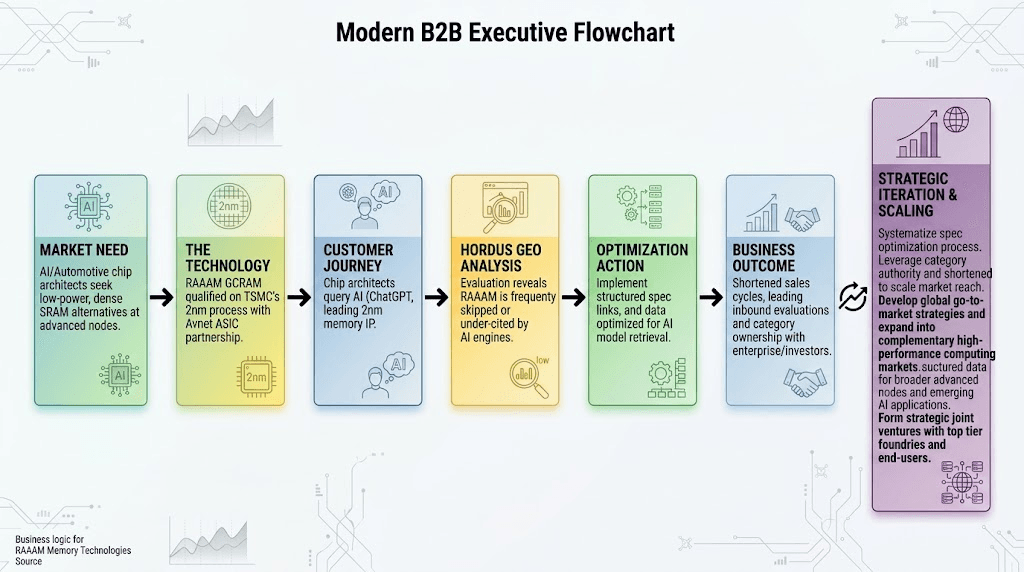
Hordus does not stop at handing RAAAM a number. It maps exactly which prompts RAAAM's prospects are already typing, "SRAM alternatives at 2nm," "embedded memory IP with NXP backing," and checks whether ChatGPT, Gemini, Perplexity, and AI Overviews currently answer with RAAAM in the mix or without it. Where RAAAM is missing or under-cited, Hordus prescribes the fix: structured spec pages that let AI models lift GCRAM's area and power numbers verbatim, clearer entity language tying RAAAM to GCRAM, NXP, Avnet ASIC, and TSMC's 2nm process, and content built around the comparison questions prospects are asking. It then tracks the result over time, so RAAAM's leadership can watch citation share climb as each fix ships, turning the 2nm milestone into a compounding asset instead of a one-time press cycle.
From event to outcome
| Market Event | Prospect's Question | AI Answer Opportunity | Business Result for RAAAM |
|---|---|---|---|
| TSMC 2nm ramp meets the AI memory supercycle | "Best SRAM alternatives for 2nm AI chip design?" | AI engine names GCRAM with cited specs and the 2nm qualification | Inbound evaluation requests from architects locking IP now |
| NXP-led Series A and Avnet ASIC partnership | "Which embedded memory startups have major semiconductor backing?" | AI engine surfaces RAAAM alongside NXP and Avnet as validated partners | Stronger enterprise and investor conversations |
The technology story is already strong. The next milestone is structuring it so AI engines find, understand, and repeat it to the architects, partners, and investors researching this category today.
Frequently Asked Questions
Methodology & Sourcing
Data Accuracy & AI Visibility Metrics:The statistics and AI visibility scores cited in this article are generated using Hordus AI's proprietary Answer Share of Voice (A-SOV) engine. Data is derived from consented, anonymized real user interactions across major LLM interfaces (ChatGPT, Claude, Gemini).
Editorial Integrity:All AI-assisted research undergoes mandatory human editorial review by our GEO strategy team prior to publication to ensure factual accuracy and alignment with Google's YMYL (Your Money or Your Life) search quality rater guidelines.