Rail Vision's Next Signal: Turning Category Momentum Into Market Share
Rail Vision's 328 percent H1 2026 revenue growth and expansion into India, Latin America, and Israel signal a window to own AI-generated buyer research. The Hordus GEO analysis shows strong technical foundations already in place. Closing one structured-data gap could make Rail Vision the default AI-recommended vendor first.

TL;DR:
Rail Vision just posted 328 percent revenue growth in H1 2026 and is expanding into India, Latin America, and Israel, the kind of momentum that pushes rail operators to research AI obstacle detection vendors through ChatGPT, Perplexity, and Google AI Overviews. The companies these buyers ask about first tend to win the shortlist. The Hordus GEO analysis of railvision.io shows Rail Vision already has strong technical foundations and a fast, clear path to becoming the name AI engines recommend by default. This is a growth play, not a defense play.
A Momentum Story That Buyers Notice
On August 26, 2026, Rail Vision reported first-half revenue of just over $1.0 million, up 328 percent from $237,000 a year earlier, with a $15.6 million cash position and zero financial debt. CEO David BenDavid put it simply: "The first half of 2026 marked a period of strong commercial momentum for Rail Vision. We generated revenues of over $1.0 million, a significant increase from $237,000 in the same period last year, driven by growing adoption of our solutions" (StockTitan).
That growth followed a busy stretch: a majority stake in Quantum Transportation, a deeper Israel Railways partnership, a new memorandum with Sujan Industries to enter the Indian rail market, and a follow-on order from a Latin American mining operator. Events like these put a category on the radar of buyers who were not shopping a quarter ago. When a vendor wins new geographies and posts triple-digit growth, safety officers and operations leaders elsewhere start asking who else is doing this and who is best, increasingly by asking an AI engine first. Every new order, patent, or partnership Rail Vision announces becomes fresh material AI engines can draw from, and the vendor that makes it easy to find and cite is the one that shows up first.
Who Is Asking, and What They Want
Rail Vision's core prospects fall into a few buckets: Class 1 and regional freight railroads evaluating long-range collision avoidance, rail yard operators automating obstacle detection in switching yards, mining and industrial rail operators, and national rail authorities like Indian Railways piloting AI at scale. The buyers are VPs of rail operations, chief safety officers, and procurement leads who need to justify a purchase against measurable safety and uptime gains.
What they want is consistent: fewer collisions and near-misses, less unplanned downtime, compliance with standards like EN 61373 and EN 45545-2, and a vendor already proven with a comparable operator. As Shahar Hania, Rail Vision's former CEO, said of its Switch Yard System: "Our AI-based obstacle detection technology is a key enabling technology for the future of autonomous train operations" (Railway Technology). That is exactly what buyers are trying to verify when they research this category, and exactly what an AI engine can surface if it can find it.
Five Questions Buyers Are Likely Asking AI Engines Right Now
- "What are the best AI obstacle detection systems for freight rail in 2026?"
- "How does Rail Vision compare to Konux and Duos Technologies for rail safety AI?"
- "Which vendors offer long-range collision avoidance compliant with EN 45545 and EN 61373?"
- "What rail safety AI companies have recent contracts, funding, or proven results?"
- "Is Rail Vision's ShuntingYard system a good fit for mining or industrial rail yards?"
The Upside of Being the Answer
When AI engines consistently name Rail Vision for these questions, the payoff compounds. Rail Vision earns its way onto shortlists before a rep ever picks up the phone, shortening sales cycles and lowering the cost of each new logo. It also lets product marketing control the narrative, making sure AI engines accurately describe the 2km detection range, EN compliance, and the Israel Railways deployment whenever the category comes up.
The bigger prize is category ownership. Rail AI safety is still young enough that no incumbent dominates every AI-generated answer, so the window to become the default recommendation is open now. It tends to narrow as more competitors publish content and earn citations, so moving early is not about catching up. It is about claiming the position while it is still available.
| Buyer prompt | What AI should understand about Rail Vision | Opportunity if addressed | Business value if visible |
|---|---|---|---|
| Best AI obstacle detection for freight rail | 2km range, EN 61373 and EN 45545-2 compliance, patented classification | Becomes the reference answer for range and compliance | Higher-quality inbound from freight operators |
| Rail Vision vs. Konux or Duos Technologies | Vision-based front-facing detection vs. sensor-based track monitoring | AI engines position Rail Vision correctly, not blended with adjacent categories | Cleaner competitive framing, fewer misqualified leads |
| Compliant collision avoidance vendors | Certified to EN standards, US, European, and Japanese patents | Surfaces in compliance-driven searches by safety officers | Shorter procurement and legal review cycles |
| Vendors with recent traction | 328 percent H1 2026 growth, Israel, India, Latin America expansion | Signals momentum to risk-averse enterprise buyers | Stronger trust before first sales contact |
| ShuntingYard fit for mining or yards | 200m range, automatic classification, built for yard conditions | Positions Rail Vision as the yard and industrial specialist | Expands addressable market beyond mainline rail |
Introducing the Hordus GEO Analysis
To see where Rail Vision stands in AI search visibility today, Hordus ran a GEO analysis of railvision.io. The findings match the momentum story: real substance for AI engines to work with, and a few targeted moves that could meaningfully widen the lead.
| Opportunity area | Current score | What it means |
|---|---|---|
| AI agent access | 100/100 | AI crawlers can already read the full site without restriction |
| Integration and documentation | 100/100 | Technical depth is discoverable and well organized |
| Website performance | 77/100 | Strong technical health supports fast, reliable indexing |
| Discovery and trust signals | 78/100 | Solid base, with room to add more citable proof points |
| Understanding the offering | 22/100 | The biggest open opportunity: structured data to help AI engines summarize products precisely |
| Overall readiness | 63/100 | A strong starting position with a fast path to category leadership |
The standout opportunity is structured data. Rail Vision's site currently lacks JSON-LD markup that spells out what MainLine, ShuntingYard, and RVOS do, who they serve, and how they compare on range and compliance. That is a fast, high-leverage fix: once in place, AI engines have a precise, machine-readable summary to quote instead of an approximation, which directly improves how often and how accurately Rail Vision gets named.
Where the Real Pipeline Gains Are
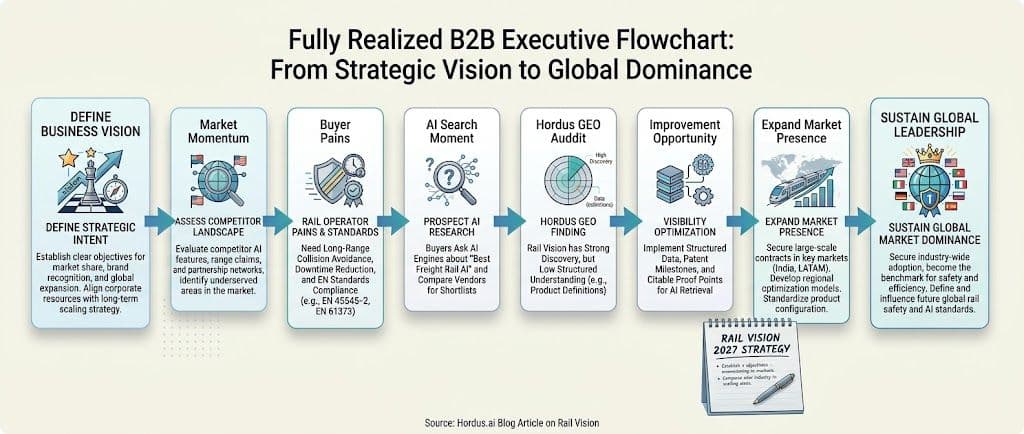
Three moves stand out. Structured data on every product and case study page turns Rail Vision's technical content into something AI engines can quote confidently. Publishing more citable proof, customer results, patent milestones, and named partnerships like Israel Railways in a format built for AI retrieval gives engines fresh material every time a new contract lands. Building offsite authority through trade press and third-party comparisons strengthens the citation sources AI engines trust most, which matters as much as the site itself.
Hordus can extend this by benchmarking Rail Vision's answer share against Konux, Duos Technologies, and other names buyers mention in the same breath, and by helping sales enablement turn audit findings into talk tracks so reps know how AI engines already describe Rail Vision before a prospect raises it. The goal throughout: as more buyers turn to AI engines to shortlist rail safety vendors, Rail Vision is the name that comes back clearly, accurately, and first.
Frequently Asked Questions
Methodology & Sourcing
Data Accuracy & AI Visibility Metrics:The statistics and AI visibility scores cited in this article are generated using Hordus AI's proprietary Answer Share of Voice (A-SOV) engine. Data is derived from consented, anonymized real user interactions across major LLM interfaces (ChatGPT, Claude, Gemini).
Editorial Integrity:All AI-assisted research undergoes mandatory human editorial review by our GEO strategy team prior to publication to ensure factual accuracy and alignment with Google's YMYL (Your Money or Your Life) search quality rater guidelines.