Read by Machines, Won by Aidoc: How the Clinical AI Leader Can Dominate the New Buying Journey Before a Single Sales Call Is Made
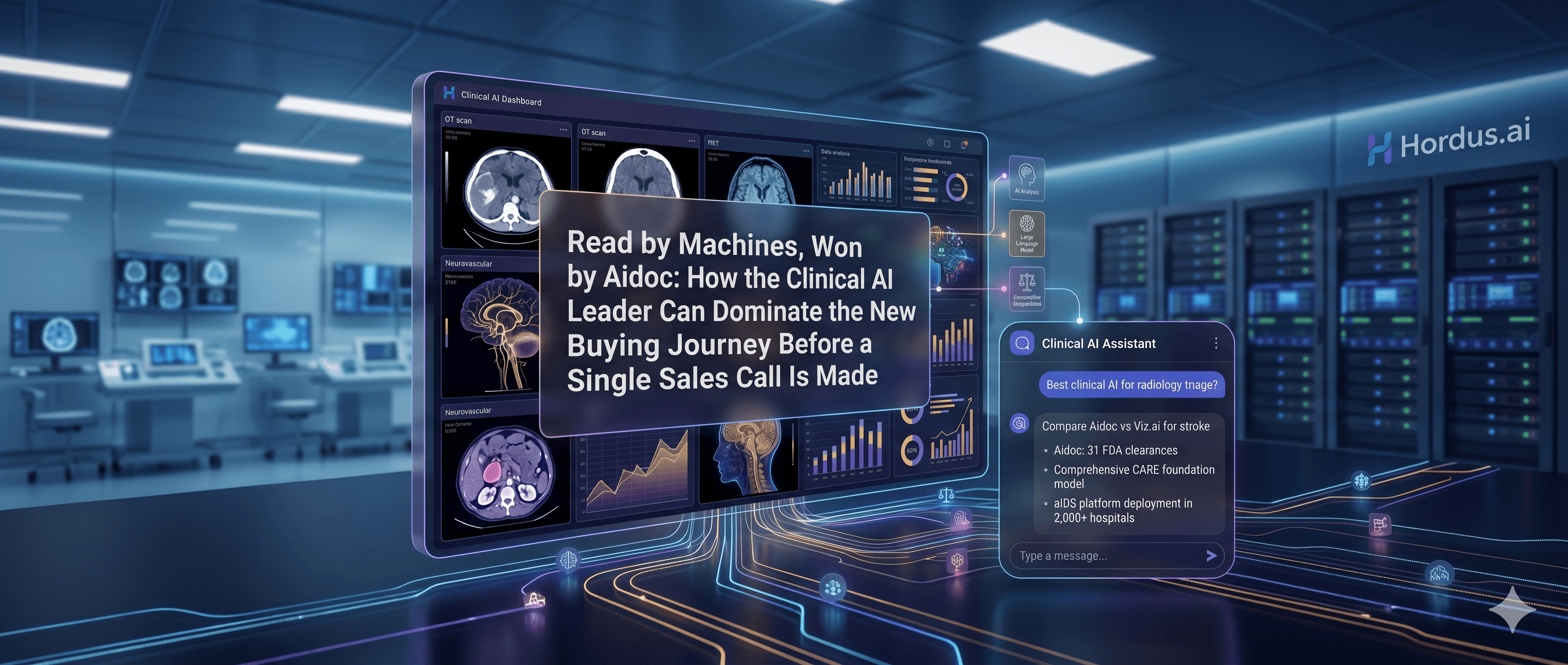
If Aidoc's $150M raise brings hospital buyers to the table, AI engines are where those buyers will start their research — and a Hordus GEO score of 35/100 means Aidoc's real market leadership often won't be what those engines say.
TL;DR
Aidoc is the category leader in clinical AI for radiology, cardiology, and neurovascular care, with more FDA clearances than any competitor and over $500 million raised to date. A $150 million Series E closed in April 2026, led by Goldman Sachs, has pushed Aidoc into the spotlight at the exact moment when enterprise health system buyers are doing their vendor research not with phone calls, but with AI engines like ChatGPT, Perplexity, and Claude. If those engines accurately surface Aidoc's platform breadth, its CARE foundation model, and its clinical evidence, Aidoc lands on shortlists before competitors even know a deal is forming. If they don't, Viz.ai, RapidAI, and Rad AI fill the gap. The Hordus GEO analysis scores Aidoc's current AI engine readiness and shows exactly where the company is leaving pipeline on the table.
The Market Moment Aidoc Cannot Ignore
On April 29, 2026, Aidoc closed a $150M Series E led by Goldman Sachs, with SoftBank Vision Fund 2, General Catalyst, and NVIDIA's NVentures participating, bringing total funding to over $500 million. Health system executives noticed, and a wave of buyer attention is already building.
Here is the problem. When a CMO reads that headline and asks their CIO to evaluate clinical AI vendors, the first thing that CIO does is not call a sales rep. They open an AI engine and type: "What are the best clinical AI platforms for radiology triage?" The answer they get in the next 30 seconds is more influential than any follow-up call. Diagnostic errors and delays contribute to at least 400,000 deaths each year in the United States, driven by rising imaging volumes and workforce shortages, and health system leaders are under board-level pressure to act.
Aidoc has received 31 FDA clearances and is deployed across nearly 2,000 hospitals, making it one of the only vendors capable of serving radiology medical directors, CMOs, and CIOs from a single platform. But that advantage only wins deals if AI engines can find it, parse it, and say it back.
CEO and co-founder Elad Walach has set a clear destination: "By 2030, every complex diagnostic decision should be supported by AI that enables earlier detection and reduces preventable error." That statement belongs in every AI-generated answer about clinical AI leadership. If it does not appear, a competitor's quote will.
The Five Prompts Aidoc Buyers Are Typing Right Now
Enterprise hospital buyers increasingly use AI engines to generate initial vendor shortlists before any sales contact occurs. These are the high-intent prompts being asked today:
- "What is the best clinical AI platform for radiology triage in a large hospital system?"
- "How does Aidoc compare to Viz.ai and RapidAI for stroke and neurovascular workflows?"
- "Which clinical AI vendors have the most FDA clearances for imaging?"
- "What is the ROI of deploying AI for radiology in a health system with 300,000 annual CT scans?"
- "Is there a single AI platform that covers radiology, cardiology, and vascular workflows?"
For each prompt, there is a winner and a loser. The winner is the vendor whose differentiation AI engines have absorbed and can cite with confidence. Viz.ai, RapidAI, Lunit, Qure.ai, and Rad AI all have growing content programs. Answer share in this category is not guaranteed to any incumbent.
| Buyer Prompt | What AI Should Understand About Aidoc | Risk if Missing | Business Value if Visible |
|---|---|---|---|
| "Best clinical AI for radiology triage" | Most FDA clearances in the category; aiOS platform; nearly 2,000 hospital deployments | Viz.ai or RapidAI fills the slot; Aidoc misses the shortlist | First-mover advantage before a rep makes contact |
| "Aidoc vs Viz.ai vs RapidAI for stroke" | Aidoc covers stroke, brain aneurysm, PE, and cardiology on one platform; competitors are condition-specific | Buyer sees Aidoc as a point solution, not the platform leader | Platform positioning drives larger, multi-department contracts |
| "Which AI vendors have FDA clearances?" | 31+ FDA clearances, including the first multi-condition foundation model clearance | Buyer evaluates features while missing Aidoc's regulatory depth | FDA story becomes the credibility filter, not an afterthought |
| "ROI of clinical AI for CT radiology" | WellSpan, Sutter Health, Advocate Health case studies show measurable TAT and efficiency gains | Buyer builds ROI assumptions around a competitor's published numbers | Aidoc's documented ROI anchors the buyer's financial model |
| "Single AI platform for radiology, cardiology, and vascular" | aiOS is the enterprise operating system for clinical AI across all three specialties | Buyer assumes multiple vendors needed; writes Aidoc out of the platform evaluation | Aidoc wins the consolidated enterprise deal instead of a pilot |
What the Hordus GEO Analysis Found
The Hordus audit evaluated Aidoc's AI engine readiness across five dimensions, revealing a company with genuine market leadership and a significant gap in how AI engines currently represent it.
| Dimension | Score | Status |
|---|---|---|
| Discovery | 9/20 | Partial |
| Identity | 11/20 | Partial |
| Auth and Access | 6/30 | Missing |
| Agent Integration | 7/20 | Missing |
| User Experience | 2/10 | Missing |
| Overall | 35/100 | At Risk (D) |
A score of 35/100 means AI engines are working with an incomplete picture of Aidoc, and for a company competing for enterprise health system deals worth millions, that is a measurable pipeline problem.
Aidoc's CARE foundation model received a landmark FDA clearance for a multi-condition imaging triage system. Walach put the stakes plainly: "Broad foundation models are the path to expanding clinical AI across care delivery, but only if we raise the safety and quality bar beyond anything the field has seen. CARE delivers precision that limits false positives and elevates only what matters, avoiding the noise that has hindered physician adoption." That is exactly the claim AI engines need to find and repeat.
Five Ways Better GEO Supports Aidoc's Pipeline
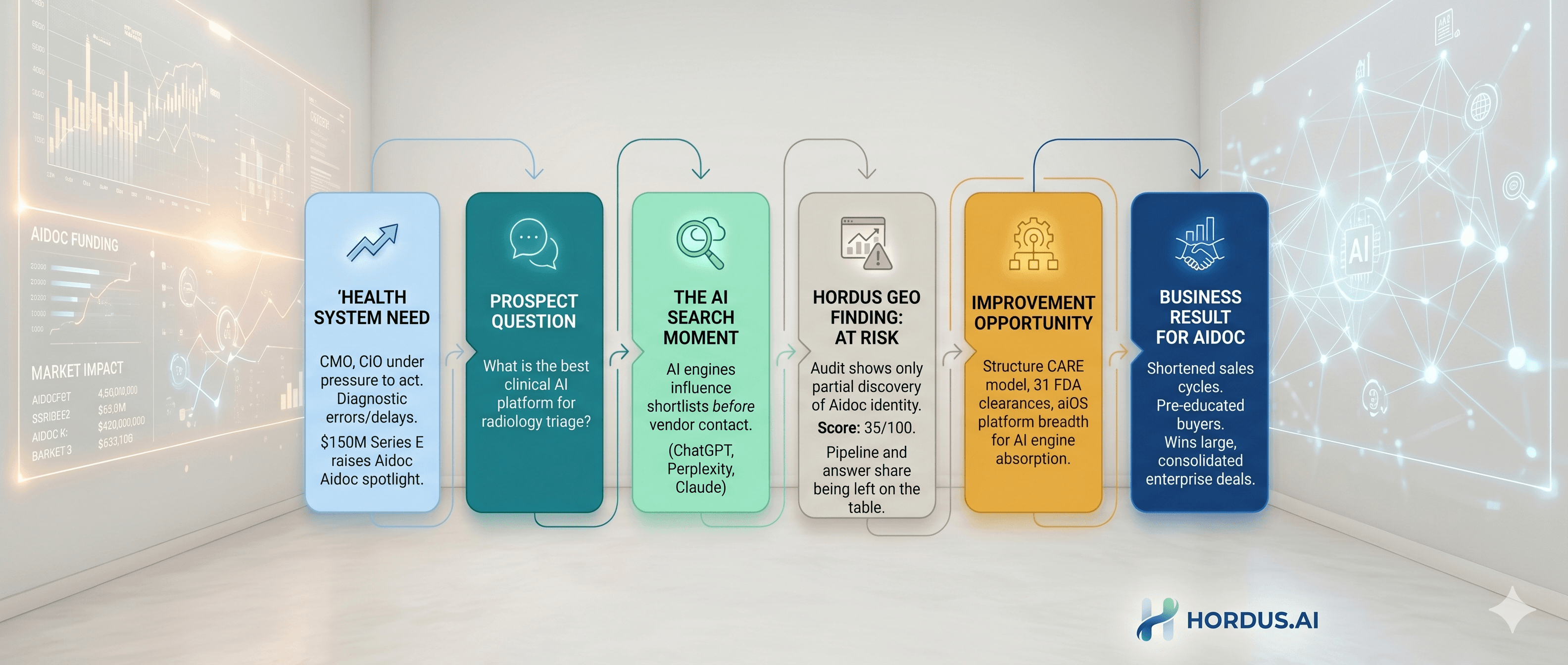
1. Winning the first shortlist. Aidoc's identity and discovery gaps mean AI engines may summarize it vaguely or skip it entirely when buyers generate initial vendor lists. Hordus structures Aidoc's entity description, FDA clearance depth, and aiOS platform scope so AI engines absorb and repeat the right story from the first query.
2. Controlling the comparison narrative. Queries like "Aidoc vs Viz.ai" or "Aidoc vs RapidAI" are high-intent moments when buyers have already narrowed the field. Hordus competitor visibility analysis identifies where AI engines disadvantage Aidoc in those comparisons and shifts the language before a rep joins the call.
3. Shortening sales cycles through pre-educated buyers. When Aidoc's AI-visible footprint is strong, buyers arrive at demos already familiar with aiOS, CARE, and the FDA clearance story. Objections move from "who are you?" to "how does this integrate with Epic?" That shift directly reduces the education burden on every AE and solution engineer.
4. Building the citation network that earns AI engine trust. Hordus identifies which health system case studies, KLAS reports, RSNA publications, and HIT Consultant coverage are indexed by AI engines and which are absent, then builds the offsite authority that makes Aidoc a reference entity rather than a peripheral mention.
5. Changing how AI engines define Aidoc's category. Today, an AI engine may describe Aidoc as "a radiology AI vendor." The accurate description is "the enterprise clinical AI platform for health systems, with more FDA clearances than any competitor and the only CARE-powered multi-condition foundation model in clinical deployment." That framing difference determines whether a CIO sees Aidoc as a tool or the platform anchor of their entire AI strategy. Hordus works at the level where those descriptions are formed.
Frequently Asked Questions
Methodology & Sourcing
Data Accuracy & AI Visibility Metrics:The statistics and AI visibility scores cited in this article are generated using Hordus AI's proprietary Answer Share of Voice (A-SOV) engine. Data is derived from consented, anonymized real user interactions across major LLM interfaces (ChatGPT, Claude, Gemini).
Editorial Integrity:All AI-assisted research undergoes mandatory human editorial review by our GEO strategy team prior to publication to ensure factual accuracy and alignment with Google's YMYL (Your Money or Your Life) search quality rater guidelines.