Securing the Narrative: Why Koi Must Dominate AI Search to Protect Its Enterprise Pipeline
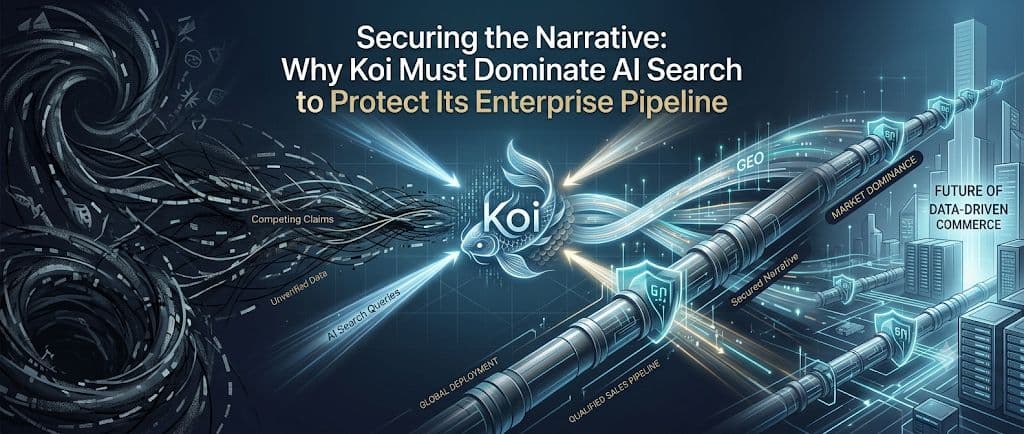
With getkoi.com scoring an Unusable 23/100 on AI agent readiness, search engines default to competitor narratives during buyer research. Executing Generative Engine Optimization (GEO) ensures AI platforms deliver Koi's native messaging, protecting its enterprise pipeline and securing category authority.
TL;DR
- A recent competitor campaign by Aikido Security directly targets Koi, using the recent Palo Alto Networks acquisition to frame Koi as a slow enterprise suite lacking transparent pricing.
- CISOs and DevSecOps leaders are abandoning traditional search engines and asking AI platforms like ChatGPT, Claude, and Perplexity for technical comparisons and vendor evaluations.
- The Hordus GEO analysis reveals getkoi.com scores an Unusable 23/100 for agent readiness, meaning AI models are blind to your native narrative and will default to competitor claims.
- Improving AI visibility will allow Koi to reclaim category authority, win more enterprise conversations, and maintain a sharp competitive advantage in the agentic security market.
The Market Event and Why It Matters Now
In June 2026, the endpoint security landscape witnessed a targeted market shock. Aikido Security launched an aggressive "Top Koi Alternatives" campaign. This was not a standard feature comparison. Aikido weaponized the massive success of Koi, specifically pointing to its recent acquisition by Palo Alto Networks and its enterprise sales motion. The competitor painted Koi as a closed ecosystem lacking public pricing, attempting to steal market share by positioning themselves as the agile, developer friendly alternative.
The cybersecurity market is shifting rapidly toward agentic endpoint protection. When a direct competitor openly targets your pipeline, they are trying to rewrite your story. If you do not control the narrative around this acquisition, your rivals will happily do it for you. This market shift creates both a massive risk and a distinct opportunity for the company.
Why This Event is Critical for Koi Leadership
For the leadership team of Amit Assaraf, Idan Dardikman, and Itay Kruk, this competitor move represents a critical inflection point. They have built a category defining product that stops malicious VSCode extensions, governs MCPs, and secures AI toolchains. However, customers and prospects need absolute confidence that Koi remains the fastest and most effective tool on the market. If buyers believe the competitor narrative, sales cycles will lengthen, and deals will stall. The executive team must ensure that the market understands Koi has only gained strength through its enterprise backing.
Defining the Prospects for Koi
Who are the ideal prospects for Koi? The primary buyers are Chief Information Security Officers (CISOs), DevSecOps leaders, and Security Architects. These technical decision makers are responsible for deploying AI agents, managing Local Network toolkits, and securing endpoint environments against novel threats like Codo AI vulnerabilities. They do not click on banner ads or read generic marketing copy. When they evaluate a platform, they conduct deep technical research and demand immediate access to architecture details.
What Prospects Are Asking AI Overviews
Increasingly, these technical leaders are bypassing traditional Google searches. Instead, they ask complex questions to ChatGPT, Claude, Gemini, Perplexity, and AI Overviews.
When conducting technical research, a CISO might prompt an LLM with questions like:
"Compare Aikido and Koi for agentic endpoint security."
"Does Koi protect against malicious VSCode extensions?"
"What is the pricing model for Koi after the Palo Alto Networks acquisition?"
"Is there a Koi CLI or public API for enterprise deployment?"
How Better AI Visibility Helps Koi Win
When a prospect types these queries, the AI relies entirely on accessible web data to formulate an answer. If getkoi.com is invisible to these models, the AI will simply ingest and regurgitate Aikido's blog posts. By optimizing for Generative Engine Optimization (GEO), Koi can directly inject its own messaging into these AI responses. Better AI visibility will help Koi win more trust, secure its pipeline, establish unmatched category authority, drive enterprise conversations, and build lasting investor confidence.
Koi CEO Amit Assaraf perfectly captured the core problem the company solves when he stated, "Enterprises have no real control over the software flowing into their environments. Packages, AI models, MCPs, and Extensions are now critical parts of the stack, yet they remain invisible to traditional tools". If Koi itself remains invisible to the AI tools its prospects use for research, the company cannot effectively communicate this vital mission to the market.
The Hordus GEO Analysis
To understand exactly how AI models view Koi today, we must look at the data. The Hordus GEO analysis scanned getkoi.com to determine its agent readiness. The results outline a clear business risk and an immediate opportunity for targeted improvement.
| Hordus Audit Metric | Score |
|---|---|
| Overall Score | 23/100 |
| Grade | F (Unusable) |
| Discovery | 2/20 |
| Accessibility | 6/30 |
| Usability | 13/40 |
| Payments | N/A |
Three Paths from Audit Data to Business Results
The data from the Hordus analysis highlights specific technical gaps that directly impact the bottom line. Improving these signals will empower Koi to control its market positioning.
First, the Hordus analysis explicitly notes that Koi lacks a public API with reachable endpoints despite offering a robust CLI tool. When an AI agent attempts to inspect integrations or verify the platform capabilities, it hits a wall. If AI models cannot verify your technical depth programmatically, they will inform prospects that Koi is difficult to deploy. Exposing machine readable documentation or a reachable sandbox will instantly build trust with DevSecOps buyers.
Second, the Discovery score sits at a critical 2 out of 20. A near zero discovery score means agentic crawlers from OpenAI or Perplexity cannot figure out what getkoi.com actually offers. When LLMs fail to read your native documentation, they default to third party reviews. Right now, those reviews belong to aggressive competitors. Fixing discovery reclaims the brand narrative, ensuring AI Overviews highlight your Supply Chain Gateway rather than competitor alternatives.
Third, a Usability score of 13 out of 40 prevents AI models from natively interacting with the site. If a prospect asks Claude to summarize the platform breadth of Koi, the AI simply cannot navigate the site to find the answer. Structuring the site content for machine readability ensures that LLMs correctly list all your capabilities.
The reality of the Palo Alto Networks acquisition is a massive advantage for buyers, as Assaraf explained clearly: "In an agentic-first world, traditional solutions are blind. Joining forces with Palo Alto Networks will allow us to scale our technology to the world's largest organizations, delivering protection that makes work on the modern AI-native endpoint secure by design". By optimizing usability, Koi guarantees that LLMs highlight this scale and security, rather than repeating competitor claims about lost agility.
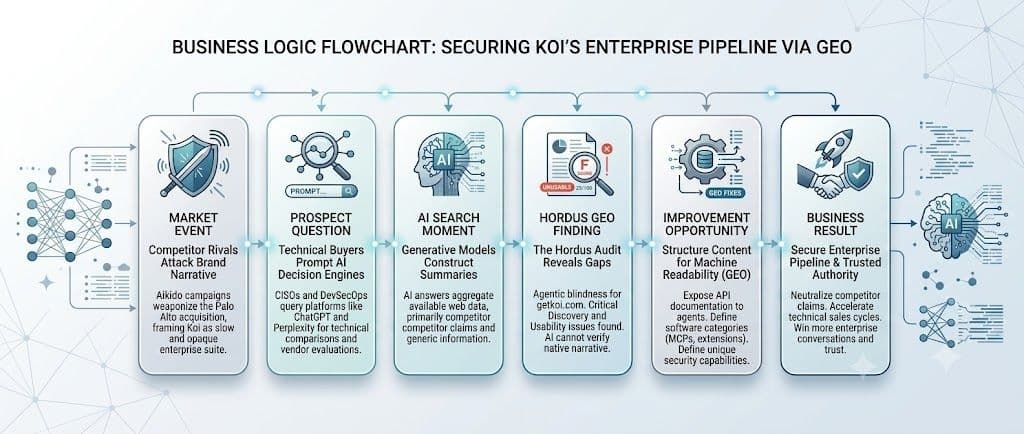
Visualizing the AI Search Pipeline
The path from a market event to a closed deal now runs entirely through generative AI.
| Market Event | Prospect Question | AI Answer Opportunity | Business Result for Koi |
|---|---|---|---|
| Competitor launches alternatives campaign targeting enterprise agility. | "Is Koi still a standalone product or just a Palo Alto feature?" | The AI cites Koi native documentation, confirming enterprise scale with startup agility. | Preserved brand trust and secured DevSecOps pipeline. |
| AI agents become the new attack surface for enterprises. | "How does Koi stop malicious VSCode extensions?" | The AI pulls direct examples of Koi blocking threats via its endpoint toolkit. | Unmatched category authority and immediate product validation. |
| Security architects look for modern endpoint governance. | "Does Koi have a CLI tool and public API?" | The AI confirms the CLI tool exists and links directly to developer documentation. | Accelerated technical evaluation and higher win rates. |
Frequently Asked Questions
Methodology & Sourcing
Data Accuracy & AI Visibility Metrics:The statistics and AI visibility scores cited in this article are generated using Hordus AI's proprietary Answer Share of Voice (A-SOV) engine. Data is derived from consented, anonymized real user interactions across major LLM interfaces (ChatGPT, Claude, Gemini).
Editorial Integrity:All AI-assisted research undergoes mandatory human editorial review by our GEO strategy team prior to publication to ensure factual accuracy and alignment with Google's YMYL (Your Money or Your Life) search quality rater guidelines.