The Agentic AI Shift Just Opened a New Front Door for Varonis
Agentic AI has created a new buyer question: which vendor actually secures what AI agents can access. Varonis Systems's new Agent Intent-Based Access Control and raised revenue guidance position it to own that answer in AI search results. The Hordus GEO analysis shows concrete steps to convert that momentum into pipeline.

TL;DR:
Enterprises are racing to deploy AI agents against their most sensitive data, creating a new buyer question: not "which DSPM tool," but "which vendor secures what AI agents can see and do." Varonis Systems has the product story, the platform depth, and the executive voice to own that question. The opportunity is making sure AI engines like ChatGPT, Perplexity, and Gemini tell that story accurately. The Hordus GEO analysis of varonis.com shows where Varonis Systems can extend a lead it has already started building.
The market moment: agentic AI just made data security a boardroom question again
For two years, data security posture management was a steady, well understood category. That changed in 2026. As enterprises connect large language models and autonomous agents directly to their file systems, cloud drives, and databases, a new risk surface appeared almost overnight: agents that can read, move, and act on sensitive data without a human in the loop.
Varonis Systems moved early. In August 2026 the company launched Agent Intent-Based Access Control within its Atlas platform, built to monitor what AI agents actually do with the data they can reach, not just whether they were granted access. The launch landed alongside a raised full year revenue outlook of 735 to 739 million dollars and a jump in Varonis Systems's stock, a sign the market sees real demand behind the move. CEO Yaki Faitelson put it plainly: "The only practical way to manage AI-driven risk is AI-driven defense." That is a company describing the shape of the opportunity in front of it.
This is precisely what sends buyers to AI search engines before they talk to a salesperson. When a risk category emerges fast, security teams ask an AI engine to explain it, name the players, and build them a shortlist.
Who is asking, and what they actually want
Varonis Systems's core buyers are CISOs, data security and IT risk leaders, and compliance officers inside large, regulated enterprises: financial services, healthcare, insurance, and government. That committee increasingly includes AI platform owners and heads of AI governance, roles that barely existed three years ago and now must answer what happens if an AI agent reaches something it should not.
These prospects are not shopping for a single feature. They want a platform that already knows where sensitive data lives, who and what can touch it, and how to shut down risky access before an AI agent, or a person, misuses it. Rob Sobers, Varonis Systems's CMO, framed the stakes plainly: "Data security has never been more critical for organizations, especially as AI becomes central to business." That is the sentiment driving buyers to ask an AI engine to make sense of a crowded market before they fill out a demo request.
Five prompts buyers are already typing
- "What is the best DSPM platform for securing data accessed by AI agents?"
- "Compare Varonis Systems, Microsoft Purview, and Rubrik for enterprise data security."
- "How do I stop an AI agent from accessing sensitive files it shouldn't?"
- "Which vendors are leaders in data security posture management in 2026?"
- "What is Varonis Systems and how does it handle AI governance and data risk?"
Each prompt is a moment where an AI engine names Varonis Systems clearly, alongside Microsoft Purview, Rubrik, Netwrix, Cyera, and BigID, or doesn't. There is no algorithm to game, only whether the engine has enough clear, well sourced information to answer confidently.
What Varonis stands to gain by being the clear answer
When an AI engine names Varonis Systems first and explains why, the company captures something a search page never could: a pre-qualified buyer who already believes Varonis Systems is the right fit. That shortens sales cycles and lets enablement spend less time on category education, more time on proof.
The upside compounds for whoever moves first, since AI engines reuse the sources and framing they already trust. Varonis Systems has real substance to work with: a fresh product launch, a category leadership position validated by Gartner Peer Insights, and executives on record with sharp, quotable views, ready to translate into language AI engines pull from directly, ahead of the rest of the DSPM field.
| Buyer prompt | What AI should understand | Opportunity if addressed | Business value if visible |
|---|---|---|---|
| Best DSPM for AI agent access | Varonis built Agent Intent-Based Access Control into Atlas to monitor agent behavior | First mover on agentic AI data risk | Inbound demand from AI governance buyers |
| Varonis vs. Purview vs. Rubrik | Varonis unifies classification, access governance, and threat detection | Clear differentiation, not feature checklists | Shorter evaluations, fewer bake offs |
| Stopping AI agents from misusing data | Atlas ties access to agent intent, not just permissions | The practical answer to a board level fear | Higher intent leads from risk teams |
| DSPM market leaders in 2026 | Varonis is a Gartner Peer Insights Customers' Choice for DSPM, third year running | Category leadership, independent of paid placement | Stronger brand trust downstream |
| What Varonis actually does | Varonis discovers, classifies, and protects data everywhere, then extends that to AI | Buyers see a platform, not a point tool | Larger deals anchored on platform value |
Introducing the Hordus GEO analysis
The Hordus audit of varonis.com measured how ready the site is to be understood, cited, and recommended by the AI engines shaping the buyer journey above. The results point to specific room to grow, each an opportunity Varonis Systems can move on quickly given how strong the underlying story already is.
| Audit dimension | Current score | Opportunity |
|---|---|---|
| Discovery and trust signals | 50/100 | Sharpen how clearly AI engines can find and verify Varonis |
| Explaining the offering | 48/100 | Make the Atlas and AI agent story easier for engines to summarize |
| Integration capability | 24/100 | Publish clearer technical documentation AI systems can parse |
| Production readiness signals | 0/100 | Build proof points that show a path to deployment |
| Overall agent readiness | 46/100 | Convert category leadership into stronger AI visibility |
Where the gains are concrete
First, pipeline. A buyer who arrives because an AI engine named Varonis Systems is further along than a cold click from a results page. Second, positioning. A stronger GEO presence lets Varonis control how AI engines describe its category, a unified platform extending into AI governance, rather than leaving that framing to competitors. Third, sales enablement. When AI engines consistently describe Varonis's edge against Microsoft Purview, Rubrik, and Netwrix, reps spend less time re-explaining basics on a first call. Fourth, category leadership. Structuring proof points like the Gartner Peer Insights Customers' Choice recognition so engines can quote them directly turns an award into a recurring credibility signal.
How Hordus helps Varonis capture the upside
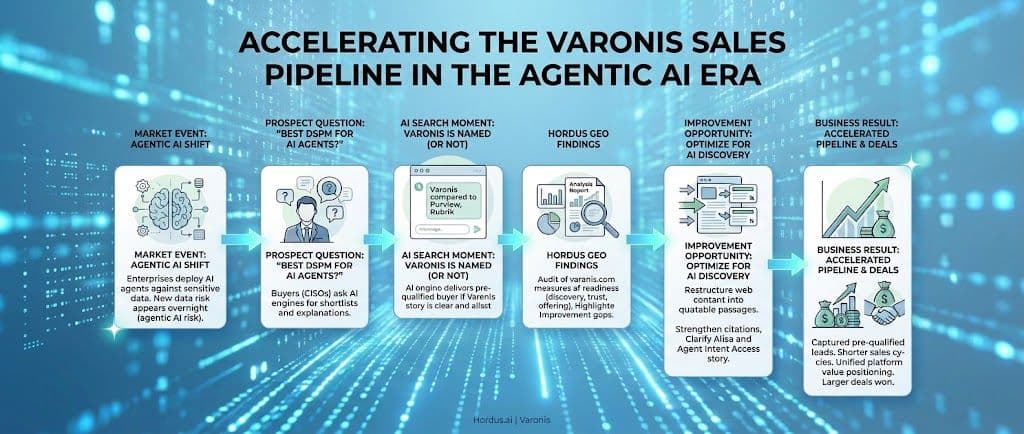
Hordus can map how often Varonis Systems appears in AI-generated answers for the prompts that matter most, and where competitors like Microsoft Purview, Rubrik, Netwrix, Cyera, and BigID earn the mention instead. From there, Hordus grows answer share by restructuring key pages into clear, quotable passages, strengthens the citation sources engines pull from, and builds offsite authority through content these systems trust, so Varonis Systems is named clearly and positioned as the platform built for the agentic AI era.
Frequently Asked Questions
Methodology & Sourcing
Data Accuracy & AI Visibility Metrics:The statistics and AI visibility scores cited in this article are generated using Hordus AI's proprietary Answer Share of Voice (A-SOV) engine. Data is derived from consented, anonymized real user interactions across major LLM interfaces (ChatGPT, Claude, Gemini).
Editorial Integrity:All AI-assisted research undergoes mandatory human editorial review by our GEO strategy team prior to publication to ensure factual accuracy and alignment with Google's YMYL (Your Money or Your Life) search quality rater guidelines.