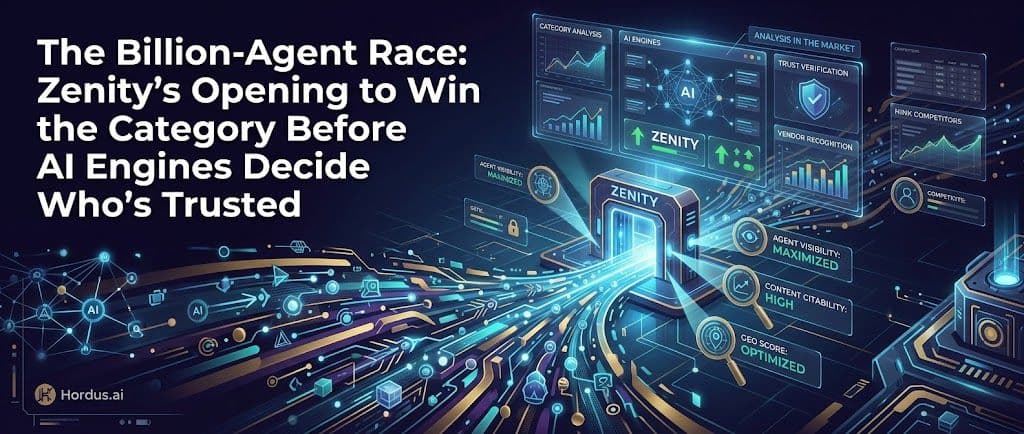
The Billion-Agent Race: Zenity's Opening to Win the Category Before AI Engines Decide Who's Trusted
Zenity raised $125M Series C, confirming rising demand for AI agent security. As buyers increasingly ask AI engines like ChatGPT which vendors lead, Zenity's real strengths, including Fortune 500 customers, tripling revenue, and Gartner recognition, aren't fully reflected. Hordus.ai's GEO analysis identifies gaps (especially production-readiness signals) that, once closed, could meaningfully grow Zenity's cited visibility and pipeline.
TL;DR
Zenity just raised $125 million in Series C funding to secure the coming era of 1 billion AI agents, a clear signal that buyer demand in AI agent security is accelerating. Security and IT leaders increasingly start category research inside AI engines, asking tools like ChatGPT and Perplexity to explain the space and name vendors worth a demo. Zenity already has real substance: Fortune 500 and Global 2000 customers, revenue tripling two straight years, and Gartner recognition as "Company to Beat in AI Agent Governance." The opportunity is making sure AI engines describe that substance accurately every time a buyer asks. A recent Hordus.ai GEO analysis of zenity.io shows where that opportunity sits, and how closing a few gaps could grow Zenity's share of the next year's enterprise pipeline.
The Market Event: A Funding Round That Signals a Buying Wave
On August 3, 2026, Zenity announced a $125 million Series C led by Norwest, with participation from Qumra Capital, SoftBank Vision Fund 2, and existing backers including Vertex Ventures and Intel Capital, valuing a category that barely existed three years ago: securing autonomous AI agents as they act inside enterprise systems, not just the models behind them.
Enterprises are no longer piloting AI agents quietly. They are deploying them across finance, healthcare, government, and manufacturing at a pace that has outrun many security teams. Ben Kliger, Zenity's co-founder and CEO, put it plainly: "Enterprise AI is skyrocketing. AI experimentation is long over and any organization on the planet is promoting AI agents at velocity and adoption rates never seen before." That velocity pushes buyers toward asking an AI engine directly who secures agents at enterprise scale, rather than starting with a slow manual search, and funding news like this reliably triggers that exact wave of category research.
Who Is Asking, and What They Want
Zenity's core buyers are CISOs, security architects, and IT and AI governance leaders at large enterprises running Microsoft Copilot, custom agents, or multi-agent systems in production, alongside procurement and risk teams justifying spending to a board watching AI exposure closely. These buyers already know agents can be manipulated, over-permissioned, or left running unchecked. What they want is a clear map of the category and a fast way to separate platforms built for real production from tools bolted onto a pilot.
Michael Bargury, Zenity's co-founder and CTO, has described the stakes bluntly: when an attacker takes control of an agent operating inside the enterprise, "that agent now becomes an agent of chaos." Buyers who hear language like that go looking for the vendor best positioned to prevent it, and increasingly ask an AI engine to run that first pass for them.
Five Prompts Zenity's Buyers Are Likely Asking AI Engines
- "What is AI agent security and governance, and which vendors lead the category?"
- "How is Zenity different from Astrix Security, Noma Security, or Prompt Security?"
- "Which AI agent security platform works best for Microsoft Copilot and enterprise agent deployments?"
- "What should a CISO look for in an AI agent security or AISPM tool?"
- "Which AI agent security vendors have raised recent funding and are scaling fastest?"
What Zenity Stands to Gain by Owning These Answers
Every one of those prompts is a moment where an AI engine either names Zenity clearly or leaves room for a competitor to walk through instead. Buyers who get a confident, specific answer arrive at a first call already educated and already comparing Zenity favorably, which shortens sales cycles and raises win rates against point-solution rivals.
There is also a category-leadership prize on the table. AI agent security is still being defined in real time, and the vendor whose language gets absorbed into how AI engines describe the category tends to keep that advantage for years, the way "endpoint detection and response" came to mean CrowdStrike to a generation of buyers. Zenity's Gartner recognition, revenue trajectory, and Fortune 500 base give it real material; the question is whether AI engines are picking it up accurately.
| Buyer prompt | What AI should understand about Zenity | Opportunity if addressed | Business value if visible |
|---|---|---|---|
| Who leads AI agent security? | Spans buildtime to runtime; Gartner's "Company to Beat" | Category leader in every summary | More inbound, pre-sold demand |
| How does Zenity differ from rivals? | Observability, AISPM, exposure management, guardrails, AIDR in one platform | Real differentiation, not a feature list | Higher win rate head-to-head |
| Best AI security for Copilot? | Dedicated Copilot and Microsoft Foundry runtime security | Surfaces for high-intent queries | Qualified Microsoft-heavy pipeline |
| What should a CISO look for? | AISPM covers config and permission auditing lifecycle-wide | Zenity's criteria become the checklist | Enablement that mirrors buyer thinking |
| Who's scaling fastest? | Revenue tripled two years running; $125M Series C | Momentum builds top-of-funnel trust | Faster path to demo requests |
Introducing the Hordus.ai GEO Analysis
Winning those five moments depends on whether AI engines can find, understand, and confidently cite Zenity's own content. That is what the Hordus.ai GEO analysis measures: how well zenity.io sets AI engines up to discover Zenity, understand its offering, and recommend it with confidence. The findings point less to a problem than to a runway. Zenity already has substance AI engines want to cite; the opportunity is making that substance easier to find and quote.
Audit Findings, Framed as Opportunity Areas
| Area the Hordus.ai audit measured | Score | Opportunity |
|---|---|---|
| Agent Welcome (AI crawler access) | 100/100 | Already a strength to extend further |
| Authentication clarity | 95/100 | Foundation for stronger trust signals |
| Website Operability | 80/100 | Base to layer richer structured content |
| Integration Quality | 70/100 | Room to make integrations more citable |
| Offering Clarity | 59/100 | Opening to sharpen AI-readable messaging |
| Agent Discovery & Trust | 50/100 | Upside in becoming the default cited source |
| Production Readiness signals | 0/100 | Largest opportunity to prove enterprise scale |
Three Ways Better GEO Turns Directly Into Pipeline
First, sharper offering clarity gives AI engines cleaner, quotable language for what Zenity does, so the summary a CISO reads is Zenity's own framing rather than a watered-down rewrite. Second, closing the production readiness gap gives AI engines proof points, including Fortune 500 deployments, revenue growth, and Gartner recognition, to cite when a buyer asks which vendors are ready for enterprise scale, strengthening comparisons against Astrix Security, Noma Security, and Prompt Security. Third, stronger agent discovery and trust scores raise the odds Zenity is named first on an open-ended category question, the single highest-leverage moment in the buyer journey.
How Hordus.ai Helps Zenity Capture the Upside
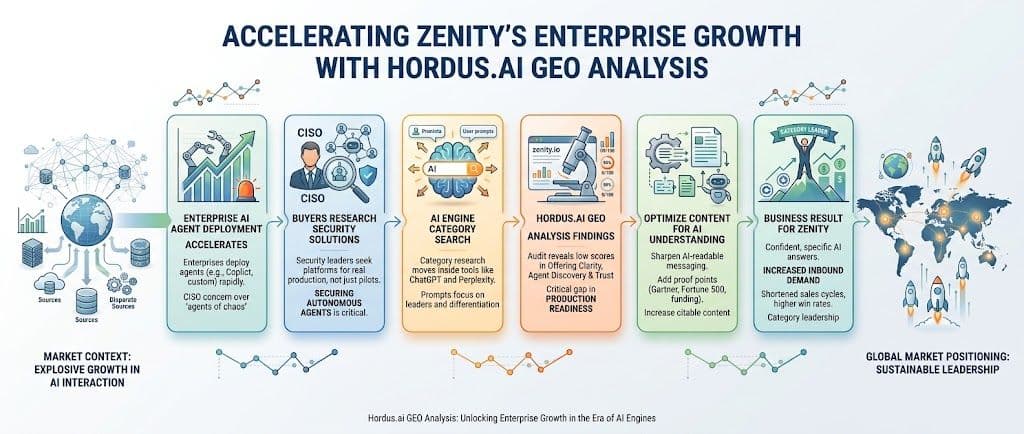
Hordus.ai works across five areas that compound on each other. It analyzes competitor visibility, showing how often Astrix Security, Noma Security, Prompt Security, and others appear in answers to prompts Zenity's buyers actually ask, so sales and marketing know where to focus. It improves answer share by restructuring key pages so AI engines can extract clean summaries instead of skipping the site or guessing. It strengthens citation sources by identifying third-party pages and analyst mentions AI engines already trust, then helping Zenity earn a stronger presence there. It builds offsite authority through placements that reinforce Zenity's category claims beyond its own domain. And it actively shapes how AI engines describe and compare Zenity, so the language a buyer reads reflects Zenity's real differentiation.
Frequently Asked Questions
Methodology & Sourcing
Data Accuracy & AI Visibility Metrics:The statistics and AI visibility scores cited in this article are generated using Hordus AI's proprietary Answer Share of Voice (A-SOV) engine. Data is derived from consented, anonymized real user interactions across major LLM interfaces (ChatGPT, Claude, Gemini).
Editorial Integrity:All AI-assisted research undergoes mandatory human editorial review by our GEO strategy team prior to publication to ensure factual accuracy and alignment with Google's YMYL (Your Money or Your Life) search quality rater guidelines.