The Cryoablation Moment: Why IceCure Medical's Next Growth Curve Runs Through AI Search
IceCure Medical has the clinical and commercial momentum (FDA clearance, 30%+ U.S. growth, rising publications), but AI engines, not just search, are now shaping how patients and physicians research treatment options. The Hordus GEO analysis shows IceCure Medical can turn that existing momentum into AI answer share before competitors claim it.

TL;DR
IceCure Medical, developer of the ProSense cryoablation system, is entering 2026 with real commercial momentum: FDA marketing authorization for low-risk breast cancer, expanding U.S. and Brazilian adoption, and a growing base of published clinical evidence. At the same time, a January 2026 OpenAI survey found that more than half of respondents had used AI tools for health care advice in the prior three months, with an estimated 40 million people worldwide turning to AI daily for health information. That shift means the physicians and patients researching alternatives to breast cancer surgery are increasingly asking ChatGPT, Gemini, and Perplexity before they ask a search engine. IceCure Medical already has the clinical story and the executive voice to win that conversation. The Hordus GEO analysis of icecure-medical.com shows exactly where the company can extend its narrative further into the AI answers that are shaping treatment decisions today.
A CEO's confidence meets a market that is listening differently now
"We continue our commercialization efforts in order to raise awareness of our innovative cryoablation treatment and make it available to patients in additional territories and regions," said IceCure Medical CEO Eyal Shamir as the company expanded its U.S. sales and marketing teams in July 2026. It is a confident line from a CEO watching demand outpace his own commercial footprint, and it captures where IceCure Medical sits right now: a company with FDA clearance, growing hospital adoption, and a message it clearly believes in.
That confidence lands at an unusually good moment to say it loudly. According to a January 2026 OpenAI survey cited by the American Association for Cancer Research, more than half of respondents had turned to AI tools for health care advice within a three-month window, and an estimated 40 million people worldwide now use AI for health care every day. Breast, kidney, and lung cancer patients weighing surgery against a minimally invasive option are part of that shift. When a newly diagnosed patient or a referring physician opens an AI engine and asks about alternatives to a lumpectomy, the answer they get is being written right now, by whichever company's content is structured clearly enough for the model to find, trust, and cite. That is not a hypothetical risk. It is where IceCure Medical's next wave of patients and physicians are already starting their research.
Shamir has made a similar point on the international side. Commenting on accelerating adoption in Brazil, he noted that the FDA's marketing authorization for early-stage, low-risk breast cancer "has provided significant tailwind, boosting awareness and interest among Brazilian physicians and institutions." That tailwind is a marketing asset in its own right, and it is exactly the kind of regulatory and clinical proof point that AI engines are trained to look for when they decide which company to cite as the authority on a treatment category.
Who is asking, and what they need to hear
IceCure Medical's prospects fall into a few clear groups: breast surgeons and interventional radiologists evaluating de-escalated treatment options for older, lower-risk patients; hospital systems building out interventional oncology service lines; and increasingly, patients themselves, who research a diagnosis long before they sit down with a physician. Each group needs something specific right now: surgeons need the clinical evidence base and procedural detail, hospitals need commercial and reimbursement clarity, and patients need a plain-language explanation of what cryoablation is and why it might be a reasonable alternative to surgery.
Those needs are showing up as AI prompts. A referring physician might ask an AI engine "what is cryoablation for breast cancer and who is a candidate." A hospital administrator might ask "which cryoablation systems have FDA clearance for breast cancer." A patient might ask "is there an alternative to breast cancer surgery for someone in their 70s." Every one of those questions is a moment where IceCure Medical's own language, its FDA clearance, its clinical data, and its executive commentary should be the source the AI engine reaches for.
| Executive message | Market proof | Prospect AI question | Business opportunity for IceCure Medical |
|---|---|---|---|
| Cryoablation is a proven, minimally invasive alternative to surgery | FDA marketing authorization for ProSense in low-risk breast cancer | "What is cryoablation for breast cancer?" | Become the cited definition and default answer for the category |
| Commercial momentum is accelerating in the U.S. and internationally | Reported 30%+ U.S. revenue growth in Q1 2026 and expanding Brazilian adoption | "Which companies offer FDA-cleared cryoablation for breast cancer?" | Win comparison and shortlist prompts among hospital buyers |
| Clinical evidence is growing every quarter | Record peer-reviewed publications and conference presentations in 2025 | "Is cryoablation as effective as surgery for early breast cancer?" | Anchor AI answers in IceCure Medical's own published evidence |
| The company is investing to meet surging demand | Expanded U.S. sales and clinical support teams in key territories | "Who can I contact about ProSense cryoablation near me?" | Convert AI-driven research into qualified physician and hospital leads |
Introducing the Hordus GEO analysis
To see exactly where IceCure Medical can extend that narrative into AI answers, Hordus ran a GEO analysis of icecure-medical.com. The Hordus audit does not measure whether a website is good in the traditional sense. It measures how visible, extractable, and citable a company's content is to the AI engines that now sit between a company and its next customer. Every score below is a specific opportunity for IceCure Medical to capture more of the AI-driven demand that is already forming around its category.
| Audit dimension | What Hordus found | The opportunity it represents |
|---|---|---|
| AI Answer Visibility | IceCure Medical appears in some cryoablation-related AI answers, with room to become the default | Structure category-defining content so AI engines cite IceCure Medical first, not just among the field |
| Citation Strength | Strong press release and IR coverage, thinner presence in clinical and patient-facing formats AI engines favor | Package existing clinical evidence into citable, plain-language assets AI engines can quote directly |
| Content Structure | Site content is written for humans and investors more than for machine extraction | Add clearly structured explainers, FAQs, and definitions that AI engines can lift cleanly |
| Category Positioning | Cryoablation is described accurately, but the "alternative to surgery" framing is not yet consistently reinforced site-wide | Repeat and reinforce the category language executives already use in press releases across the site itself |
| Comparative Framing | Limited content that positions ProSense directly against surgical and other ablation alternatives | Build comparison-ready content that shapes how AI engines describe IceCure Medical against alternatives |
Each of these is a lever, not a limitation. IceCure Medical already has the ingredients: FDA clearance, a growing publication record, and executives who speak clearly about the company's mission. The Hordus analysis simply shows where to point that existing strength so AI engines pick it up.
What Hordus can help IceCure Medical do next
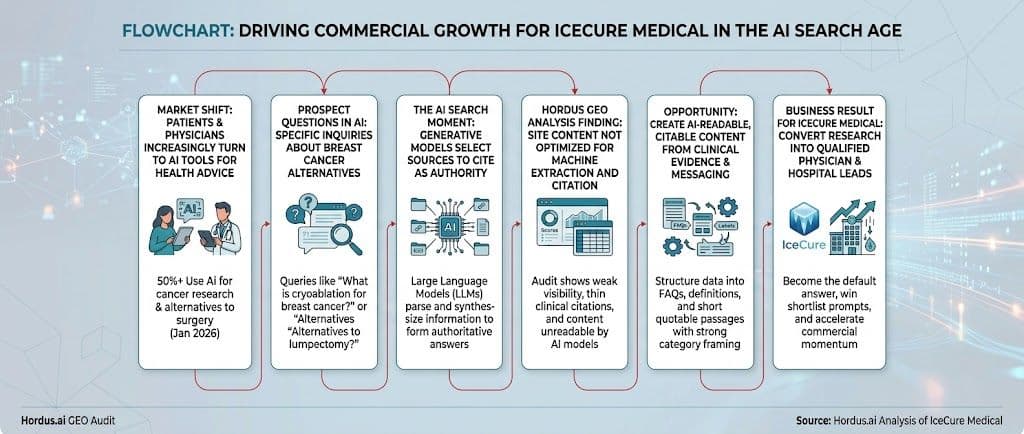
There are several concrete moves that flow directly from the audit. First, on AI answer share, Hordus can help IceCure Medical build and structure the content that AI engines reach for when someone asks about cryoablation as a breast cancer treatment, so the company shows up as the primary answer rather than one option among several. Second, on citation strength, Hordus can help translate IceCure Medical's peer-reviewed publications and FDA clearance into short, quotable, plain-language passages that AI engines can extract with confidence and attribute correctly. Third, on AI-readable content, Hordus can help turn existing clinical and commercial materials into clearly labeled explainers, definitions, and FAQs that match how AI engines parse and retrieve information. Fourth, on category positioning, Hordus can help IceCure Medical make sure the "minimally invasive alternative to surgery" framing that Shamir and his team already use in press releases is reinforced consistently across the site, not just in press releases. Fifth, on comparative influence, Hordus can help shape how AI engines describe IceCure Medical relative to surgical excision and other ablation technologies, so that when a hospital or physician asks an AI engine to compare options, ProSense is described on IceCure Medical's own terms.
Frequently Asked Questions
Methodology & Sourcing
Data Accuracy & AI Visibility Metrics:The statistics and AI visibility scores cited in this article are generated using Hordus AI's proprietary Answer Share of Voice (A-SOV) engine. Data is derived from consented, anonymized real user interactions across major LLM interfaces (ChatGPT, Claude, Gemini).
Editorial Integrity:All AI-assisted research undergoes mandatory human editorial review by our GEO strategy team prior to publication to ensure factual accuracy and alignment with Google's YMYL (Your Money or Your Life) search quality rater guidelines.